Have you ever stopped while writing and wondered whether toward or towards is the better choice? I know how confusing these two words can feel because they look almost identical and often appear in the same kinds of sentences.
You may be surprised to learn that both forms are standard English, but their usage can depend on the variety of English you are using. If you are writing in US English, I’ll help you understand which form is generally preferred and why.
By the end, you will have a clear, practical understanding of toward or towards, including their meanings, differences, and everyday usage. You can then write with confidence instead of second-guessing your word choice.
Toward or Towards: Quick Answer
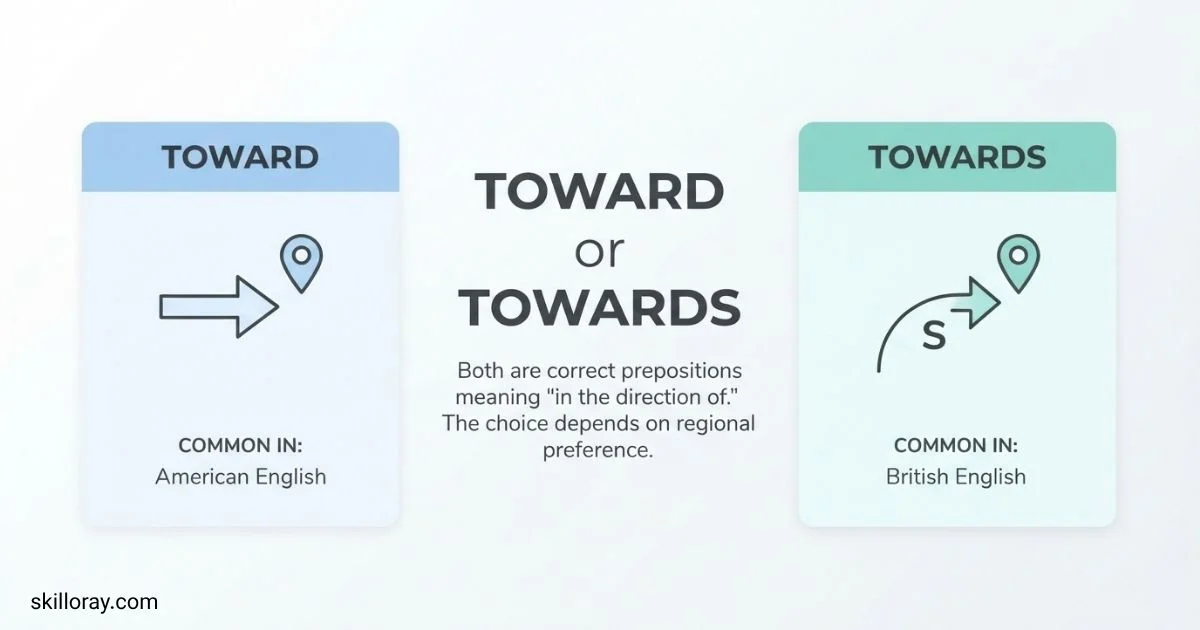
Toward or towards are both correct. They generally have the same meaning and function as prepositions. Toward is more common in American English, while towards is more common in British English. If you’re writing in American English, toward is usually the safest choice. If you’re following British English conventions, towards is often preferred.
| Form | Common preference | Meaning | Example |
| toward | American English | In the direction of or closer to | She walked toward the door. |
| towards | British English | In the direction of or closer to | She walked towards the door. |
The important point is that this is not usually a difference in meaning or grammar. It is mainly a matter of regional usage and style.
What Does Toward Mean?
Toward is a preposition that indicates movement, direction, position, attitude, or an objective.
For example:
- He walked toward the station.
- The dog ran toward its owner.
- We are working toward a solution.
- Her attitude toward the project has changed.
- The company is moving toward renewable energy.
In each sentence, toward connects an action, direction, attitude, or goal with its object.
The word can describe physical movement, such as walking toward a building, or an abstract goal, such as working toward success.
What Does Towards Mean?
Towards has essentially the same meaning and grammatical function as toward.
It can indicate:
- Direction
- Movement
- Progress
- A goal
- An attitude
- A relationship to something
Examples include:
- He walked towards the station.
- The child ran towards her mother.
- We are working towards a solution.
- His attitude towards change is positive.
- The organization is moving towards its goal.
The extra s does not normally create a different meaning. The choice is primarily associated with regional preference.
Is Toward or Towards Correct?
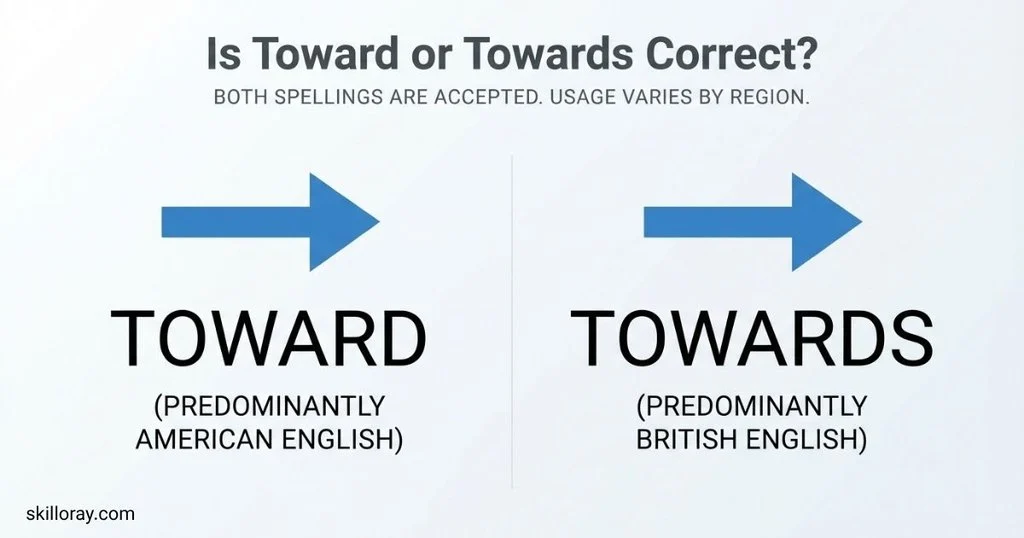
Both are correct.
If you’re writing American English, toward is generally the more common choice. If you’re writing British English, towards is generally more common.
For most ordinary sentences, either form will be grammatically acceptable:
- She moved toward the window.
- She moved towards the window.
Both sentences mean that she moved in the direction of the window.
The most important thing is to use the form that fits your intended variety of English and to remain consistent with the style of your writing.
Toward or Towards Pronunciation
Toward or towards are pronounced similarly, but the final s in towards is pronounced.
Toward
Common pronunciation:
tuh-WORD or tawrd
IPA can vary by accent, but common pronunciations include:
/təˈwɔːrd/
In some American accents, it may sound closer to /tɔrd/.
Towards
Common pronunciation:
tuh-WORDZ or tawrdz
A common IPA representation is:
/təˈwɔːdz/
The key difference is the final s sound in towards.
Are Toward or Towards Pronounced Differently?
Yes, slightly. Towards has an additional final z sound, while toward ends without that sound.
The stress generally falls on the second syllable:
- to-WARD
- to-WARDS
Pronunciation can vary naturally across English accents.
Toward or Towards in American English
Toward is generally preferred in American English.
For example:
- We walked toward the building.
- She is working toward her degree.
- The company is moving toward a new strategy.
- He has a positive attitude toward his coworkers.
Towards is also understood and used by American English speakers, but it is less common than toward.
If you are writing for a primarily American audience, toward is usually the more natural choice.
Toward or Towards in British English
Towards is generally more common in British English.
For example:
- We walked towards the station.
- She is working towards her degree.
- The car moved towards the bridge.
- His attitude towards the issue has changed.
Toward is also a legitimate English form and can appear in British writing, but towards is often the more familiar choice for British readers.
So, if regional consistency matters, a simple guideline is:
- American English: toward
- British English: towards
This is a preference rather than a strict rule that makes the other form incorrect.
Toward or Towards in UK English
In UK English, towards is generally the more common form.
You may see sentences such as:
- She walked towards the garden.
- We are working towards a better outcome.
- The train is heading towards London.
- He turned towards the door.
However, toward is not inherently incorrect in British English. It simply occurs less frequently in ordinary British usage.
If you’re writing specifically for a UK audience, towards will usually sound more natural.
Toward or Towards Me
Both toward me and towards me are grammatically correct.
Examples:
- He walked toward me.
- He walked towards me.
Both mean that he moved in my direction.
The choice usually depends on regional preference. American writers commonly use toward, while British writers commonly use towards.
The same pattern applies to phrases such as:
- toward you or towards you
- toward him or towards him
- toward her or towards her
- toward us or towards us
- toward them or towards them
Toward or Towards in Legal Writing
Both toward or towards can be grammatically correct in legal writing.
However, legal writers should prioritize clarity, consistency, and the applicable style guide. If you’re writing American legal documents, toward is often the more natural choice because it is the standard preference in American English.
For example:
The payment shall be applied toward the outstanding balance.
You could also write:
The payment shall be applied towards the outstanding balance.
The meaning remains essentially the same.
If you’re drafting a contract, court document, legal memorandum, or policy, consistency matters more than choosing one form simply because it looks more formal. Follow the conventions required by your jurisdiction, organization, court, publisher, or style guide.
Toward or Towards in AP Style
For American news writing, toward is the preferred form.
Examples:
- The team moved toward an agreement.
- The company took steps toward reducing costs.
- Officials are working toward a solution.
If you’re writing according to AP style, use toward rather than towards.
This preference fits the broader American English convention in which the shorter form toward is more common.
When to Use Toward or Towards
Use toward or towards when you need to express direction, movement, progress, an objective, or an attitude.
Physical Direction
Both forms can describe movement in a particular direction.
- The boy ran toward the playground.
- The boy ran towards the playground.
Movement
They can describe something moving closer to another place or object.
- The boat moved toward the shore.
- The boat moved towards the shore.
Progress
Both can describe progress toward a goal.
- We are making progress toward our goal.
- We are making progress towards our goal.
An Objective
They can introduce something that someone is trying to achieve.
- She is working toward a promotion.
- She is working towards a promotion.
Attitude
They can also describe someone’s attitude or feelings in relation to something.
- His attitude toward his employees is respectful.
- His attitude towards his employees is respectful.
Working Toward or Towards
Both working toward or working towards are correct.
The phrase means making an effort to achieve something.
Examples:
- We are working toward a solution.
- We are working towards a solution.
- She is working toward her degree.
- She is working towards her degree.
- The team is working toward its long-term goal.
- The team is working towards its long-term goal.
For American English, working toward is generally preferred. For British English, working towards is often more natural.
Leaning Toward or Towards
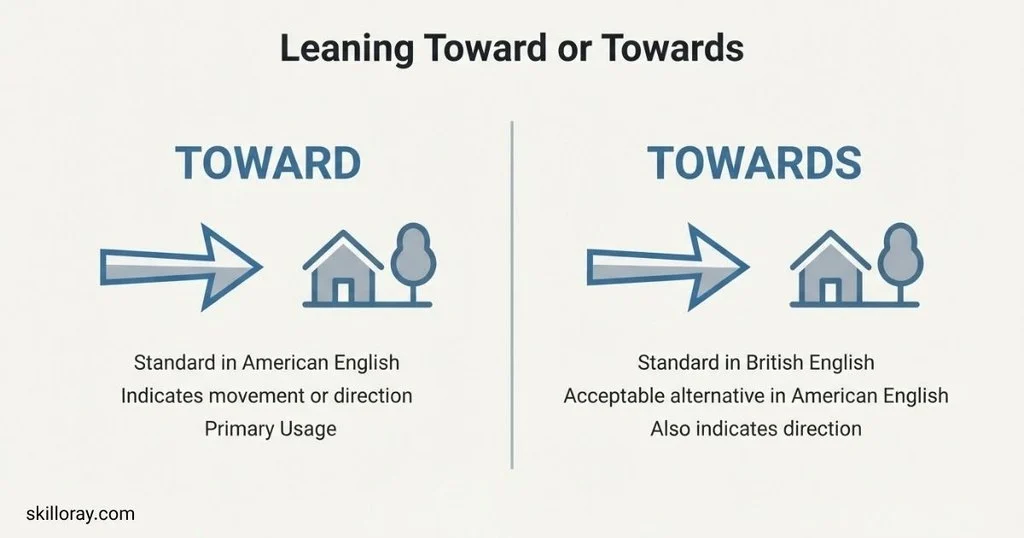
Both leaning toward or leaning towards are correct.
The phrase can describe physical leaning or a developing preference.
For example:
- She is leaning toward the blue option.
- She is leaning towards the blue option.
When it refers to a preference, the phrase means that someone is beginning to favor one possibility.
For American English, leaning toward is generally the more common choice.
Geared Toward or Towards
Both forms can be used:
- The program is geared toward young professionals.
- The program is geared towards young professionals.
Here, geared toward or towards means designed or intended for a particular group, purpose, or result.
In American English, geared toward is generally more common.
Progress Toward or Towards
Both are correct:
- The project is making progress toward completion.
- The project is making progress towards completion.
The meaning is that something is moving closer to a desired result.
In American English, progress toward is usually preferred.
Step Toward or Towards
Both forms are possible:
- This is an important step toward success.
- This is an important step towards success.
Here, toward or towards introduces the goal that the step helps someone approach.
You can also use the phrase with physical movement:
- He took a step toward the door.
- He took a step towards the door.
Moving Toward or Towards
Both forms are grammatically correct.
Examples:
- The car was moving toward the intersection.
- The car was moving towards the intersection.
- The industry is moving toward cleaner technology.
- The industry is moving towards cleaner technology.
The first pair describes physical direction, while the second can describe gradual change or development.
Tows It Toward or Towards
When tow is used as a verb, either form can follow it:
- The truck tows it toward the garage.
- The truck tows it towards the garage.
Here, tow means to pull something behind a vehicle, while toward or towards indicates the direction.
The grammatical structure is:
subject + tow + object + toward/towards + destination
For example:
- The boat tows the damaged vessel toward the harbor.
- The boat tows the damaged vessel towards the harbor.
Both are correct.
Toward or Towards Examples
Here are practical examples showing how both forms work.
Sentences With Toward
- She walked toward the front door.
- The children ran toward their teacher.
- We are working toward a common goal.
- He moved toward the window.
- The company is moving toward a new business model.
- She has a positive attitude toward learning.
- They took a major step toward success.
- The project is making progress toward completion.
- He turned toward the sound.
- The boat sailed toward the island.
Sentences With Towards
- She walked towards the front door.
- The children ran towards their teacher.
- We are working towards a common goal.
- He moved towards the window.
- The company is moving towards a new business model.
- She has a positive attitude towards learning.
- They took a major step towards success.
- The project is making progress towards completion.
- He turned towards the sound.
- The boat sailed towards the island.
Notice that the meaning does not materially change when toward is replaced with towards.
Common Mistakes With Toward or Towards
Because both forms are legitimate, the most common mistake is not choosing the “wrong” form. It is misunderstanding what the word does in a sentence.
Mistake 1: Treating Towards as a Different Meaning
Incorrect assumption: The extra s gives towards a completely different meaning.
That isn’t generally the case.
Toward or towards normally express the same idea.
Mistake 2: Assuming Towards Is Always Incorrect
Some American English learners are taught to use toward, so they may assume towards is incorrect.
That isn’t true.
Towards is a standard form, particularly common in British English.
Mistake 3: Assuming Toward Is Only American
Toward is strongly associated with American English, but it isn’t exclusively American.
It can also occur in British English and other varieties of English.
Mistake 4: Mixing Regional Style Without a Reason
Neither form is wrong, but inconsistent regional style can make writing feel less polished.
For example, if you’re consistently following American English conventions, using toward throughout your article will generally provide better stylistic consistency.
Should I Use Toward or Towards?
Use toward if you’re primarily writing in American English or following an American style guide.
Use towards if you’re primarily writing in British English and want to follow common British usage.
If your audience is international, either form is generally understandable. The most important thing is to choose one style and use it consistently.
A Simple Rule
If you need a quick rule to remember:
American English → toward
British English → towards
This is a useful guideline, not an absolute grammar rule.
Is Toward or Towards More Formal?
Neither word is inherently more formal.
Toward can sometimes appear more natural in American formal writing, while towards is completely normal in British formal writing.
For example:
- The policy is directed toward improving workplace safety.
- The policy is directed towards improving workplace safety.
The difference is primarily regional or stylistic, not a difference in formality.
Can Toward or Towards Be Used Interchangeably?
In most contexts, yes.
You can generally replace toward with towards without changing the basic meaning:
- She walked toward the house.
- She walked towards the house.
Likewise:
- We are working toward a solution.
- We are working towards a solution.
However, if you’re following a particular style guide, regional standard, or organizational writing policy, follow that preference consistently.
Final Rule to Remember
Toward or towards are both correct English words. They are normally used as prepositions and generally have the same meaning.
Choose toward when writing primarily in American English, especially when following American style conventions. Choose towards when writing primarily in British English, where the longer form is more common.
You don’t need to memorize a complicated grammar rule. Just remember that the difference is mainly one of regional preference and style, not correctness.
FAQs
Is toward or towards correct?
Both toward or towards are correct. Toward is more common in American English, while towards is more common in British English.
Is toward or towards more common in American English?
Toward is generally more common in American English. If you’re writing for a U.S. audience, toward is usually the natural choice.
Is towards correct in American English?
Yes. Towards is a valid English form and is understood in American English, although toward is generally more common.
Is toward correct in British English?
Yes. Toward can be used in British English, although towards is generally more common in everyday British usage.
Do toward or towards have the same meaning?
Yes. In normal usage, toward and towards have essentially the same meaning. Both can express direction, movement, progress, an objective, or an attitude.
How do you pronounce toward?
Toward is commonly pronounced something like tuh-WORD or tawrd, depending on the speaker’s accent. The stress generally falls on the second syllable.
How do you pronounce towards?
Towards is commonly pronounced something like tuh-WORDZ or tawrdz. The final s is pronounced as a z sound.
Should I write working toward or working towards?
Both are correct. Working toward is generally preferred in American English, while working towards is more common in British English.
Should I write progress toward or progress towards?
Both are correct. The choice usually depends on regional English. Progress toward is more common in American English, while progress towards is common in British English.
Which should I use in formal American writing?
In formal American writing, toward is usually the safer choice. It is concise, standard, and widely preferred in American English style.
Conclusion
Toward or towards is not a case where one form is correct and the other is wrong. Both are standard English forms with essentially the same meaning.
The easiest distinction to remember is that toward is generally preferred in American English, while towards is generally preferred in British English. Both can describe physical direction, progress, goals, attitudes, and movement.
If you’re writing for an American audience, choose toward. If you’re writing for a British audience, towards will often sound more natural. Above all, stay consistent with the variety of English and style you’re using.

I am Daniel Carter, a grammar enthusiast and language educator with over 10 years of experience helping students and professionals improve their English writing and communication skills. I enjoy simplifying complex grammar rules into easy-to-understand lessons that anyone can follow. My goal is to help learners write with confidence, avoid common mistakes, and develop strong communication skills for academic and professional success. I regularly create practical grammar guides, writing tips, and language resources that make learning both enjoyable and effective.
Books: Mastering English Grammar and The Complete Guide to Better Writing
 James Walker
 Olivia Brown