Have you ever wondered whether humour or humor is the correct spelling? I’ve seen this small spelling difference confuse many English learners, especially when British and American English use different forms.
The good news is that both spellings are correct, but they belong to different varieties of English. You can choose the right one easily once you understand where and how each form is used.
In this guide, I’ll explain the difference between humour or humor, where each spelling is preferred, and how to use them naturally in your writing. You’ll also learn which form is standard in US English and why the difference exists.
Humour or Humor: Which Is Correct?
Both humour or humor are correct.
| Spelling | Common English variety | Meaning |
| humour | British English | The quality of being funny or amusing |
| humor | American English | The quality of being funny or amusing |
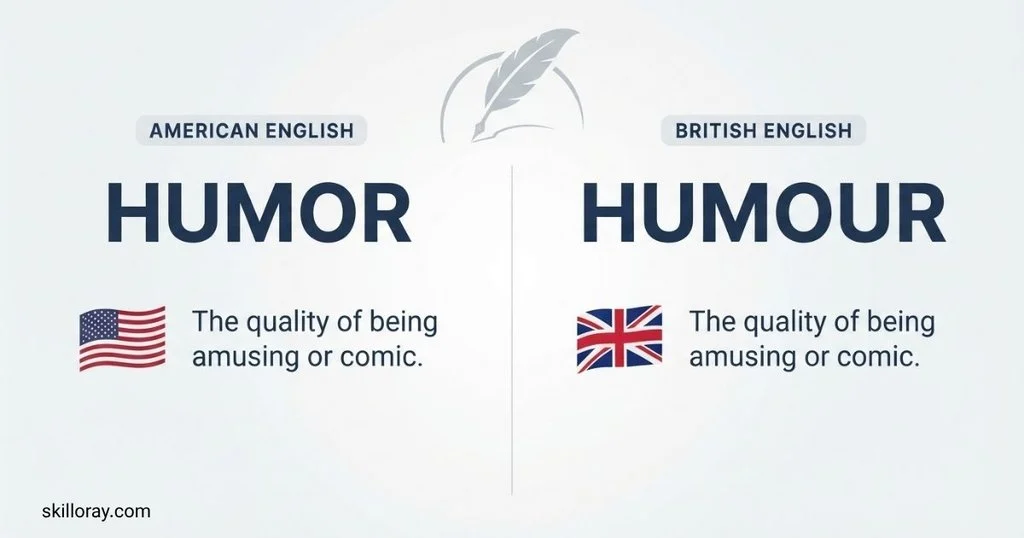
If you’re writing for an American audience, use humor. If you’re writing in British English, use humour.
For example:
- American English: She has a great sense of humor.
- British English: She has a great sense of humour.
Neither spelling is inherently more correct than the other. The important thing is to remain consistent with the variety of English you’re using.
What Does Humour or Humor Mean?
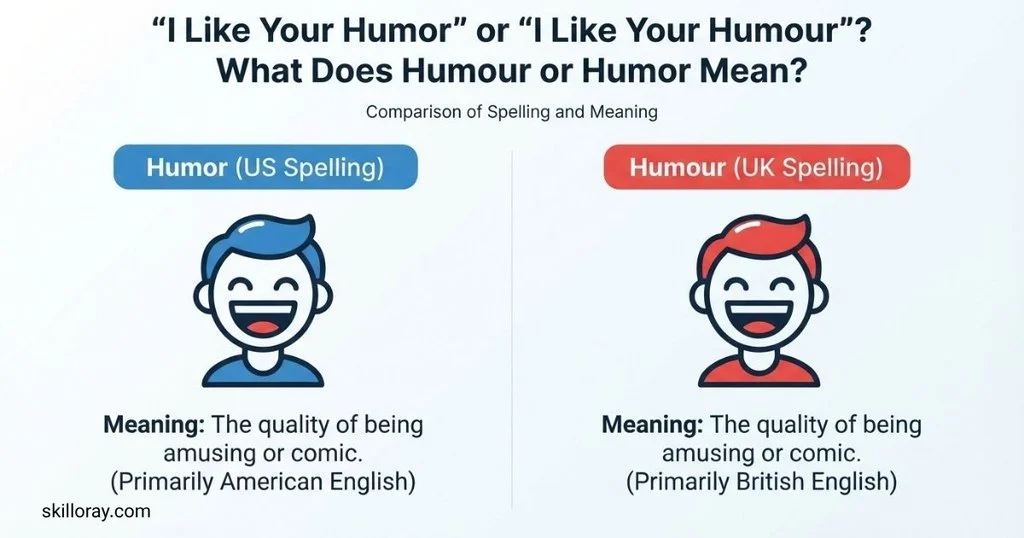
Humour or humor refers to the quality or ability that makes something funny, amusing, or entertaining. It can also describe a person’s ability to recognize and appreciate funny situations.
For example:
- His humor makes everyone laugh.
- She has a wonderful sense of humour.
- The comedian uses observational humor.
- His dry humour is easy to recognize.
The word can describe many different styles, including dry humor, dark humor, sarcastic humor, slapstick humor, observational humor, and self-deprecating humor.
In older or more formal contexts, humour can also have other meanings, including a person’s mood or temperament. However, the modern everyday meaning usually relates to comedy or amusement.
Humour or Humor: What Is the Difference?
The main difference is spelling, not meaning.
Humour uses the British spelling with -our.
Humor uses the American spelling with -or.
This follows a broader spelling pattern found in words such as:
- colour / color
- favour / favor
- honour / honor
- labour / labor
- behaviour / behavior
- neighbour / neighbor
So, if you are writing in British English, you will generally see humour. If you are writing in American English, humor is normally preferred.
A Simple Comparison
| Feature | Humour | Humor |
| Spelling | British | American |
| Meaning | Same | Same |
| Pronunciation | Same | Same |
| Part of speech | Noun | Noun |
| Common phrase | Sense of humour | Sense of humor |
| Standard usage | British English | American English |
Humour or Humor in British English
Humour is the standard spelling in British English.
British publications, schools, dictionaries, and general writing commonly use forms such as:
- sense of humour
- dark humour
- British humour
- sarcastic humour
- dry humour
- humour in conversation
Examples:
- He has a great sense of humour.
- British humour can sometimes be quite dry.
- Her dark humour surprised everyone.
- I enjoy his unusual sense of humour.
If your entire piece follows British spelling, humour is the natural choice.
Humour or Humor in American English
Humor is the standard spelling in American English.
American writing commonly uses:
- sense of humor
- dark humor
- American humor
- dry humor
- humor in conversation
- humorous
Examples:
- He has a great sense of humor.
- Her dry humor makes me laugh.
- The movie uses dark humor.
- I appreciate his sense of humor.
If you’re writing for readers in the United States, humor is usually the better choice.
What About Canadian English?
Canadian English can show influences from both British and American English.
For this word, humour is commonly used in Canadian English, particularly in formal and edited writing. You may therefore encounter:
- sense of humour
- Canadian humour
- dark humour
- humorous
Canadian spelling often retains several British-style spellings while also using some American conventions.
If you’re writing specifically for a Canadian audience, follow the spelling style required by the publication, organization, school, or style guide you’re using.
What About Australian English?
Humour is the standard spelling commonly used in Australian English.
For example:
- She has a good sense of humour.
- Australian humour can be quite understated.
- His dry humour was obvious.
- The program included plenty of humour.
Australian English generally retains the -our spelling in words such as colour, favour, and humour.
Humour or Humor Pronunciation
The good news is that humour or humor are normally pronounced the same way in their respective standard varieties.
A simple pronunciation guide is:
Humour: HYOO-muh
Humor: HYOO-mer
The exact vowel quality at the end can vary depending on accent.
The IPA pronunciation is commonly represented approximately as:
- British English: /ˈhjuːmə/
- American English: /ˈhjuːmɚ/
The first syllable receives the main stress:
HYOO-mour / HYOO-mer
The spelling difference does not create a major difference in pronunciation.
Is It Humour or Humor in “Sense of Humour”?
Both are correct, depending on the variety of English.
British English
Sense of humour
Example:
She has an excellent sense of humour.
American English
Sense of humor
Example:
She has an excellent sense of humor.
The expression refers to someone’s ability to recognize, appreciate, or create things that are funny.
You should match the spelling to the rest of your writing.
Is It Dark Humour or Dark Humor?
Again, both forms are correct.
Use dark humour in British English and commonly in Australian and Canadian English.
Use dark humor in American English.
| Variety | Preferred spelling |
| British English | Dark humour |
| American English | Dark humor |
| Canadian English | Dark humour is common |
| Australian English | Dark humour |
The meaning stays the same. The phrase generally refers to comedy that deals with serious, uncomfortable, or difficult subjects in a deliberately humorous way.
“I Like Your Humor” or “I Like Your Humour”?
Both sentences are correct. The choice depends on your English variety.
American English:
I like your humor.
British English:
I like your humour.
The sentence means that you appreciate someone’s style of being funny or the way they respond to situations.
You can use either spelling, but don’t mix regional spelling styles unnecessarily in the same piece of formal writing.
Humour or Humor: Example Sentences
Here are some natural examples showing how both spellings work.
Examples With “Humour”
- She has a wonderful sense of humour.
- His dry humour made the conversation more interesting.
- I enjoy British humour.
- Her humour helped everyone relax.
- The book contains plenty of gentle humour.
- He uses humour to make difficult subjects easier to discuss.
- Their friendship is built on shared humour.
- The comedian is known for his clever humour.
- His sarcastic humour isn’t for everyone.
- A little humour can improve an otherwise serious conversation.
Examples With “Humor”
- She has a wonderful sense of humor.
- His dry humor made the conversation more interesting.
- I enjoy American humor.
- Her humor helped everyone relax.
- The book contains plenty of gentle humor.
- He uses humor to make difficult subjects easier to discuss.
- Their friendship is built on shared humor.
- The comedian is known for his clever humor.
- His sarcastic humor isn’t for everyone.
- A little humor can improve an otherwise serious conversation.
Notice that the meaning and grammatical role remain the same. Only the regional spelling changes.
Is “Humour” a Word?
Yes. Humour is a standard English word, especially in British English and other varieties that commonly use British spelling conventions.
It is not a misspelling of humor.
For example:
He has a good sense of humour.
This is completely standard British English.
Is “Humor” a Word?
Yes. Humor is also a standard English word.
It is the usual American English spelling.
For example:
He has a good sense of humor.
This is standard American English.
So, neither form should automatically be labeled incorrect.
Why Do Humour or Humor Have Different Spellings?
The difference comes from historical spelling traditions in English.
Many British spellings retain -our, while American English adopted a number of simplified -or spellings over time.
This is why you see pairs such as:
- humour / humor
- colour / color
- honour / honor
- favour / favor
- labour / labor
These differences don’t normally change the meaning of the words. They reflect different spelling conventions.
Humorous: Does the Same Difference Apply?
Yes, but there is an interesting detail.
The adjective is generally spelled humorous in both British and American English.
For example:
- She told a humorous story.
- His humorous comments made everyone laugh.
- The article has a humorous tone.
You don’t normally change humorous to a form such as humourous merely because you’re using British English.
A common spelling mistake is:
Incorrect: humourous
Correct: humorous
The standard adjective is humorous.
Humour or Humor: Common Mistakes
Mistake 1: Calling “Humour” Incorrect
Incorrect assumption: Humour is a misspelling.
Correct: Humour is a standard British spelling.
The spelling is perfectly acceptable when British English is being used.
Mistake 2: Calling “Humor” Incorrect
Incorrect assumption: Humor is an incorrect shortened spelling.
Correct: Humor is the standard American spelling.
It is widely used in American English.
Mistake 3: Mixing Spelling Styles
A piece of writing can become inconsistent when it uses British and American spellings without a reason.
For example, using:
- colour
- favourite
- humour
- neighbor
creates a mixed spelling style.
For polished writing, choose a consistent variety of English.
Mistake 4: Spelling “Humorous” as “Humourous”
Incorrect: humourous
Correct: humorous
Although humour contains -our in British English, the adjective is generally spelled humorous in both major spelling systems.
Which Spelling Should You Use?
The best choice depends on your audience.
Use humor if you’re writing primarily for an American audience or following American English conventions.
Use humour if you’re writing primarily for a British audience or following British English conventions.
If your audience is international, either spelling can work. The most important thing is consistency.
Quick Rule
American English → humor
British English → humour
Canadian English → humour is commonly used
Australian English → humour
If a school, employer, publisher, or style guide specifies a particular variety, follow that requirement.
Humour or Humor in Formal Writing
Both spellings are appropriate in formal writing when they match the chosen variety of English.
For example, an American academic paper can correctly use:
The researcher used humor to make the presentation more engaging.
A British article can correctly use:
The researcher used humour to make the presentation more engaging.
The spelling itself does not determine whether the writing is formal or informal.
Can Humour or Humor Be Used Interchangeably?
They are interchangeable in meaning, but not always in spelling style.
If you replace humour with humor, the meaning usually stays exactly the same. However, the spelling changes from British-style English to American-style English.
So it’s better to think of them as regional spelling variants, rather than two completely different words.
Quick Reference: Humour or Humor?
| Question | Answer |
| Are both words correct? | Yes |
| Is humour British English? | Yes |
| Is humor American English? | Yes |
| Do they have the same meaning? | Yes |
| Are they pronounced differently? | Generally no major difference |
| Is “humour” a misspelling? | No |
| Is “humor” a misspelling? | No |
| Which should Americans use? | Humor |
| Which should British writers use? | Humour |
| Is “humourous” standard? | No; use “humorous” |
FAQs
Is humour or humor correct?
Both humour and humor are correct. Humour is the standard British spelling, while humor is the standard American spelling.
Is humour British or American?
Humour is primarily the British spelling. It is also commonly used in Australian and Canadian English.
Is humor American English?
Yes. Humor is the standard spelling in American English.
Is there a pronunciation difference between humour or humor?
There is generally no major difference in pronunciation. Accent can affect the final sound, but the words refer to the same concept.
Should I write “sense of humour” or “sense of humor”?
Use sense of humour in British English and sense of humor in American English.
Is dark humour or dark humor correct?
Both are correct. Dark humour follows British-style spelling, while dark humor follows American-style spelling.
Is “humour” a misspelling?
No. Humour is a standard spelling used in British English and other varieties influenced by British spelling conventions.
Is “humor” a misspelling?
No. Humor is the standard American English spelling.
Is “humourous” correct?
No. The standard adjective is humorous in both British and American English.
Which spelling should I use in international English?
Choose the spelling that matches your target audience or your organization’s style guide. If you use British spelling elsewhere, use humour; if you use American spelling, use humor.
Conclusion
Humour or humor are both correct English spellings. The difference is mainly regional: humour is standard in British English, while humor is standard in American English. Canadian and Australian English commonly use humour as well.
The meaning, grammatical role, and basic pronunciation are essentially the same. So when you’re deciding between humour or humor, don’t ask which word is universally correct. Instead, ask which English spelling matches your audience and the style of your writing.
If you’re writing for Americans, choose humor. If you’re writing in British English, choose humour. Most importantly, stay consistent throughout your writing.

I am Daniel Carter, a grammar enthusiast and language educator with over 10 years of experience helping students and professionals improve their English writing and communication skills. I enjoy simplifying complex grammar rules into easy-to-understand lessons that anyone can follow. My goal is to help learners write with confidence, avoid common mistakes, and develop strong communication skills for academic and professional success. I regularly create practical grammar guides, writing tips, and language resources that make learning both enjoyable and effective.
Books: Mastering English Grammar and The Complete Guide to Better Writing
 James Walker
 Olivia Brown