Have you ever stopped mid-sentence and wondered whether to say “you and me” or “you and I”? I have, and this small grammar choice can feel surprisingly confusing.
You want your sentence to sound natural and correct, but the answer depends on how the phrase is being used. I’ll show you a simple way to understand the difference without making grammar complicated.
By the end, you’ll know when to use “you and me” and when to use “you and I,” with clear examples that you can easily remember and use in everyday writing and conversation.
You and Me or You and I: Quick Answer
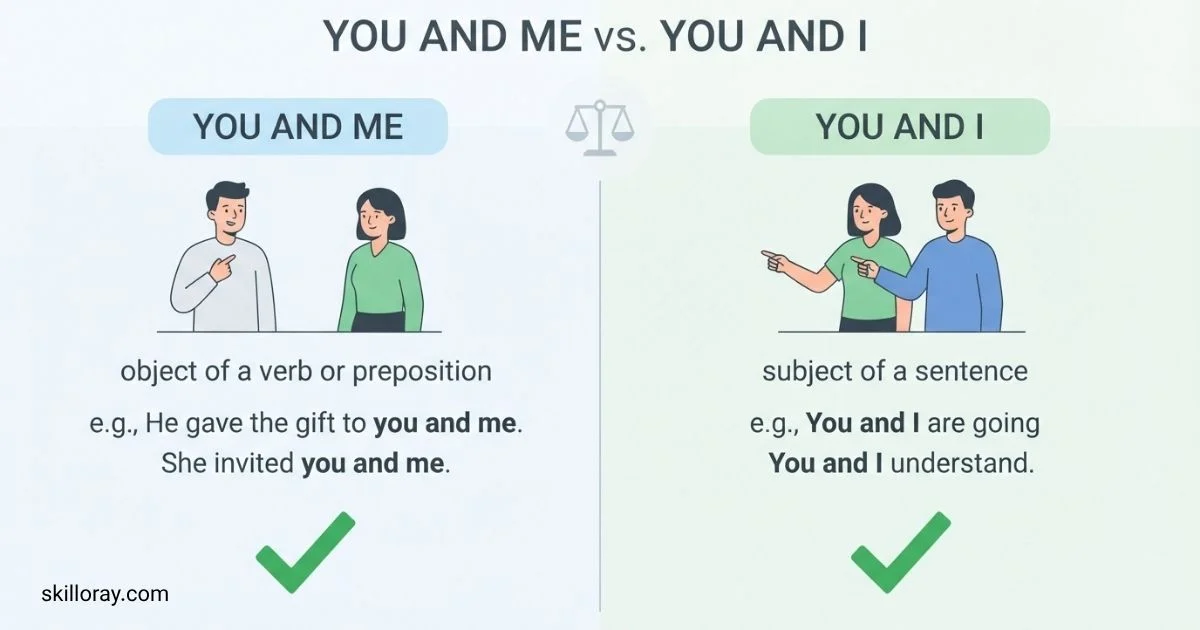
Both “you and me” and “you and I” are correct, but they have different grammatical uses.
- You and I is normally used as a subject.
- You and me is normally used as an object.
- After a preposition such as with, for, to, from, between, or by, use you and me.
- In some comparisons, especially those involving than, either form can occur depending on the grammatical structure and intended meaning.
A useful test is to remove “you and” from the sentence. If “I” sounds correct by itself, use “you and I.” If “me” sounds correct, use “you and me.”
Quick Examples
- You and I should leave now.
- She invited you and me to dinner.
- This secret is between you and me.
- You and I have known each other for years.
- He gave the tickets to you and me.
When to Use You and I
Use “you and I” when the two people are performing the action described by the verb.
In grammatical terms, “you and I” functions as a compound subject.
For example:
- You and I need to talk.
- You and I are responsible for this project.
- You and I went to the same school.
- You and I can solve this problem.
- You and I should leave early.
- You and I were there yesterday.
- You and I understand what happened.
- You and I have a lot in common.
- You and I should practice together.
- You and I made the decision.
Here, the phrase is doing the action. That is why the subject pronoun I is appropriate.
A Simple Test for You and I
Remove “you and” from the sentence:
You and I should go.
Becomes:
I should go.
That sounds correct, so “you and I” works.
Try another:
You and I are responsible.
Becomes:
I am responsible.
Again, “I” is the correct subject pronoun.
When to Use You and Me
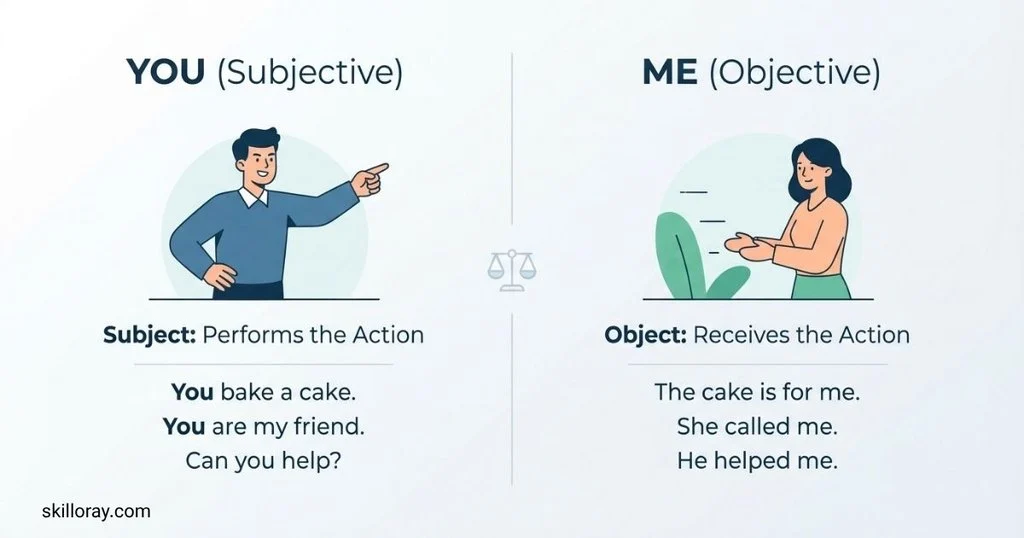
Use “you and me” when the phrase functions as an object.
An object receives an action, follows certain prepositions, or appears in other positions where an object pronoun is required.
Examples include:
- She called you and me.
- They invited you and me.
- He gave the books to you and me.
- The teacher spoke to you and me.
- This message is for you and me.
- They chose you and me for the team.
- Nobody told you and me about the change.
- The manager thanked you and me.
- She sat beside you and me.
- The decision affects you and me.
Use the same removal test:
She invited you and me.
Remove “you and”:
She invited me.
That is correct, so “you and me” is correct.
You and I or You and Me After a Verb
The verb itself can help you determine which form to use.
If you and I perform the action, use “you and I.”
You and I work together.
If the action is done to you and me, use “you and me.”
The manager praised you and me.
Compare these sentences:
| Phrase | Grammatical role | Example |
| You and I | Subject | You and I work together. |
| You and me | Object | She called you and me. |
The important point is not simply whether the phrase comes before or after a verb. Ask who is performing the action and who is receiving it.
You and Me or You and I With Prepositions
After a preposition, “you and me” is normally the natural choice.
Common prepositions include:
- with
- for
- to
- from
- between
- by
- beside
- about
- without
- around
Examples:
- She went with you and me.
- This gift is for you and me.
- He spoke to you and me.
- The letter came from you and me.
- There is a strong friendship between you and me.
- They sat beside you and me.
- Nobody can do this without you and me.
- The discussion was about you and me.
With You and Me
The phrase “with you and me” is correct because with is a preposition and requires an object form.
I would like to go with you and me.
More naturally, depending on the intended meaning:
She went with you and me.
Not:
She went with you and I.
The same principle applies to other prepositions.
From You and Me
After from, use “you and me.”
Examples:
- This message came from you and me.
- There is no pressure from you and me.
- They received a letter from you and me.
The reason is grammatical case: me is the object form of the first-person singular pronoun.
Between You and Me or Between You and I
The standard expression is:
Between you and me
This is because between is a preposition, and the pronoun following it takes the object form.
For example:
- Between you and me, I was surprised.
- This should stay between you and me.
- There is a lot of trust between you and me.
“Between you and I” is a common mistake caused by the belief that I always sounds more formal or correct.
It doesn’t.
The correct grammatical form after between is “you and me.”
Is It You and Me or You and I?
The answer depends on the role of the phrase in the sentence.
Use “you and I” when it is the subject:
You and I need to decide.
Use “you and me” when it is the object:
She asked you and me to decide.
Use “you and me” after a preposition:
She spoke with you and me.
A quick way to remember this is:
Subject → you and I
Object → you and me
You and Me or You and I Examples
Here are several examples showing how the choice changes according to grammar.
Examples With You and I
- You and I should leave now.
- You and I have a meeting tomorrow.
- You and I can handle this.
- You and I were classmates.
- You and I need to work together.
Examples With You and Me
- She invited you and me.
- They called you and me yesterday.
- He gave the responsibility to you and me.
- The teacher asked you and me to stay.
- This conversation is between you and me.
The difference becomes much clearer when you identify the grammatical function rather than relying on which form sounds more formal.
You and Me Is or Are?
When “you and me” is the subject of a sentence, the phrase is generally not the correct subject form. In formal standard English, use “you and I” instead.
For example:
You and I are responsible for the project.
Not:
You and me are responsible for the project.
The verb are is plural because the compound subject contains two people.
However, “you and me” can appear naturally after is when it is part of an informal or conversational construction:
It’s just you and me.
Here, “you and me” is not functioning like the subject of a normal active sentence. This construction is extremely common in everyday English.
Is “You and Me” Grammatically Correct?
Yes. “You and me” is grammatically correct when it is used in an object position or another construction that calls for the object form.
For example:
She called you and me.
This is between you and me.
He gave the tickets to you and me.
The phrase is not inherently incorrect. The mistake occurs when “you and me” is used as the subject of a sentence where standard grammar requires “you and I.”
Is “You and I” Grammatically Correct?
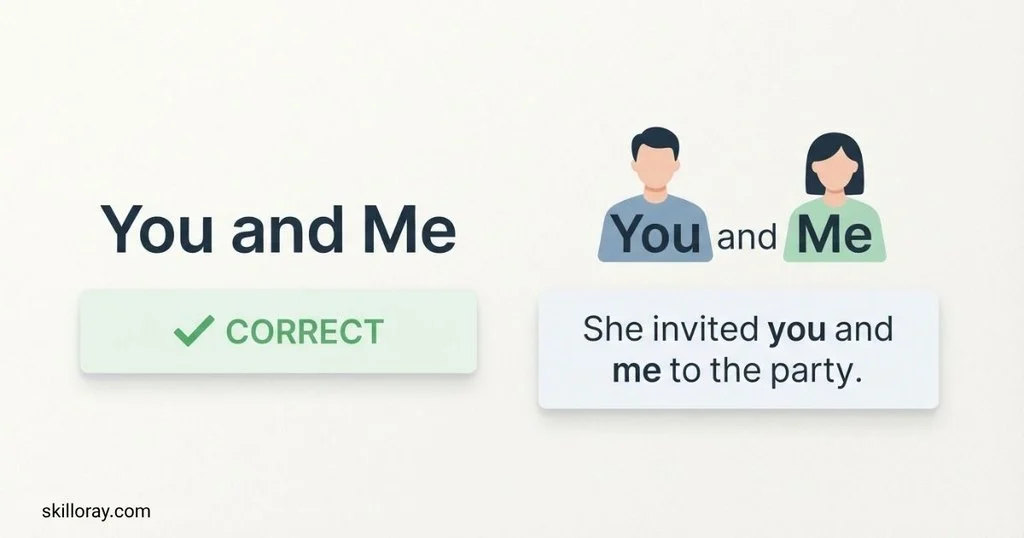
Yes. “You and I” is grammatically correct when the phrase functions as the subject.
For example:
You and I are good friends.
You and I should discuss this.
You and I made the plan.
However, using “you and I” everywhere is also incorrect.
For example:
She invited you and I.
In standard English, this should be:
She invited you and me.
Using I simply because it sounds more formal is a common hypercorrection.
You and Me or You and I in Comparisons With Than
This is one of the trickier areas.
Consider:
She is taller than you and I.
Some speakers use “you and I” because they mentally expand the sentence to:
She is taller than you and I are.
In that expanded structure, you and I functions as the subject of are.
But you will also hear:
She is taller than you and me.
This can be analyzed as a comparison in which than functions like a preposition, making the object form me natural.
The safest approach is to consider the complete implied meaning rather than assuming that I must always follow than.
For formal writing, if there is any possibility of ambiguity, rewrite the sentence:
She is taller than both of us.
This avoids the problem completely.
“It’s Bigger Than You and Me” or “It’s Bigger Than You and I”
The phrase “than you and me” is common in everyday English, but “than you and I” can also occur when the writer understands an implied verb such as are.
For example:
The responsibility is bigger than you and me.
A clearer version might be:
The responsibility is bigger than both of us.
Or, if the intended structure is explicit:
The responsibility is bigger than you and I are prepared to handle.
When a sentence feels awkward, rewriting it is often better than trying to force I or me into the sentence.
You and Me or You and I in “It’s Just…”
The expression “It’s just you and me” is natural and extremely common in everyday English.
For example:
It’s just you and me here.
It’s just you and me tonight.
This construction is widely accepted in conversational English.
Trying to change every instance of me to I can produce unnatural sentences. Grammar depends on the structure of the entire sentence, not on a simple rule that I is always more correct.
Why Do People Confuse You and Me or You and I?
The confusion usually comes from a few common habits.
1. People Learn That “I” Is More Formal
Many speakers are taught to avoid “me” in phrases such as “you and me”, so they start using “you and I” everywhere.
That creates sentences such as:
She invited you and I.
The phrase sounds formal to some people, but it is not the standard object form.
2. People Forget to Test the Pronoun Alone
A very useful trick is to remove “you and.”
You and I went home.
Becomes:
I went home.
Correct.
Now:
She called you and I.
Becomes:
She called I.
That clearly doesn’t work. The correct version is:
She called me.
Therefore:
She called you and me.
3. Fixed Expressions Can Be Confusing
Expressions such as “you and me” and “you and I” appear in songs, titles, casual speech, advertising, and everyday conversation.
A song title or artistic phrase doesn’t necessarily demonstrate a formal grammar rule. Writers and musicians may choose wording for rhythm, rhyme, style, or meaning.
You and Me or You and I in Songs
Both forms appear in song titles and lyrics because both are legitimate English expressions.
However, a song title isn’t necessarily a grammar lesson. Songwriters may choose “you and me” or “you and I” because of rhythm, sound, emphasis, rhyme, or artistic style.
So if you’re trying to decide which form to use in ordinary English, use the grammatical role of the pronoun rather than copying wording from a song.
You and Me or You and I Quiz
Test yourself with these sentences. Choose “you and me” or “you and I.”
- ___ should leave before it gets dark.
- She invited ___ to the party.
- This secret is between ___.
- ___ are responsible for the project.
- He spoke with ___ yesterday.
- ___ need to finish the work.
- The teacher called ___ into the office.
- This gift is for ___.
- ___ have known each other for years.
- They chose ___ for the team.
Answers
- You and I
- you and me
- you and me
- You and I
- you and me
- You and I
- you and me
- you and me
- You and I
- you and me
The pattern is straightforward: subjects generally take I, while objects take me.
A Quick Trick to Remember You and Me or You and I
When you’re unsure, remove “you and.”
If “I” works, use You and I
You and I should go.
Remove “you and”:
I should go.
So you and I is correct.
If “me” works, use You and Me
She invited you and me.
Remove “you and”:
She invited me.
So you and me is correct.
This simple test works for many everyday sentences.
Common Mistakes With You and Me or You and I
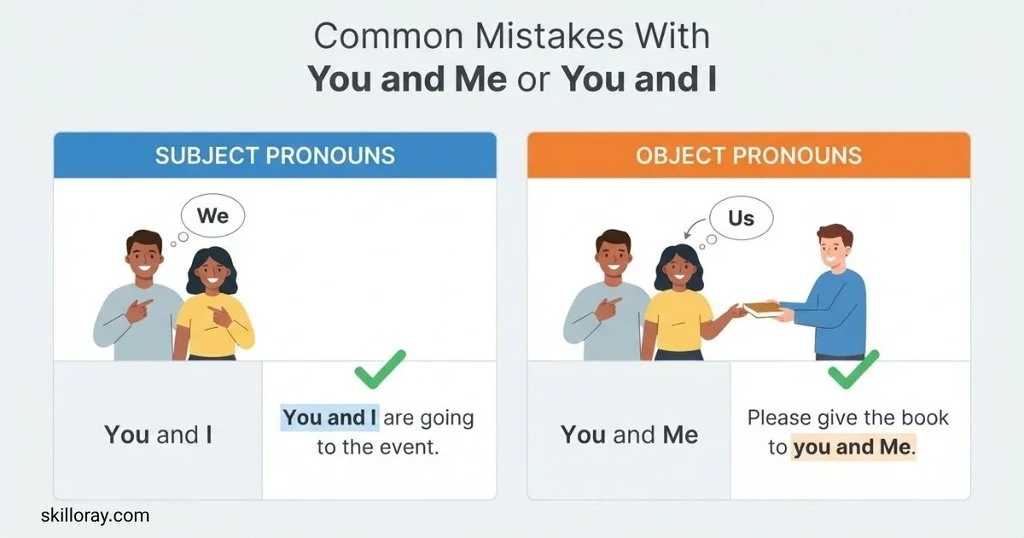
Incorrect: She invited you and I.
Correct: She invited you and me.
Why?
The phrase is the object of invited, so me is required.
Incorrect: You and me are going to the store.
Correct: You and I are going to the store.
Why?
The phrase is the subject performing the action, so I is the standard subject pronoun.
Incorrect: This is between you and I.
Correct: This is between you and me.
Why?
Between is a preposition, so the object form me is required.
Incorrect: He gave the letter to you and I.
Correct: He gave the letter to you and me.
Why?
The phrase follows the preposition to, so me is correct.
Difference Between You and Me or You and I
The main difference is grammatical function.
| Form | Typical role | Example |
| You and I | Subject | You and I should talk. |
| You and me | Object | She called you and me. |
| You and me | After a preposition | She went with you and me. |
| You and me | Common conversational construction | It’s just you and me. |
The most useful rule to remember is:
Use “you and I” as a subject. Use “you and me” as an object or after a preposition.
Frequently Asked Questions
Is “you and me” or “you and I” correct?
Both are correct, but they have different grammatical functions. Use “you and I” when the phrase is the subject. Use “you and me” when it is an object or follows a preposition.
Is it “you and I are” or “you and me are”?
For a standard sentence in which the phrase is the subject, use “you and I are.”
You and I are friends.
Should I say “between you and me” or “between you and I”?
Use “between you and me.” The preposition between takes an object pronoun.
Is “with you and me” correct?
Yes. “With you and me” is correct because with is a preposition and me is the appropriate object pronoun.
Is “you and I” always more formal?
No. “You and I” is not automatically more formal or more correct. Its correctness depends on its grammatical role.
Why is “you and I” correct in some sentences?
It is correct when you and I functions as the subject.
You and I work together.
Why is “you and me” correct in some sentences?
It is correct when you and me functions as an object.
They invited you and me.
Is “it’s just you and me” correct?
Yes. “It’s just you and me” is a natural and widely used English construction.
Which should I use after “than”?
It depends on the structure of the comparison. “Than you and I” can occur when an implied verb makes the phrase a subject, while “than you and me” can occur when than functions as a preposition. If the sentence sounds unclear, rewrite it with “both of us” or make the implied verb explicit.
What is the easiest way to remember the difference?
Remove “you and.” If I works, choose “you and I.” If me works, choose “you and me.”
Conclusion
“You and me” or “you and I” are both correct expressions, but they aren’t interchangeable in every sentence. Use “you and I” when the phrase is the subject, such as “You and I are friends.” Use “you and me” when the phrase is an object, such as “She invited you and me,” or after a preposition, as in “between you and me.”
When you’re unsure, use the simple removal test: take away “you and” and see whether I or me fits naturally. Once you start thinking about the grammatical role rather than which form sounds more formal, the choice becomes much easier.

I am Olivia Brown, a professional English editor and grammar writer who believes that great writing begins with a strong foundation in grammar. I have spent years creating educational resources that help students and professionals improve their writing, avoid common errors, and communicate more effectively. I strive to provide clear explanations and practical examples that make grammar easy to understand and apply.
Books: English Grammar Essentials and Modern Writing Success
 James Walker
 Daniel Carter