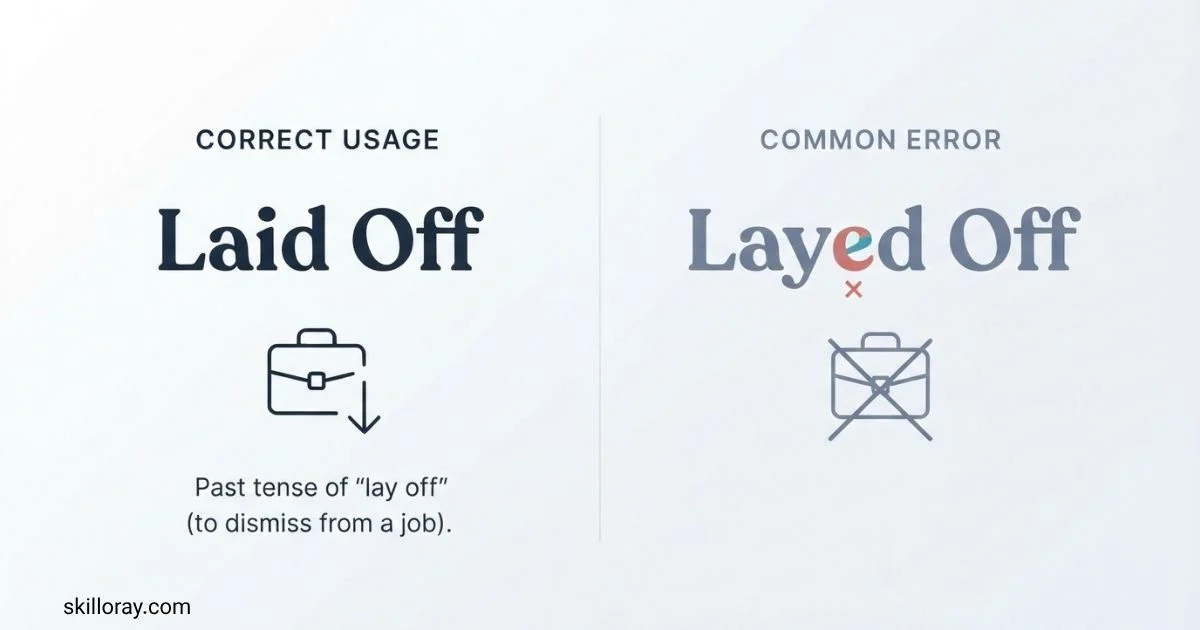
If you have ever paused before writing “laid off,” you are not alone. I know how easy it is to second-guess the spelling, especially when “layed” looks like it could be correct.
You may have seen both “laid off” and “layed off” online, but only one is the standard form in this expression. You can quickly learn which phrase is correct and why it is used this way.
I’ll walk you through the difference in simple language, with clear examples you can remember. By the end, you’ll feel confident using “laid off” correctly in everyday writing, work messages, and professional communication.
Laid Off or Layed Off: (Quick Answer)
“Laid off” is correct. “Layed off” is not the standard form.
The phrase laid off is the past-tense or past-participle form of the phrasal verb lay off. In employment contexts, it means that an employer ended someone’s job, typically because of staffing, financial, organizational, or business reasons.
| Form | Correct? | Meaning |
| laid off | ✅ Yes | Lost a job because an employer ended the position |
| layed off | ❌ No | Nonstandard spelling for this employment expression |
Examples
- I was laid off from my job last month.
- Several employees were laid off after the company reduced its workforce.
- She was laid off from work during the restructuring.
- He got laid off after the department was closed.
So, if you are writing “I was ___ from my job,” the correct choice is “laid off.”
What Does Laid Off Mean?
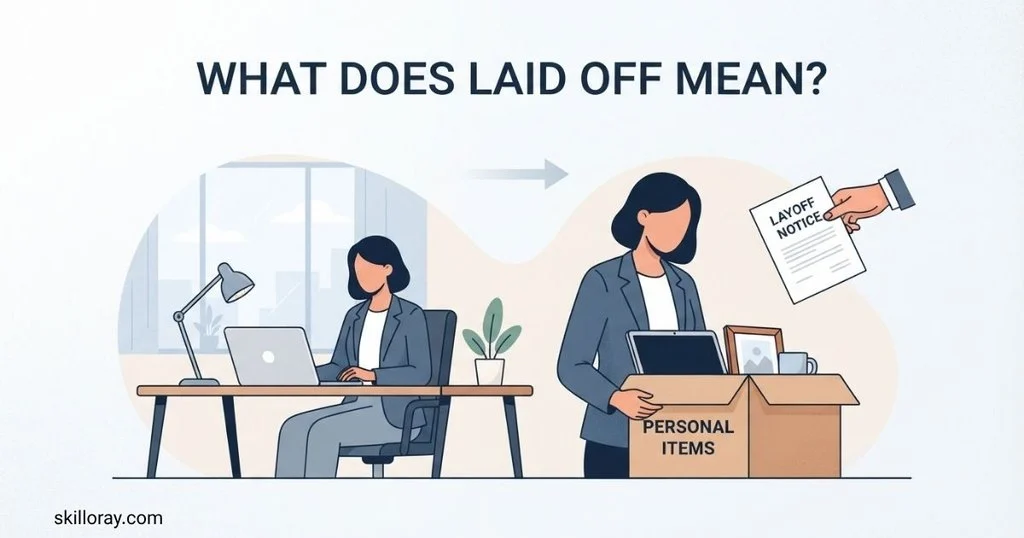
Laid off is an employment phrase that means an employee’s job has been ended by the employer, generally for reasons that are not described simply as the employee choosing to leave.
For example, a company might lay employees off because of:
- Reduced business demand
- Budget cuts
- A company restructuring
- A department closing
- A merger
- A reduction in available positions
- Changes in business operations
The exact circumstances can vary. Being laid off generally refers to the employer ending the employment relationship for business-related reasons rather than the employee voluntarily resigning.
Example
Maria was laid off after her company closed the department where she worked.
Here, laid off tells us that Maria’s employer ended her position.
Why Is Layed Off Incorrect?
The confusion comes from the verb lay.
English has several related forms that can be confusing:
- lay — present form
- laid — past tense
- laid — past participle
For the expression lay off, the past form is laid off.
So:
- Present: The company lays off employees.
- Past: The company laid off employees.
- Past participle: The employees were laid off.
The spelling layed is not the standard past-tense form needed in laid off.
Laid Off as a Verb Phrase
Lay off is a phrasal verb. Its meaning depends on the context.
In an employment context:
The company laid off 50 workers.
Here, laid off means the company ended those workers’ employment.
It can also appear in other contexts with a different meaning. For example:
The doctor told him to lay off sugary drinks.
Here, lay off means to stop doing or consuming something.
The past form remains laid off:
He laid off sugary drinks.
The meaning changes according to context, but layed off is not the standard past form of this phrasal verb.
Is Laid Off the Past Tense?
Yes. Laid is the past-tense form of lay, so laid off is the past form of lay off.
Consider this progression:
| Time | Example |
| Present | The company lays off workers. |
| Past | The company laid off workers. |
| Present perfect | The company has laid off workers. |
| Past perfect | The company had laid off workers. |
| Passive | Workers were laid off. |
Notice that laid stays the same when it functions as a past participle.
Present
The company lays off employees when sales decline.
Simple past
The company laid off several employees last year.
Present perfect
The company has laid off several employees this year.
Passive construction
Hundreds of workers were laid off.
These are all standard uses of lay off.
Laid Off From a Job or Layed Off From a Job
The correct phrase is:
laid off from a job
Not:
layed off from a job
For example:
- I was laid off from my job.
- She was laid off from her position.
- He was laid off from work.
- They were laid off from their jobs.
The phrase laid off from a job is grammatically natural when you want to specify the employment situation.
However, laid off by itself is often enough:
I was laid off last week.
The listener already understands that the statement refers to employment.
Is It Laid Off or Layed Off From Work?
If you’re asking which expression to use, choose laid off from work.
Correct
I was laid off from work.
Incorrect
I was layed off from work.
You can also say:
I was laid off from my job.
Or:
I got laid off from work.
In everyday American English, I got laid off is also very common.
Laid Off or Laid-Off: When Should You Use the Hyphen?
The expression can appear as laid off or laid-off, depending on its grammatical position.
When the phrase functions as a predicate after a verb, it is normally written without a hyphen:
She was laid off last week.
When it appears as a compound modifier before a noun, a hyphen can be appropriate:
The company offered assistance to laid-off employees.
Compare:
- Employees were laid off.
- The company helped laid-off employees.
The hyphen in laid-off employees helps show that the two words work together as a modifier before the noun.
Laid Off or Fired: Are They the Same?
Laid off or fired can both describe someone losing a job, but they do not necessarily communicate the same circumstances.
Laid off generally refers to an employer ending employment because of business or organizational circumstances.
Fired generally means an employer dismissed someone because of that employee’s conduct, performance, or another employment-related reason.
For example:
The company lost a major contract, so several employees were laid off.
This sentence presents the job loss as connected to the company’s circumstances.
By contrast:
He was fired after repeatedly violating company rules.
This sentence presents the dismissal as connected to the employee’s conduct.
The exact meaning can depend on the circumstances and how the employer describes the employment decision.
Laid Off or Layoff: What’s the Difference?
Laid off is a verb phrase, while layoff is generally a noun.
Laid off
Use laid off when describing what happened to an employee.
She was laid off last Friday.
Layoff
Use layoff when referring to the employment action or event as a noun.
The company announced a major layoff.
This distinction is useful:
| Form | Grammatical role | Example |
| laid off | Verb phrase | I was laid off. |
| layoff | Noun | The layoff affected many employees. |
You may also see lay-off in some varieties or contexts, but layoff is a common modern spelling in American English.
Laid Off Examples
Here are natural examples showing how laid off works in everyday English.
- I was laid off from my job last month.
- The company laid off several employees.
- She was laid off after the department closed.
- Many workers were laid off during the restructuring.
- He got laid off because his position was eliminated.
- The company has laid off hundreds of employees.
- They were laid off when the factory reduced its operations.
- My friend was laid off from work earlier this year.
- Several employees were laid off after the merger.
- The manager explained why the company had laid off workers.
Sentences With Layed Off
Because layed off is not the standard spelling for this employment phrase, it should not be used in standard English writing.
Incorrect
I was layed off from my job.
Correct
I was laid off from my job.
Incorrect
She got layed off last week.
Correct
She got laid off last week.
Incorrect
The company layed off several workers.
Correct
The company laid off several workers.
A useful way to remember this is simple:
Lay → laid → laid
Not:
Lay → layed
Why Do People Say Layed?
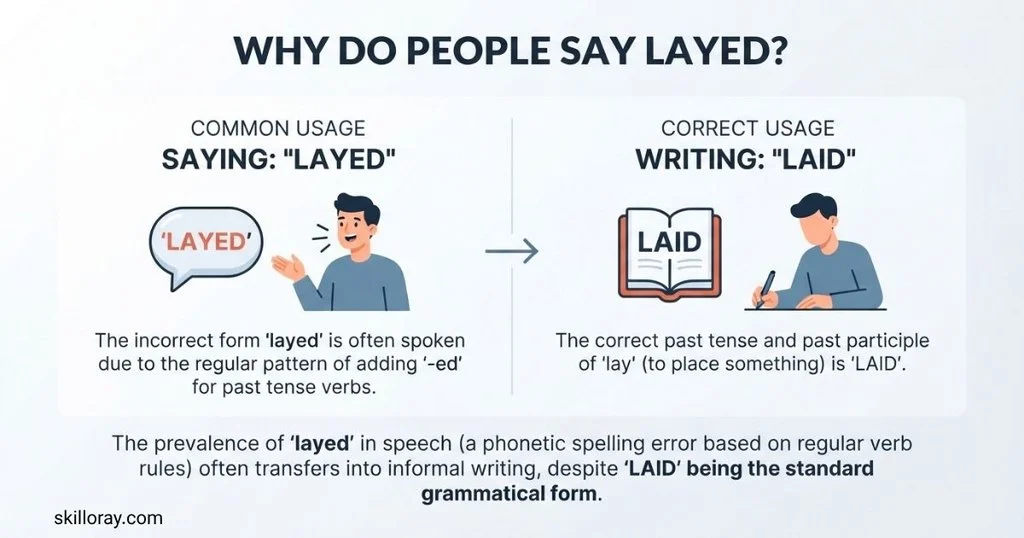
The spelling layed is an understandable mistake because many regular English verbs form their past tense by adding -ed.
For example:
- work → worked
- call → called
- play → played
- walk → walked
A learner may therefore assume:
lay → layed
But lay is an irregular verb, so its past form is laid.
That same irregular form appears in lay off:
lay off → laid off
This is why laid off needs to be memorized as the standard expression.
The Verb Forms of Lay
Understanding the basic forms of lay makes laid off much easier.
| Verb form | Word | Example |
| Base form | lay | They lay the book on the desk. |
| Past tense | laid | They laid the book on the desk. |
| Past participle | laid | They have laid the book on the desk. |
| -ing form | laying | They are laying the book down. |
The same past form appears when lay is combined with off:
lay off → laid off
Don’t Confuse Lay With Lie
Another reason laid can be confusing is that lay or lie have different verb forms.
For example:
- lay → laid → laid
- lie → lay → lain
The verbs have different meanings and grammatical patterns.
Lay
Lay generally means to put or place something somewhere.
Please lay the book on the table.
Past:
She laid the book on the table.
Lie
Lie generally refers to being in a reclining or resting position.
I want to lie down.
Past:
Yesterday, I lay down for an hour.
This distinction is separate from the employment phrase laid off, but learning it can prevent confusion with related verb forms.
Common Mistakes With Laid Off
Mistake 1: Using Layed
Incorrect:
I was layed off.
Correct:
I was laid off.
Why?
The past form of lay is laid, not layed.
Mistake 2: Writing Lay Off in the Past
Incorrect:
The company lay off 20 employees last month.
Correct:
The company laid off 20 employees last month.
Why?
The sentence describes a completed event in the past, so the past form laid is required.
Mistake 3: Confusing Layoff With Laid Off
Incorrect:
I was layoff last week.
Correct:
I was laid off last week.
Why?
Laid off functions as a verb phrase, while layoff functions as a noun.
Correct noun example:
The layoff affected hundreds of workers.
Is Laid Off Grammatically Correct?
Yes. Laid off is grammatically correct and standard English.
It can be used in active sentences:
The company laid off 100 employees.
It can also be used in passive sentences:
100 employees were laid off.
And it can appear after forms of be:
She was laid off.
They have been laid off.
The grammatical form changes around it, but laid remains the standard past or past-participle form of lay.
Is Layed a Word?
Layed can appear in historical, dialectal, or specialized contexts, but it is not the standard form used for the past tense of lay in ordinary modern English. More importantly, layed off is not the standard expression for losing a job.
For normal English writing, use:
laid off
If you’re writing a résumé, cover letter, workplace message, article, or professional document, laid off is the appropriate standard form.
Laid Off Synonyms
Depending on the exact context, several expressions can describe a similar employment situation.
Common alternatives include:
- let go
- dismissed
- made redundant
- job eliminated
- employment terminated
- position eliminated
- released from employment
These expressions aren’t always exact substitutes because employment terminology can carry different meanings in different workplaces or legal systems.
Example
She was laid off when the company reduced its workforce.
A broader alternative could be:
She was let go when the company reduced its workforce.
For precise communication, laid off is often preferable when a genuine layoff is what you mean.
Is Laid Off American or British English?
Laid off is used in both American English or British English, although employment terminology can differ by region.
In American English, laid off is a very common expression for employment ending because an employer eliminates positions or reduces its workforce.
British English commonly uses made redundant for certain situations in which an employee’s job is eliminated.
For example:
- American English: She was laid off.
- British English: She was made redundant.
This doesn’t mean laid off is grammatically incorrect in British English. It means employment vocabulary and preferred expressions can vary by region and context.
Laid Off or Layed Off From Work: Quick Guide
If you’re still unsure, use this quick reference:
| What you want to say | Standard form |
| I lost my job because my position was eliminated. | I was laid off. |
| The company dismissed workers because of restructuring. | The company laid off workers. |
| I lost my job last month. | I was laid off last month. |
| Several employees lost their positions. | Several employees were laid off. |
| The company announced the job reductions. | The company announced a layoff. |
The main rule is:
Use “laid off,” not “layed off,” when talking about employment.
How to Remember Laid Off
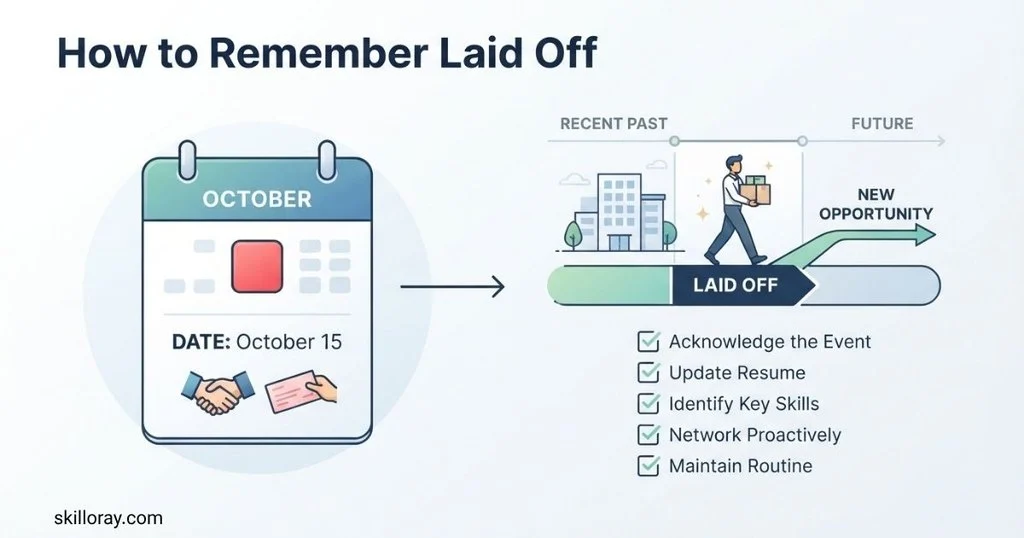
A simple memory trick is to remember the irregular verb pattern:
lay → laid → laid
Then attach off:
lay off → laid off
So if you’re describing something that already happened:
I was laid off.
Not:
I was layed off.
You don’t need to memorize a complicated rule. Just remember that laid is the standard past form used in laid off.
FAQs
Is it laid off or layed off?
Laid off is the correct standard expression. Layed off is a common misspelling when referring to losing a job.
Is laid off the past tense of lay off?
Yes. Laid off is the past form of the phrasal verb lay off.
Present: The company lays off workers.
Past: The company laid off workers.
Is layed off ever correct?
Not as the standard spelling of the employment phrase. In ordinary modern English, write laid off.
What does laid off from a job mean?
Laid off from a job means an employer ended an employee’s job, commonly because of business, organizational, or staffing circumstances.
Can I say I got laid off?
Yes. I got laid off is a natural, commonly used expression, particularly in conversational English.
What is the noun form of laid off?
The noun is generally layoff.
The company announced a layoff.
What is the synonym of laid off?
Depending on the context, possible alternatives include let go, dismissed, made redundant, or position eliminated. These expressions aren’t always exact equivalents.
Is laid off formal English?
Yes. Laid off is standard English and is appropriate in both everyday communication or professional writing when it accurately describes the employment situation.
Why is it laid off instead of layed off?
Because lay is an irregular verb. Its past form is laid, not layed. Therefore, lay off becomes laid off in the past.
What should I write on a professional document?
If your employment ended because your employer eliminated your position or reduced its workforce, laid off is the standard expression. Choose more specific wording if the circumstances call for it.
Conclusion
The correct expression is laid off, not layed off, when you’re talking about losing a job because an employer ends your position. The key grammar rule is that lay has the past form laid, so lay off becomes laid off.
If you’re writing “I was laid off from my job” or “The company laid off several employees,” you’re using the standard form correctly. Remember the simple pattern lay → laid → laid, and the spelling becomes much easier to remember.

I am Daniel Carter, a grammar enthusiast and language educator with over 10 years of experience helping students and professionals improve their English writing and communication skills. I enjoy simplifying complex grammar rules into easy-to-understand lessons that anyone can follow. My goal is to help learners write with confidence, avoid common mistakes, and develop strong communication skills for academic and professional success. I regularly create practical grammar guides, writing tips, and language resources that make learning both enjoyable and effective.
Books: Mastering English Grammar and The Complete Guide to Better Writing
 James Walker
 Olivia Brown