Have you ever stopped while writing and wondered whether wont or won’t is the correct choice? I understand how one tiny apostrophe can create surprising confusion, especially when both forms look almost identical.
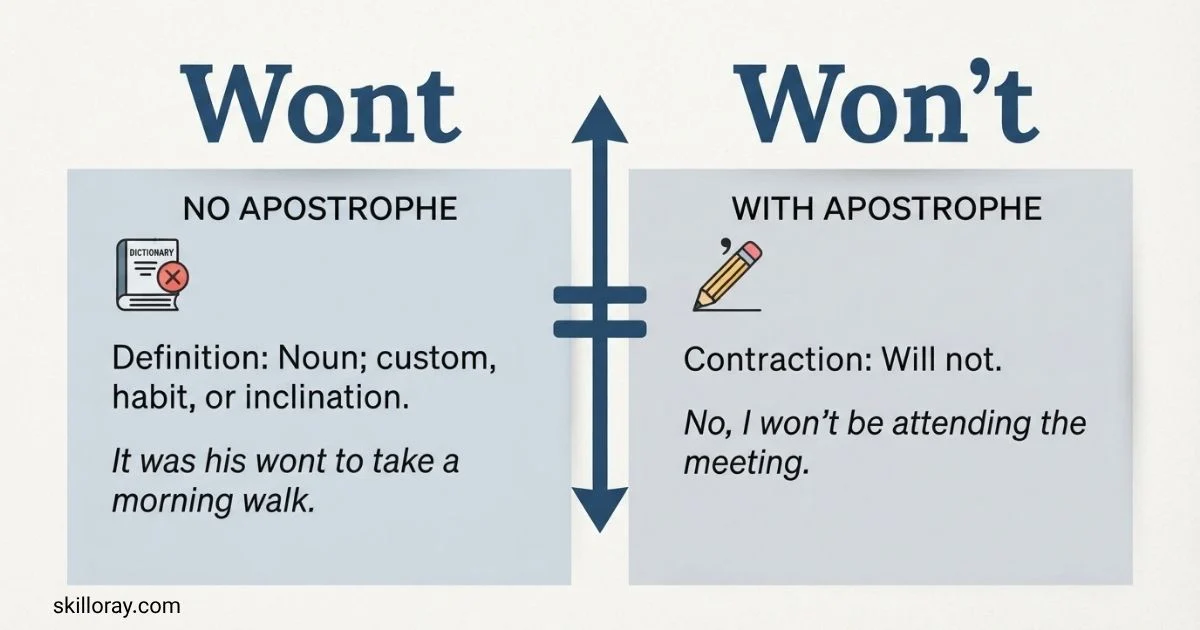
You may see these words often, but they do not mean the same thing. Won’t is a contraction of “will not,” while wont is a different word with its own meaning and usage.
In this guide, I’ll make the difference simple and practical for you. You’ll learn what each form means, when to use it, and how to avoid common mistakes with clear examples.
Wont or Won’t: The Quick Answer
“Wont” or “won’t” are both correct, but they have different meanings and grammatical functions.
| Form | Meaning | Typical use | Example |
| won’t | will not | Contraction | I won’t be late. |
| wont | accustomed to; habitual custom | Formal/literary usage | She was wont to walk alone. |
The apostrophe in won’t is essential because it marks the contraction of will not. Without the apostrophe, wont becomes a different word.
What Does “Won’t” Mean?
Won’t is the contraction of will not.
It is used to make a negative statement about a future action, intention, willingness, or expected behavior.
For example:
- I won’t forget your advice.
- She won’t be at school tomorrow.
- We won’t arrive before noon.
- He won’t answer the phone.
- They won’t agree to the proposal.
You can usually check whether won’t is correct by expanding it to will not.
I won’t go.
I will not go.
Because the meaning stays the same, won’t is correct.
Won’t as a Contraction
The structure is:
will + not → won’t
Examples:
- I will not → I won’t
- You will not → You won’t
- He will not → He won’t
- She will not → She won’t
- We will not → We won’t
- They will not → They won’t
Unlike many simple contractions, won’t has an irregular spelling. It isn’t written as willn’t. Its unusual form developed historically from earlier forms of will not.
What Does “Wont” Mean?
Wont is a separate word from won’t. It can mean accustomed to, in the habit of, or custom/habit.
It is usually found in expressions such as:
- be wont to
- as is his wont
- as is her wont
- as was their wont
For example:
She was wont to rise early.
This means that she was accustomed to rising early.
Another example:
As was his wont, he arrived before everyone else.
Here, wont means his usual habit or customary behavior. Dictionary sources describe this word as referring to being accustomed or to a customary practice.
Wont or Won’t: Grammar Difference
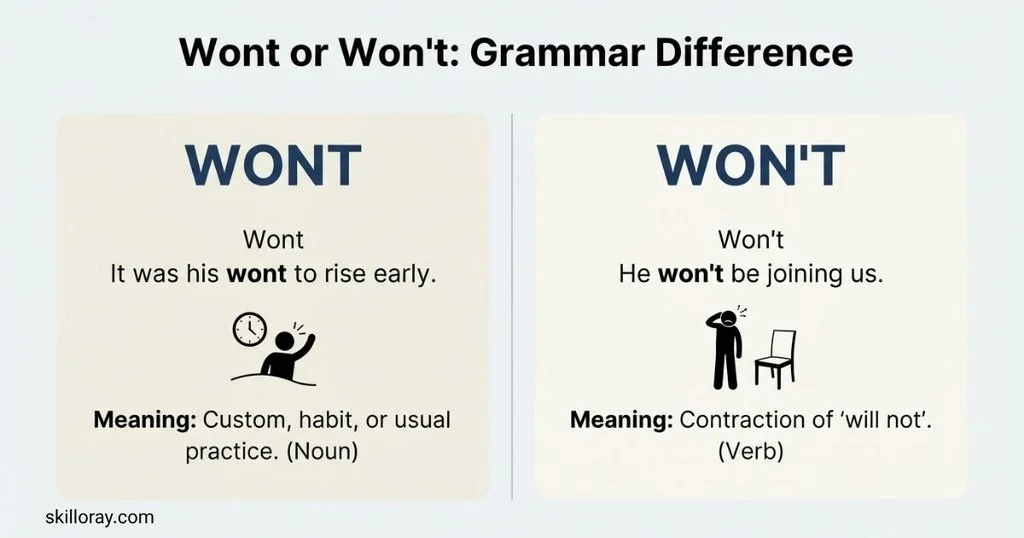
The easiest way to remember the distinction is to look at the grammar.
Won’t
Won’t is a contraction containing the auxiliary verb will and the negative not.
Examples:
- I won’t leave.
- She won’t complain.
- They won’t understand.
- He won’t come tomorrow.
It commonly appears before a base-form verb:
won’t + verb
She won’t come.
We won’t wait.
He won’t change his mind.
Wont
Wont is a separate lexical word. As an adjective, it is commonly used with to + verb:
be + wont + to + verb
He was wont to complain.
They were wont to travel in winter.
It can also function as a noun meaning a customary habit or practice:
As was her wont, she checked the details twice.
The noun form can be pluralized as wonts, although this usage is uncommon.
How Do You Know Which One to Use?
Use this simple substitution test.
Test 1: Replace It With “Will Not”
If will not makes sense, use won’t.
I won’t go.
→ I will not go. ✓
He won’t call tonight.
→ He will not call tonight. ✓
They won’t agree.
→ They will not agree. ✓
Test 2: Replace It With “Accustomed To”
If the meaning is accustomed to, in the habit of, or custom, use wont.
She was wont to read before bed.
→ She was accustomed to reading before bed. ✓
As was his wont, he arrived early.
→ As was his custom, he arrived early. ✓
This substitution method is one of the quickest ways to avoid confusing the two forms.
Wont or Won’t in a Sentence
Here are examples showing the difference clearly:
Sentences With “Won’t”
- I won’t be available this afternoon.
- She won’t forget what you told her.
- He won’t change his decision.
- We won’t leave without saying goodbye.
- They won’t arrive until evening.
- My computer won’t start.
- The door won’t open.
- I won’t make the same mistake again.
- She won’t answer the question.
- The weather won’t improve today.
In each example, won’t can be expanded to will not.
Sentences With “Wont”
- He was wont to rise before sunrise.
- She was wont to speak quietly.
- The writer was wont to work late at night.
- They were wont to gather there after dinner.
- As was his wont, he arrived early.
- As was her wont, she reviewed every detail.
- The old professor was wont to tell long stories.
- As is their wont, they met every Friday.
- He was wont to take a long walk after lunch.
- As was the team’s wont, they prepared carefully.
These examples use wont in its traditional sense of habit or customary behavior.
Is “Wont” a Formal Word?
Yes. Wont is a legitimate English word, but it is much less common in ordinary modern conversation than won’t.
It often sounds formal, literary, old-fashioned, or traditional, especially in expressions such as “as was his wont” or “was wont to.”
For everyday writing, a more natural alternative may be:
- accustomed to
- usually
- habit
- custom
- typically
For example:
Formal/literary:
She was wont to arrive early.
More natural modern English:
She usually arrived early.
That doesn’t make wont incorrect. It simply means that its tone and frequency differ from those of ordinary conversational English.
Is “Won’t” Formal or Informal?
Won’t is standard English and is widely used in both American and British English.
However, in particularly formal writing, you may sometimes prefer the full form will not.
Compare:
I won’t be able to attend.
I will not be able to attend.
Both are grammatically correct. The second can sound more formal or deliberate.
So the apostrophe in won’t isn’t a sign of incorrect or poor English. It is simply the normal contraction of will not.
Won’t Pronunciation
Won’t is generally pronounced:
/woʊnt/ in many varieties of American English
/wəʊnt/ in standard British pronunciation
A simple approximation is:
“wohnt”
It has one syllable.
For example:
I won’t go.
The pronunciation is not the same as the common pronunciation of want in standard English.
Oxford gives won’t as the short form of will not and lists the British pronunciation /wəʊnt/.
Wont Pronunciation
Wont is more complicated because its pronunciation varies.
Pronunciations documented for the word include forms such as:
- /wʌnt/
- /wɔnt/
- /woʊnt/
- /wəʊnt/
Some speakers pronounce wont like “wunt,” while others pronounce it similarly to “won’t” or “want.”
This variation helps explain why the word can be confusing when heard aloud.
If you’re learning English, don’t rely only on pronunciation to decide between wont or won’t. Look at the meaning and grammar instead.
Is “Wont” the Same as “Want”?
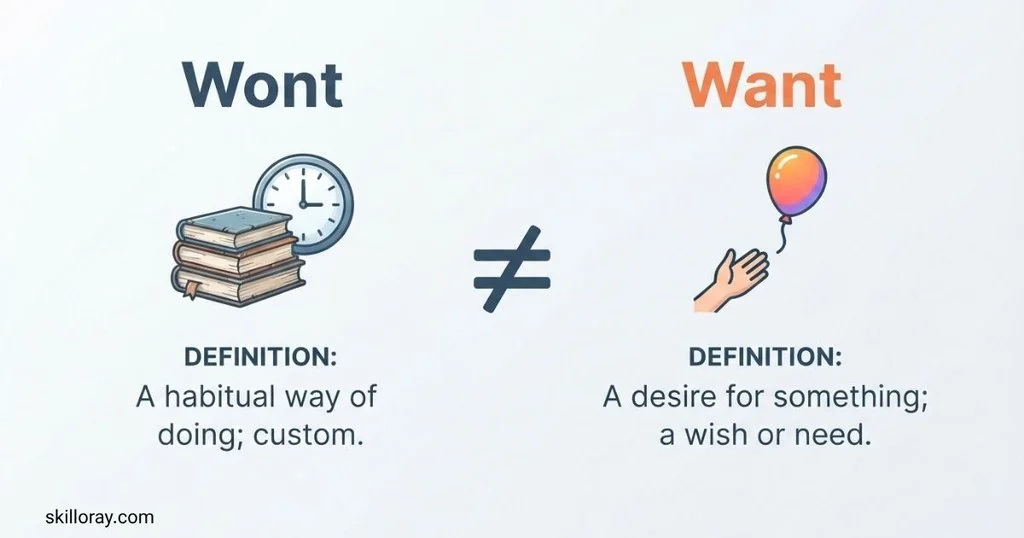
No. Wont or want are different words.
Want usually expresses a desire or lack of something:
I want some water.
Wont relates to habit or being accustomed to something:
He was wont to arrive early.
The pronunciation of wont varies among speakers, and some pronunciations can sound similar to want. That doesn’t make the words interchangeable.
What Is the Full Form of “Won’t”?
The full form of won’t is:
will not
Examples:
I won’t go.
I will not go.
She won’t agree.
She will not agree.
They won’t attend.
They will not attend.
So if someone asks, “What is won’t full form?”, the answer is simply will not.
Wont Etymology
The two spellings have different histories.
Wont is an old English word. Its history goes back through Middle English to Old English gewunod, related to a verb meaning to become accustomed to or be used to something. It has therefore been associated with ideas of habit and customary behavior for centuries.
Won’t, on the other hand, developed as a contraction of forms meaning will not. Historical forms included variations such as wil not, wol not, and related spellings before the modern contraction became established.
The similar modern spellings are therefore misleading: wont and won’t are not simply two spellings of the same word.
Common Mistakes With Wont or Won’t
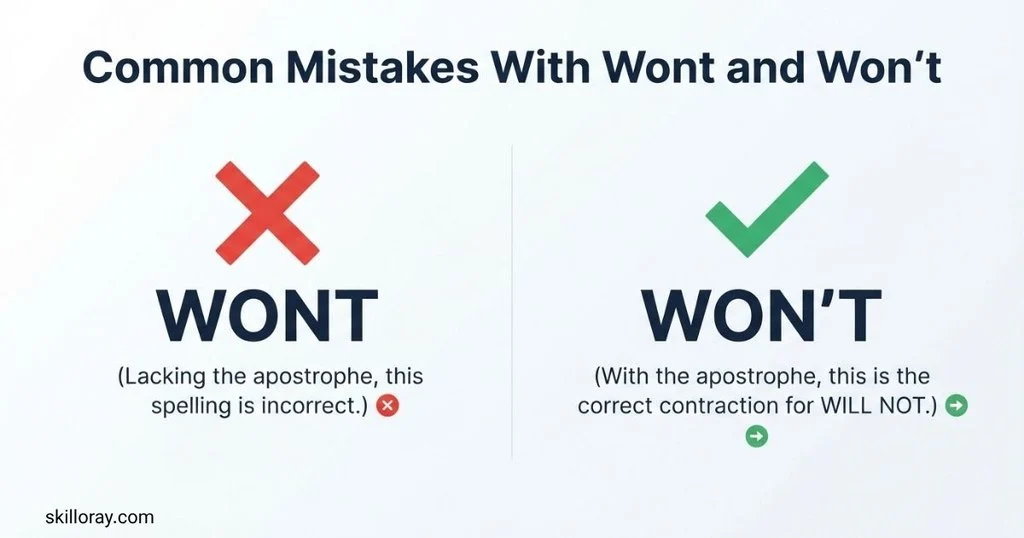
Mistake 1: Leaving Out the Apostrophe
Incorrect:
I wont go tomorrow.
If you mean I will not go, the correct form is:
Correct:
I won’t go tomorrow.
Mistake 2: Adding an Apostrophe to “Wont”
Incorrect:
He was won’t to arrive early.
Correct:
He was wont to arrive early.
Here, wont means accustomed to.
Mistake 3: Treating “Wont” as a Casual Form of “Won’t”
Incorrect idea:
“Wont” is just a shortened spelling of “will not.”
Correct:
Won’t is the contraction of will not, while wont is a separate word meaning accustomed to or habit/custom.
Mistake 4: Assuming “Wont” Means “Want”
Incorrect:
He was wont some coffee.
Correct:
He wanted some coffee.
Or, if you mean habit:
He was wont to drink coffee in the morning.
Wont or Won’t: Which Should You Use?
For almost all ordinary situations involving will not, use won’t.
Use wont only when you genuinely mean accustomed to, habitual, or custom.
| If you mean… | Use | Example |
| will not | won’t | I won’t go. |
| will not happen | won’t | It won’t happen. |
| refuse to | won’t | He won’t listen. |
| accustomed to | wont | She was wont to read. |
| habitual custom | wont | As was his wont, he arrived early. |
A useful rule is:
“Will not” → won’t
“Accustomed to / custom” → wont
FAQs
Is “wont” a correct English word?
Yes. Wont is a legitimate English word meaning accustomed to, habitual, or custom. It is relatively uncommon in everyday modern English and often has a formal or literary tone.
Is “wont” the same as “won’t”?
No. Won’t means will not, while wont relates to habit, custom, or being accustomed to something.
What is the full form of “won’t”?
The full form of won’t is will not.
Is “won’t” formal English?
Yes, won’t is standard English, but it is a contraction. In especially formal writing, you may choose will not instead.
Is “wont” formal?
Wont is generally associated with formal, literary, or somewhat old-fashioned English. It is correct, but it is much less common in everyday conversation.
How do you pronounce “won’t”?
Won’t is generally pronounced /woʊnt/ in many American varieties and /wəʊnt/ in standard British pronunciation. It has one syllable.
How do you pronounce “wont”?
Pronunciation varies. Common documented pronunciations include /wʌnt/, /wɔnt/, and /woʊnt/, depending on the speaker and variety of English.
Can “wont” or “won’t” be used interchangeably?
No. They have different meanings. Use won’t for will not and wont for habit, custom, or being accustomed to something.
Is “won t” correct?
No. If you mean will not, write won’t with an apostrophe.
Conclusion
Wont or won’t are both correct, but they are completely different in meaning. Use won’t when you mean will not, such as “I won’t go.” Use wont when you mean accustomed to or custom, as in “She was wont to rise early.”
If you’re unsure which form belongs in your sentence, try replacing it with “will not.” If that works, choose won’t. If the meaning is closer to “accustomed to” or “habit,” choose wont.
For most everyday writing, won’t will be the form you need. Wont is correct too, but its formal and literary character makes it much less common.

I am Olivia Brown, a professional English editor and grammar writer who believes that great writing begins with a strong foundation in grammar. I have spent years creating educational resources that help students and professionals improve their writing, avoid common errors, and communicate more effectively. I strive to provide clear explanations and practical examples that make grammar easy to understand and apply.
Books: English Grammar Essentials and Modern Writing Success
 James Walker
 Daniel Carter