Have you ever paused while writing because you were unsure about Labelling or Labeling? I know how confusing two nearly identical spellings can feel, especially when you want your writing to look polished and correct.
The good news is that you do not need to guess. Labelling or Labeling follows a clear spelling difference, and once you understand the rule, you can choose the right form with confidence.
In this guide, I’ll explain the difference simply and show you when to use each spelling. By the end, you’ll know which form fits US English and how to avoid common spelling mistakes.
Labelling or Labeling: Correct Answer
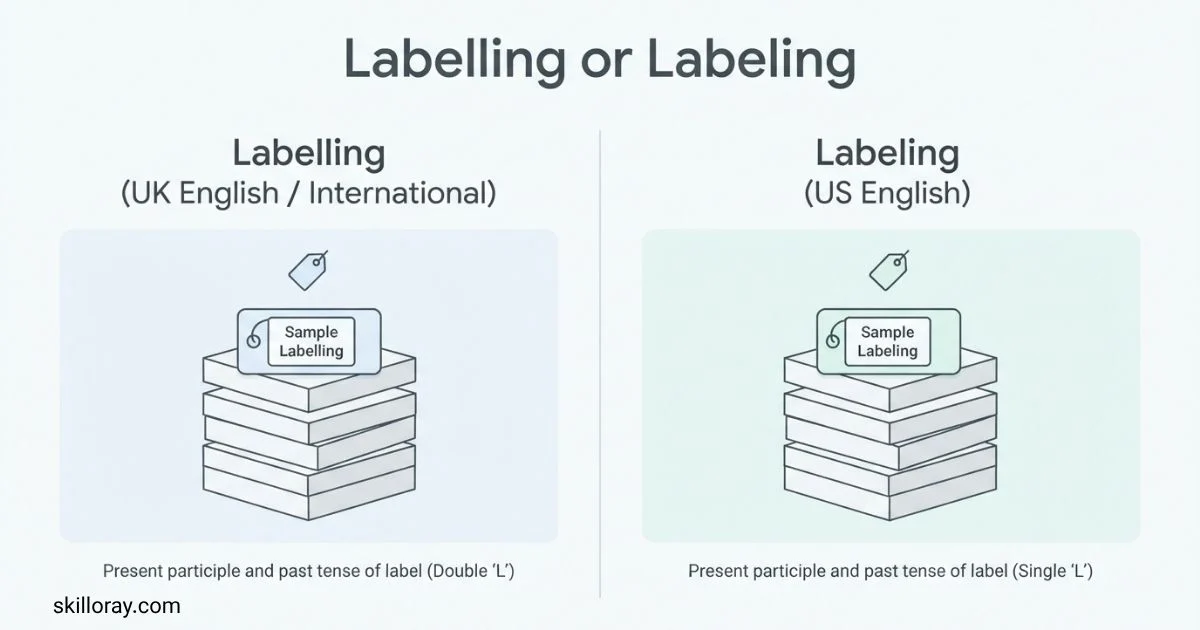
Both “labelling” or “labeling” are correct. They are regional spelling variants of the present participle and gerund form of the verb label.
| Form | Main usage | Example |
| labelling | British English; generally Australian English | The company is labelling the products. |
| labeling | American English | The company is labeling the products. |
Cambridge identifies labelling as the UK form and labeling as the US form. It defines the word as the present participle of label and also uses labelling as a noun for the process of putting labels on things.
So, neither spelling is simply “wrong.” Your choice should match the English variety and style you are following.
What Does Labelling or Labeling Mean?
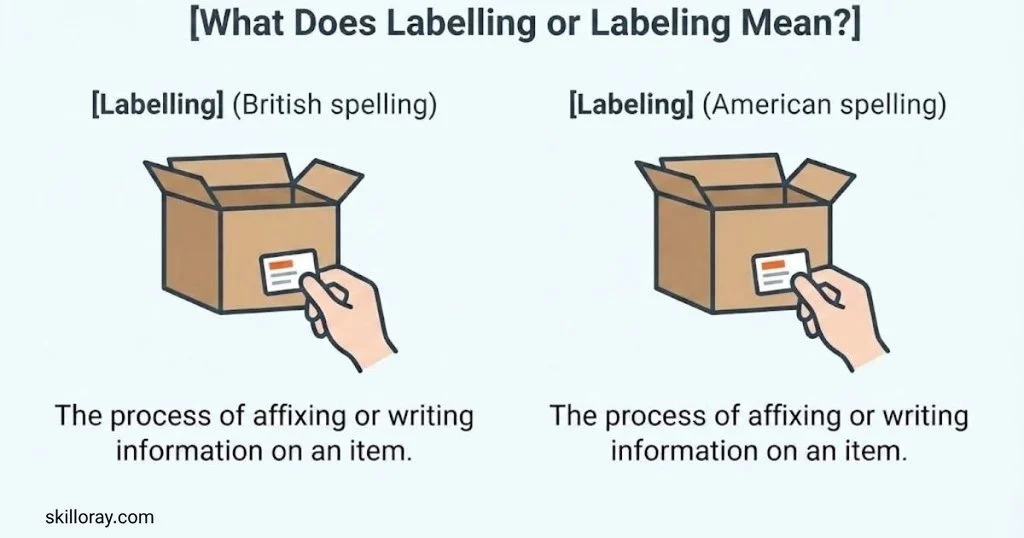
Labelling or labeling have the same basic meaning.
They can describe:
- Putting a label on a product or object
- Adding identifying information
- Marking containers, files, or samples
- Naming or classifying something
- Describing a person or thing with a particular term
For example:
- The staff are labelling the boxes before delivery.
- The staff are labeling the boxes before delivery.
- The company improved its product labelling.
- The company improved its product labeling.
- The scientist is labelling each sample.
- The scientist is labeling each sample.
The meaning doesn’t change when you switch from one spelling to the other.
In business and consumer contexts, labelling/labeling can refer to information placed on products, including food, nutritional, packaging, and country-of-origin information.
Why Are Labelling or Labeling Spelled Differently?
The difference comes from regional English spelling conventions.
The base verb is:
label
When the -ing ending is added, British English commonly doubles the final l:
label → labelling
American English normally keeps one l:
label → labeling
The same regional pattern appears in the past tense and past participle:
- British English: labelled
- American English: labeled
This is a spelling difference, not a difference in grammar or meaning. Both versions are standard within their respective varieties of English.
Labelling in British English
Labelling is the standard British English spelling.
Use it when writing for readers in the United Kingdom or when following British spelling conventions.
Examples:
- The manufacturer is labelling the new products.
- Clear food labelling helps consumers understand the contents.
- The boxes are being labelled for delivery.
- The teacher is labelling the parts of the diagram.
- The company changed its product labelling requirements.
British English also commonly uses other double-l forms, such as:
- travelling
- cancelled
- modelling
- labelled
- labelling
If the rest of your writing follows British spelling, labelling is the natural choice.
Labeling in American English
Labeling is the standard American English spelling.
Use it when writing for readers in the United States or when following an American style guide.
Examples:
- The manufacturer is labeling the new products.
- Clear food labeling helps consumers understand the contents.
- The boxes are being labeled for delivery.
- The teacher is labeling the parts of the diagram.
- The company changed its product labeling requirements.
American English commonly uses the single-l forms:
- traveling
- canceled
- modeling
- labeled
- labeling
Therefore, if your article or document otherwise uses American spelling, labeling will usually be the better choice.
Labelling or Labeling in Australia
For Australian English, labelling is generally the preferred spelling.
Australian English shares many spelling conventions with British English, including the use of the double l in this word.
Examples:
- The company updated its product labelling.
- The ingredients are clearly labelled.
- Accurate food labelling is important.
- The staff are labelling the packages.
Australian usage can have its own conventions, so a particular organization may follow a house style. But for this word, labelling is the natural standard choice.
Labelling or Labeling in Canada
Canadian English needs a little more care because it contains influences from both British and American English.
Labelling is well established in Canadian English, while labeling can also appear. For formal writing, the safest approach is to follow the style guide used by the publication, school, organization, or institution.
For example, you may encounter:
- The products were labelled correctly.
- The products were labeled correctly.
Both can be understood as Canadian usage, depending on the spelling system being followed.
So, unlike the clearer UK-US distinction, Canadian English doesn’t always require one absolute answer.
Labelling or Labeling: Quick Comparison
| Feature | Labelling | Labeling |
| British English | Yes | Usually not preferred |
| American English | Usually not preferred | Yes |
| Australian English | Generally preferred | Less typical |
| Canadian English | Common | Also found |
| Meaning | Same | Same |
| Pronunciation | Essentially the same | Essentially the same |
| Grammar | Same | Same |
| Base verb | label | label |
| Past tense | labelled | labeled |
The key difference is regional spelling, not meaning.
Is Labelling a Noun or a Verb?
Labelling can function as both a present participle and a noun, depending on how it is used.
As a verb form:
The employee is labelling the packages.
Here, labelling is part of the present progressive verb phrase is labelling.
As a noun:
Product labelling must be accurate.
Here, labelling refers to the process or practice of putting information on products.
The same distinction applies to labeling in American English:
The employee is labeling the packages.
Product labeling must be accurate.
So the spelling changes by regional convention, but the grammatical possibilities remain the same.
What Is the Difference Between Labelled or Labeled?
Labelled or labeled are the corresponding past-tense and past-participle forms.
- Labelled = British English
- Labeled = American English
Examples:
British English:
The samples were labelled before testing.
American English:
The samples were labeled before testing.
Both sentences mean the same thing.
The same regional distinction applies to:
label → labelling → labelled
label → labeling → labeled
If you choose one spelling system, it’s best to use its forms consistently.
Labeling Pronunciation
Labelling or labeling are pronounced essentially the same way. The extra l in the British spelling does not create a separate pronunciation.
A simple pronunciation guide is:
LAY-buh-ling
The stress falls on the first syllable:
LAY-buh-ling
A commonly given British pronunciation is approximately:
/ˈleɪbəlɪŋ/
You therefore cannot normally hear whether someone intends to write labelling or labeling. The distinction appears in spelling rather than ordinary pronunciation.
Syllable Breakdown
labelling: LAY-buh-ling
labeling: LAY-buh-ling
The first syllable receives the main stress.
Examples of Labelling in Sentences
Here are natural examples using the British spelling:
- The staff are labelling the boxes for shipment.
- The company improved its food labelling.
- She is labelling each folder by date.
- The scientist is labelling the samples carefully.
- The teacher is labelling the diagram.
- The products require clear nutritional labelling.
- We spent the afternoon labelling the storage containers.
- The bottles were labelled with their contents.
- Accurate product labelling helps customers.
- He finished labelling the files before lunch.
These sentences use labelling because they follow British-style spelling.
Labelling or Labeling Products
Both forms are correct when talking about products.
In British English:
The company is labelling products with nutritional information.
In American English:
The company is labeling products with nutritional information.
The choice should match your regional style.
You may also see phrases such as:
- product labelling
- product labeling
- food labelling
- food labeling
- package labelling
- package labeling
- nutritional labelling
- nutritional labeling
- product labelling requirements
- product labeling requirements
Cambridge specifically lists product, food, nutritional, and mandatory labelling among established uses of the word.
Definition of Labelling Someone
Labelling someone means assigning a particular description, category, or identity to that person.
For example:
Calling someone “lazy” based on one mistake can be a form of labelling.
The word can be neutral in some situations, such as categorizing people for a particular purpose, but it can also describe an unfair or overly simplistic judgment.
For example:
Labelling someone as a troublemaker may affect how others treat them.
This sense connects with labeling theory, a sociological perspective concerned with how social labels can influence people’s identities and behavior. The APA describes labeling theory as a sociological hypothesis in which describing someone using particular behavioral characteristics may affect their behavior, including through a self-fulfilling process.
What Is Labeling Theory?
Labeling theory is a sociological perspective that examines how labels applied by society can influence how people are viewed and how they understand themselves.
It is particularly associated with the study of deviance and social reactions. Instead of focusing only on why a person performs a particular behavior, labeling theory also considers what happens when other people or institutions classify that behavior or person in a particular way.
The American spelling labeling theory is common in English-language academic writing. In British English, you may also see labelling theory.
For example:
Labeling theory examines the effects of social reactions on individuals.
British spelling:
Labelling theory examines the effects of social reactions on individuals.
The spelling changes, but the underlying sociological concept does not.
Labelling Synonyms
The best synonym depends on what labelling means in the sentence.
When you mean putting information on something, possible alternatives include:
- marking
- tagging
- identifying
- marking with information
- classifying
When you mean describing or categorizing a person or thing, possible alternatives include:
- categorizing
- classifying
- describing
- characterizing
- identifying
- designating
These words aren’t perfect substitutes in every context. For example, marking a package and classifying a person involve different actions, so always consider the intended meaning.
Common Mistakes With Labelling or Labeling
Mistake 1: Calling one spelling universally wrong
Incorrect idea: “Labelling is wrong.”
Better understanding: Labelling is standard British English and generally used in Australian English.
Likewise, labeling is not a mistake. It is the standard American English spelling.
Mistake 2: Mixing regional spellings
You may accidentally write:
The products are labelling and have already been labeled.
The combination may look inconsistent if you’re following one regional style.
For British English, use:
The products are labelling and have already been labelled.
For American English, use:
The products are labeling and have already been labeled.
Mistake 3: Thinking the extra L changes the meaning
It doesn’t.
Labelling or labeling refer to the same basic action or process.
Mistake 4: Confusing spelling with grammar
The difference between these forms is primarily a regional spelling difference.
It isn’t like workout versus work out, where the spacing can affect grammatical function.
Mistake 5: Using an inconsistent style
If your article uses:
- colour
- centre
- travelling
- cancelled
then labelling will generally fit that British spelling style.
If it uses:
- color
- center
- traveling
- canceled
then labeling fits American spelling better.
Labelling or Labeling: Which One Should You Use?
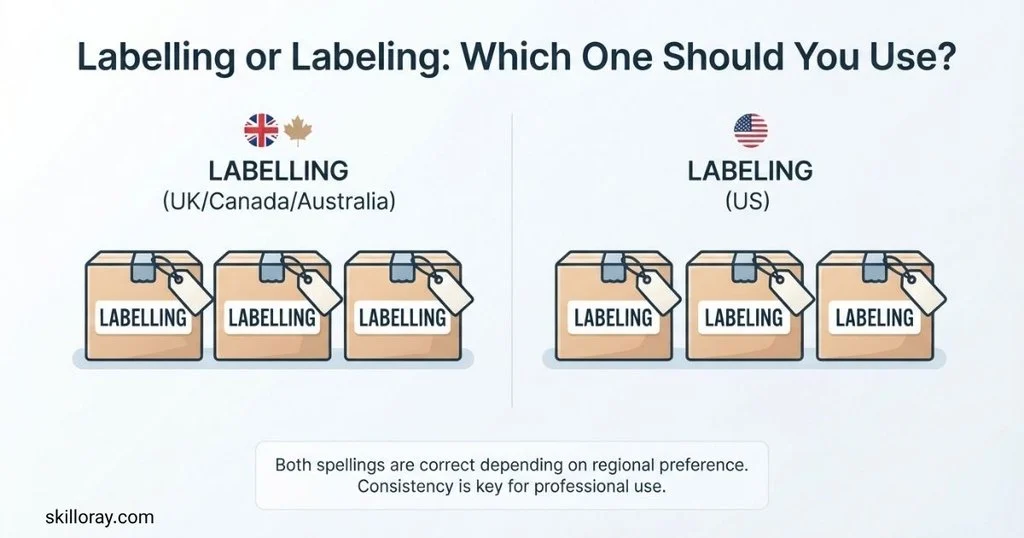
The easiest rule is to consider your audience.
Use labelling if:
- You’re writing in British English.
- Your audience is primarily in the UK.
- You’re generally following British spelling.
- You’re writing in Australian English.
Use labeling if:
- You’re writing in American English.
- Your audience is primarily in the United States.
- Your publication uses American spelling.
- Your style guide specifically requires the American form.
For Canada: either form may occur, so follow the established style of the publication or organization.
If you’re writing a longer article, consistency matters more than trying to combine both spellings. Pick the form that fits your audience and use it throughout.
An Easy Way to Remember the Spelling
A simple memory trick is:
British English → labelling → double L
American English → labeling → single L
The related past-tense forms follow the same pattern:
British: labelled
American: labeled
So you can remember the two word families like this:
| British English | American English |
| label | label |
| labelling | labeling |
| labelled | labeled |
This is a useful shortcut for these forms, although English spelling rules have many exceptions, so it shouldn’t be treated as a rule that applies to every word ending in l.
Frequently Asked Questions
Is labelling or labeling correct?
Both are correct. Labelling is the standard British English spelling, while labeling is the standard American English spelling. Australian English generally uses labelling, while Canadian usage can vary.
Is labelling British or American English?
Labelling is the British English spelling. American English normally uses labeling.
Is labeling a real word?
Yes. Labeling is a standard English word and is the usual American English spelling of the present participle or gerund of label.
How do you pronounce labeling?
Labeling is commonly pronounced approximately LAY-buh-ling, with the main stress on the first syllable. The British spelling labelling has essentially the same pronunciation.
Is labelling used in Australia?
Yes. Labelling is generally the preferred Australian English spelling and follows the double-l convention used in British-style spelling.
Which is correct in Canada: labelling or labeling?
Both forms can occur in Canadian English. Labelling is well established, particularly in formal contexts, but Canadian English has influences from both British and American spelling. Follow the relevant house or style guide when one is available.
Is it labelled or labeled?
Both are correct regional forms. Labelled is standard British English, while labeled is standard American English.
Are labelling or labeling pronounced differently?
No significant pronunciation difference is normally intended. The main distinction is written spelling, not pronunciation.
Is labeling a noun or a verb?
It can be either a present participle/verb form or a gerund/noun, depending on how it functions in the sentence.
For example:
She is labeling the boxes.
Here, it is part of the verb phrase.
Product labeling is regulated.
Here, it functions as a noun.
What is the difference between labelling or labeling?
The difference is primarily regional spelling. Labelling is standard British English, while labeling is standard American English. They have the same basic meaning and grammatical role.
Conclusion
Labelling or labeling are both correct. The choice depends mainly on the variety of English you’re using.
Use labelling for British English and generally for Australian English. Use labeling for American English. In Canadian English, both forms can be found, so it’s best to follow the style guide or spelling convention of your intended publication.
The same distinction appears in labelled or labeled. Most importantly, don’t treat one form as a universal misspelling. Choose the regional spelling that fits your audience, then use it consistently.

I am Daniel Carter, a grammar enthusiast and language educator with over 10 years of experience helping students and professionals improve their English writing and communication skills. I enjoy simplifying complex grammar rules into easy-to-understand lessons that anyone can follow. My goal is to help learners write with confidence, avoid common mistakes, and develop strong communication skills for academic and professional success. I regularly create practical grammar guides, writing tips, and language resources that make learning both enjoyable and effective.
Books: Mastering English Grammar and The Complete Guide to Better Writing
 James Walker
 Olivia Brown