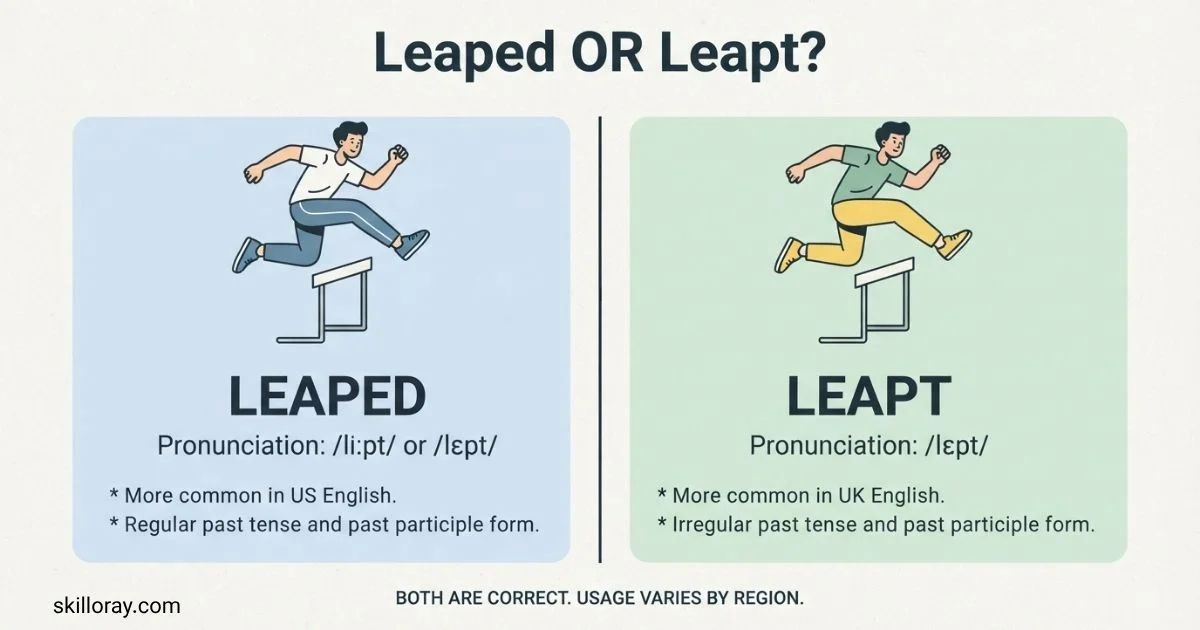
Have you ever stopped while writing because you weren’t sure whether leaped or leapt was the right word? I know how confusing two perfectly familiar forms can feel, especially when both appear in books, articles, and everyday English.
The good news is that you don’t have to guess which form is correct. Once you understand how “leaped” or “leapt” are used, you can choose the right form with confidence.
In this guide, I’ll break down the difference in a simple, practical way so you can see when each form works best. Whether you’re a student, writer, or simply improving your English, you’ll leave with a clear understanding of leaped or leapt.
Leaped or Leapt: Quick Answer
Both “leaped” or “leapt” are correct past-tense and past-participle forms of the verb “leap.” They do not have different meanings or grammatical roles.
| Form | Status | Typical use |
| leaped | Correct | Common in American English and widely understood elsewhere |
| leapt | Correct | Common in British English and also used in American English |
| lept | Usually incorrect as the written form | A common misspelling or confusion based on pronunciation |
For example:
- The dog leaped over the fence.
- The dog leapt over the fence.
Both sentences are grammatically correct.
The difference is mainly a matter of preference and variety of English, not correctness. Cambridge lists both leaped or leapt as forms of leap, while Canada’s Language Portal explicitly gives both as past-tense forms.
What Does “Leap” Mean?
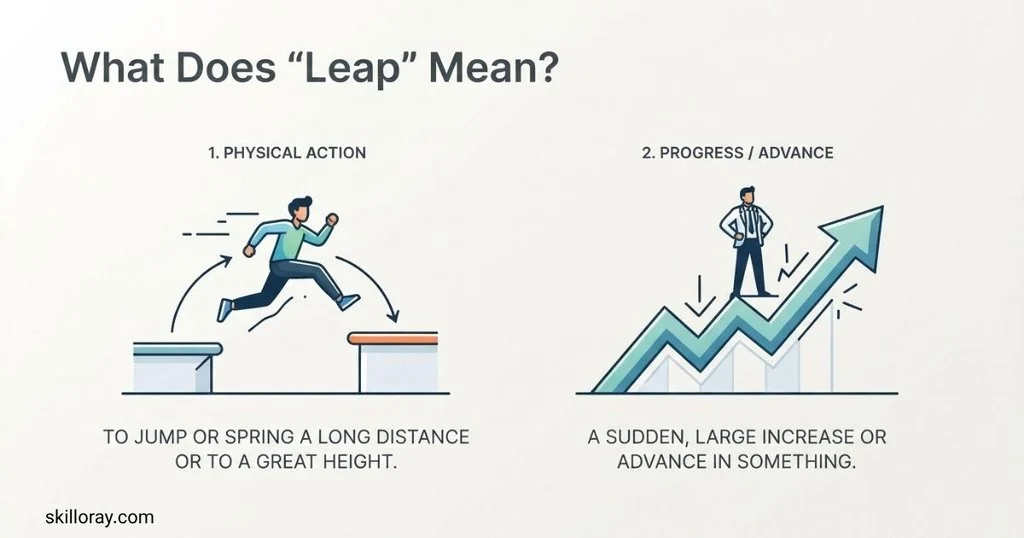
Leap is a verb meaning to jump or move suddenly, usually with considerable force or distance. It can also describe something that increases or changes suddenly.
For example:
- The cat leaped onto the table.
- The athlete leapt over the barrier.
- Prices leaped higher during the shortage.
- Her heart leapt with excitement.
The word can also be a noun:
- He made a huge leap across the stream.
- The company made a major leap in productivity.
So, depending on the sentence, leap can describe physical movement, sudden action, or a significant increase or change.
Leaped: Meaning and Usage
Leaped is the regular-looking past-tense and past-participle form of leap. It is formed by adding -ed.
Examples of “Leaped”
- The horse leaped over the fence.
- She leaped out of her chair.
- The boy leaped into the pool.
- The rabbit leaped across the path.
- He leaped at the opportunity.
- The flames leaped into the air.
- Sales leaped by 20 percent.
- She leaped to her feet when she heard the news.
In American English, leaped is a particularly natural choice. Cambridge’s American English entry lists leaped or leapt as the past tense and past participle of leap.
Leapt: Meaning and Usage
Leapt is the other standard past-tense and past-participle form of leap. It is an irregular form and does not use the normal -ed ending.
Examples of “Leapt”
- The deer leapt over the stream.
- She leapt from her seat.
- The child leapt into his father’s arms.
- The dog leapt onto the sofa.
- He leapt at the chance to compete.
- The frog leapt out of the water.
- Prices leapt unexpectedly.
- Her heart leapt when she saw the result.
Leapt is especially familiar in British English, although it is not limited to Britain. It is also perfectly acceptable in American English. Cambridge identifies leapt as a past-simple and past-participle form of leap.
Leaped or Leapt: What’s the Difference?
There is no major difference in meaning or grammar between the two forms.
The main distinction is usage preference:
| Feature | Leaped | Leapt |
| Meaning | Same | Same |
| Past tense | Yes | Yes |
| Past participle | Yes | Yes |
| American English | Common | Also correct |
| British English | Correct | Very common |
| Canadian English | Correct | Correct |
| Formal writing | Correct | Correct |
| Literary tone | Possible | Often feels more traditional |
You can therefore write:
The bird leaped into the air.
or:
The bird leapt into the air.
Neither sentence is grammatically wrong.
Leaped or Leapt in American English
In American English, both forms are accepted. Leaped is often a straightforward choice, especially in everyday writing.
Examples:
- The dog leaped over the gate.
- She leaped from the platform.
- The child leaped with excitement.
However, leapt is not incorrect in American English. It can appear in books, journalism, formal writing, and expressions where the shorter traditional form feels natural.
For example:
- The stock price leapt unexpectedly.
- He leapt to his feet.
So, if you’re writing for an American audience, leaped is a safe everyday choice, but you do not need to avoid leapt.
Leapt or Leaped in British English
In British English, leapt is very common and often feels natural in ordinary writing.
Examples:
- The dog leapt over the wall.
- She leapt out of the car.
- He leapt to his feet.
That does not make leaped incorrect. British English speakers also use leaped, and dictionaries recognize it as a standard form.
The safest conclusion is that British English often favors leapt, while American English often favors leaped, but the boundary is not absolute.
Leaped or Leapt in Canadian English
Canadian English accepts both leaped or leapt.
Canada’s Language Portal specifically states that the past tense of leap can be leaped or leapt. It gives examples using both forms, such as the lion leaped and the cat leapt.
So if you’re writing in Canadian English, you don’t need to treat either form as an error.
For consistency, however, it can be helpful to choose one form and use it consistently throughout a piece of writing.
Leaped or Leapt Pronunciation
The pronunciation can cause some confusion because the spelling changes while the two forms are pronounced very similarly.
Leaped
Leaped is pronounced approximately:
LEEPT
IPA: /lept/
Cambridge gives the UK pronunciation as /lept/.
Leapt
Leapt is also pronounced:
LEPT
IPA: /lept/
So:
- leaped → /lept/
- leapt → /lept/
The spelling is different, but the pronunciation is essentially the same.
How to Remember the Pronunciation
Think of both forms as ending with a quick “ept” sound:
leaped → lept
leapt → lept
Don’t pronounce leaped as though it has two syllables. It is normally one syllable.
Is “Leapt” the Past Tense of “Leap”?
Yes.
Leapt is a correct past-tense form of leap.
- Present: I leap over the puddle.
- Past: I leapt over the puddle.
- Past participle: I have leapt over the puddle.
You can also use leaped in both past-tense and past-participle positions:
- Present: I leap over the puddle.
- Past: I leaped over the puddle.
- Past participle: I have leaped over the puddle.
Canada’s language guidance lists leap → leaped (or leapt) → leaped (or leapt) as the verb forms.
Leaped or Leapt as a Past Participle
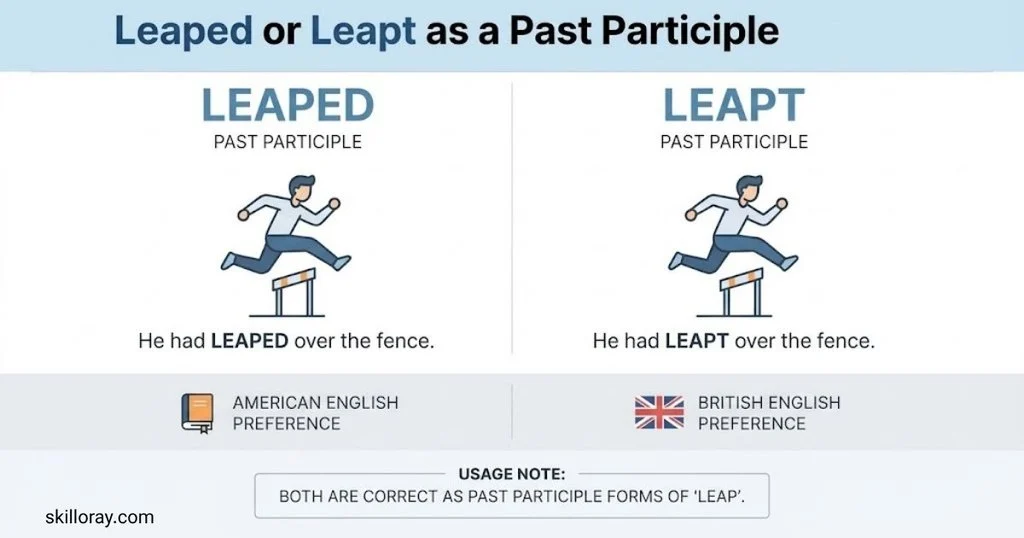
Both forms can also function as the past participle.
After have, has, or had, you can use either form:
- She has leaped over the obstacle.
- She has leapt over the obstacle.
- They had leaped into action.
- They had leapt into action.
The grammar is the same. Your choice is mainly stylistic or regional.
Leaped or Leapt Examples
Here are natural examples showing how both forms work in sentences.
Examples With “Leaped”
- The rabbit leaped across the narrow stream.
- The athlete leaped over the final hurdle.
- She leaped from her chair.
- The dog leaped into the lake.
- The children leaped with excitement.
- The cat leaped onto the windowsill.
- He leaped at the opportunity.
- The flames leaped higher as the wind increased.
- Sales leaped after the new product launched.
- She leaped to her feet when the door opened.
Examples With “Leapt”
- The rabbit leapt across the narrow stream.
- The athlete leapt over the final hurdle.
- She leapt from her chair.
- The dog leapt into the lake.
- The children leapt with excitement.
- The cat leapt onto the windowsill.
- He leapt at the opportunity.
- The flames leapt higher as the wind increased.
- Sales leapt after the new product launched.
- She leapt to her feet when the door opened.
Notice that the meaning stays the same when you replace one form with the other.
Common Mistakes With Leaped or Leapt
The biggest mistake is assuming that one of these forms must be wrong.
Mistake 1: Calling “Leapt” Incorrect
Incorrect assumption:
“Leapt” is an old-fashioned or incorrect spelling of “leaped.”
Correct:
Both “leapt” or “leaped” are standard forms.
The form leapt is listed as the past tense and past participle of leap in major dictionaries.
Mistake 2: Calling “Leaped” Incorrect
Incorrect assumption:
“Leaped” is an American-only mistake.
Correct:
Leaped is a standard English form.
It is recognized in British and American English and is explicitly listed alongside leapt in dictionary and Canadian language guidance.
Mistake 3: Writing “Lept” as the Past Form
Incorrect:
The horse lept over the fence.
Correct:
The horse leapt over the fence.
The horse leaped over the fence.
Lept can reflect the pronunciation of leapt or leaped, but it is not the standard spelling of the past tense.
Mistake 4: Mixing Forms Without Reason
There’s nothing grammatically wrong with either form, but switching randomly between them can make your writing look inconsistent.
For example, if an article repeatedly uses leapt, suddenly changing to leaped may be unnecessary.
Choose the form that fits your audience and style, then use it consistently.
Leaped or Leapt in Formal Writing
Both forms are appropriate in formal writing.
For example:
- The researchers leaped to an unsupported conclusion.
- The researchers leapt to an unsupported conclusion.
Both are grammatically sound.
However, the surrounding style can influence your choice. If you’re following a specific publication or editorial style, use its preferred spelling. Otherwise, regional preference and consistency are good guides.
Leaped or Leapt in the Phrase “Leaped to Conclusions”
Both forms can be used in the expression leap to conclusions.
Examples:
- Don’t leap to conclusions before checking the evidence.
- They leaped to conclusions without enough information.
- They leapt to conclusions without enough information.
The expression means to reach a judgment too quickly without having enough evidence.
Leaped or Leapt With “Have”
After have, has, or had, both forms work as past participles.
Examples:
- The dog has leaped over the fence.
- The dog has leapt over the fence.
- The players had leaped into action.
- The players had leapt into action.
The auxiliary verb does not determine whether you must use leaped or leapt.
Is “Leaped or Leapt” a Grammar Difference?
No. This is not like a pair such as workout/work out, where the forms can belong to different grammatical categories.
Leaped or leapt are two forms of the same verb.
Both can function as:
- Simple past
- Past participle
The main difference is form and usage preference rather than grammar.
What About “Leap” as a Noun?
It’s also useful to remember that leap can be a noun.
Examples:
- The athlete made a huge leap.
- The company experienced a leap in sales.
- The invention represents a major leap forward.
- It was a leap of faith.
Here, leap is not being used as a past-tense verb. The words leaped or leapt cannot replace the noun in these sentences.
For example:
Correct: The company made a huge leap in profits.
Incorrect: The company made a huge leapt in profits.
Leaped or Leapt: Which One Should You Use?
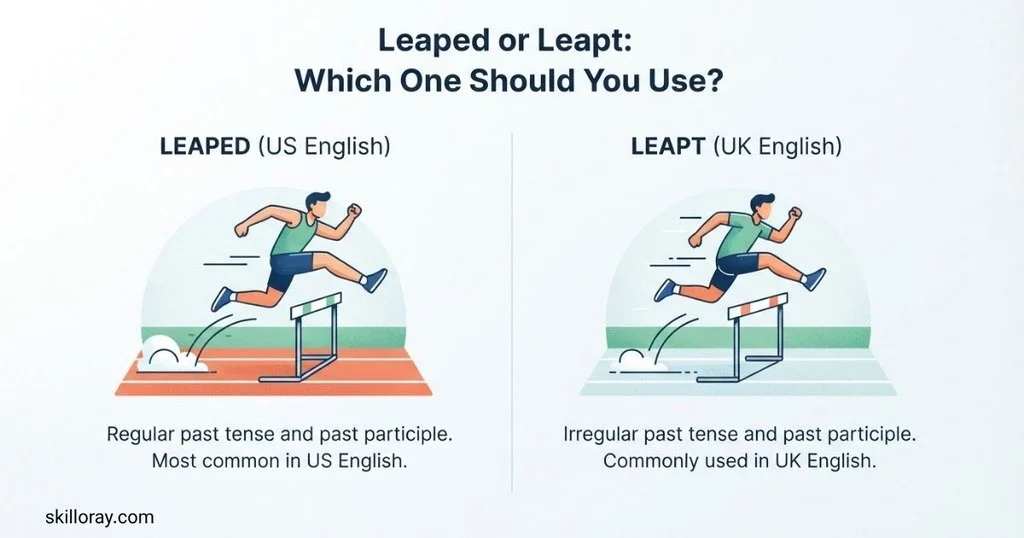
If you’re still unsure, use this simple rule:
Both “leaped” or “leapt” are correct. Choose “leaped” for a straightforward choice that is especially common in American English, or choose “leapt” if it better fits British English or a more traditional style.
There is no grammatical rule requiring every writer to choose one form.
If your audience is international, either is understandable and standard.
Frequently Asked Questions
Is it leaped or leapt?
Both are correct. Leaped or leapt are standard past-tense and past-participle forms of leap.
Which is more common: leaped or leapt?
Usage varies by region and writing style. Leaped is particularly common in American English, while leapt is especially common in British English. Both occur in both varieties.
Is “leapt” British or American?
Leapt is used in both British and American English. It is especially common in British English, but American English also accepts and uses it.
Is “leaped” American English?
Leaped is common in American English, but it is not restricted to the United States. It is also a standard form in British and Canadian English.
What is the past tense of leap?
The past tense can be leaped or leapt.
Examples:
- She leaped over the wall.
- She leapt over the wall.
What is the past participle of leap?
The past participle can also be leaped or leapt.
Examples:
- He has leaped over the barrier.
- He has leapt over the barrier.
How do you pronounce leaped or leapt?
Both are normally pronounced /lept/, roughly like “lept.” Cambridge lists leaped as /lept/ or leapt as /lept/.
Is “lept” the correct spelling?
No. Lept is not the standard written past tense of leap. Use leaped or leapt.
Does “leaped” mean something different from “leapt”?
No. They have the same basic meaning and grammatical function. The difference is primarily regional and stylistic.
Should I use leaped or leapt in American English?
Either is grammatically correct. Leaped is a natural everyday choice in American English, while leapt is also acceptable.
Conclusion
Leaped or leapt are both correct forms of the verb “leap.” They can both be used as the simple past and past participle, and they have the same basic meaning.
The main difference is preference. Leaped is especially common in American English, while leapt is especially common in British English. Canadian English accepts both as well.
So you don’t need to worry that choosing one automatically makes your sentence incorrect. Pick the form that suits your audience or preferred style, and use it consistently. And remember: “lept” may be how both forms sound, but “leaped” or “leapt” are the standard spellings.

I am James Walker, an English language specialist with extensive experience in grammar, editing, and academic writing. I enjoy helping students, bloggers, and professionals strengthen their writing by explaining grammar concepts in a clear and engaging way. My focus is on providing accurate, practical, and easy-to-follow guidance that helps learners communicate more effectively in everyday and professional situations.
Books: Perfect English Grammar Handbook and Advanced Writing Techniques
 Daniel Carter
 Olivia Brown