
I know some English expressions look simple but can still leave you wondering what they really mean. “Yay or nay” is one of those phrases that sounds casual, yet its meaning and usage can be confusing at first.
If you’ve ever wondered whether “yay or nay” is correct, what it means, or when you should use it, you’re in the right place. I’ll break it down in simple language so you can understand the expression without overthinking it.
You’ll learn its meaning, pronunciation, common uses, examples, and mistakes to avoid. By the end, you’ll know exactly how to recognize and use “yay or nay” naturally in everyday English.
What Does “Yay or Nay” Mean?
“Yay or nay” is an informal way to ask whether someone approves of something, likes it, supports it, or rejects it.
In simple terms:
- Yay = yes, approval, excitement, or support
- Nay = no, rejection, disagreement, or opposition
For example:
- “New logo design—yay or nay?”
- “Should we order pizza tonight? Yay or nay?”
- “Yay or nay on this outfit?”
- “Is this new idea a yay or nay?”
The phrase is especially natural in casual conversation, online polls, messages, social media posts, and informal discussions.
Cambridge Dictionary defines yay as an informal exclamation used to show that you are pleased about something.
Is “Yay or Nay” Correct?
Yes, “yay or nay” is a legitimate modern informal expression. However, the spelling you should choose depends on what you mean.
If you are casually asking for an opinion, “yay or nay” is natural:
“Yay or nay on the new design?”
If you are talking specifically about a formal vote, “yea or nay” is the traditional spelling:
“The members voted yea or nay on the proposal.”
This distinction matters because yay or yea are pronounced alike but serve different purposes. LanguageTool notes that yea means an affirmative vote, while yay is an exclamation expressing excitement or joy.
Quick Comparison
| Form | Meaning | Typical Use |
| Yay | Excitement, approval, enthusiasm | Casual conversation |
| Yea | Yes or an affirmative vote | Formal voting |
| Nay | No or a negative vote | Voting, formal or traditional contexts |
So, if someone asks, “How do you spell yay or nay?”, the answer depends on the intended meaning. For a casual opinion question, yay or nay is appropriate. For formal voting terminology, yea or nay is the traditional form.
Yay Meaning
Yay is an informal interjection that expresses happiness, excitement, approval, or enthusiasm.
For example:
- “Yay! We finished the project.”
- “Yay! It’s finally Friday.”
- “Yay, you made it!”
- “That sounds like a yay to me.”
It can also be used informally to indicate a positive choice or approval:
“Is the new design a yay?”
Cambridge Dictionary gives the pronunciation of yay as /jeɪ/ and identifies its celebratory use as informal.
Yay as an Informal Approval
In modern online communication, yay can function almost like “yes” when someone is expressing enthusiasm.
For example:
“Should we go to the beach tomorrow?”
“Yay!”
Here, yay expresses enthusiastic agreement rather than functioning as the formal voting term yea.
Nay Meaning
Nay is an older English word meaning no, refusal, disagreement, or a negative vote.
It is less common in ordinary everyday conversation than no, but it remains recognizable in formal voting language, historical writing, literature, and playful expressions.
Examples:
- “The proposal received one nay.”
- “The committee recorded several nays.”
- “I vote nay.”
- “The answer is nay.”
In voting terminology, nay represents a negative vote.
Yea or Nay: The Formal Voting Expression
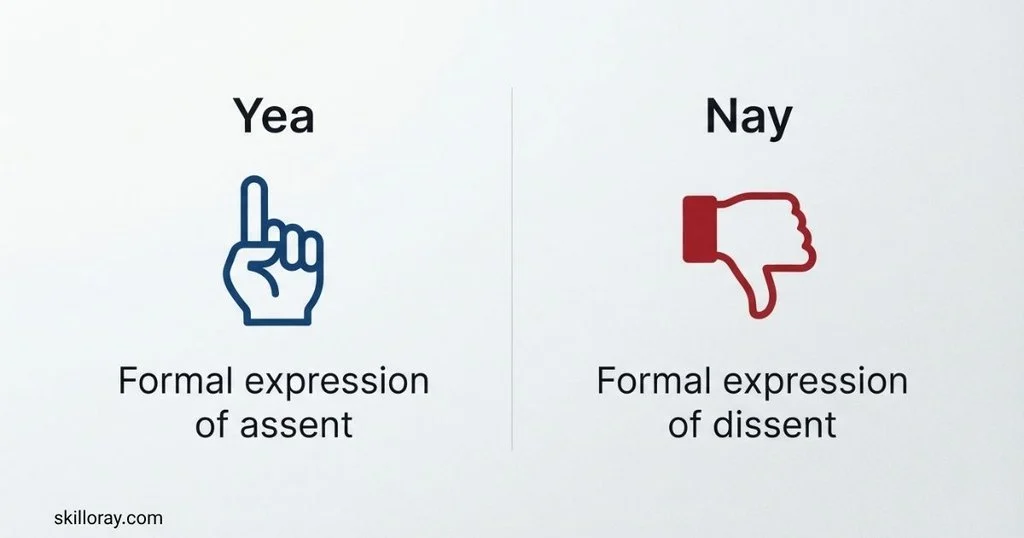
If the question concerns an official vote, “yea or nay” is the traditional expression.
Yea means an affirmative answer or vote.
Nay means a negative answer or vote.
For example:
“Members were asked to vote yea or nay on the proposal.”
This distinction is particularly relevant when reading government or legislative records. The U.S. House of Representatives currently labels recorded votes as “Yea-OR-Nay” and lists individual members as voting “Yea” or “Nay.”
The U.S. Senate also describes its roll-call results using yea or nay tallies.
So, when you see yea or nay in an official voting context, yea is not simply another spelling of the celebratory yay.
Yay or Yea: Why Are They Confusing?
The main reason for the confusion is pronunciation.
Yay or yea are both pronounced /jeɪ/.
That means they sound the same when spoken aloud, even though their written forms have different meanings.
| Word | Pronunciation | Meaning |
| Yay | /jeɪ/ | Excitement or approval |
| Yea | /jeɪ/ | Yes or an affirmative vote |
| Nay | /neɪ/ | No or a negative vote |
LanguageTool specifically identifies yea or yay as words with the same pronunciation but different uses.
An Easy Way to Remember
Think of:
Yay! → excitement
Yea → affirmative vote
Nay → negative vote
So:
“Yay! We won.”
but:
“The motion passed with 20 yeas and 5 nays.”
How Do You Spell “Yay or Nay”?
If you mean the casual expression used to ask for an opinion, spell it:
Yay or nay
For example:
“New website design: yay or nay?”
If you mean the traditional voting expression, spell it:
Yea or nay
For example:
“The members must vote yea or nay.”
The spelling yea is especially important in formal voting terminology.
Yay or Nay Pronunciation
The pronunciation is straightforward.
Yay
IPA: /jeɪ/
It rhymes with words such as:
- day
- say
- play
- way
Nay
IPA: /neɪ/
It rhymes with:
- day
- say
- way
- play
Yea
IPA: /jeɪ/
Yea is pronounced exactly like yay.
That is why the difference is mainly visible in writing rather than speech. Cambridge Dictionary lists yay as /jeɪ/, while language references likewise give yea the same pronunciation.
Yay or Nay Examples
Here are natural examples showing how the phrase works in everyday English:
- “New haircut—yay or nay?”
- “Should we watch this movie? Yay or nay?”
- “Yay or nay on the blue background?”
- “Is pineapple on pizza a yay or nay for you?”
- “Yay or nay: should we leave early?”
- “I need your opinion. Yay or nay?”
- “New logo concept—yay or nay?”
- “Yay or nay on this idea?”
- “Would you call this a yay or a nay?”
- “Quick question: yay or nay?”
These examples use yay or nay as a casual way to request a simple opinion.
Examples of “Yay”
- “Yay! We’re going on vacation.”
- “Yay, my package arrived.”
- “Yay! You finished your exam.”
- “That sounds like a yay to me.”
- “It’s definitely a yay from me.”
Examples of “Nay”
- “I vote nay.”
- “The proposal received two nays.”
- “My answer is nay.”
- “She gave the suggestion a firm nay.”
- “The committee recorded several nays.”
Examples of “Yea”
- “The member voted yea.”
- “The proposal received 30 yeas.”
- “The motion passed after the yea votes were counted.”
- “Each member could vote yea or nay.”
- “The roll call recorded 40 yeas and 10 nays.”
Official U.S. legislative records continue to use yea or nay in recorded vote results.
Yay or Nay in Congress
The phrase can become especially confusing when you encounter yay, yea, or nay in discussions about Congress.
In current U.S. House records, official roll-call pages use Yea or Nay to identify how members voted. For example, a September 2026 House roll call is labeled “Yea-OR-Nay” and reports separate yea and nay totals.
The House’s historical materials also explain that its electronic voting system has indicators labeled yay, nay, present, and open.
So you may encounter yay in descriptions of the voting equipment while yea remains the standard term in official roll-call results.
The Practical Rule
When writing about a formal congressional vote, yea or nay is the safer standard wording.
For example:
“The bill received 214 yea votes and 208 nay votes.”
rather than using yay as the formal spelling of the affirmative vote.
Is “Yay or Nay” a Vote?
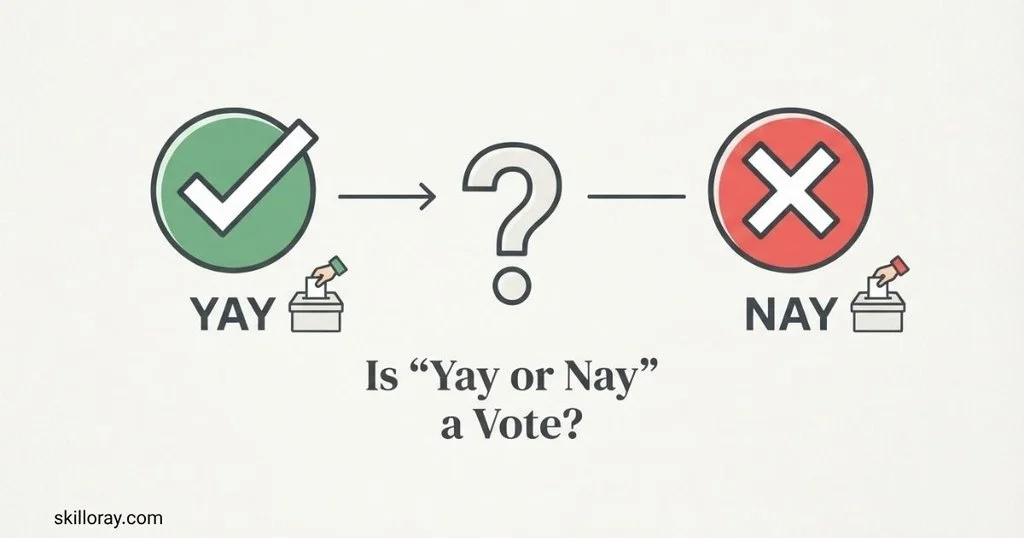
It can be used informally as a vote or quick choice, but context matters.
If someone posts:
“New logo—yay or nay?”
they are essentially asking:
“Do you approve of it or not?”
This is an informal opinion poll.
In a legislative context, however, the traditional terminology is yea or nay. Official House and Senate records demonstrate that terminology in current U.S. voting records.
Yay or Nay Synonyms
Depending on the context, alternatives include:
- yes or no
- approve or reject
- support or oppose
- for or against
- thumbs up or thumbs down
- positive or negative response
- accept or decline
For casual conversation, yes or no is usually the clearest alternative.
For an informal opinion question:
“Yay or nay?”
For a neutral direct question:
“Yes or no?”
For a formal vote:
“Yea or nay?”
Yay or Nay or Yay or Neigh?
The correct phrase is:
Yay or nay
Neigh is a completely different word. It refers to the characteristic sound made by a horse.
For example:
“The horse gave a loud neigh.”
So neigh does not mean “no” in the expression yay or nay.
The word nay is the one that means no, refusal, or a negative vote.
Is “Yay” a Word?
Yes. Yay is an established informal English word used as an exclamation to express happiness, excitement, or pleasure. Cambridge Dictionary lists it as an informal interjection and gives its pronunciation as /jeɪ/.
It can also appear informally as an expression of approval.
However, yay should not automatically replace yea when you’re writing about a formal affirmative vote.
Is “Nay” a Word?
Yes. Nay is a standard English word meaning no or expressing refusal, denial, or opposition.
It is less frequent in everyday speech than no, but it remains familiar in voting terminology and formal or literary language.
For example:
“The vote was 12 yeas and 4 nays.”
Common Mistakes With Yay or Nay
Mistake 1: Using “yay” for a formal affirmative vote
Less appropriate for formal voting:
“The bill received 200 yays.”
Standard formal wording:
“The bill received 200 yeas.”
The distinction is especially useful when writing about legislative votes.
Mistake 2: Confusing “yea” with “yeah”
Yea in voting means an affirmative vote.
Yeah is an informal form of yes used in ordinary conversation.
For example:
“Yeah, I agree.”
But:
“She voted yea.”
Mistake 3: Writing “neigh” for “nay”
Neigh refers to a horse’s sound.
Nay means no or a negative vote.
So:
“Yay or nay?” ✅
not:
“Yay or neigh?” ❌
unless you’re deliberately making a horse-related joke.
Yay or Nay Game
A yay or nay game is an informal activity in which someone presents choices, ideas, situations, or items and another person responds with yay or nay.
For example:
- “Beach vacation: yay or nay?”
- “Early morning classes: yay or nay?”
- “Chocolate ice cream: yay or nay?”
- “New school club: yay or nay?”
The format works because the two responses create a quick approval-or-rejection choice.
Online, the phrase is also frequently used in polls, captions, discussion posts, and memes. Search results show examples of “yay or nay” being used in meme templates and casual community posts.
Yay or Nay Questions
If you want to use the phrase for a casual game or conversation, you can ask questions such as:
- “Summer or winter?”
- “Reading before bed: yay or nay?”
- “Online shopping: yay or nay?”
- “Morning workouts: yay or nay?”
- “Group projects: yay or nay?”
- “Spicy food: yay or nay?”
- “Road trips: yay or nay?”
- “Surprise parties: yay or nay?”
- “Studying with music: yay or nay?”
- “Trying a new hobby: yay or nay?”
The phrase works best when the person can give a quick opinion.
Yay or Nay Origin
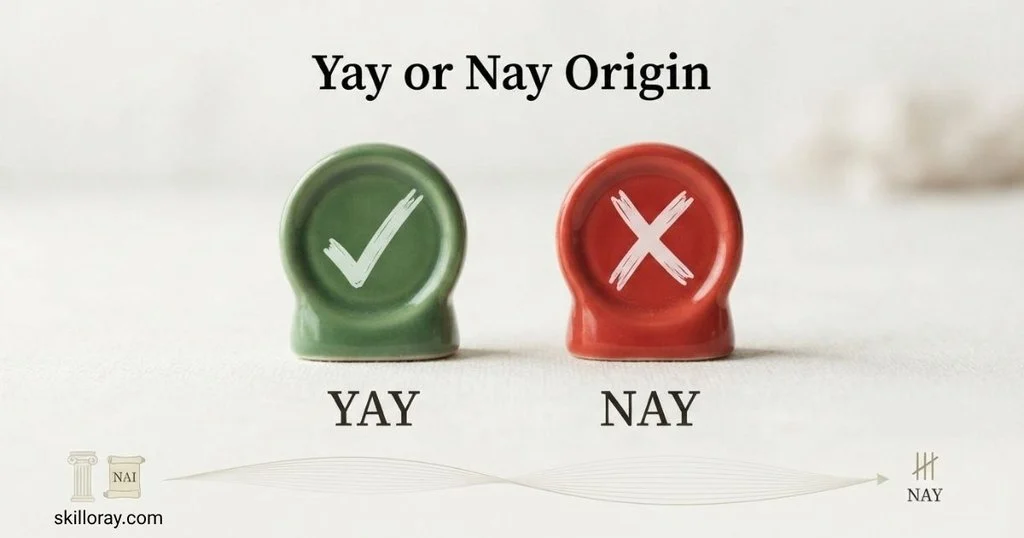
The modern casual expression yay or nay brings together two words with different histories and functions.
Yay developed as an informal expression of excitement or approval. Modern dictionaries recognize its use as an exclamation of pleasure.
Yea has a much older history. Dictionary sources trace it through Middle English forms to Old English gēa, meaning yes. Nay also has an old history in English and developed from Germanic forms associated with negation.
Over time, yes or no became the ordinary choices for everyday English, while yea or nay remained especially visible in formal voting, historical language, literature, and traditional expressions.
The modern informal yay or nay therefore sounds natural in casual contexts even though the traditional voting expression is yea or nay.
British or American English
There is not a simple British-or-American spelling difference between yay or yea.
The more important distinction is meaning and context:
- Yay = informal expression of excitement or approval
- Yea = affirmative vote or older form meaning yes
- Nay = negative vote or no
The formal voting terminology can appear in both British and American contexts, although different legislative institutions may use different voting conventions or terminology.
For example, U.S. congressional records use yea or nay in roll-call results.
Frequently Asked Questions
What does “yay or nay” mean?
Yay or nay means an informal request for a positive or negative opinion. It can be understood as asking whether someone approves of something.
Is “yay or nay” grammatically correct?
Yes. Yay or nay is a natural informal expression. It is especially common in casual speech, online posts, polls, and conversations.
Is it “yay or nay” or “yea or nay”?
Both expressions can be encountered, but they serve different purposes. Yay or nay is common as a casual approval question, while yea or nay is the traditional wording associated with affirmative or negative voting.
How do you spell yay or nay?
For a casual opinion question, write yay or nay. For formal voting terminology, use yea or nay.
How do you pronounce “yay or nay”?
Yay is pronounced /jeɪ/, while nay is pronounced /neɪ/. The phrase sounds roughly like “jay or nay,” except the first sound is the normal English y sound.
Is “yea” pronounced like “yay”?
Yes. Yea meaning an affirmative vote is pronounced /jeɪ/, the same as yay.
What does “nay” mean in voting?
Nay means a negative or opposing vote. In official U.S. congressional records, members’ votes are recorded as yea or nay.
Is “yay” a formal word for yes?
Not generally. Yay is primarily an informal expression of excitement or approval. For formal affirmative voting, yea is the traditional term.
Can I use “yay or nay” in a social media poll?
Yes. Yay or nay is well suited to informal polls, captions, comments, and quick opinion questions.
Conclusion
“Yay or nay” is correct as a casual expression asking for approval or disapproval. Use yay when you want to express excitement or enthusiastic approval, while nay means no or rejection.
The important spelling distinction appears when you are talking about formal voting: yea or nay is the traditional expression, with yea representing an affirmative vote. Current U.S. House and Senate records continue to use yea or nay for recorded voting results.
The easiest memory trick is simple: yay expresses excitement, yea represents an affirmative vote, and nay represents a negative vote.

I am Olivia Brown, a professional English editor and grammar writer who believes that great writing begins with a strong foundation in grammar. I have spent years creating educational resources that help students and professionals improve their writing, avoid common errors, and communicate more effectively. I strive to provide clear explanations and practical examples that make grammar easy to understand and apply.
Books: English Grammar Essentials and Modern Writing Success
 James Walker
 Daniel Carter