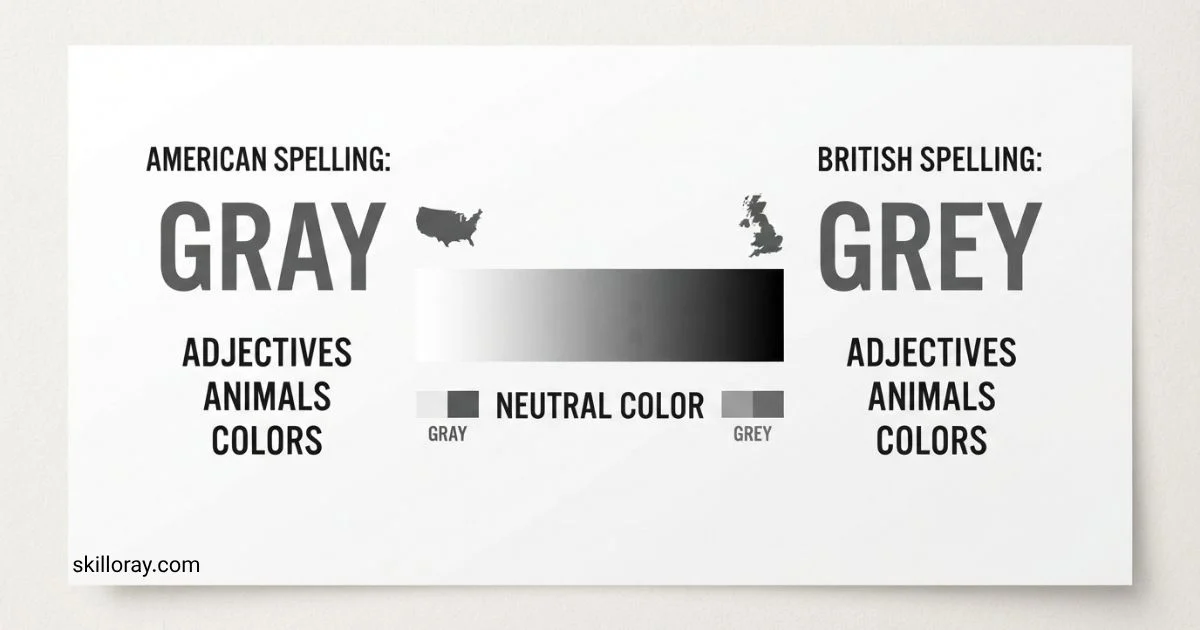
Have you ever paused while writing and wondered whether it should be Gray or Grey? I know this small spelling difference can make you hesitate, especially when both forms appear correct.
The good news is that you are not dealing with two completely different words. Gray or Grey usually has the same meaning, but the preferred spelling can depend on where you are writing.
In this guide, I’ll show you the simple difference, explain which spelling is preferred in American English, and help you confidently choose the right form whenever you write it.
Gray or Grey: Quick Answer
Both gray or grey are correct spellings of the same word.
| Form | Common usage | Pronunciation | Meaning |
| Gray | American English | /ɡreɪ/ | The color between black and white |
| Grey | British English | /ɡreɪ/ | The color between black and white |
The main difference is regional spelling, not meaning or pronunciation. Cambridge lists gray as the US spelling and grey as the mainly UK spelling.
So neither spelling is simply wrong. Your choice should depend on the English variety you are following.
What Does Gray or Grey Mean?
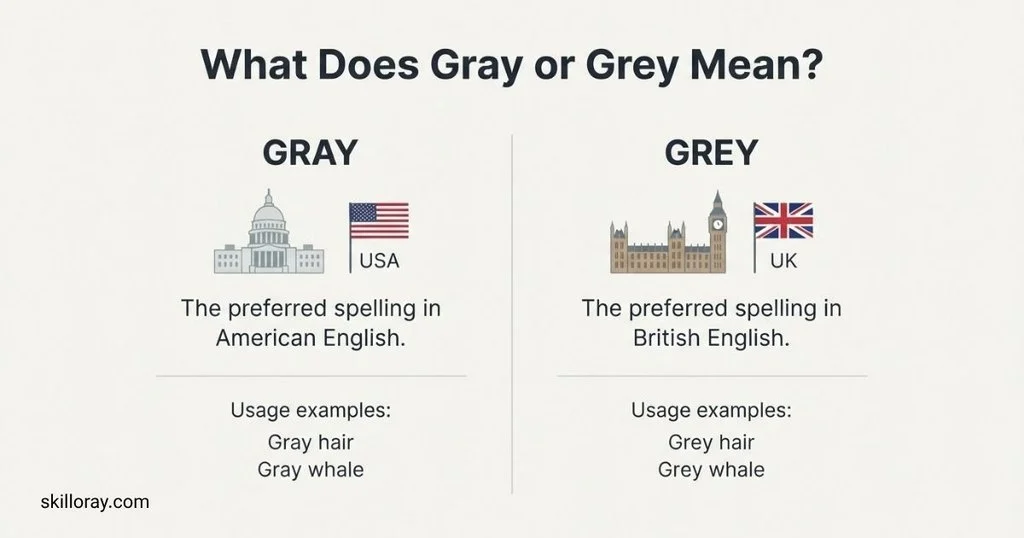
Gray or grey refers to a color that falls between black and white. It can describe objects, clothing, skies, hair, animals, paint, and many other things.
For example:
- The walls are gray.
- The sky turned grey before the storm.
- She bought a gray sweater.
- His hair is becoming grey.
The word can also have figurative meanings. For example, a gray area can describe something that is not clearly defined or does not have an obvious answer.
Both spellings carry these meanings.
Is It Gray or Grey in American English?
In American English, gray is the standard spelling.
Examples include:
- gray hair
- gray eyes
- gray matter
- gray clouds
- light gray
- dark gray
- gray area
- gray jacket
If you are writing an American English article, essay, email, or website, gray is generally the spelling to choose.
Cambridge identifies gray as the US spelling of the word.
Is It Gray or Grey in British English?
In British English, grey is the standard spelling.
Examples include:
- grey hair
- grey eyes
- grey matter
- grey clouds
- light grey
- dark grey
- grey area
- grey jacket
Cambridge identifies grey as the mainly UK spelling and gives the same pronunciation, /ɡreɪ/.
This is similar to other regional spelling differences in English. The spelling changes, but the underlying word and meaning remain the same.
Gray or Grey for Color: Which Should You Use?
For the color itself, both spellings are correct.
Choose gray when following American English:
The designer chose a soft gray for the background.
Choose grey when following British English:
The designer chose a soft grey for the background.
The important thing is consistency. If the rest of your writing follows American spelling, use gray. If it follows British spelling, use grey.
How Do You Spell Gray or Grey?
The spelling depends on the variety of English:
- Gray — standard American English spelling
- Grey — standard British English spelling
Both contain four letters and differ only in the position of the vowel letters.
A useful memory trick is:
Gray = American English
Grey = British English
There are exceptions in proper names, titles, or established names, so a particular name should normally retain its official spelling.
Gray or Grey Pronunciation
Gray or grey are pronounced exactly the same in standard English:
/ɡreɪ/
A simple pronunciation guide is:
gray/grey → “gray”
It rhymes with words such as:
- day
- say
- way
- play
- stay
The spelling does not create a pronunciation difference.
Is Gray Pronounced Differently From Grey?
No. The standard pronunciation is the same for both spellings: /ɡreɪ/. Cambridge gives the same IPA pronunciation for gray or grey.
So you do not need to change your pronunciation when changing the spelling.
Gray or Grey Hair
Both gray hair or grey hair are correct.
American English normally uses:
My grandfather has gray hair.
British English normally uses:
My grandfather has grey hair.
The same regional spelling pattern applies to related forms such as graying or greying. Cambridge identifies greying as the mainly UK spelling of graying.
You may also see the word used as a verb:
- His hair is graying.
- Her hair is greying.
The choice depends on the English variety.
Gray or Grey Matter
Gray matter is the usual American English spelling, while grey matter is the usual British English spelling.
For example:
The brain contains gray matter and white matter.
In British English:
The brain contains grey matter and white matter.
Here, gray or grey does not change the meaning. The spelling simply follows the regional convention.
Gray or Grey in a Sentence
Here are some natural examples showing how the word is used.
Sentences With “Gray”
- The sky became gray before the rain started.
- She wore a gray coat to school.
- The cat has soft gray fur.
- He painted the room light gray.
- My old sweater is dark gray.
- The building has gray walls.
- His hair is turning gray.
- The road disappeared into the gray fog.
- The designer selected a gray background.
- There is a gray area in the current policy.
Sentences With “Grey”
- The sky became grey before the rain started.
- She wore a grey coat.
- The cat has soft grey fur.
- He painted the room light grey.
- The building has grey walls.
- Her hair is beginning to turn grey.
- The clouds looked grey and heavy.
- They chose a pale grey color.
- The old house had grey stone walls.
- The situation falls into a grey area.
Notice that the meaning of the sentences does not change when the regional spelling changes.
Is Gray or Grey More Common?
The answer depends on the English variety and the source you are examining.
Gray is more typical of American English, while grey is more typical of British English. Cambridge also notes grey as especially associated with British usage and gray with US usage.
So there is no universal rule saying that one spelling is always more common everywhere.
If your audience is primarily American, gray will generally look more natural. If your audience is primarily British, grey will generally look more natural.
Gray or Grey: British or American?
The simplest rule is:
| English variety | Preferred spelling |
| American English | gray |
| British English | grey |
| Canadian English | grey is common |
| Australian English | grey is common |
Regional usage can vary, especially in names, organizations, publications, or established terms. When a specific name has an official spelling, follow that spelling rather than changing it to fit a general regional rule.
Are Gray or Grey Interchangeable?
In ordinary writing, gray or grey are interchangeable in meaning because they represent the same color word.
However, you should not randomly switch between them in the same piece of writing.
For example, if your article follows American English, write:
The gray sky matched the gray walls.
If you are following British English, write:
The grey sky matched the grey walls.
Consistency makes your writing look more polished.
Gray or Grey: Common Mistakes
The most common mistake is assuming that one spelling must be incorrect.
Mistake 1: Calling “Grey” Incorrect
Incorrect assumption: “Grey” is a misspelling.
Better understanding: Grey is a standard British spelling.
Mistake 2: Calling “Gray” Incorrect
Incorrect assumption: “Gray” is only a misspelling of grey.
Better understanding: Gray is the standard American spelling.
Mistake 3: Changing the Pronunciation
Some learners think the different spelling means the words have different pronunciations.
Correct: Both are pronounced /ɡreɪ/.
Mistake 4: Mixing Regional Styles
Using one spelling throughout an article is usually better than switching between gray or grey without a reason.
50 Shades of Gray or Grey
If you are referring to the well-known book or film title, the spelling requires special attention because Fifty Shades of Grey is the established title.
The title uses Grey, so you should preserve that spelling when referring to the work by its official title.
This is a good example of why proper names and titles should not automatically be changed according to your preferred regional spelling.
Crayola Grey or Gray
Crayola’s American materials commonly use gray in descriptions of colors. For example, Crayola’s educational material refers to gray among its colors.
However, Crayola materials can contain specific named colors or regional product terminology, so an official product or color name should always be written exactly as the company presents it.
For ordinary American English writing, gray is the expected spelling.
Gray or Grey as an Adjective
Gray or grey can function as an adjective when it describes a noun.
Examples:
- a gray shirt
- a grey shirt
- a gray sky
- a grey sky
- a gray building
- a grey building
The adjective describes the color or, in some contexts, a quality associated with the color.
Gray or Grey as a Noun
The word can also function as a noun when referring to the color itself.
Examples:
Gray is one of my favorite colors.
Grey is often associated with cloudy weather.
Again, the grammatical function stays the same. Only the regional spelling changes.
Gray or Grey as a Verb
The word can also be used as a verb when talking about hair becoming gray or grey.
American English:
His hair is beginning to gray.
British English:
His hair is beginning to grey.
The related forms also follow the regional spelling pattern:
- graying — American English
- greying — British English
Cambridge specifically identifies greying as the mainly UK spelling of graying.
Does the Meaning Change?
No. In the ordinary color sense, gray or grey have the same meaning.
Both can describe:
- a color between black and white
- gray or grey hair
- cloudy weather
- objects with that color
- figurative ideas such as a gray or grey area
The difference is primarily spelling and regional convention, not meaning.
Which Spelling Should You Use?
Use the spelling that matches your intended audience.
Choose “gray” if:
- You are writing in American English.
- Your audience is mainly in the United States.
- Your style guide uses American spelling.
- You are following an American organization’s terminology.
Choose “grey” if:
- You are writing in British English.
- Your audience is mainly in the United Kingdom.
- Your style guide uses British spelling.
- You are following a British organization’s terminology.
If you are writing for a general international audience, either form can work. The key is to choose one style and use it consistently.
FAQs
Is gray or grey correct?
Both are correct. Gray is the standard American English spelling, while grey is mainly the British English spelling.
Is gray or grey more common in the USA?
Gray is the standard spelling in American English, so it is the form you will normally see in US writing.
Is grey or gray British English?
Grey is the standard British English spelling.
Are gray or grey pronounced differently?
No. Both are normally pronounced /ɡreɪ/.
Should I write gray hair or grey hair?
Use gray hair in American English and grey hair in British English.
Is it gray matter or grey matter?
Both forms are used according to regional spelling. Gray matter is typical of American English, while grey matter is typical of British English.
Why are there two spellings of gray or grey?
English has developed different spelling conventions in different regions. In this case, American English generally uses gray, while British English generally uses grey.
Is grey a misspelling of gray?
No. Grey is a legitimate standard spelling, particularly in British English.
Is gray a misspelling of grey?
No. Gray is a legitimate standard spelling, particularly in American English.
Which spelling should English learners learn?
Learn the spelling that matches the variety of English you are studying or using. If you are learning American English, gray is the natural choice. If you are learning British English, grey is the natural choice.
Conclusion
The choice between gray or grey is straightforward once you know the regional spelling rule. Gray is standard in American English, while grey is mainly standard in British English. Both refer to the same color, have the same pronunciation, and can be used as an adjective, noun, or verb in appropriate contexts.
If you are writing for an American audience, choose gray. If you are following British English, choose grey. Most importantly, stay consistent with the English variety you have chosen.

I am Olivia Brown, a professional English editor and grammar writer who believes that great writing begins with a strong foundation in grammar. I have spent years creating educational resources that help students and professionals improve their writing, avoid common errors, and communicate more effectively. I strive to provide clear explanations and practical examples that make grammar easy to understand and apply.
Books: English Grammar Essentials and Modern Writing Success
 James Walker
 Daniel Carter