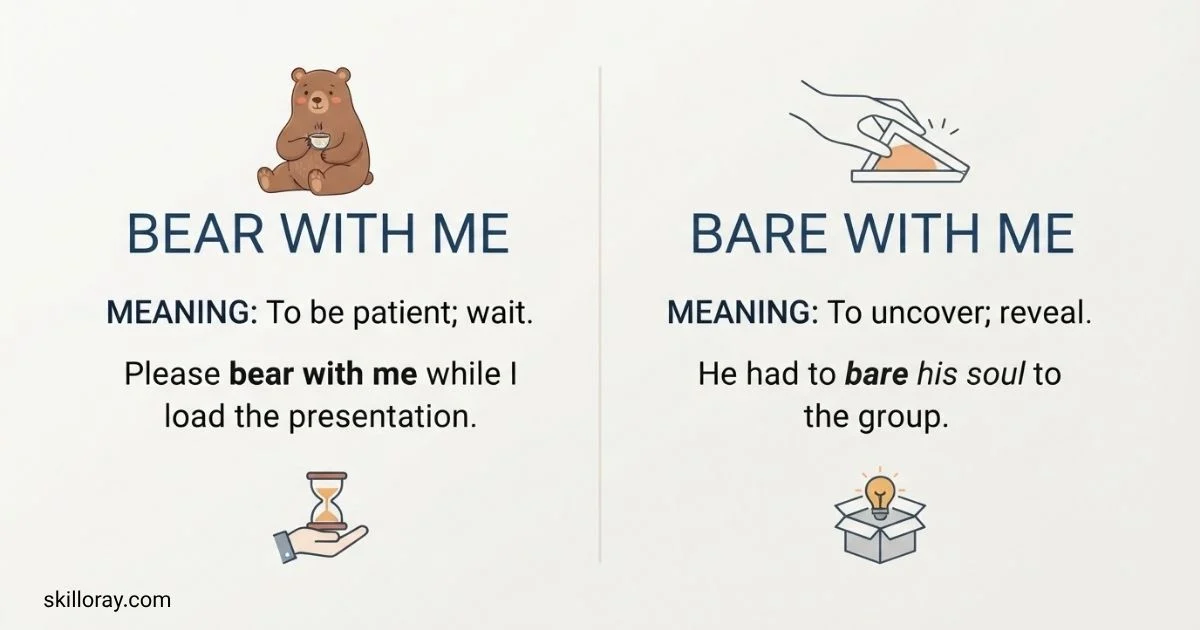
If you have ever wondered whether to write “bear with me” or “bare with me,” you are definitely not alone. I know these two phrases look almost identical, but one small spelling difference completely changes the meaning.
When you ask someone to be patient, you want your words to sound clear and natural. You may see both versions online, but I’ll help you understand which one is correct and why you should use it.
By the end, you’ll know exactly when to use “bear with me” and why “bare with me” can mean something very different. You’ll also see simple examples that make the difference easy to remember.
Quick Answer: Bear With Me or Bare With Me?
“Bear with me” is the correct phrase when you are asking someone to be patient.
Here, bear is a verb meaning to tolerate, endure, or patiently deal with something. The expression “bear with someone” means to be patient while that person does something.
“Bare with me” is not the standard spelling of this expression. The verb bare means to uncover or expose, so it does not convey the intended meaning of asking for patience.
| Form | Meaning | Correct for asking for patience? | Example |
| bear with me | Be patient with me | Yes | Please bear with me while I check. |
| bare with me | Uncover or expose with me | No, not for this expression | This is normally a spelling mistake. |
So, if you are writing “Please ___ with me while I check the information,” choose bear.
What Does “Bear With Me” Mean?
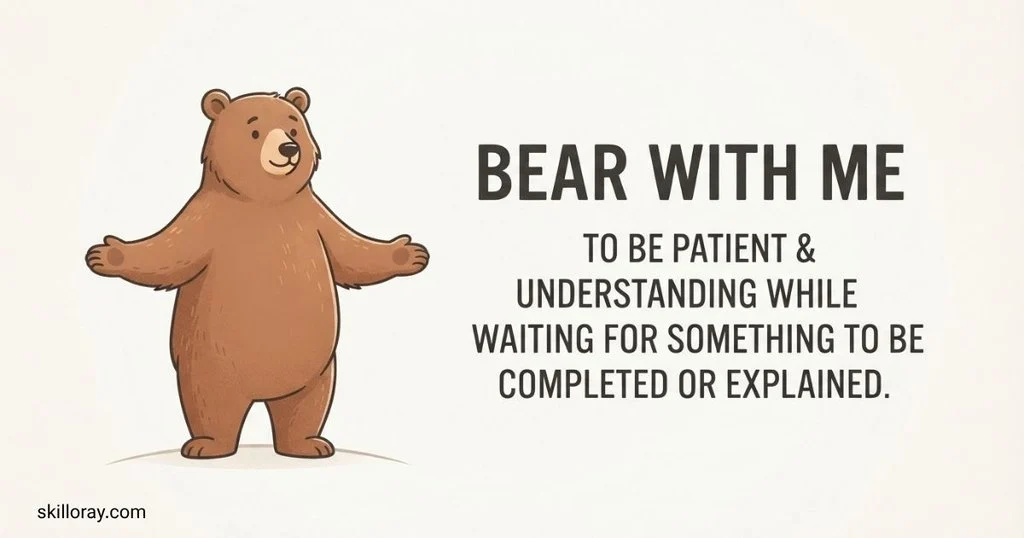
“Bear with me” means “please be patient with me.”
You normally say it when you need someone to wait, listen, tolerate a delay, or give you a little extra time.
For example:
- Please bear with me while I find the document.
- Bear with me for a moment while I check the details.
- If you can bear with me, I’ll explain what happened.
- Please bear with me while I finish this task.
The expression is especially useful when you know that someone is waiting for you or may need to tolerate a temporary delay. Oxford defines bear with somebody or something as being patient with someone or something.
Why Is “Bear With Me” Correct?
The key is the meaning of the verb bear.
One meaning of bear is to tolerate, endure, or carry something difficult. In the expression “bear with me,” the idea is that the listener should patiently tolerate the situation while you continue.
The structure is:
bear + with + person
Examples include:
- bear with me
- bear with us
- bear with him
- bear with her
- bear with them
- bear with the situation
Cambridge gives the meaning as being patient while someone does something.
What Part of Speech Is “Bear” Here?
In “bear with me,” bear is a verb.
The phrase uses the base form of the verb because it commonly follows an imperative structure:
Bear with me for a moment.
You can also use it after modal verbs:
Can you bear with me for a minute?
Or in other verb forms:
Thank you for bearing with me.
The form changes according to the grammar of the sentence, but the underlying expression remains bear with.
What Does “Bare With Me” Mean?
“Bare with me” is usually a misspelling of “bear with me” when the writer is asking for patience.
The word bare is a real English word, but it has a different meaning.
As an adjective, bare can describe something uncovered, empty, plain, or lacking its usual covering.
Examples:
- The room had bare walls.
- He walked across the floor with bare feet.
- The tree had bare branches.
As a verb, bare means to uncover or expose something.
For example:
The artist began to bare the surface beneath the old paint.
That meaning does not fit the idiom “bear with me.”
So if your intended meaning is “please be patient with me,” write bear, not bare.
Bear With Me or Bare With Me: Grammar Difference
The main issue is not simply spelling. The two words belong to different meanings.
Bear
Bear can function as a verb meaning to carry, tolerate, endure, or withstand.
In “bear with me,” it is part of a phrasal verb meaning to be patient with someone.
Examples:
- Please bear with me.
- Can you bear with me for another minute?
- Bear with us while we resolve the issue.
Bare
Bare can function as an adjective or verb.
As an adjective, it describes something uncovered or lacking something:
The shelves were bare.
As a verb, it means to uncover or expose:
The process may bare the underlying structure.
It is not the verb used in the established expression “bear with me.”
Bear With Me or Bare With Me Pronunciation
One reason this mistake is so common is pronunciation.
Bear or bare are homophones in standard English: they have the same pronunciation even though their spellings and meanings differ.
In American English, bear is commonly pronounced /ber/.
In British English, it is commonly pronounced /beə/. Cambridge lists these pronunciations for bear with someone.
The pronunciation does not tell you which spelling to choose. You have to use the meaning and context.
A useful reminder is:
If you mean patience, choose “bear.”
How to Use “Bear With Me” Correctly
You can use “bear with me” when you need someone to wait or remain patient.
1. Asking Someone to Wait
Please bear with me while I check your information.
2. Explaining a Delay
Bear with me; the computer is taking longer than expected.
3. During a Presentation
Please bear with me while I explain this final point.
4. During a Conversation
Bear with me for a moment. I’m trying to remember the name.
5. In Customer Service
Please bear with us while we work to resolve the issue.
6. During a Technical Problem
Bear with me while I restart the system.
7. When Explaining Something Complicated
Bear with me while I walk you through the process.
8. When You Need More Time
Can you bear with me for another few minutes?
9. In an Email
Please bear with me while I gather the requested information.
10. As a Short Request
Bear with me.
This last form works when the situation already makes the reason for the request clear.
“Please Bear With Me” in a Sentence
If you specifically want to use “please bear with me” in a sentence, here are several natural examples:
- Please bear with me while I review the document.
- Please bear with me while I find the information you need.
- Please bear with me for a moment while I check.
- Please bear with me as I explain the situation.
- Please bear with me while we work through this problem.
- Please bear with me while I finish the presentation.
- Please bear with me if this takes a little longer than expected.
- Please bear with me while I confirm the details.
- Please bear with me as I answer your questions.
- Please bear with me while I make a few corrections.
These examples all use bear because the intended meaning is patience.
“Bear With It” Meaning
“Bear with it” is also a correct expression, but it refers to patiently tolerating or enduring a situation, thing, or experience.
For example:
The training is difficult at first, but bear with it.
Here, it refers to the situation or activity that requires patience.
You can also say:
Bear with it for a few more minutes.
The general idea is continue to tolerate or endure it patiently.
Bear With Me or Bear With It
These expressions have closely related meanings, but the object changes.
Bear with me → asks someone to be patient with the speaker.
Bear with me while I explain.
Bear with it → asks someone to tolerate or endure a situation.
Bear with it until the problem is fixed.
Bear With Me or Bear With Us
The same expression can be used with different pronouns.
- Bear with me.
- Bear with us.
- Bear with him.
- Bear with her.
- Bear with them.
For example:
Please bear with us while we update the website.
The spelling of bear does not change according to the pronoun.
“Thank You for Bearing With Me”
There is an important grammar point when using the expression after “thank you for.”
Use the -ing form:
Thank you for bearing with me.
Not:
Thank you for bear with me.
The verb becomes bearing because the preposition for is followed here by a gerund form.
You can also write:
Thank you for bearing with us during the delay.
Or:
I appreciate you bearing with me while I worked through the problem.
Common Mistakes With “Bear With Me”
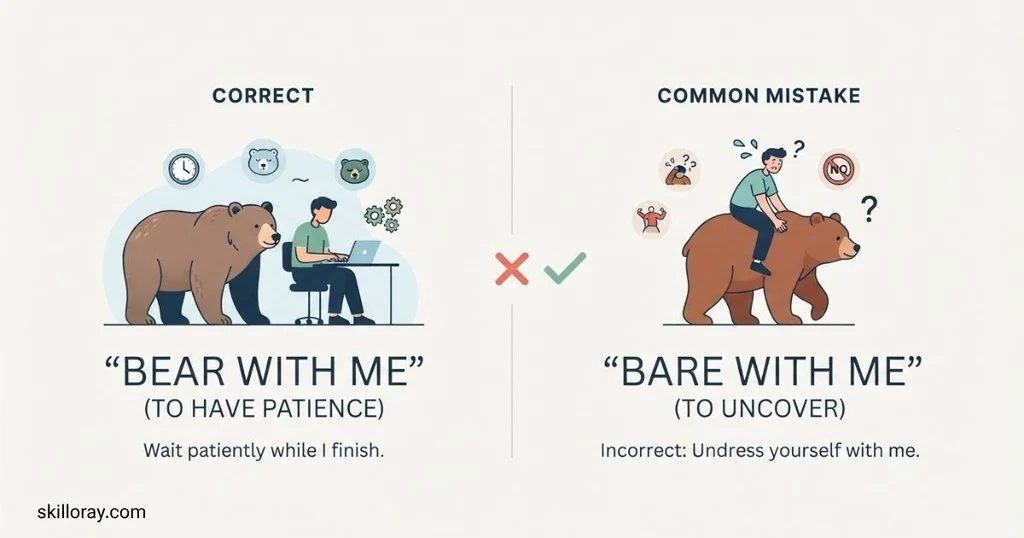
Incorrect: Please Bare With Me
Correct: Please bear with me.
The intended meaning is a request for patience, so the verb should be bear.
Incorrect: Thank You for Bear With Me
Correct: Thank you for bearing with me.
After “thank you for,” use bearing in this construction.
Incorrect: Can You Bare With Me?
Correct: Can you bear with me?
The meaning is a request for patience.
Incorrect: Please Bear Me With
Correct: Please bear with me.
The standard expression places with before the pronoun.
Incorrect: Thanks for Bare With Me
Correct: Thanks for bearing with me.
The phrase needs the participle bearing after for.
Bear With Me or Bare With Me: Common Mistake Explained
This error happens because bear or bare sound alike.
A person may know that bare is a correctly spelled English word, so a spell checker may not always flag it as a spelling error. The real problem is that the selected word does not match the intended meaning.
Think about the sentence:
Please ___ with me while I check.
You are not asking someone to uncover anything. You are asking them to be patient.
Therefore:
Please bear with me while I check.
This is the standard expression.
Is “Bear With Me” Grammatically Correct?
Yes. “Bear with me” is grammatically correct.
It is an established phrasal verb used as a request for patience. Oxford, Cambridge, and Collins all recognize bear with with this meaning.
The expression can appear in several grammatical structures:
Imperative:
Bear with me for a moment.
Modal verb:
Could you bear with me while I check?
Infinitive:
I need you to bear with me for a moment.
-ing form:
Thank you for bearing with me.
These structures are all natural when the context calls for patience.
Is “Bear With Me” Formal or Informal?
“Bear with me” works in both casual and professional English.
You might hear it during a conversation:
Bear with me. I’m almost finished.
You can also see it in a professional email:
Please bear with me while I confirm the requested information.
It is polite, but it can sometimes sound slightly formal depending on the surrounding language.
For a very simple message, you could write:
Please wait a moment.
For a professional message, you could write:
Please bear with me while I look into this.
Synonyms for “Bear With Me”
Depending on the situation, you can replace “bear with me” with several expressions:
- Please be patient with me.
- Please give me a moment.
- Please wait a moment.
- Please hold on.
- Please give me a little time.
- Please stand by.
- Just a moment, please.
- I appreciate your patience.
- Thank you for your patience.
The best choice depends on your tone and situation.
For example, “I appreciate your patience” is particularly useful in professional communication because it sounds polite without directly asking someone to tolerate a delay.
Is “Bear With Me” Used in British English?
Yes. “Bear with me” is standard in British English. It is also standard in American English. Cambridge lists the expression in both British English and American English.
The expression itself does not change to “bare with me” in British English.
So whether you are writing for readers in the United Kingdom, United States, Canada, Australia, or another English-speaking region, use:
Bear with me.
Regional spelling does not create a different standard spelling for this expression.
What Is the Origin of “Bear With Me”?
The expression is old and is connected to the older sense of bear meaning to endure, tolerate, support, or carry something difficult.
The exact history of the modern expression is not as simple as a single documented starting point. However, “bear with” has been used for centuries. Historical examples show the expression in English writing from at least the sixteenth century, including works by Shakespeare.
The underlying idea is straightforward: if someone asks you to bear with them, they are asking you to tolerate a delay, difficulty, explanation, or inconvenience patiently.
That meaning remains in modern English.
Why Do People Write “Bare With Me”?
There are several simple reasons.
First, bear or bare sound alike. That makes them easy to confuse when writing from memory.
Second, bare is a legitimate English word. A writer may know the word but choose it incorrectly because the pronunciation does not provide a spelling clue.
Third, the expression is often heard rather than read. Someone who has mostly heard “bear with me” may not immediately know which spelling represents the phrase.
The important thing to remember is that the expression has a fixed meaning:
Bear with me = please be patient with me.
A Simple Memory Trick
If you struggle to remember the spelling, connect bear with the idea of bearing a burden.
To bear something can mean to carry or endure it.
So:
Bear with me = patiently endure this situation with me.
The word bare relates to something uncovered or exposed.
That gives you a quick memory rule:
Patience → bear
Uncovered → bare
Bear With Me: 10 Natural Examples
Here are ten practical examples you can use as models:
- Please bear with me while I check the information.
- Bear with me for a moment while I find the right file.
- Could you bear with me while I explain the problem?
- Please bear with us while we fix the issue.
- Bear with me; I’m still learning how this system works.
- Thank you for bearing with me during the delay.
- Please bear with me while I finish this section.
- If you can bear with me, I’ll have an answer shortly.
- Bear with me while I make one final adjustment.
- I appreciate you bearing with me while I sort everything out.
Can “Bare With Me” Ever Be Correct?
The phrase “bare with me” is not the standard expression used to ask for patience.
However, bare itself is a legitimate English verb. In a different literal context, it can mean to uncover or expose something.
For example:
The process may bare the underlying surface.
That does not make “bare with me” the correct spelling of the patience expression.
If your intended message is “please be patient with me,” always choose bear with me.
Is “Bear With Me” the Same in Emails?
Yes. “Bear with me” is perfectly acceptable in emails when you need to ask someone for patience.
For example:
Hi James,
Please bear with me while I review the figures. I’ll send you the updated document shortly.
For a more polished professional style, you could also use:
Thank you for your patience while I review the figures.
Both communicate patience, but the second wording can sound more formal.
Bear With Me or Bare With Me: Which One Should You Use?
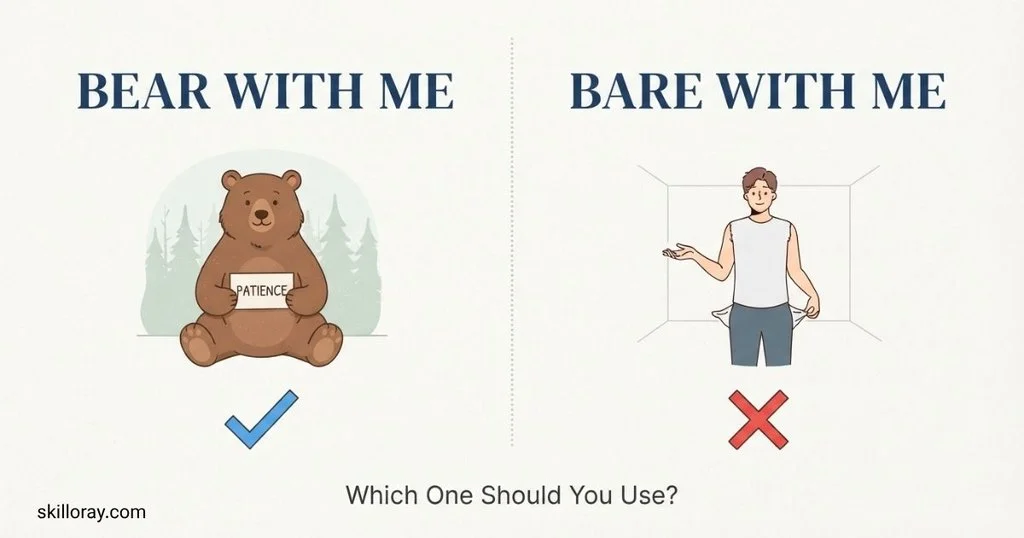
Use “bear with me” whenever you are asking someone to be patient, wait briefly, or tolerate a delay.
Do not use “bare with me” for this meaning.
The easiest rule is:
If you mean “please be patient,” use “bear.”
Remember these examples:
- Please bear with me. ✓
- Can you bear with me? ✓
- Thank you for bearing with me. ✓
- Please bare with me. ✗
- Thank you for bare with me. ✗
Once you connect bear with the idea of enduring or patiently carrying something, the correct spelling becomes much easier to remember.
FAQs
Is it “bare with me” or “bear with me”?
It is “bear with me” when you mean “please be patient with me.” Bare is a different word meaning uncovered or to uncover.
Is “please bear with me” grammatically correct?
Yes. “Please bear with me” is a standard grammatical expression used to ask someone for patience.
What does “bear with me” mean?
“Bear with me” means “please be patient with me.” It is commonly used when you need additional time to explain something, complete a task, solve a problem, or handle a delay.
What is the synonym of “bear with me”?
Useful alternatives include please be patient with me, please wait, give me a moment, please hold on, or I appreciate your patience.
How do you use “bear with me” in a sentence?
You can write:
Please bear with me while I check the details.
This asks the reader to remain patient while you complete the task.
What does “bear with it” mean?
“Bear with it” means to patiently tolerate or endure a situation or experience.
For example:
Bear with it for another few minutes.
Is “bear with me” used in British English?
Yes. “Bear with me” is standard in British English. It is also standard in American English.
How do you pronounce “bear with me”?
In American English, bear is commonly pronounced /ber/. In British English, it is commonly pronounced /beə/. Bare has the same pronunciation in standard English, which is why the spelling can be confusing.
Why do people confuse “bear” with “bare”?
They are homophones, so they sound alike while having different spellings and meanings. Context determines which word belongs in a sentence.
What should I write: “thank you for bear with me” or “thank you for bearing with me”?
Write “thank you for bearing with me.” The -ing form is required in this construction after for.
Conclusion
The correct phrase is “bear with me” when you are asking someone to be patient, wait, or tolerate a temporary delay. The word bear carries the sense of enduring or tolerating something, which is why it belongs in this expression.
“Bare with me” is a common spelling mistake in this context. Although bare is a real English word, its meaning does not fit the established expression.
If you’re ever unsure, remember this simple rule:
Asking for patience? Use “bear with me.”

I am James Walker, an English language specialist with extensive experience in grammar, editing, and academic writing. I enjoy helping students, bloggers, and professionals strengthen their writing by explaining grammar concepts in a clear and engaging way. My focus is on providing accurate, practical, and easy-to-follow guidance that helps learners communicate more effectively in everyday and professional situations.
Books: Perfect English Grammar Handbook and Advanced Writing Techniques
 Daniel Carter
 Olivia Brown