Have you ever stopped while writing because you were unsure whether to use “layed” or “laid”? I know how confusing these two forms can look, especially when you are trying to write a sentence quickly and correctly.
You may see “layed” used online, but that does not always mean it is the correct form. I’ll help you understand the difference between layed and laid in a simple way, so you can choose the right word with confidence.
By the end, you’ll know when to use “laid,” why “layed” is usually considered incorrect in standard English, and how real examples can make the rule much easier to remember.
Layed or Laid: Quick Answer
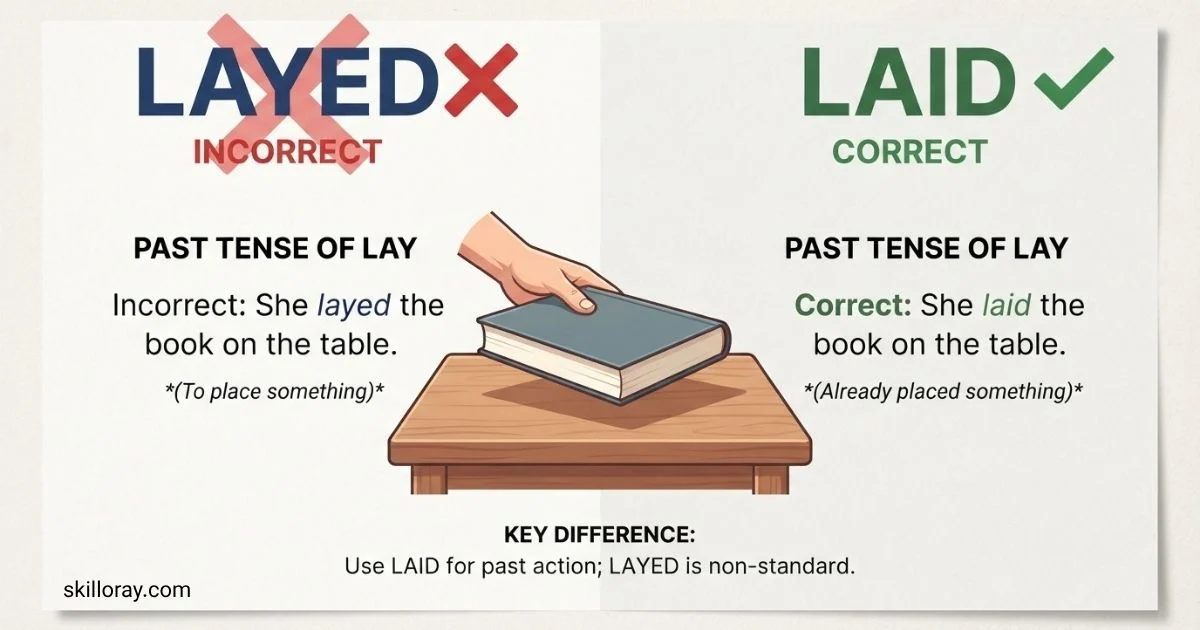
Laid is the standard English form. It is the past tense and past participle of the verb lay.
Layed is not the standard form used in ordinary modern English. Although you may encounter it in informal writing, dialectal English, historical texts, or specialized usage, it is not the spelling you should normally choose.
| Form | Standard modern English? | Main use |
| laid | Yes | Past tense or past participle of lay |
| layed | Generally no | Nonstandard or dialectal usage |
Examples:
- She laid the book on the table.
- He laid his keys beside the door.
- The hen laid three eggs.
- They laid the foundation for the building.
- The company laid off several employees.
So, if you’re writing standard English, choose laid.
What Does Laid Mean?
Laid is the past tense and past participle of lay, a transitive verb. A transitive verb normally takes an object.
The basic pattern is:
lay + object
For example:
- I lay the phone on the desk.
- Yesterday, I laid the phone on the desk.
- She has laid the papers on the table.
The object is the thing being placed somewhere.
Lay can mean to put or place something in a particular position.
Examples With Laid
- She laid the baby on the bed.
- He laid his coat on the chair.
- I laid the documents on your desk.
- They laid the bricks carefully.
- We laid the cards on the table.
What Does Layed Mean?
In standard modern English, layed is generally not the form you should use as the past tense of lay.
People sometimes create layed because many regular English verbs form their past tense by adding -ed, such as:
- play → played
- stay → stayed
- clean → cleaned
It can therefore seem logical to assume:
- lay → layed
But lay is an irregular verb, so its standard past form is laid.
Think of it this way:
lay → laid → laid
Not:
lay → layed
Why Do People Confuse Layed or Laid?
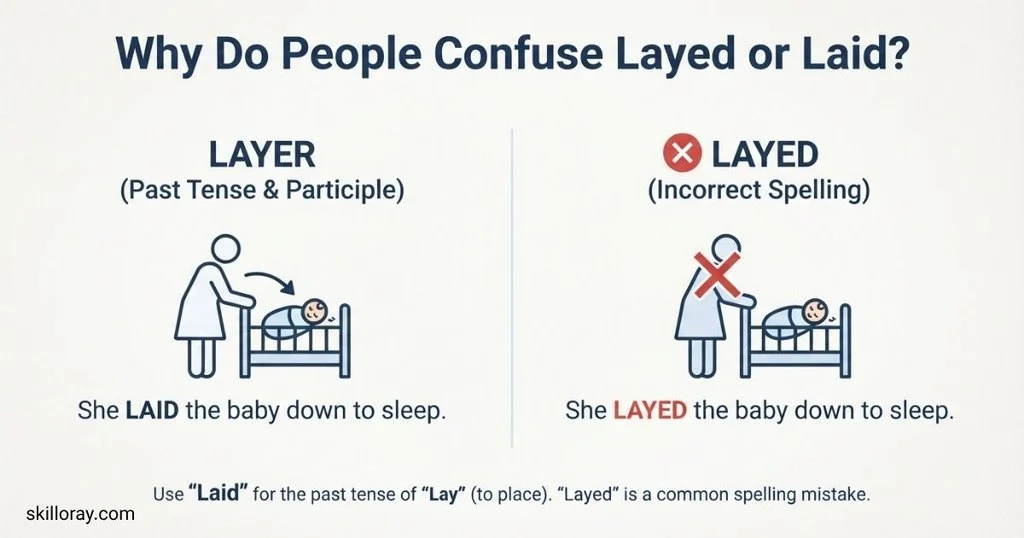
The confusion partly comes from the fact that lay and lie have overlapping meanings related to position.
The verb lay means to put something somewhere:
- I lay the book on the desk.
- Yesterday, I laid the book on the desk.
The verb lie means to be in a resting position:
- I lie on the bed when I am tired.
- Yesterday, I lay on the bed.
This creates a particularly confusing pattern:
| Verb | Present | Past | Past participle |
| lay | lay | laid | laid |
| lie | lie | lay | lain |
So lay can be the present form of one verb or the past form of lie.
That is why “I lay in bed” can be correct, while “I layed in bed” is not standard English.
Layed or Laid in Bed?
The correct choice depends on what you mean.
If you mean that you were resting in bed, the usual expression is:
I lay in bed.
Here, lay is the past tense of lie.
Examples:
- I lay in bed all morning.
- She lay in bed listening to music.
- He lay in bed for several hours.
- We lay in bed talking.
“I layed in bed” is not standard English.
However, laid can be correct when someone places something or someone in bed:
- She laid the baby in bed.
- He laid the blanket on the bed.
- The nurse laid the patient in bed.
The key question is whether someone is resting somewhere or placing something somewhere.
Layed or Laid Down?
For standard English, use laid when lay is the intended verb.
Examples:
- She laid the book down.
- He laid the phone down.
- I laid my keys down.
- They laid the tools down.
But if you mean that someone moved into a resting position, lay may be the correct past form of lie:
- I lay down for a few minutes.
- She lay down after lunch.
- He lay down on the sofa.
This is one of the most common sources of confusion.
Layed or Laid in a Sentence?
In standard English, laid is the correct choice when the past form of lay is needed.
Correct Examples
- She laid the letter on the desk.
- He laid his jacket on the chair.
- The farmer laid the tools beside the barn.
- We laid the foundation last year.
- The hen laid an egg.
- They laid the flowers near the memorial.
Incorrect Standard Usage
- She layed the letter on the desk.
- He layed his jacket on the chair.
- The hen layed an egg.
- They layed the flowers near the memorial.
Replace layed with laid in these sentences.
Layed or Laid Off?
The standard expression is laid off.
When an employer temporarily or permanently removes employees from their jobs, the usual past form is laid off.
Examples:
- The company laid off several workers.
- He was laid off last month.
- Many employees were laid off during the restructuring.
- She was worried about being laid off.
“Layed off” is not standard English.
The same spelling applies whether the phrase is active or passive:
- The company laid off 50 employees.
- Fifty employees were laid off.
Layed or Laid My Eyes on You?
The standard expression is:
laid my eyes on you
The phrase uses the past tense laid.
For example:
I knew something was different the moment I laid my eyes on you.
A related expression is “lay eyes on”, which commonly appears in constructions such as:
I haven’t laid eyes on him since Monday.
The spelling layed my eyes on you is not standard.
Layed or Laid Past Tense?
The standard past tense of lay is laid.
The verb forms are:
- Present: lay
- Past: laid
- Past participle: laid
- Present participle: laying
Examples:
- Today I lay the book on the desk.
- Yesterday I laid the book on the desk.
- I have laid the book on the desk.
- I am laying the book on the desk.
There is no standard modern form layed in this basic verb pattern.
Layed or Laid Eggs?
The correct phrase is laid eggs.
Animals such as birds and reptiles lay eggs, so the past tense is laid.
Examples:
- The hen laid three eggs.
- The turtle laid her eggs in the sand.
- The bird laid an egg in the nest.
- The duck laid several eggs this season.
Therefore:
lay eggs → laid eggs
Not:
lay eggs → layed eggs
Layed or Laid Out?
The standard expression is laid out.
Laid out can mean arranged, displayed, explained, or planned, depending on the context.
Examples:
- She laid out the clothes for tomorrow.
- He laid out the documents on the table.
- The teacher laid out the instructions clearly.
- They laid out their plans for the project.
The adjective laid-back also uses laid, not layed.
Layed or Laid Back?
The correct expression is laid-back.
Laid-back is an adjective describing someone or something relaxed, calm, or easygoing.
Examples:
- He has a very laid-back personality.
- She is friendly and laid-back.
- We stayed at a laid-back beach resort.
- His laid-back attitude makes people feel comfortable.
Layed-back is not the standard spelling.
Layed or Laid to Rest?
The standard expression is laid to rest.
It can literally refer to burial or figuratively mean putting an issue to rest.
Examples:
- The family gathered to honor him before he was laid to rest.
- The new evidence finally laid the rumor to rest.
- The investigation helped lay the controversy to rest.
The expression uses laid, not layed.
Is It Layed or Laid?
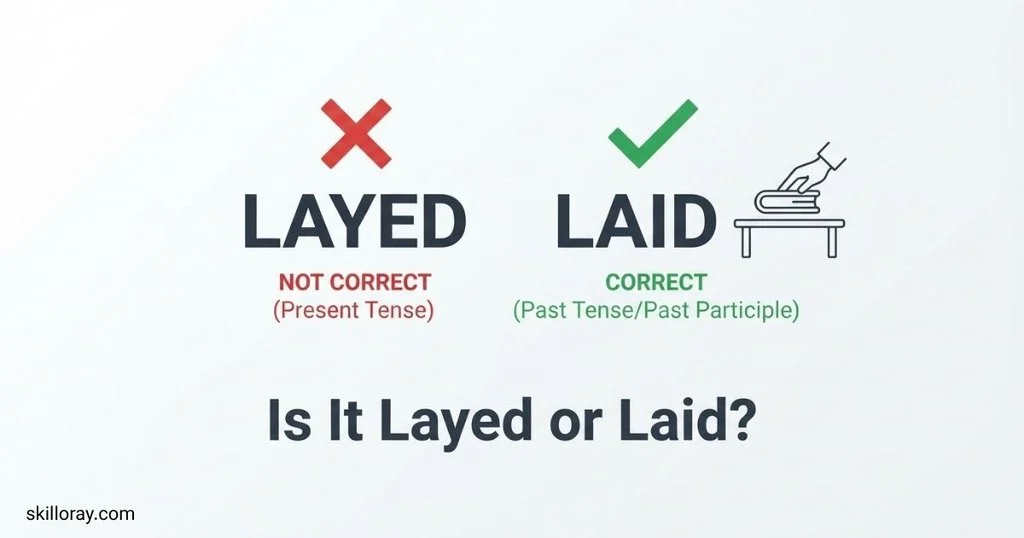
If you’re asking for the standard past tense or past participle of lay, the answer is laid.
Use:
- laid down
- laid off
- laid out
- laid eggs
- laid to rest
- laid my eyes on you
- laid the book on the table
Do not normally use layed in these expressions.
There is one important qualification: English contains dialectal, historical, and specialized uses that may contain layed. Seeing the spelling somewhere does not necessarily mean the writer made a simple typing mistake. However, for ordinary modern standard English, laid is the form you should choose.
When to Use Layed or Laid
For everyday standard English, use laid when you need the past tense or past participle of lay.
| Situation | Correct form | Example |
| Put something somewhere in the past | laid | She laid the book down. |
| Past form of lay | laid | He laid the keys on the desk. |
| Eggs | laid | The hen laid an egg. |
| Job dismissal | laid off | They were laid off. |
| Arrange or explain | laid out | She laid out the plan. |
| Relaxed personality | laid-back | He is laid-back. |
| Put something or someone in a resting place | laid | She laid the baby down. |
| Resting position, past tense of lie | lay | I lay in bed. |
Lay or Lie: The Rule You Need to Remember
If you’re confused by layed or laid, learning the difference between lay and lie will solve many of the problems.
Lay
Lay means to put or place something. It normally needs an object.
- I lay the book on the table.
- She lays the clothes on the bed.
- Yesterday, I laid the book on the table.
- She has laid the clothes on the bed.
Lie
Lie means to be in a resting or horizontal position. It does not normally take an object.
- I lie on the sofa.
- She lies on the bed.
- Yesterday, I lay on the sofa.
- She has lain on the bed for an hour.
The past forms are what make this confusing:
lay → laid
lie → lay → lain
Once you remember this pattern, phrases such as “I lay in bed” become much easier to understand.
Pronunciation of Laid
Laid is pronounced like “layd.”
- Spelling: laid
- IPA: /leɪd/
- One syllable
- Rhymes with words such as made, paid, and shade
Layed, when encountered in nonstandard usage, is generally pronounced the same way as laid. The important difference in ordinary standard writing is the spelling and grammatical form.
Common Mistakes With Layed or Laid
Mistake 1: Using Layed as the Past Tense of Lay
Incorrect in standard English:
I layed the book on the table.
Correct:
I laid the book on the table.
Mistake 2: Saying I Layed in Bed
Incorrect:
I layed in bed all morning.
Correct:
I lay in bed all morning.
Here, lay is the past tense of lie.
Mistake 3: Writing Layed Eggs
Incorrect:
The chicken layed two eggs.
Correct:
The chicken laid two eggs.
Mistake 4: Writing Layed Off
Incorrect:
The company layed off 20 employees.
Correct:
The company laid off 20 employees.
Mistake 5: Writing Layed Out
Incorrect:
She layed out the documents.
Correct:
She laid out the documents.
Mistake 6: Writing Layed Back
Incorrect:
He has a layed-back personality.
Correct:
He has a laid-back personality.
10 Examples With Laid
Here are some natural examples that show how laid works in standard English:
- She laid the keys on the kitchen counter.
- He laid his jacket over the chair.
- The hen laid two eggs this morning.
- We laid the foundation for the new building.
- She laid the baby gently in the crib.
- The company laid off several employees.
- He laid out the documents for everyone to review.
- They laid flowers beside the memorial.
- I laid my phone on the table.
- The family gathered after their loved one was laid to rest.
10 Examples With Lay
Because lay can also be the past tense of lie, these examples are worth remembering:
- I lay in bed for an hour.
- She lay on the sofa after dinner.
- He lay awake for most of the night.
- The dog lay beside the fireplace.
- We lay on the grass and watched the clouds.
- She lay quietly until morning.
- He lay on the beach all afternoon.
- The cat lay under the table.
- I lay down after feeling tired.
- They lay on the floor and looked at the ceiling.
Notice that none of these sentences needs layed.
Quick Way to Remember Layed or Laid
Use this simple memory rule:
If you mean “put or place,” use “lay” in the present and “laid” in the past.
- Present: I lay the book down.
- Past: I laid the book down.
If you mean “rest in a position,” use “lie” in the present and “lay” in the past.
- Present: I lie on the bed.
- Past: I lay on the bed.
So:
lay → laid → laid
lie → lay → lain
This distinction is much more useful than simply memorizing that layed is not the standard spelling.
Is Layed Ever Used?
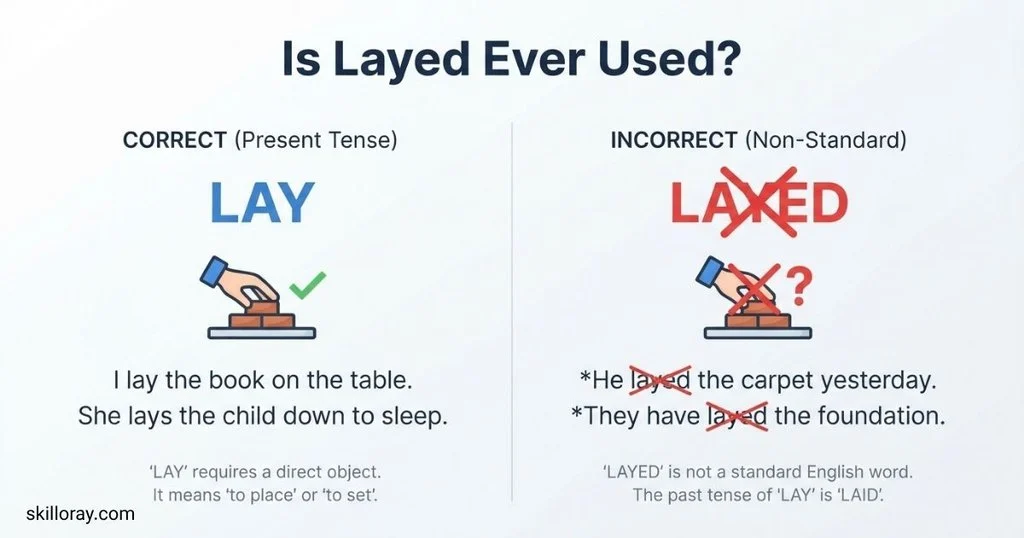
You may encounter layed in some historical, dialectal, or specialized contexts. English has many forms that survive outside mainstream standard usage, and older texts can contain spellings that are not preferred in contemporary standard English.
That does not change the practical rule for everyday writing.
If you’re writing an email, school assignment, article, report, website, or ordinary conversation, choose laid when you need the past tense or past participle of lay.
Layed or Laid: Quick Reference
| Expression | Standard form |
| layed or laid | laid |
| layed or laid in bed | lay in bed when describing resting |
| layed or laid down | laid down when using the past of lay |
| layed or laid in a sentence | Usually laid |
| layed or laid off | laid off |
| layed or laid my eyes on you | laid my eyes on you |
| layed or laid past tense | laid |
| layed or laid examples | laid |
| is it layed or laid | laid in standard English |
| layed or laid out | laid out |
| I layed or laid | I laid when using the past of lay |
| he layed or laid | he laid when using the past of lay |
| layed or laid back | laid-back |
| layed or laid to rest | laid to rest |
| layed or laid eggs | laid eggs |
| when to use layed or laid | Use laid in standard English for the past of lay |
FAQs
Is “layed” a correct English word?
Layed can be found in some dialectal, historical, or specialized usage, but it is not the standard modern form for the ordinary past tense of lay. In everyday standard English, use laid.
Is it “I layed” or “I laid”?
If you mean that you placed something somewhere, use I laid.
I laid the book on the table.
If you mean that you were resting somewhere, use I lay because lay is the past tense of lie.
I lay in bed all morning.
Is it “he layed” or “he laid”?
Use he laid when lay is the intended verb.
He laid the keys on the desk.
If you’re describing where he rested, use he lay.
He lay on the sofa.
Is it “layed eggs” or “laid eggs”?
The standard expression is laid eggs.
The hen laid three eggs.
The past tense of lay is laid, so layed eggs is not the standard form.
Is it “layed off” or “laid off”?
The standard expression is laid off.
The company laid off several employees.
Is it “layed down” or “laid down”?
Laid down is correct when lay means to put or place something.
She laid down the book.
But lay down can also be the past form of lie when someone moves into a resting position.
I lay down for a while.
Is it “layed out” or “laid out”?
Use laid out in standard English.
He laid out the documents on the table.
Is it “layed back” or “laid-back”?
The standard spelling is laid-back.
She has a laid-back personality.
Is “I lay in bed” grammatically correct?
Yes. I lay in bed is grammatically correct when lay is the past tense of lie.
For example:
I lay in bed until noon.
This does not mean that layed is the correct spelling. The form lay comes from the irregular verb lie.
What is the past tense of “lay”?
The past tense of lay is laid.
Present: I lay the book on the desk.
Past: I laid the book on the desk.
The past participle is also laid:
I have laid the book on the desk.
Conclusion
For standard modern English, laid is the form you should normally choose instead of layed. The past tense and past participle of lay are both laid, which gives us expressions such as laid off, laid out, laid eggs, laid down, laid-back, and laid to rest.
The bigger source of confusion is lie. When someone rests in a position, the past tense of lie is lay, as in “I lay in bed.” When someone puts or places something, the past tense of lay is laid, as in “I laid the book on the table.”
Remember these two patterns:
lay → laid → laid
lie → lay → lain
If you keep those forms in mind, you’ll know when to use laid and when lay is the correct choice.

I am Olivia Brown, a professional English editor and grammar writer who believes that great writing begins with a strong foundation in grammar. I have spent years creating educational resources that help students and professionals improve their writing, avoid common errors, and communicate more effectively. I strive to provide clear explanations and practical examples that make grammar easy to understand and apply.
Books: English Grammar Essentials and Modern Writing Success
 James Walker
 Daniel Carter