Choosing between Ms or Mrs can feel surprisingly confusing, especially when you want to address someone respectfully. I know how a small title can make you pause and wonder which choice is appropriate.
If you are unsure which one to use, you are not alone. You want your message, invitation, form, or introduction to sound natural and respectful without making an unnecessary assumption.
In this guide, I’ll explain Ms or Mrs in a simple way so you can understand the difference and choose the right title with confidence. You’ll learn when each is commonly used and how to avoid common mistakes.
Ms or Mrs: Quick Answer
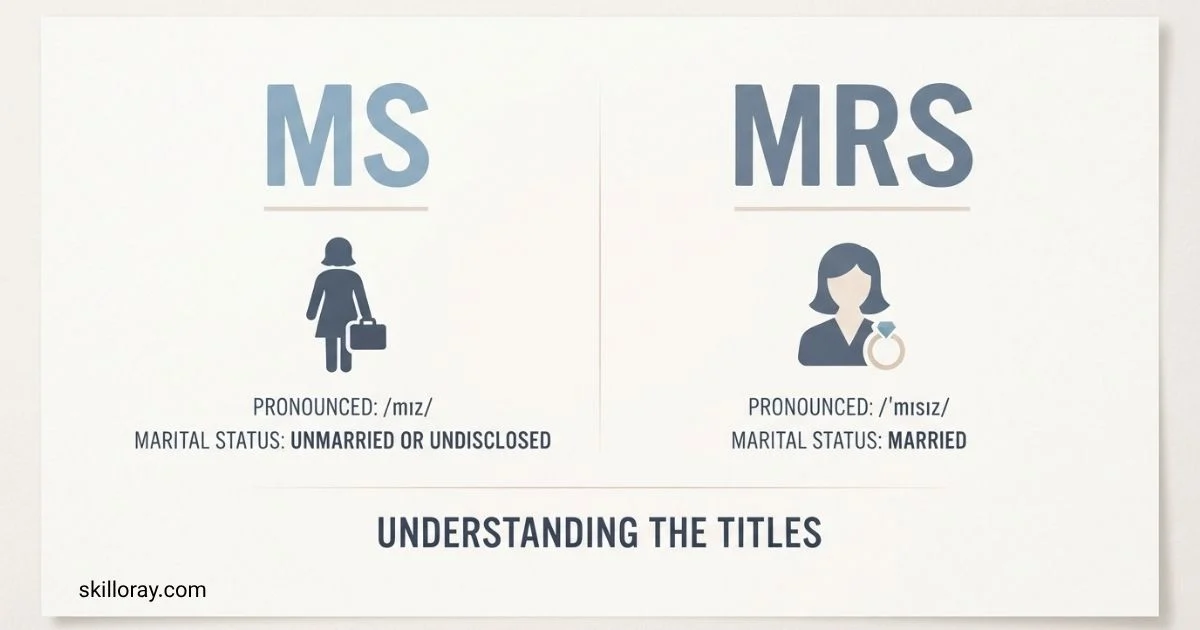
Both Ms or Mrs are correct titles. The right choice depends on the woman’s preference, marital status, and the context in which you are addressing her.
- Ms — a title for a woman that does not specify whether she is married.
- Mrs — traditionally a title for a married woman.
- Miss — traditionally a title for an unmarried girl or woman.
- Mr — a title generally used for a man, regardless of marital status.
If you are unsure whether a woman is married, Ms is generally the appropriate choice.
| Title | Common use | Indicates marital status? | Pronunciation |
| Ms | Woman of any marital status | No | /mɪz/ |
| Mrs | Married woman | Traditionally yes | /ˈmɪsɪz/ |
| Miss | Unmarried girl or woman | Traditionally yes | /mɪs/ |
| Mr | Man | No | /ˈmɪstər/ |
What Does Ms Mean?
Ms is a title used for a woman without specifying whether she is married. It is especially useful in professional, formal, or unfamiliar situations when you do not know someone’s marital status.
For example:
- Ms Johnson will lead the meeting today.
- Please send the documents to Ms Carter.
- I spoke with Ms Williams yesterday.
- Ms Brown is the new manager.
The important point is that Ms does not mean unmarried. A married woman can use Ms, just as an unmarried woman can use Ms.
What Does Ms Mean in Terms of Gender?
Ms is traditionally a title for a woman. It does not identify a person’s marital status.
So, if you are asking whether Ms means female or male, Ms is generally used for women, while Mr is generally used for men.
The title itself tells you little about the person’s personal circumstances beyond the traditional gender association of the title.
What Does Mrs Mean?
Mrs is traditionally a title used for a married woman. It is often followed by the woman’s surname.
For example:
- Mrs Smith is my teacher.
- I spoke with Mrs Davis this morning.
- Please ask Mrs Taylor to call me.
- Mrs Wilson will attend the ceremony.
A woman who is married may choose to use Mrs, but personal preference matters. Not every married woman uses Mrs.
What Does Mr Mean?
Mr is a title generally used for a man regardless of whether he is married.
For example:
- Mr Adams is waiting outside.
- Please contact Mr Harris.
- Mr Wilson will speak first.
Unlike Mrs, Mr does not normally tell you whether a man is married.
Miss or Mrs or Ms: What Is the Difference?
The traditional distinction is straightforward:
- Miss traditionally refers to an unmarried girl or woman.
- Mrs traditionally refers to a married woman.
- Ms refers to a woman without specifying marital status.
These titles can be useful in different situations, but modern usage places greater emphasis on personal preference. A woman may prefer Ms even if she is married, or she may prefer Mrs.
| Title | Traditional meaning | Marital status |
| Miss | Unmarried girl or woman | Usually unmarried |
| Mrs | Married woman | Usually married |
| Ms | Woman without stated marital status | Not specified |
When Should You Use Ms?
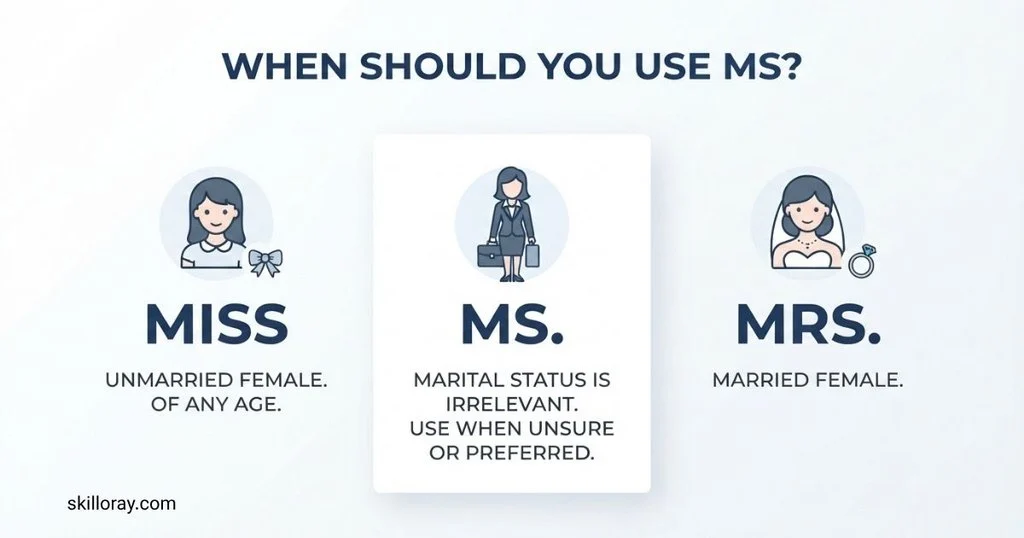
Use Ms when you do not know a woman’s marital status or when marital status is irrelevant.
It is particularly useful in:
- Business emails
- Formal letters
- Workplace communication
- Applications
- Invitations
- Customer service
- Professional introductions
For example:
Dear Ms Anderson,
This is a natural formal greeting when you do not know whether Anderson is married.
You can also use Ms when you already know the person is married but she prefers that title.
When Should You Use Mrs?
Use Mrs when you know a woman prefers this title, or when she has specifically introduced herself using Mrs.
For example, if someone signs a formal letter as Mrs Thompson, following that preference is appropriate.
In many situations, however, you should not assume that every married woman wants to be called Mrs. Some married women prefer Ms.
Ms or Mrs When Married
A married woman can use Ms or Mrs.
Traditionally, Mrs identifies a woman as married. Ms does not.
For example:
- Ms Parker — her marital status is not stated.
- Mrs Parker — she is using a title traditionally associated with marriage.
If you know a woman is married but do not know which title she prefers, Ms is often the safer professional choice.
The best approach is to follow the title she uses herself.
Ms or Mrs When Unmarried
An unmarried woman can use Ms, while Miss has traditionally been used for an unmarried woman.
Mrs is traditionally associated with married women, so it should not normally be chosen for an unmarried woman unless she specifically uses that title for a particular reason.
If you are unsure, Ms avoids making a statement about marital status.
Ms or Mrs When Unsure
If you are unsure whether a woman is married, use Ms.
This is one of the most useful rules to remember:
If marital status is unknown or irrelevant, Ms is usually the safest title.
For example:
Dear Ms Morgan,
is generally more appropriate than guessing Mrs Morgan.
Using Ms also avoids making an unnecessary assumption about someone’s personal life.
Do You Use Ms or Mrs for a Widow?
A widow may use Ms or Mrs, depending on her personal preference.
There is no universal rule requiring a widow to stop using Mrs. Some widows continue to use Mrs because it is the title they have always used. Others prefer Ms because it does not identify marital status.
If you are addressing a widow and do not know her preference, Ms is generally a respectful neutral choice.
Are Widows Ms or Mrs?
Widows can use Ms or Mrs. A widow does not automatically have to change from Mrs to Ms after her spouse dies.
The correct title depends primarily on what she prefers.
If she introduces herself as Mrs Adams, use Mrs Adams. If she uses Ms Adams, use Ms Adams.
How Do You Pronounce Ms?
Ms is pronounced /mɪz/.
A simple way to think about it is:
Ms = miz
The final sound is a z sound rather than the s sound heard in Miss.
Examples:
- Ms Brown → “miz Brown”
- Ms Carter → “miz Carter”
Because the pronunciation is short, some English learners confuse Ms with Miss. The main difference is the ending sound.
How Do You Pronounce Mrs?
Mrs is traditionally pronounced /ˈmɪsɪz/.
A simple pronunciation guide is:
Mrs = MIS-iz
In everyday speech, it is often heard as something close to “missus.”
Examples:
- Mrs Smith → “MISS-iz Smith”
- Mrs Green → “MISS-iz Green”
The spelling can look surprising because the pronunciation does not sound like the letters are pronounced individually.
How Do You Pronounce Miss?
Miss is pronounced /mɪs/.
A simple pronunciation guide is:
Miss = miss
The final sound is an s sound.
For example:
- Miss Brown
- Miss Carter
- Miss Davis
Traditionally, Miss is associated with an unmarried girl or woman.
Ms or Mrs in Formal Writing
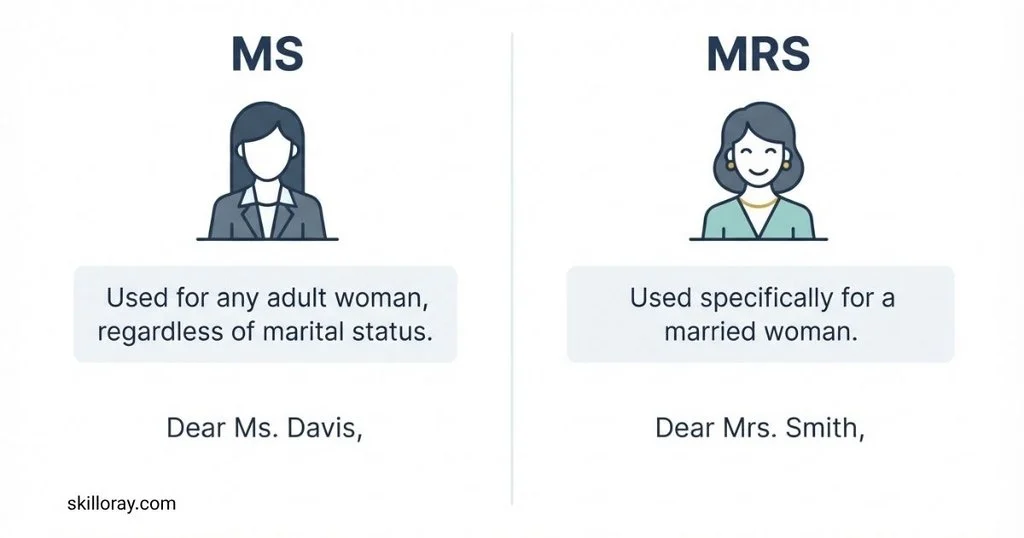
In formal writing, the safest approach is to use the title the person prefers.
For example:
Dear Ms Johnson,
is appropriate when you do not know her marital status.
If she has identified herself as Mrs Johnson, then:
Dear Mrs Johnson,
is appropriate.
Avoid guessing a woman’s preferred title simply from her age or appearance.
Ms or Mrs in Professional Emails
Ms is often the best default for professional communication when you do not know a woman’s preferred title.
For example:
Dear Ms Lewis,
Thank you for your message. I am writing to confirm the appointment for Tuesday.
If the recipient normally uses Mrs, you can follow that preference instead.
The goal in professional writing is not to identify someone’s marital status. It is to address them accurately and respectfully.
Common Mistakes With Ms or Mrs
Mistake 1: Assuming Every Married Woman Uses Mrs
Being married does not automatically mean a woman wants to be addressed as Mrs.
Better approach: Use the title she chooses.
Mistake 2: Thinking Ms Means Unmarried
Ms does not mean unmarried.
Correct: Ms can be used by a married or unmarried woman.
Mistake 3: Using Mrs When You Are Guessing
If you do not know someone’s marital status or preferred title, guessing can create an unnecessary assumption.
Better approach: Use Ms in most formal situations where the preference is unknown.
Mistake 4: Treating Ms as Gender-Neutral
Ms is traditionally a title for women. It is not generally used as a gender-neutral equivalent of Mr.
Mistake 5: Pronouncing Ms Like Miss
Ms is pronounced /mɪz/, while Miss is pronounced /mɪs/.
The final consonant sound is different.
Examples of Ms in Sentences
Here are some natural examples:
- Ms Davis will contact you tomorrow.
- I sent the letter to Ms Wilson.
- Please ask Ms Brown to sign the form.
- Ms Taylor is our new supervisor.
- Dear Ms Miller, thank you for your application.
- I spoke with Ms Carter yesterday.
- Ms Evans will attend the meeting.
- The package was addressed to Ms Parker.
- Please forward the email to Ms Green.
- Ms Adams has requested a copy of the report.
Examples of Mrs in Sentences
Here are some natural examples:
- Mrs Wilson teaches English.
- I spoke with Mrs Davis this morning.
- Mrs Taylor will welcome the guests.
- Please send the invitation to Mrs Brown.
- Mrs Miller signed the document.
- We thanked Mrs Carter for her help.
- Mrs Evans is attending the event.
- I received a message from Mrs Parker.
- Mrs Green will arrive later.
- The letter was addressed to Mrs Adams.
Examples of Miss in Sentences
Traditional examples include:
- Miss Brown teaches music.
- I spoke with Miss Carter yesterday.
- Miss Davis is waiting outside.
- Please give this letter to Miss Wilson.
- Miss Taylor won the competition.
In modern professional settings, however, Ms is often preferred when marital status is unknown or irrelevant.
What Title Should You Use If You Do Not Know a Woman’s Marital Status?
Use Ms in most formal situations.
For example:
Dear Ms Robinson,
This avoids making an assumption about whether Robinson is married.
If the person has a stated preference, always follow that preference instead.
Can a Married Woman Use Ms?
Yes. A married woman can use Ms.
Ms does not indicate that a woman is unmarried. It simply avoids specifying marital status.
For example, a married professional may choose Ms Robinson for workplace communication because her marital status is not relevant to her professional identity.
Can an Unmarried Woman Use Ms?
Yes. An unmarried woman can use Ms.
Although Miss has traditionally been associated with unmarried women, Ms is widely used without reference to marital status.
This makes Ms a practical choice for many adults in professional and formal settings.
Can a Widow Use Mrs?
Yes. A widow can continue using Mrs if that is her preference.
There is no universal requirement that a widow change to Ms. Some women continue using Mrs, while others choose Ms.
When addressing someone else, follow the title she uses.
Is Ms More Formal Than Mrs?
Neither title is inherently more formal than the other. Ms or Mrs are both formal titles.
The difference is primarily what information the title communicates.
- Ms does not specify marital status.
- Mrs traditionally indicates marriage.
The choice should therefore depend on the person’s preference or the information available to you.
Quick Guide to Choosing the Right Title
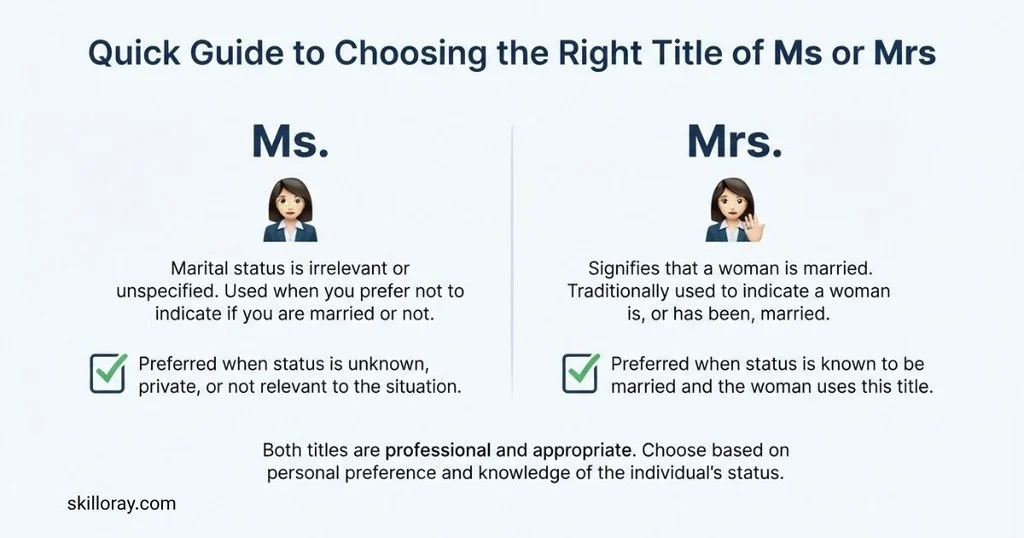
If you need a simple rule, use this guide:
- Ms → Use for a woman when marital status is unknown, irrelevant, or intentionally unspecified.
- Mrs → Use for a married woman who prefers Mrs.
- Miss → Traditionally use for an unmarried girl or woman.
- Mr → Use for a man regardless of marital status.
When in doubt about a woman’s preferred title, Ms is usually the safest formal choice.
Frequently Asked Questions
Is Ms or Mrs correct?
Both Ms or Mrs are correct. Ms does not specify marital status, while Mrs is traditionally associated with married women.
Should I use Ms or Mrs for a married woman?
A married woman may use Ms or Mrs. The best choice is the title she prefers. If you do not know her preference, Ms is often the safer option.
Should I use Ms or Mrs when I do not know if someone is married?
Use Ms in most formal situations. It avoids making an assumption about marital status.
Are widows Ms or Mrs?
A widow may use Ms or Mrs. She can continue using Mrs or choose Ms according to her personal preference.
Does Ms mean unmarried?
No. Ms does not mean unmarried. It is a title that does not specify whether a woman is married.
Is Ms only for women?
Traditionally, yes. Ms is a title used for women, while Mr is generally used for men.
What is the pronunciation of Ms?
Ms is pronounced /mɪz/, approximately like “miz.”
What is the pronunciation of Mrs?
Mrs is traditionally pronounced /ˈmɪsɪz/, approximately like “missus.”
Can a woman use Ms after marriage?
Yes. A married woman can use Ms if that is her preferred title.
Is Mrs still appropriate for a widow?
Yes. A widow may continue using Mrs if she prefers it. She may also choose Ms.
Conclusion
Ms or Mrs are both correct titles, but they serve different purposes. Ms does not identify a woman’s marital status, while Mrs traditionally identifies a married woman. A married woman can choose Ms or Mrs, and a widow can also choose either title according to her preference.
If you do not know which title a woman prefers, Ms is usually the safest choice because it does not require you to make an assumption about her marital status. When you know her preference, simply use the title she uses for herself.

I am Daniel Carter, a grammar enthusiast and language educator with over 10 years of experience helping students and professionals improve their English writing and communication skills. I enjoy simplifying complex grammar rules into easy-to-understand lessons that anyone can follow. My goal is to help learners write with confidence, avoid common mistakes, and develop strong communication skills for academic and professional success. I regularly create practical grammar guides, writing tips, and language resources that make learning both enjoyable and effective.
Books: Mastering English Grammar and The Complete Guide to Better Writing
 James Walker
 Olivia Brown