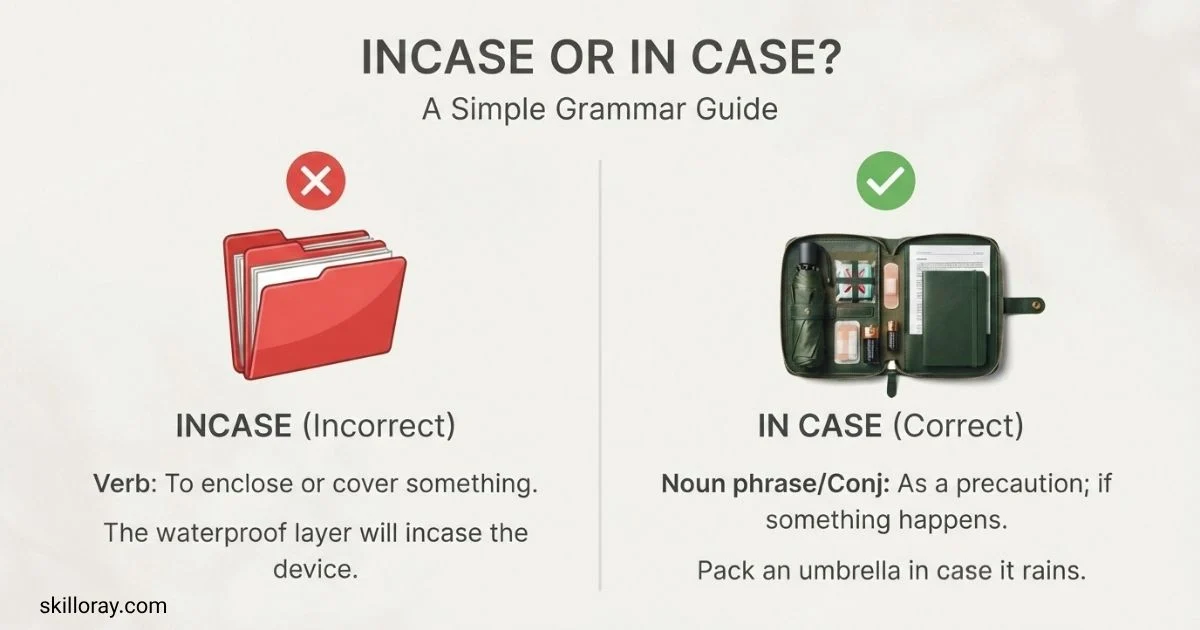
I know English spelling can be confusing, especially when two forms look almost identical. If you have ever wondered whether incase or in case is correct, you are not alone.
When I see this question, the answer is simple: in case is the standard expression in modern English. You can use it when talking about a possible situation or something you should prepare for.
By the end of this guide, you will clearly understand the difference, see real examples, and know exactly when to use in case. You will also avoid one of the most common spelling mistakes.
Incase or In Case: (Quick Answer)
“In case” is the correct spelling when you mean “if,” “because something might happen,” or “as a precaution.”
For example:
- Take an umbrella in case it rains.
- Keep my phone number in case you need help.
- Call 911 in case of emergency.
- I saved a copy just in case.
The two words should remain separate in these uses.
“Incase” should not normally be used as a one-word replacement for “in case.”
| Form | Standard use | Example |
| in case | Correct phrase meaning if or as a precaution | Take a jacket in case it gets cold. |
| in case of | Used before a noun to describe a possible situation | In case of emergency, call for help. |
| just in case | Means as a precaution | I brought some water just in case. |
| incase | Not the standard spelling for these meanings | Avoid using it to mean “in case.” |
| encase | A verb meaning to surround or enclose completely | The object was encased in glass. |
What Does “In Case” Mean?
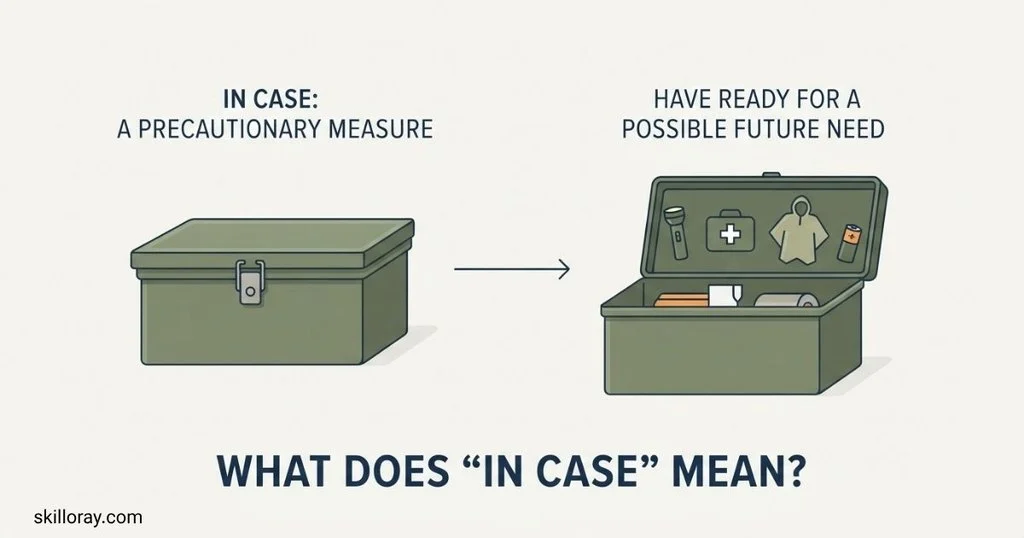
“In case” is a common English phrase used when something is possible and you want to be prepared for it.
It can express the idea of “if something happens” or “as a precaution.”
For example:
Bring your charger in case your phone battery runs low.
This means you should bring the charger because your battery might run low.
Another example:
I wrote down the address in case I forgot it.
Here, the person wrote down the address as a precaution against forgetting it.
“In Case” Meaning
Depending on the sentence, “in case” can have meanings such as:
- if something happens
- if something is true
- as a precaution
- because something might happen
- to be prepared for a possible situation
The exact meaning comes from the context.
Is “Incase” a Word?
“Incase” is not the standard spelling to use when you mean “in case.”
Many people write “incase” because English contains many words that combine naturally into one word. For example, inside, instead, and indeed are written as single words. It can therefore feel natural to write “incase,” but standard modern English uses “in case” for the meanings discussed here.
For everyday writing, use:
in case ✅
Not:
incase ❌
For example:
- Correct: Save the document in case your computer crashes.
- Incorrect: Save the document incase your computer crashes.
Is “In Case” Two Words?
Yes. When you use the phrase to mean “if” or “as a precaution,” it is written as two separate words:
in case
The word “in” functions as a preposition, while “case” is a noun. Together, they form a phrase that can introduce a possible situation or condition.
Examples:
- Take some cash in case the store doesn’t accept cards.
- Keep the receipt in case you need to return the item.
- Bring a sweater in case it gets cold.
- I left early in case there was traffic.
“In Case” Grammar
“In case” can be used in several grammatical structures.
In Case + Clause
A common structure is:
in case + subject + verb
Examples:
- Take an umbrella in case it rains.
- Save the file in case you lose your work.
- Call me in case you need help.
- Bring your identification in case they ask for it.
The clause after “in case” describes something that could happen.
In Case of + Noun
Another common structure is:
in case of + noun
Examples:
- In case of emergency, call the appropriate emergency service.
- In case of fire, use the nearest safe exit.
- In case of rain, the event will move indoors.
- In case of an accident, contact the relevant authorities.
Notice that “in case of” is normally followed by a noun or noun phrase rather than a complete clause.
“In Case” or “In Case of”
Both structures are correct, but they are used differently.
“In case” is commonly followed by a clause:
Take an umbrella in case it rains.
“In case of” is commonly followed by a noun or noun phrase:
Take shelter in case of severe weather.
| Form | Typical structure | Example |
| in case | in case + clause | Call me in case you need help. |
| in case of | in case of + noun | Call for help in case of an emergency. |
A useful way to remember this is that “in case” often introduces something that may happen, while “in case of” identifies a possible event or situation by name.
“Incase” or “In Case of Emergency”
The correct phrase is:
in case of emergency ✅
Not:
incase of emergency ❌
You may see “in case of emergency” on signs, instructions, safety notices, transportation information, and public buildings.
Examples:
- In case of emergency, remain calm.
- In case of emergency, follow the posted instructions.
- In case of emergency, use the nearest safe exit.
The phrase remains two words because “in case” is functioning as the standard phrase.
“Just Incase” or “Just In Case”
The correct expression is:
just in case ✅
Not:
just incase ❌
“Just in case” means that you are doing something as a precaution because a particular event might happen.
Examples:
- I brought an extra shirt just in case.
- Take some cash just in case.
- I’ll save your number just in case I need to contact you.
- We left early just in case there was heavy traffic.
Why Do People Write “Just Incase”?
The mistake usually happens because “just in case” is pronounced naturally as a connected phrase in conversation. When people hear the expression frequently, they may assume that it is one word.
In standard writing, however, keep it as:
just in case
“In Case You Didn’t Know”
The correct expression is:
in case you didn’t know ✅
This phrase is commonly used when introducing information that the listener or reader may not already know.
For example:
In case you didn’t know, the library closes at six.
It can also be used more casually:
In case you didn’t know, tomorrow is a holiday.
The spelling “incase you didn’t know” is not the standard form.
“In Case” or “Incase” Examples
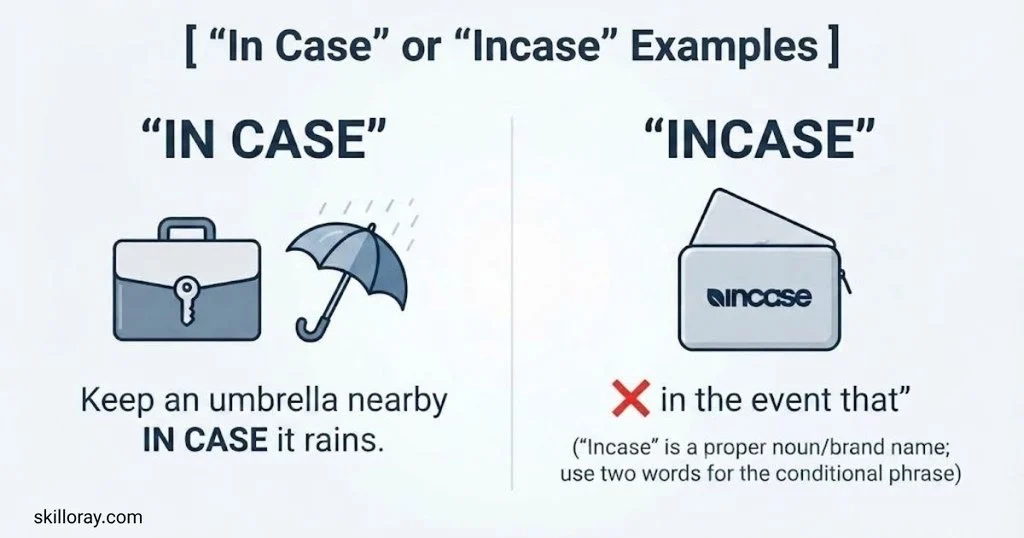
Here are natural examples showing how to use “in case” correctly:
- Take an umbrella in case it rains.
- Save my number in case you need anything.
- Bring a jacket in case the weather gets colder.
- I’ll write down the address in case you forget it.
- Keep some extra food in case we arrive late.
- Charge your phone in case you need to make a call.
- Take a copy of your documents in case they are needed.
- I set an alarm in case I oversleep.
- Bring some water in case you’re thirsty.
- I’ll keep the receipt in case we need it later.
Each sentence uses “in case” as two separate words.
Common “In Case” Mistakes
Incorrect: Incase It Rains
Incorrect:
Take an umbrella incase it rains.
Correct:
Take an umbrella in case it rains.
The phrase is written as two words.
Incorrect: Just Incase
Incorrect:
I’ll take it just incase.
Correct:
I’ll take it just in case.
“Just in case” is the standard expression.
Incorrect: Incase of Emergency
Incorrect:
Incase of emergency, leave the building.
Correct:
In case of emergency, leave the building.
The phrase “in case of” is written as separate words.
Incorrect: Incase You Didn’t Know
Incorrect:
Incase you didn’t know, the meeting starts at nine.
Correct:
In case you didn’t know, the meeting starts at nine.
“In Case” or “Encase”
“In case” or “encase” are not interchangeable.
In case is a phrase used for a possible situation or as a precaution:
Take a flashlight in case the power goes out.
Encase is a verb meaning to surround or enclose something completely:
The artifact was encased in protective glass.
This is an important distinction because encase is a genuine one-word English verb.
What Does “Encase” Mean?
Encase means to surround something completely or place it inside something that covers or protects it.
Examples:
- The valuable item was encased in glass.
- The wires were encased in protective material.
- The statue was encased in a transparent structure.
Its forms include:
- encase
- encases
- encased
- encasing
Do not use encase when you mean “if” or “as a precaution.”
Is “In Case” Grammatically Correct?
Yes. “In case” is grammatically correct and very common in standard English.
It can introduce a clause describing a possible future situation:
Bring your passport in case you need identification.
It can also appear in the expression “in case of”:
In case of emergency, follow the safety instructions.
The important point is to preserve the two-word spelling.
Should You Use “In Case” or “Incase”?
You should normally use “in case.”
If you mean:
- if something happens
- because something might happen
- as a precaution
- if something is needed
write “in case.”
Examples:
- in case it rains
- in case you need help
- in case of emergency
- just in case
- in case you didn’t know
Writing “incase” as a replacement for these expressions is generally considered a spelling error in standard modern English.
Is “Incase” Correct in British English?
No, you should not use “incase” as a one-word spelling of “in case” in standard British English.
British English uses:
in case ✅
For example:
Take an umbrella in case it rains.
The same two-word form is also standard in American English and other major varieties of English.
Is “Incase” Correct in Australian English?
Australian English also uses “in case” as the standard spelling for this phrase.
For example:
Bring a jacket in case the weather changes.
So if you’re writing for an Australian audience, you should still write “in case”, not “incase,” when expressing a precaution or possible condition.
“In Case” Pronunciation
“In case” is pronounced approximately:
in KAYS
IPA:
/ɪn keɪs/
The phrase contains two words, but in natural speech they often sound closely connected.
- in — /ɪn/
- case — /keɪs/
The pronunciation does not turn the phrase into a single written word.
This is one reason learners may hear “incase” and assume it should be written that way. English pronunciation often connects neighboring words in normal conversation, but spelling still follows the standard word forms.
Is “In Case” a Preposition or Conjunction?
The grammatical role of “in case” depends on how it is used.
When it introduces a clause, it can function as a conjunction-like subordinating expression:
Take a coat in case it gets cold.
When used in “in case of”, the phrase functions as a prepositional expression:
In case of heavy rain, the event will move indoors.
For everyday writing, you don’t need to memorize the terminology to use it correctly. The practical rule is more useful: use “in case” before a clause and “in case of” before a noun or noun phrase.
“In Case” Sentence Patterns
These patterns can help you recognize the correct form.
Pattern 1: In Case + Subject + Verb
Bring your phone in case you need help.
Save the information in case you need it later.
Pattern 2: In Case + It + Verb
Take a jacket in case it gets cold.
Carry an umbrella in case it rains.
Pattern 3: In Case of + Noun
In case of emergency, call for assistance.
In case of fire, use the designated exit.
Pattern 4: Just In Case
I’ll bring some water just in case.
Keep the receipt just in case.
These structures all use “in case” as separate words.
Why Is “Incase” a Common Mistake?
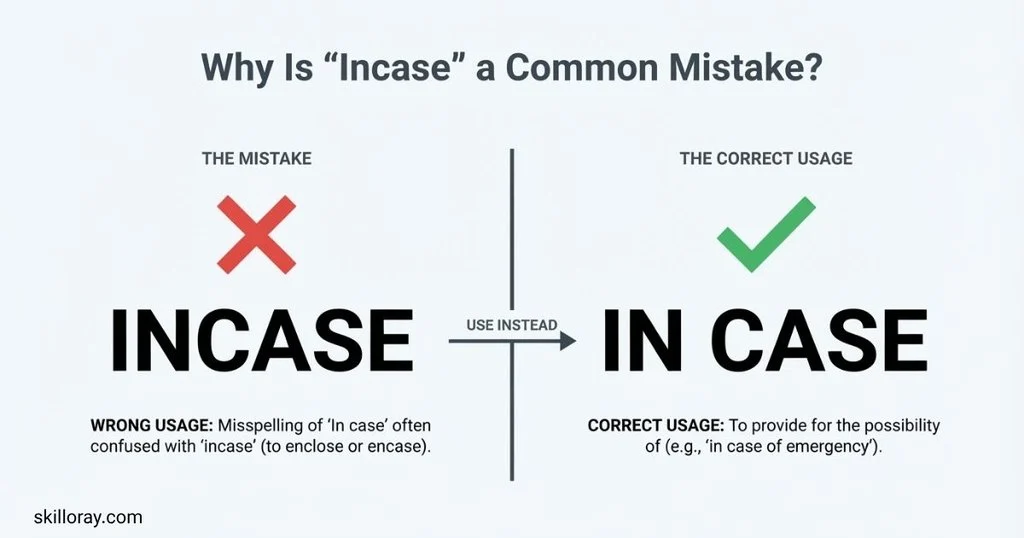
The confusion is understandable because English contains many words that begin with “in” and are written as one word. When people hear “in case” spoken quickly, the phrase can also sound like a single unit.
Another reason is informal online writing. Misspellings can become familiar when people repeatedly see them in messages, social media posts, or comments.
However, familiarity doesn’t make the spelling standard.
When you’re writing an email, school assignment, article, report, business document, or formal message, use “in case.”
Quick Comparison
| Expression | Correct? | Meaning |
| in case | Yes | if something happens or as a precaution |
| in case of | Yes | if a particular event or situation occurs |
| just in case | Yes | as an extra precaution |
| in case you didn’t know | Yes | introducing information the reader may not know |
| incase | Generally no for these meanings | Common misspelling of “in case” |
| encase | Yes | to surround or enclose completely |
Frequently Asked Questions
Is “incase” or “in case” correct?
“In case” is correct when you mean “if something happens” or “as a precaution.” The two words should remain separate.
Is “just incase” or “just in case” correct?
“Just in case” is correct. For example, “I’ll bring an umbrella just in case.”
Is “incase” a word?
“Incase” is not the standard spelling to use when you mean the common phrase “in case.” You may encounter it in older or specialized usage, but it should not replace “in case” in ordinary modern writing.
Is “in case of emergency” correct?
Yes. “In case of emergency” is the standard expression. For example, “In case of emergency, follow the posted instructions.”
Is “in case you didn’t know” correct?
Yes. “In case you didn’t know” is grammatically correct and commonly used to introduce information that someone may not already know.
Is “in case” one word or two?
“In case” is two words when it means “if,” “as a precaution,” or refers to a possible situation.
Is “in case” grammatically correct?
Yes. “In case” is a standard English expression used to introduce a possible situation or precaution.
Is “in case” used in British English?
Yes. “In case” is standard in British English. The same spelling is also used in American English and Australian English.
What is the difference between “in case” or “encase”?
“In case” is a phrase referring to a possible situation or precaution. “Encase” is a verb meaning to surround or enclose something completely.
How do you pronounce “in case”?
“In case” is pronounced approximately “in KAYS” and is represented in IPA as /ɪn keɪs/.
Conclusion
The answer is simple for most everyday writing: use “in case,” not “incase.” The phrase “in case” means “if something happens,” “because something might happen,” or “as a precaution.”
Use “in case of” before a noun or situation, such as “in case of emergency,” and use “just in case” when you mean that you’re taking an extra precaution. If you mean to surround something completely, use the separate verb “encase.”When you’re unsure, remember this simple rule: if you mean “as a precaution,” write “in case” as two words.

I am Olivia Brown, a professional English editor and grammar writer who believes that great writing begins with a strong foundation in grammar. I have spent years creating educational resources that help students and professionals improve their writing, avoid common errors, and communicate more effectively. I strive to provide clear explanations and practical examples that make grammar easy to understand and apply.
Books: English Grammar Essentials and Modern Writing Success
 James Walker
 Daniel Carter