Have you ever stopped while writing and wondered whether it should be “every day” or “everyday”? I know how confusing these two forms can feel because they look almost identical, yet they have different jobs in a sentence.
You want your writing to sound natural and correct, but remembering the difference does not have to be difficult. I’ll walk you through the simple rule so you can quickly tell which form fits your sentence.
Once you understand how “every day” or “everyday” work, you’ll be able to use them with confidence. You’ll also see clear examples that make the difference easy to remember.
Every Day or Everyday: (Quick Answer)
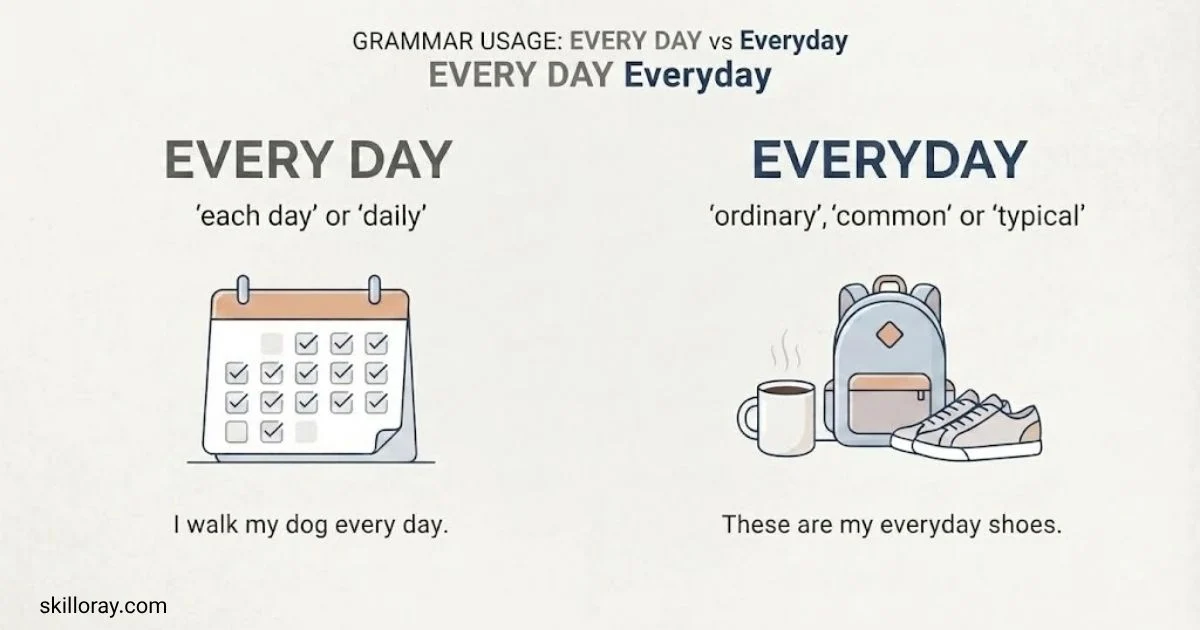
Both “every day” or “everyday” are correct, but they are not interchangeable.
- Every day means each day and describes when something happens.
- Everyday means ordinary, usual, or routine and describes a noun.
A simple test is to replace every day with each day. If the sentence still makes sense, every day is probably the correct choice.
Example:
- I walk to school every day.
- I wear my everyday shoes to school.
In the first sentence, the phrase tells us when the action happens. In the second sentence, the adjective describes the type of shoes.
Every Day Meaning
Every day is a two-word phrase meaning each day. It is generally used to describe an action, event, or situation that occurs daily.
Examples of “Every Day”
- I read for thirty minutes every day.
- She calls her mother every day.
- We exercise every day.
- He takes the bus every day.
- They practice English every day.
- I drink plenty of water every day.
- The store is open every day.
- She learns something new every day.
In each example, every day tells us how often something happens.
The “Each Day” Test
One of the easiest ways to remember this form is to substitute each day.
I study English every day.
Change it to:
I study English each day.
The meaning remains essentially the same, so every day is correct.
This test works particularly well when you’re unsure while writing quickly.
Everyday Meaning
Everyday is a single word that functions primarily as an adjective. It describes something that is ordinary, common, routine, or suitable for normal daily use.
It usually appears directly before a noun.
Examples of “Everyday”
- These are my everyday clothes.
- Walking is an everyday activity for me.
- We all face everyday challenges.
- This is an everyday problem.
- She uses an everyday backpack for school.
- Cooking is part of my everyday routine.
- These shoes are comfortable enough for everyday use.
- He enjoys talking about everyday life.
Here, everyday does not mean “each day.” Instead, it describes something ordinary or associated with normal daily life.
The Difference Between Every Day or Everyday
The main difference is grammatical.
| Form | Meaning | Typical use | Example |
| Every day | Each day | Adverbial phrase | I exercise every day. |
| Everyday | Ordinary, usual, routine | Adjective | These are my everyday shoes. |
A useful rule is:
Every day = each day
Everyday = ordinary or usual
If you remember those two meanings, most situations become easy to solve.
When to Use Every Day
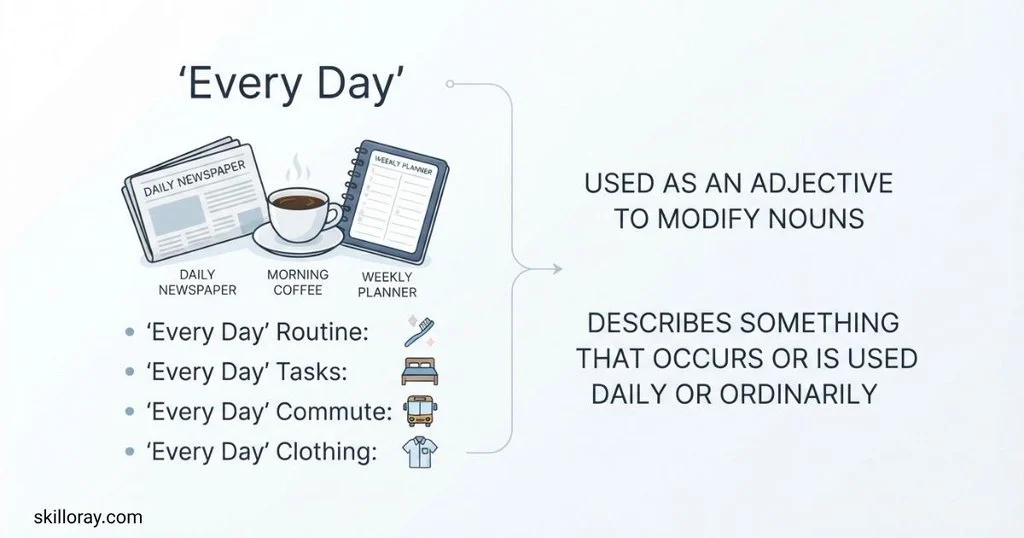
Use every day when you are talking about something that happens on a daily basis.
It often appears after a verb or at the beginning or end of a sentence.
Examples
- I practice the piano every day.
- She walks her dog every day.
- We go outside every day.
- He checks his email every day.
- Every day, I try to learn something new.
- They visit the park every day during summer.
- I think about that lesson every day.
In these sentences, the phrase answers the question “How often?”
How often do you practice?
Every day.
That is a strong signal that you need the two-word form.
When to Use Everyday
Use everyday when it describes a noun.
It usually answers a question such as “What kind?” or “Which type?”
Examples
- I need comfortable everyday shoes.
- This is an everyday conversation.
- She has an everyday routine.
- We discussed several everyday problems.
- He prefers simple everyday clothing.
- Smartphones are part of modern everyday life.
- These bags are designed for everyday use.
Here, everyday acts as an adjective.
For example:
everyday shoes
The word everyday tells us what kind of shoes they are.
Every Day or Everyday Examples
Seeing the forms in complete sentences makes the distinction much easier.
Sentences With “Every Day”
- I go for a walk every day.
- She reads the news every day.
- We study together every day.
- He drinks coffee every day.
- They open the shop every day.
- I practice speaking English every day.
- She writes in her journal every day.
- We talk to our grandparents every day.
- He checks the schedule every day.
- I learn something interesting every day.
Sentences With “Everyday”
- These are my everyday shoes.
- Cooking is an everyday activity.
- We all experience everyday problems.
- She prefers everyday clothing.
- This is an everyday conversation.
- The book explains common everyday expressions.
- He carries an everyday backpack.
- Money is part of everyday life.
- These tools are designed for everyday use.
- Small decisions can affect your everyday routine.
Notice the grammatical difference: every day usually describes an action’s timing, while everyday describes a noun.
Is It Every Day or Everyday?
The correct form depends on what you mean.
Use every day when you mean each day.
I go running every day.
Use everyday when you mean ordinary, usual, or routine.
Running has become part of my everyday routine.
A quick substitution can help:
Every day → each day
Everyday → ordinary
If the replacement works, you’ve probably found the correct form.
Every Day or Everyday in Everyday Life
The phrase everyday life is a common example of the adjective everyday.
Here, everyday describes the noun life, meaning ordinary or normal life.
Correct:
Technology plays an important role in everyday life.
You could not replace everyday with every day in this sentence because every day life does not have the intended meaning.
However, consider this sentence:
I use technology every day.
Here, every day tells us how frequently the action happens.
The two forms can appear in closely related sentences while performing different grammatical jobs.
Open Every Day or Everyday?
If you are describing business hours, use every day.
Correct:
The store is open every day.
Here, every day means each day.
You would use everyday when describing something as ordinary or routine:
The store sells everyday household products.
In the first sentence, the phrase describes when the store is open. In the second, the adjective describes the type of products.
I Miss You Every Day or Everyday?
If you want to say that you miss someone each day, use every day.
Correct:
I miss you every day.
Here, every day means each day.
The sentence is describing how frequently you miss the person, so the two-word form is appropriate.
Everyday would not fit because you are not describing a noun as ordinary or routine.
Today or Every Day
Today refers to the current day, while every day means each day.
For example:
I am working today.
This refers to one particular day.
I work every day.
This describes a repeated daily activity.
You can also use both in one sentence:
I am working today, as I do every day.
The meanings are different because today identifies a particular day, while every day describes a recurring frequency.
Each Or Every Day or Everyday?
The expression each and every day uses every day as two words.
Correct:
I think about my goals each or every day.
Here, every day means each day, and the phrase emphasizes the daily repetition.
By contrast, everyday is an adjective:
This is part of my everyday routine.
A useful distinction is:
- each or every day = each day
- everyday routine = ordinary or regular routine
It’s Not Every Day or Everyday
When you mean something does not happen each day, use every day.
For example:
It’s not every day that you get an opportunity like this.
Here, every day means each day.
You can also say:
We don’t visit the restaurant every day.
Again, the phrase describes frequency.
The adjective everyday would only be appropriate when it modifies a noun:
We don’t discuss everyday problems at every meeting.
How to Write Every Day or Everyday Correctly
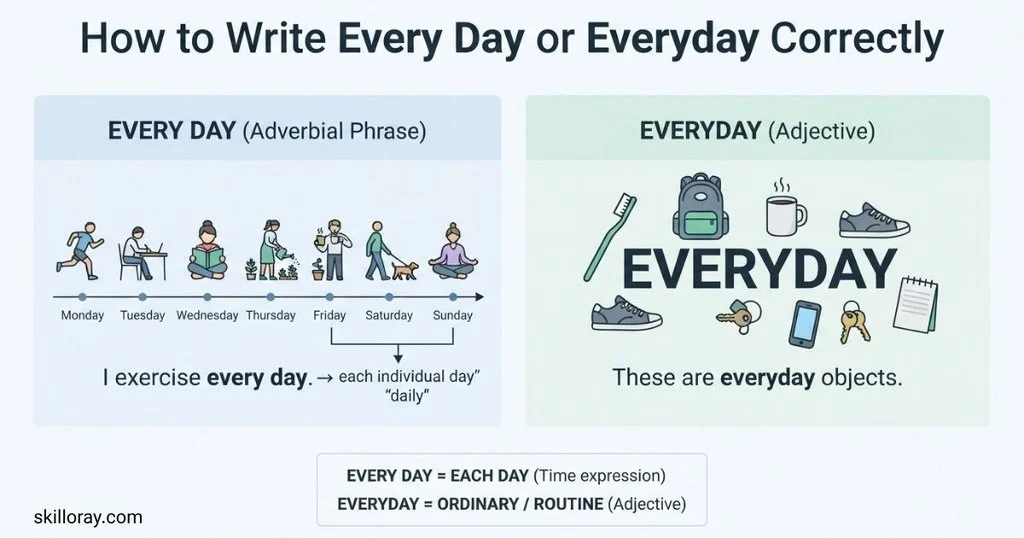
When you’re writing quickly, use this simple three-step test:
1. Ask What You Mean
Do you mean each day?
If yes, write:
every day
2. Look for a Noun
Is the word describing a noun as ordinary, usual, or routine?
If yes, write:
everyday
3. Try a Replacement
Replace every day with each day.
If the sentence still makes sense, use the two-word form.
Replace everyday with ordinary.
If that works, use the one-word adjective.
Quick Examples
I exercise every day.
I exercise each day. ✓
I wear everyday clothes.
I wear ordinary clothes. ✓
This simple method will solve most cases.
Common Mistakes With Every Day or Everyday
A common mistake is using everyday when the sentence needs a phrase showing frequency.
Incorrect:
I go to the gym everyday.
Correct:
I go to the gym every day.
The word is describing how often the person goes to the gym, so every day is needed.
Another common mistake is separating everyday when it functions as an adjective.
Incorrect:
These are my every day shoes.
Correct:
These are my everyday shoes.
Here, everyday describes the noun shoes.
Another Example
Incorrect:
She calls me everyday.
Correct:
She calls me every day.
The intended meaning is “She calls me each day.”
But:
She has an everyday routine.
This is correct because everyday describes the noun routine.
Every Day or Everyday in American English
Both forms are standard in American English.
The distinction is grammatical rather than a British English or American English spelling difference.
- Every day = each day
- Everyday = ordinary, usual, routine
The same basic distinction is used in standard British English as well.
So if you’re writing for a US audience, you should not choose everyday simply because it looks more compact. Choose the form that matches the sentence’s meaning.
Every Day or Everyday Pronunciation
Every day or everyday are generally pronounced the same when spoken naturally.
A common pronunciation is approximately:
EV-ree day
The difference is therefore mainly visible in writing and grammatical function rather than pronunciation.
This is one reason people frequently confuse the forms. When you hear the expression aloud, there is no clear space between the two words in every day.
The key distinction becomes clear when you look at the sentence.
Every Day or Everyday Synonym
The best synonym depends on the form you’re using.
Synonyms for “Every Day”
When every day means each day, useful alternatives include:
- each day
- daily
- day after day
- on a daily basis
For example:
I exercise every day.
You could also say:
I exercise daily.
Synonyms for “Everyday”
When everyday means ordinary or usual, possible alternatives include:
- ordinary
- usual
- routine
- common
- normal
- typical
- regular
For example:
These are my everyday clothes.
You could describe them as ordinary, usual, or regular clothes, depending on the intended meaning.
Every Day or Everyday Worksheet
A simple practice exercise can help you remember the distinction.
Choose every day or everyday in each sentence:
- I walk to work ______.
- These are my ______ shoes.
- She practices English ______.
- Cooking is part of my ______ routine.
- We don’t see this problem ______.
- He wears ______ clothes to work.
- I check my messages ______.
- Small problems are part of ______ life.
Answers
- every day
- everyday
- every day
- everyday
- every day
- everyday
- every day
- everyday
The key is to identify whether the word describes frequency or describes a noun.
Every Day or Everyday Quiz
Try this quick quiz without looking at the answers first.
1. I read ______.
- A. every day
- B. everyday
2. This is my ______ bag.
- A. every day
- B. everyday
3. She calls her parents ______.
- A. every day
- B. everyday
4. We face ______ challenges.
- A. every day
- B. everyday
5. The restaurant is open ______.
- A. every day
- B. everyday
Quiz Answers
- A — every day
- B — everyday
- A — every day
- B — everyday
- A — every day
If you remember each day = every day or ordinary = everyday, these questions become much easier.
Is Everyday One Word?
Yes. Everyday is a standard English word when it is used as an adjective meaning ordinary, usual, or routine.
For example:
These are my everyday shoes.
However, every day is also correct when the intended meaning is each day.
For example:
I wear these shoes every day.
The spelling depends on the grammatical role and intended meaning.
Is Every Day Two Words?
Yes. Every day is written as two words when it means each day.
Examples include:
I study every day.
She walks her dog every day.
The library is open every day.
The phrase functions as a time or frequency expression.
Which Is Correct: Every Day or Everyday?
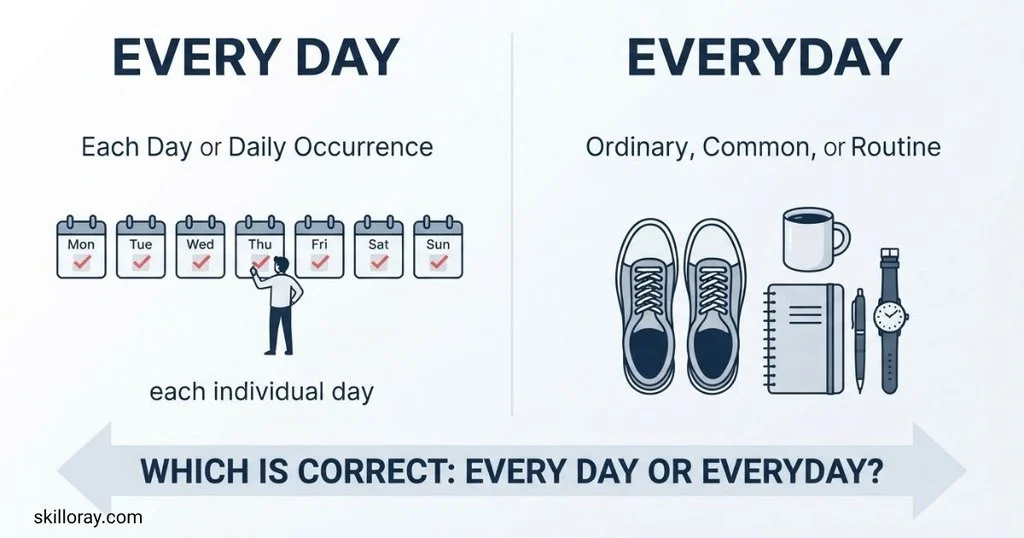
Both are correct, but they are used differently.
Use every day for each day:
I practice writing every day.
Use everyday for ordinary, usual, or routine:
Writing is part of my everyday routine.
If you can replace the expression with each day, choose every day. If you can replace it with ordinary or usual, choose everyday.
Quick Memory Trick
Think of everyday as a describing word.
If it comes before a noun and tells you what kind of thing it is, everyday is often correct:
everyday clothes
everyday problems
everyday language
everyday life
everyday activities
Think of every day as a time expression:
work every day
study every day
exercise every day
call every day
practice every day
The phrase every day answers “How often?”, while everyday usually answers “What kind?”
FAQs
Is every day or everyday correct?
Both are correct. Every day means each day, while everyday is an adjective meaning ordinary, usual, or routine.
Is it every day or everyday in a sentence about frequency?
Use every day. For example, “I exercise every day” means “I exercise each day.”
Is “everyday life” correct?
Yes. Everyday life is correct because everyday describes the noun life, meaning ordinary or normal life.
Is “I do it everyday” correct?
If you mean “I do it each day,” the standard form is “I do it every day.” The two-word form is required because it describes how frequently the action occurs.
Is “everyday” an adjective?
Yes. Everyday is primarily an adjective meaning ordinary, usual, routine, or common.
Is “every day” an adjective?
No. Every day is a two-word phrase that commonly functions as an adverbial expression of time or frequency.
Do every day or everyday sound different?
They are generally pronounced the same in normal speech. The important difference is their spelling and grammatical function.
Can everyday mean daily?
Sometimes the meanings overlap in casual contexts, but everyday primarily means ordinary or usual. When you specifically mean “each day,” use every day.
Is “open every day” correct?
Yes. Open every day is correct because it means the business is open each day.
How can I remember every day or everyday?
Remember this simple rule: every day = each day, while everyday = ordinary or usual. If you can substitute each day, use two words.
Conclusion
Choosing every day or everyday becomes simple once you identify the meaning you need. Use every day when you mean each day or when you’re describing how frequently something happens. Use everyday when you’re describing something as ordinary, usual, common, or routine.
Remember the easiest test: every day = each day, while everyday = ordinary. Once you recognize whether you’re describing frequency or a noun, you’ll usually know which form belongs in your sentence.

I am James Walker, an English language specialist with extensive experience in grammar, editing, and academic writing. I enjoy helping students, bloggers, and professionals strengthen their writing by explaining grammar concepts in a clear and engaging way. My focus is on providing accurate, practical, and easy-to-follow guidance that helps learners communicate more effectively in everyday and professional situations.
Books: Perfect English Grammar Handbook and Advanced Writing Techniques
 Daniel Carter
 Olivia Brown