Have you ever typed cancelation or cancellation and suddenly wondered if one of them is wrong? I know how confusing English spelling can feel when two forms look almost identical.
You want to use the correct spelling, especially in an email, article, school assignment, or professional message. I’ll help you understand the difference without making the rule complicated.
By the end, you’ll know which form is preferred in US English, why the spelling varies, and how you can use it confidently whenever you write.
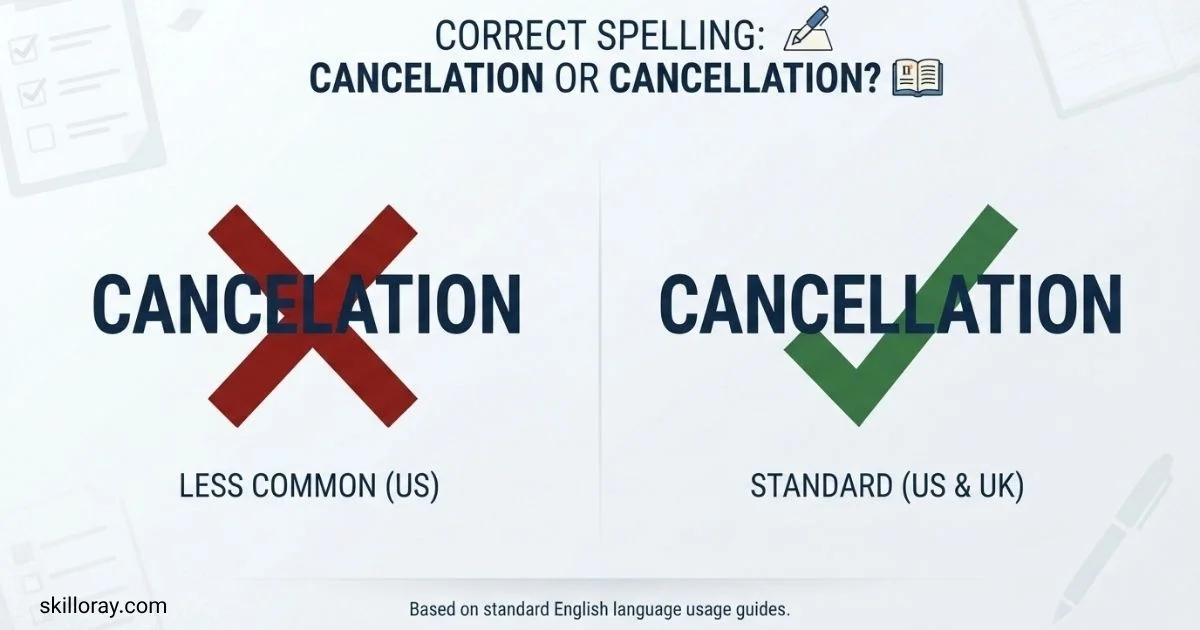
Cancelation or Cancellation: (Quick Answer)
Both “cancelation” and “cancellation” are accepted spellings, but “cancellation” is the more widely used standard form. British English uses cancellation, while American English can use cancelation as a variant.
| Form | Status | Typical use |
| cancellation | Standard and widely preferred | British English, international English, formal writing |
| cancelation | Accepted US variant | American English, less common spelling |
If you want one spelling that will look natural to the widest audience, choose cancellation.
What Does Cancellation Mean?
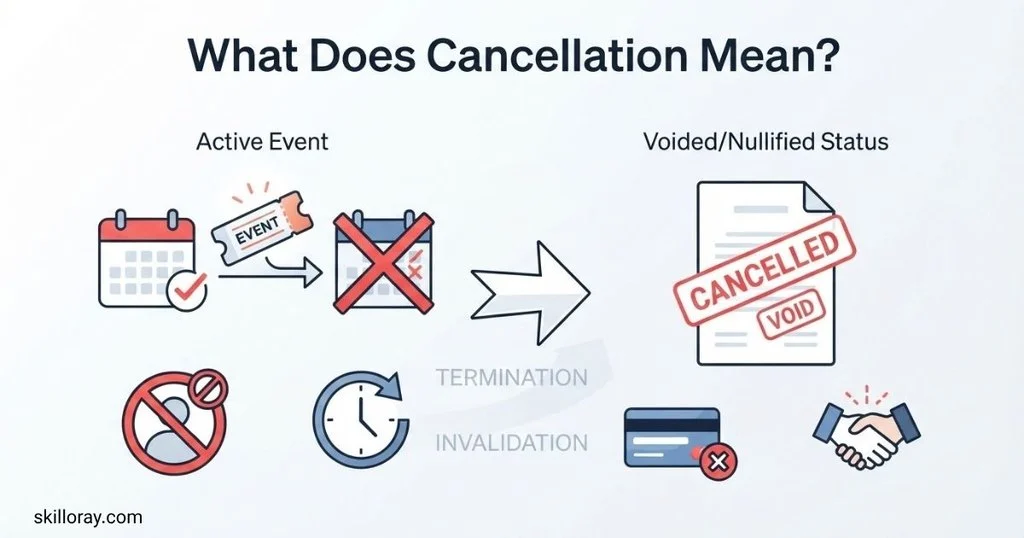
Cancellation is a noun meaning the act of stopping something that was planned, arranged, ordered, or scheduled.
For example, it can refer to:
- stopping an event from happening
- ending an appointment
- stopping an order
- ending a subscription
- withdrawing from a reservation
- officially ending an agreement
Cambridge defines cancellation as the act of deciding that an organized event will not happen or stopping an order for something.
Examples of Cancellation
- The cancellation of the flight caused several problems.
- I received a confirmation of my order cancellation.
- The concert was postponed after the cancellation of the original event.
- Please send your cancellation notice by Friday.
- We were surprised by the sudden cancellation of the meeting.
Is Cancelation a Correct Word?
Yes. Cancelation is a legitimate spelling, particularly in US English.
However, it is much less common than cancellation. Cambridge lists cancelation as a US variant of cancellation.
That means it would be misleading to call cancelation an outright spelling mistake.
If you’re writing for a broad English-speaking audience, however, cancellation is generally the better choice because readers are more accustomed to seeing it.
Why Are Cancelation or Cancellation Spelled Differently?
The difference comes from how the noun is formed from the verb cancel.
The verb has two common spelling patterns in English:
- cancelled in British English
- canceled in American English
Cambridge notes that British English commonly doubles the final l, while US English usually uses a single l in forms such as canceling or canceled.
The noun is slightly different. The standard noun cancellation retains the double l, while cancelation uses only one.
So you may encounter:
- cancel → cancellation
- cancel → canceling
- cancel → canceled
The exact spelling depends partly on regional convention and the individual word form.
Cancelation or Cancellation in American English
American English allows cancelation, but cancellation remains very common and widely understood.
Cambridge’s Business English entry explicitly identifies cancelation as a US variant.
For American readers, therefore, these forms can both be encountered:
- cancellation
- cancelation
If you’re writing an important document for an American audience, using cancellation is still a safe choice.
Example
The company announced the cancellation of the event.
This sentence is completely natural in American English.
Cancelation or Cancellation in British English
For British English, cancellation is the standard spelling.
Examples include:
- flight cancellation
- order cancellation
- cancellation notice
- cancellation fee
- cancellation policy
- appointment cancellation
If you’re following British spelling conventions, choose cancellation.
Cancelation or Cancellation in Canadian English
Canadian English generally follows spelling conventions influenced by both British and American English, so you may encounter variation.
For formal Canadian writing, cancellation is a clear and widely recognized choice.
If you’re following a specific organization’s style guide, use that guide consistently. The important point is that cancellation is not an unusual spelling in Canadian English.
Cancelation or Cancellation in a Sentence
Here are some natural sentences using cancellation:
- The airline announced the cancellation of the flight.
- I received an email confirming the cancellation.
- There is a cancellation fee for late requests.
- The sudden cancellation disappointed many customers.
- Please read our cancellation policy before booking.
- The event was called off because of the weather.
- We requested the cancellation of the order.
- The hotel requires 24 hours’ notice for cancellation.
- She submitted a written cancellation notice.
- The show’s cancellation surprised its fans.
What Is a Cancellation Notice?
A cancellation notice is a message informing someone that an event, service, order, agreement, appointment, or other arrangement has been canceled.
For example:
We received a cancellation notice from the airline.
A cancellation notice may include:
- what has been canceled
- the date of cancellation
- the reason, when appropriate
- refund information
- replacement arrangements
- any applicable fees
- contact information
The exact information depends on what is being canceled.
What Is a Cancellation List?
A cancellation list is a list of people, appointments, bookings, events, or other items affected by cancellations.
For example, a medical office might keep a cancellation list for patients who want an earlier appointment if another patient cancels.
You might also see the phrase used for:
- canceled appointments
- canceled reservations
- canceled events
- canceled orders
- canceled services
The meaning depends on the context.
What Does Canceled Order Mean?
A canceled order is an order that has been stopped before it is completed or fulfilled.
For example:
The customer received a refund for the canceled order.
Notice that canceled describes the order, while cancellation refers to the act or process of canceling it.
In British English, cancelled order is also standard. Cambridge gives cancelled as the British past form and canceled as the US form.
Cancellation or Canceled: What Is the Difference?
Cancellation is a noun, while canceled is a past-tense or past-participle form of the verb cancel.
| Form | Part of speech | Example |
| cancel | Verb | I need to cancel my appointment. |
| canceled | US past form | The airline canceled the flight. |
| cancelled | UK past form | The airline cancelled the flight. |
| cancellation | Noun | The cancellation was unexpected. |
This distinction is important because these words do different grammatical jobs.
How Do You Spell Cancellation?
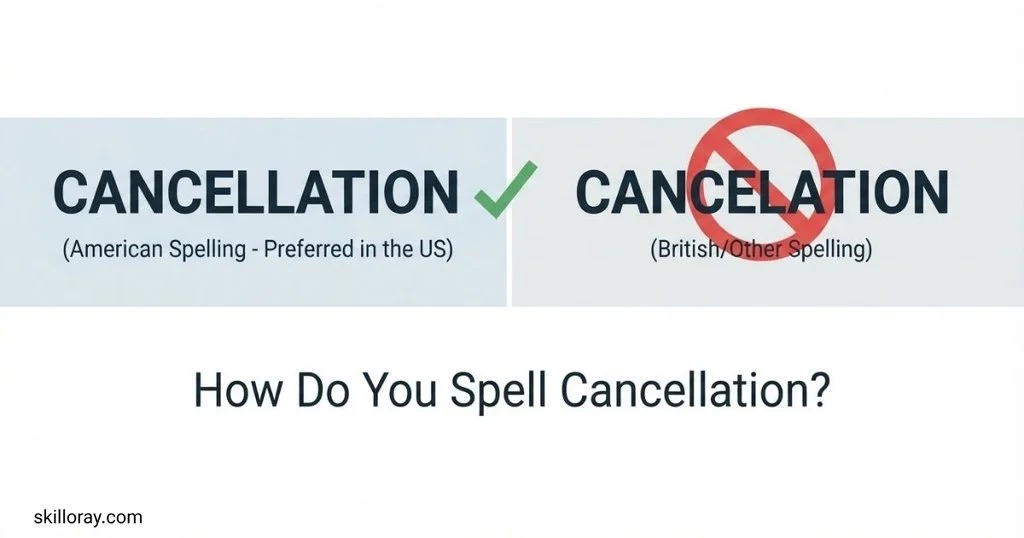
The standard spelling is:
C-A-N-C-E-L-L-A-T-I-O-N
The spelling contains double l:
cancellation
A common mistake is to write:
cancelation
Although cancelation is accepted as a US variant, cancellation is the more broadly recognized spelling.
How Do You Pronounce Cancellation?
Cancellation is pronounced approximately:
KAN-suh-LAY-shun
Cambridge gives the pronunciation as:
UK: /ˌkæn.səlˈeɪ.ʃən/
US: /ˌkæn.səlˈeɪ.ʃən/
The main stress falls on LAY:
can-suh-LAY-shun
The spelling difference between cancelation and cancellation does not normally create a meaningful pronunciation difference.
Is Cancelation or Cancellation More Common?
Cancellation is more common and is the safer general-purpose spelling.
You are especially likely to see cancellation in:
- formal documents
- business communication
- academic writing
- news writing
- policies
- websites
- customer-service information
- British English
Cancelation exists as a US variant, but it is less common.
So if you’re unsure which spelling to choose, cancellation is usually the best option.
Cancelation or Cancellation in AP Style
If you’re following Associated Press style, use cancellation.
The Associated Press Stylebook’s published guidance lists the forms cancel, canceled, canceling, cancellation.
So an AP-style sentence would be:
The company announced the cancellation of the event.
The related verb forms follow AP’s US-style spelling:
The company canceled the event.
This is a useful distinction: AP uses canceled for the past tense but cancellation for the noun.
Cancelation or Cancellation: Common Mistakes
Mistake 1: Assuming Cancelation Is Always Wrong
Not quite.
Because cancelation is recognized as a US variant, it isn’t accurate to label it universally incorrect.
For general writing, though, cancellation is usually the better choice.
Mistake 2: Assuming the Verb Must Have the Same Spelling Pattern
The noun cancellation and the past form canceled don’t necessarily follow the same spelling pattern.
For example:
The event was canceled.
The cancellation was announced yesterday.
Both forms can be correct in US English.
Mistake 3: Treating Regional Spelling as a Grammar Error
A spelling difference doesn’t necessarily mean that one form is grammatically incorrect.
English contains many regional spelling differences. In this case, cancelation is recognized as a US variant, while cancellation is the established standard form used broadly, especially in British English.
What Is the Plural of Cancellation?
The plural is:
cancellations
Simply add -s to cancellation.
Examples:
- The airline reported several cancellations.
- We received multiple cancellations this morning.
- The weather caused numerous event cancellations.
What Is the Possessive Form of Cancellation?
The singular possessive form is:
cancellation’s
For example:
The cancellation’s impact was greater than expected.
However, writers often restructure the sentence to avoid an awkward possessive.
The plural possessive form is:
cancellations’
For example:
The cancellations’ effects were difficult to predict.
In everyday writing, these possessive forms are less common than simply using of constructions.
What Are Some Synonyms for Cancellation?
Depending on the context, possible alternatives include:
- withdrawal
- termination
- revocation
- annulment
- abandonment
- postponement
- call-off
- discontinuation
These aren’t always exact substitutes.
For example, postponement usually means something has been moved to a later time, while cancellation means the planned activity has been stopped.
So choose the synonym according to the actual meaning you want.
How Do You Say Cancellation in Spanish?
The most common Spanish translation is:
cancelación
Depending on the context, other translations may be appropriate. Cambridge lists cancelación among the Spanish translations of cancellation.
For example:
cancellation of the reservation → cancelación de la reserva
The exact Spanish wording can change depending on whether you’re discussing an appointment, order, reservation, contract, or event.
Cancellation Meaning in Simple English
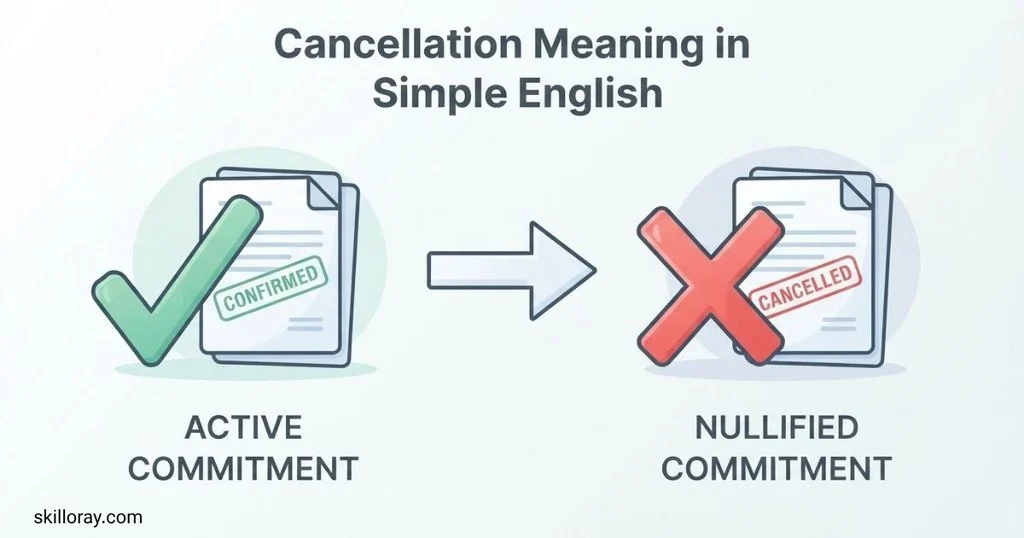
In simple English, cancellation means:
the act of stopping something that was planned, arranged, ordered, or scheduled.
For example:
The cancellation of the game means the game will not happen as planned.
It can describe something as small as canceling an appointment or as significant as canceling a major event.
Quick Comparison of Cancelation or Cancellation
| Question | Answer |
| Which spelling is most widely preferred? | Cancellation |
| Is cancelation a word? | Yes, as a US variant |
| Is cancellation correct in US English? | Yes |
| Is cancellation standard in British English? | Yes |
| Which spelling should I use generally? | Cancellation |
| How is cancellation pronounced? | KAN-suh-LAY-shun |
| What part of speech is cancellation? | Noun |
| What is the plural? | Cancellations |
| What is the Spanish translation? | Cancelación |
| What does cancellation mean? | The act of stopping something planned or arranged |
FAQs
Is cancelation or cancellation correct?
Both spellings can be correct. Cancellation is the standard and more widely preferred spelling, while cancelation is recognized as a US variant.
Is cancelation a misspelling?
Not necessarily. Cancelation is an accepted US spelling variant, although it is much less common than cancellation.
Should I use cancelation or cancellation?
For most readers, use cancellation. It is the safest general-purpose spelling and is standard in British English.
Is cancellation spelled with one l or two?
Cancellation is spelled with two l’s:
c-a-n-c-e-l-l-a-t-i-o-n
Does AP style use cancelation or cancellation?
AP style uses cancellation. AP’s published style guidance lists cancel, canceled, canceling, cancellation.
Is cancellation British or American English?
Cancellation is standard in both British and American English. Cancelation is recognized as a US variant.
Is cancellation a noun or verb?
Cancellation is a noun. The verb is cancel.
For example:
I need to cancel the appointment.
The cancellation was unexpected.
What is the correct plural of cancellation?
The plural is cancellations.
Example:
Several flight cancellations were announced.
How do you pronounce cancellation?
It is pronounced approximately KAN-suh-LAY-shun, with the main stress on LAY. Cambridge gives /ˌkæn.səlˈeɪ.ʃən/ for both UK and US pronunciation.
What is cancellation in Spanish?
The common Spanish translation is cancelación. The exact translation can depend on the context.
Conclusion
So, cancelation or cancellation? If you want the clearest answer, choose cancellation.
It is the standard spelling most readers will recognize, particularly in British English and formal writing. Cancelation is not simply an error, however; it is an accepted US variant.
For everyday writing, business communication, academic work, or content intended for a broad English-speaking audience, cancellation is the safest choice. If you’re following a specific US style guide, check its preferred spelling and use it consistently.

I am Daniel Carter, a grammar enthusiast and language educator with over 10 years of experience helping students and professionals improve their English writing and communication skills. I enjoy simplifying complex grammar rules into easy-to-understand lessons that anyone can follow. My goal is to help learners write with confidence, avoid common mistakes, and develop strong communication skills for academic and professional success. I regularly create practical grammar guides, writing tips, and language resources that make learning both enjoyable and effective.
Books: Mastering English Grammar and The Complete Guide to Better Writing
 James Walker
 Olivia Brown