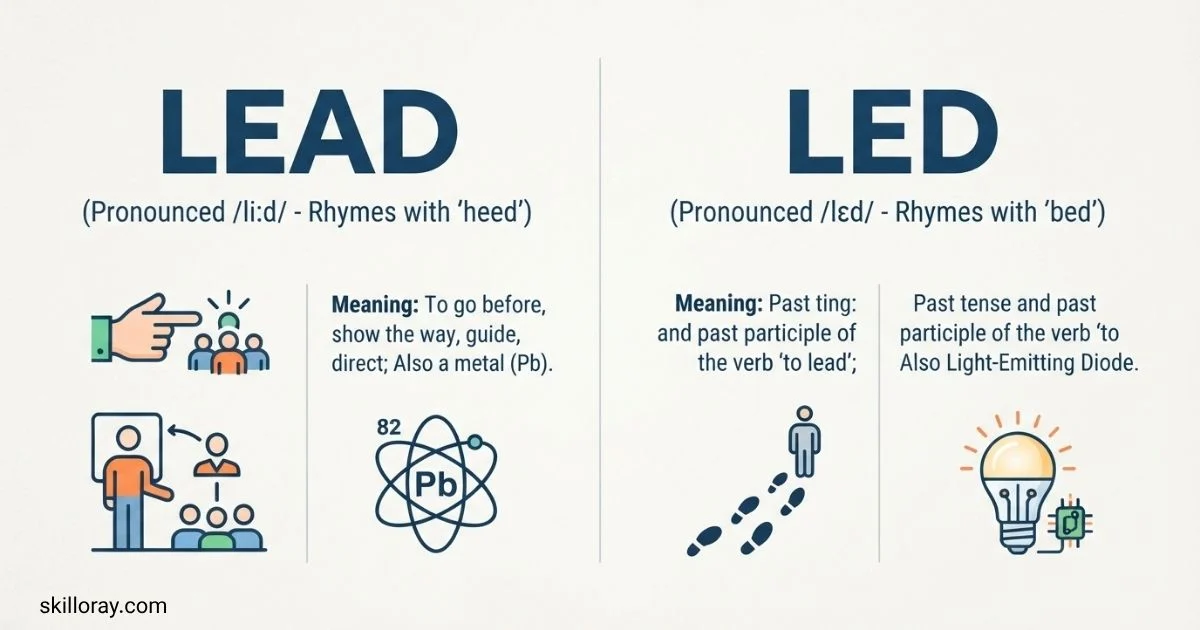
Have you ever paused while writing and wondered whether you should use “lead” or “led”? I know how confusing these two words can be because they look almost identical but can have very different meanings and pronunciations.
You may see “lead” or “led” used in everyday writing, work, school, and conversation. If you are unsure which word fits your sentence, you are not alone—and learning the simple difference can make your writing much clearer.
In this guide, I’ll break down lead or led in a simple, practical way. You’ll learn what each word means, how to pronounce it, when to use it, and see clear examples that make the difference easy to remember.
Lead or Led: Quick Answer
Lead is the present form of the verb: I lead the team every Monday.
Led is the past tense of lead: She led the team last year.
Lead can also be a noun referring to the metal, pronounced like “led.” The word used in a pencil is also pronounced “led,” although modern pencil cores are generally made from graphite and clay rather than metallic lead.
| Form | Main use | Pronunciation | Example |
| lead | Present-tense verb | “leed” /liːd/ | I lead the group. |
| led | Past tense of lead | “led” /lɛd/ | I led the group yesterday. |
| lead | Metal | “led” /lɛd/ | Lead is a heavy metal. |
| lead | Pencil material | “led” /lɛd/ | My pencil has a broken lead. |
What Does Lead Mean?
Lead has several meanings, but one of the most common is the verb meaning to guide, direct, manage, or go in front of others.
When used as a verb in the present tense, it is pronounced “leed.”
For example:
- I lead the project.
- She leads the department.
- They lead the discussion.
- He wants to lead the team.
- Good managers lead by example.
The word can also be a noun or adjective in other contexts, so its pronunciation depends on its meaning.
Lead as a Verb
As a verb, lead means to guide someone or something toward a place, goal, action, or result.
Examples:
- The coach will lead the players onto the field.
- She leads a team of designers.
- His advice may lead to a better decision.
- I usually lead the morning meeting.
The past tense is led, not leaded.
Present: I lead the team.
Past: I led the team.
What Does Led Mean?
Led is the past tense and past participle of the verb lead.
It describes an action that happened in the past.
Examples:
- She led the meeting yesterday.
- He led us through the building.
- The teacher led the students through the exercise.
- Our captain led the team to victory.
- They led the project last year.
The important point is simple:
If the action of guiding or directing already happened, use “led.”
Lead or Led Pronunciation
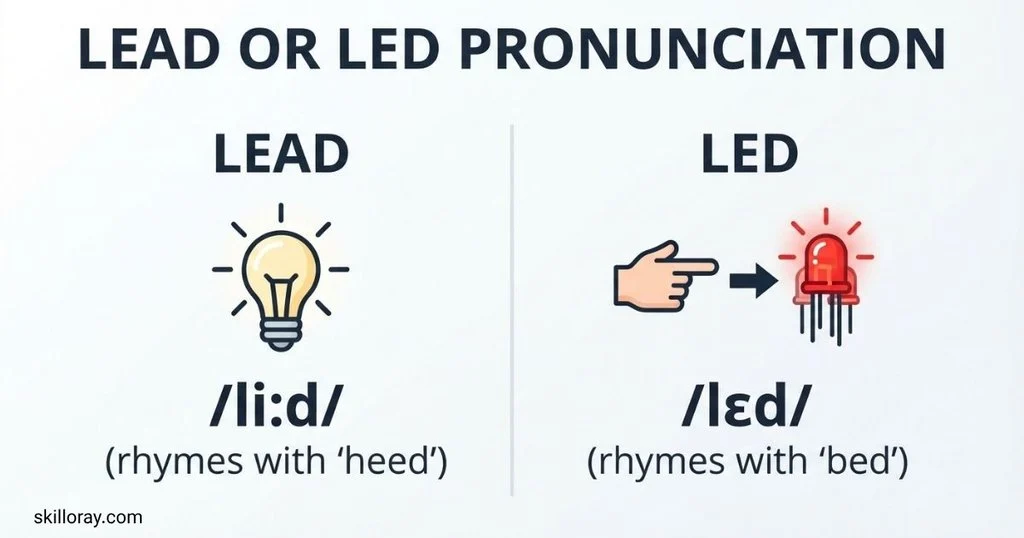
One reason this pair is confusing is that lead has two common pronunciations.
Lead as a Verb: “Leed”
When lead means to guide or direct, it is pronounced:
/liːd/ — similar to “leed.”
Examples:
- lead a team
- lead a meeting
- lead a discussion
- lead the way
The present-tense verb lead sounds different from led.
Led: “Led”
Led is pronounced:
/lɛd/ — like the word “led.”
Examples:
- led the team
- led the meeting
- was led by
- has led the project
Lead as a Metal: “Led”
When lead refers to the metal, it is also pronounced:
/lɛd/
For example:
- Lead is a dense metal.
- The material contains lead.
- Lead exposure can be dangerous.
So the spelling lead can have two pronunciations:
- /liːd/ — to guide or direct
- /lɛd/ — the metal
Lead or Led in a Sentence
The easiest way to choose between lead or led is to determine whether the action is happening now or happened in the past.
Use Lead for a Present Action
Use lead when someone currently guides, directs, or manages something.
- I lead the marketing team.
- She leads the class.
- They lead the project.
- He will lead the discussion tomorrow.
Use Led for a Past Action
Use led when the action happened in the past.
- I led the team last year.
- She led the meeting yesterday.
- They led the project before I joined.
- He led us to the correct room.
A useful memory trick is:
Lead → present
Led → past
Lead or Led Past Tense
The past tense of lead is led.
This is an irregular verb, so you do not form its past tense by adding -ed.
| Tense | Form | Example |
| Present | lead | I lead the team. |
| Third-person present | leads | She leads the team. |
| Past | led | She led the team yesterday. |
| Past participle | led | She has led the team before. |
| Present participle | leading | She is leading the team. |
A common mistake is writing leaded when you mean the past tense of lead. In standard English, the past form is led.
Incorrect: She leaded the team last year.
Correct: She led the team last year.
Lead or Led a Team
Use lead a team when talking about leading a team in the present or future.
Examples:
- I lead a team of five employees.
- She will lead a team next month.
- He wants to lead a team someday.
Use led a team when describing a past situation.
Examples:
- I led a team during my previous job.
- She led a team for three years.
- He led a team through a difficult project.
So:
I lead a team now.
I led a team before.
Student Lead or Led
The correct choice depends on what you mean.
Use student-led when a student or students are directing, organizing, or controlling an activity.
Examples:
- It was a student-led project.
- The school organized a student-led discussion.
- We joined a student-led campaign.
- The workshop included several student-led activities.
Here, led works as part of a compound adjective meaning that the student or students were responsible for leading the activity.
If you mean that a student currently guides something as a verb, use student leads.
- The student leads the discussion every Friday.
- One student leads the group.
Instructor Lead or Led
The same principle applies to instructor-led.
Use instructor-led when an instructor directs or teaches the activity.
Examples:
- We offer instructor-led training.
- The course includes instructor-led sessions.
- She attended an instructor-led workshop.
When using the verb in the present tense, use instructor leads:
- The instructor leads the class.
- The instructor leads the discussion.
The phrase instructor-led is especially common when describing courses, training programs, workshops, and educational sessions.
To Be Lead or Led
The correct form is usually to be led when you mean that someone is being guided or directed.
Examples:
- I want to be led by an experienced professional.
- The students need to be led through the process.
- The group was designed to be led by a trained instructor.
Here, led is the past participle used after to be in a passive construction.
Incorrect: The students need to be lead through the activity.
Correct: The students need to be led through the activity.
However, to lead is correct when the person is performing the action:
- I want to lead the team.
- She hopes to lead the project.
- He plans to lead the discussion.
Being Lead or Led
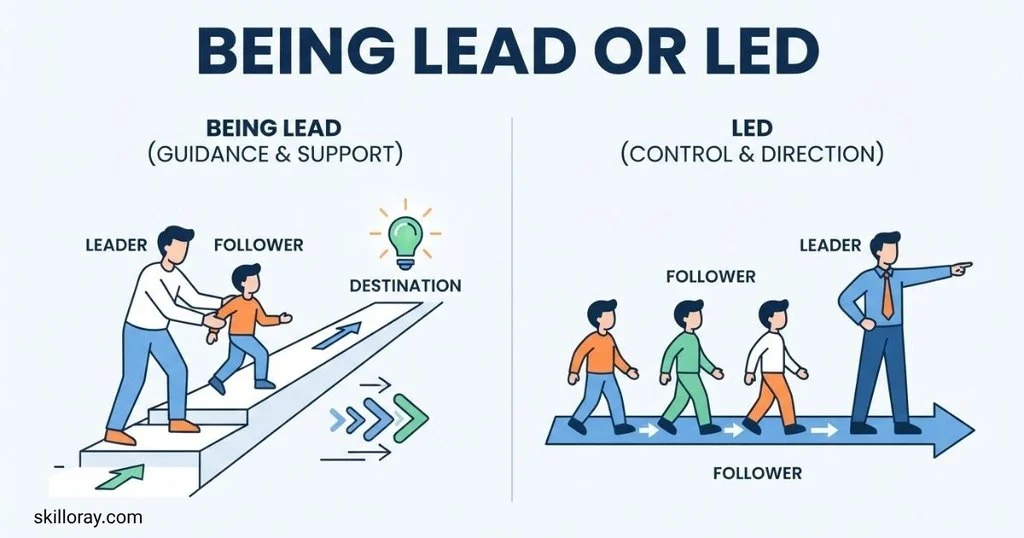
When describing someone receiving guidance in a passive construction, use being led.
Examples:
- I don’t mind being led by someone experienced.
- The group enjoyed being led through the museum.
- The students were comfortable being led by their instructor.
Use being led, not being lead, when lead means guided or directed.
However, being a lead can have a different meaning in some contexts, such as describing someone who holds a leading role.
If You Feel Lead or Led
The correct word depends on the meaning of the sentence.
If you mean that you feel guided or directed, use led:
- I felt led in the right direction.
- She felt led by her mentor.
- We felt led toward the right decision.
If you mean the physical sensation or presence of the metal, lead may be correct:
- I felt the weight of the lead in my hand.
So, if your intended meaning is “I felt guided,” the correct expression is “I felt led.”
Lead or Led Mineral
When lead refers to the chemical element or metal, it is pronounced “led.”
Lead is a chemical element with the symbol Pb and atomic number 82. It is a heavy metal that has been used historically in products such as batteries, pipes, pigments, and other industrial materials.
In this meaning, the spelling is lead, but the pronunciation is the same as led.
This is one reason English learners can find the word confusing. Two completely different meanings can share the same spelling while having different pronunciations.
- lead /liːd/ = guide or direct
- lead /lɛd/ = the metal
- led /lɛd/ = past tense of lead
Pencil Lead or Led
The correct expression is pencil lead, not pencil led.
Here, lead is a noun describing the material inside a pencil or mechanical pencil.
It is pronounced “led.”
For example:
- I need a new pencil lead.
- The pencil lead broke while I was writing.
- This mechanical pencil uses thin lead.
Despite the name, traditional pencil “lead” is not metallic lead. Modern pencil cores are generally made from graphite mixed with clay and other materials.
The expression pencil lead remains standard because of the historical name.
Lead or Led Synonyms
The appropriate synonym depends on the meaning.
When lead means to guide or direct, possible alternatives include:
- guide
- direct
- manage
- supervise
- command
- head
- oversee
- conduct
For example:
She leads the team.
could be expressed as:
She manages the team.
When led describes a completed action, you can often replace it with a past-tense form such as:
- guided
- directed
- managed
- supervised
- headed
- commanded
For example:
He led the group through the building.
could become:
He guided the group through the building.
The best synonym depends on the exact context.
Lead or Led: Common Mistakes
Mistake 1: Using Lead for a Past Action
Incorrect: She lead the meeting yesterday.
Correct: She led the meeting yesterday.
Because the meeting already happened, use the past tense led.
Mistake 2: Using Lead After “Was”
Incorrect: The class was lead by the instructor.
Correct: The class was led by the instructor.
The passive construction requires the past participle led.
Mistake 3: Writing “Leaded” as the Past Tense
Incorrect: He leaded the group last week.
Correct: He led the group last week.
The standard past tense of lead is led.
Mistake 4: Confusing Pencil Lead With Led
Incorrect: My pencil led broke.
Correct: My pencil lead broke.
Here, lead is a noun referring to the material in the pencil.
Lead or Led Examples
Here are some simple examples that show the difference clearly:
- I lead the team every Monday.
- She led the team last year.
- He will lead the meeting tomorrow.
- He led the meeting yesterday.
- Good teachers lead their students carefully.
- The teacher led the students through the lesson.
- I want to lead the project.
- She has led several successful projects.
- The course is instructor-led.
- The project was student-led.
How to Remember Lead or Led
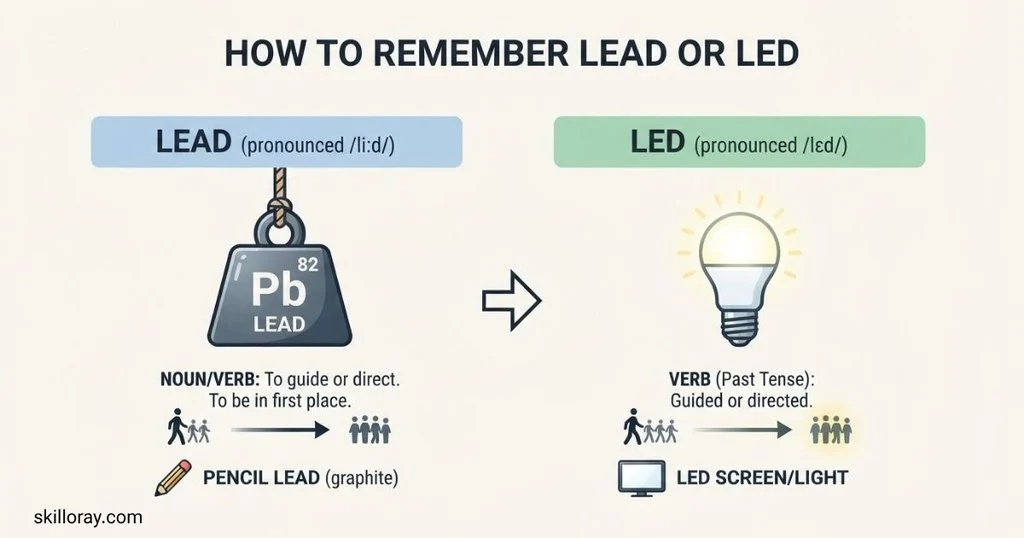
A simple way to remember the difference is to connect led with completed actions.
If someone is guiding or directing something now, use lead:
I lead the team.
If someone guided or directed something in the past, use led:
I led the team last year.
You can also remember the pronunciation:
Lead meaning guide → sounds like “leed.”
Led → sounds like “led.”
Lead meaning metal → also sounds like “led.”
This pronunciation distinction can help you recognize the intended meaning when you hear the word spoken aloud.
Lead or Led: Which One Should You Use?
Choose lead when you mean to guide, direct, or manage something in the present or future.
Choose led when you mean that the guiding or directing happened in the past.
Choose lead when you mean the metal or the material traditionally called pencil lead. In those meanings, lead is pronounced like “led.”
The key distinction is:
| If you mean… | Use |
| Guide or direct now | lead |
| Guide or direct in the past | led |
| The metal | lead |
| Material inside a pencil | lead |
| Guided or directed in a passive phrase | led |
| A current action | lead |
| A completed action | led |
FAQs About Lead or Led
Is lead or led correct?
Both lead or led are correct words, but they have different uses. Lead is the present form of the verb meaning to guide or direct, while led is its past tense and past participle.
Is the past tense of lead led?
Yes. The past tense of lead is led.
For example:
Present: She leads the team.
Past: She led the team.
Is it lead or led a team?
Use lead a team for a present or future action. Use led a team for a past action.
- I lead a team now.
- I led a team last year.
Is pencil lead spelled lead or led?
It is spelled pencil lead. In this expression, lead is a noun and is pronounced like “led.”
Is it student-led or student-lead?
When you mean that students direct or organize something, the standard compound adjective is student-led.
Example: The school hosted a student-led event.
Is it instructor-led or instructor-lead?
When an instructor directs or teaches an activity, use instructor-led.
Example: The program includes instructor-led training.
Is “to be led” correct?
Yes. To be led is correct when someone is being guided or directed.
Example: The students were ready to be led through the exercise.
Is “being led” correct?
Yes. Being led is correct when someone is receiving guidance or direction.
Example: She was comfortable being led by an experienced instructor.
Why is lead sometimes pronounced like led?
English spelling preserves forms from different historical sources, so the spelling lead represents more than one word or meaning. As a result, lead meaning “guide” is pronounced /liːd/, while lead meaning the metal is pronounced /lɛd/.
Conclusion
The easiest way to choose lead or led is to focus on the time of the action. Lead is the present-tense verb meaning to guide or direct, while led is the past tense and past participle. The spelling lead also refers to the metal and to pencil lead, but those meanings are pronounced like “led.”
Once you separate the meanings, the distinction becomes straightforward: lead for guiding in the present or future, led for guiding in the past, and lead for the metal or pencil material.

I am Olivia Brown, a professional English editor and grammar writer who believes that great writing begins with a strong foundation in grammar. I have spent years creating educational resources that help students and professionals improve their writing, avoid common errors, and communicate more effectively. I strive to provide clear explanations and practical examples that make grammar easy to understand and apply.
Books: English Grammar Essentials and Modern Writing Success
 James Walker
 Daniel Carter