Have you ever paused while writing and wondered whether “use to” or “used to” is correct? I know this small difference can feel confusing, especially when both forms sound almost the same in everyday speech.
You want your English to sound natural and grammatically correct, and that starts with knowing when each form belongs. I’ll break down the difference in a simple way so you can understand the rule without memorizing complicated grammar terms.
By the end, you’ll know exactly when to use “use to” or “used to,” with clear examples that make the difference easy to remember. You’ll also be able to spot and avoid the most common mistakes.
Use to or Used to: (Quick Answer)
Both use to or used to can be correct, but they appear in different grammatical structures.
| Form | Main use | Example |
| used to + base verb | Past habit or past situation | I used to play football. |
| did + use to + base verb | Question about a past habit | Did you use to play football? |
| didn’t + use to + base verb | Negative about a past habit | I didn’t use to like coffee. |
| be used to + noun/gerund | Be accustomed to something | I am used to waking up early. |
| get used to + noun/gerund | Become accustomed to something | She is getting used to her new job. |
So, “used to” is normally the form you need in an ordinary affirmative sentence, while “use to” commonly appears after the auxiliary “did.”
What Does Used to Mean?
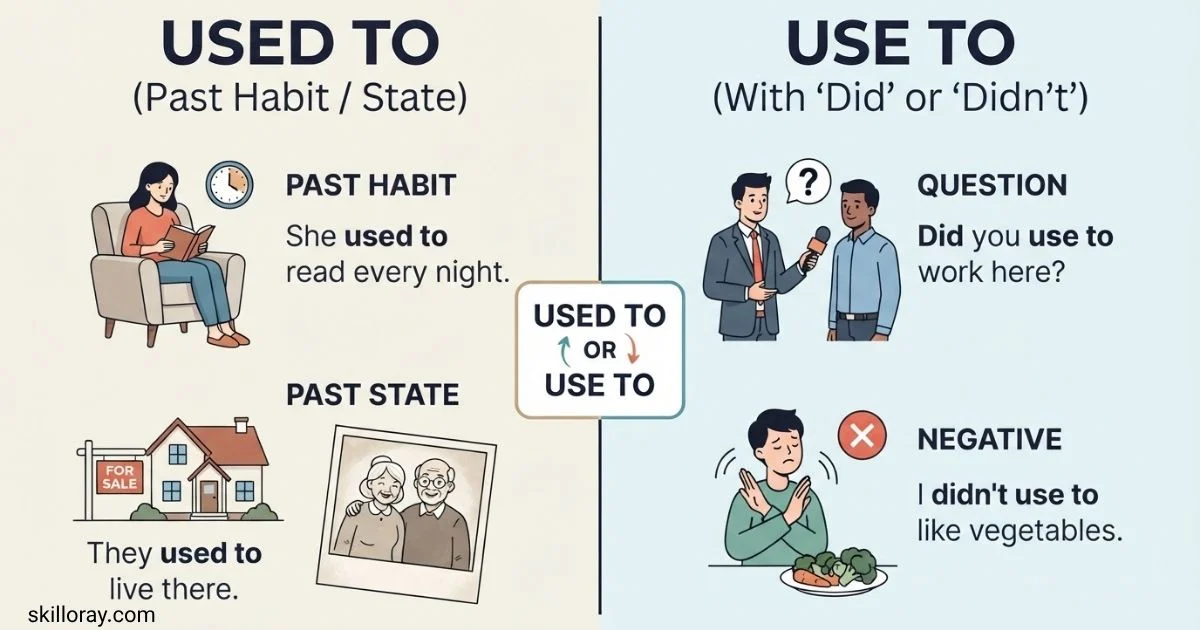
Used to is used to describe something that happened regularly in the past or a situation that was true in the past but is no longer true.
The basic structure is:
subject + used to + base verb
Examples:
- I used to walk to school.
- She used to live in London.
- We used to visit our grandparents every summer.
- He used to play tennis.
- They used to have a small house.
The important point is that used to refers to a past habit or past state.
Used to for Past Habits
You can use used to when something happened repeatedly in the past.
- I used to drink tea every morning.
- My father used to take us fishing.
- We used to play outside after school.
- She used to read before going to bed.
These sentences suggest that the habit existed in the past but does not necessarily continue now.
Used to for Past States
Used to can also describe a past situation or state.
- I used to live in Karachi.
- She used to be very shy.
- He used to have long hair.
- There used to be a shop here.
This use is different from simply describing a repeated action. It tells the reader that a particular condition or situation existed in the past.
What Does Use to Mean?
Use to appears most commonly after did or didn’t when talking about past habits.
Examples:
- Did you use to play football?
- Did she use to live here?
- I didn’t use to like vegetables.
- We didn’t use to have a car.
- He didn’t use to wake up early.
Why does the spelling change?
Because did already carries the past tense. After did, the main verb normally returns to its base form.
Compare:
- You used to play football.
- Did you use to play football?
- You didn’t use to play football.
This is the same general grammatical principle seen in other sentences:
- She went home.
- Did she go home?
- She didn’t go home.
After did, we use the base form of the verb.
Is It Use to or Used to in a Sentence?
It depends on the sentence structure.
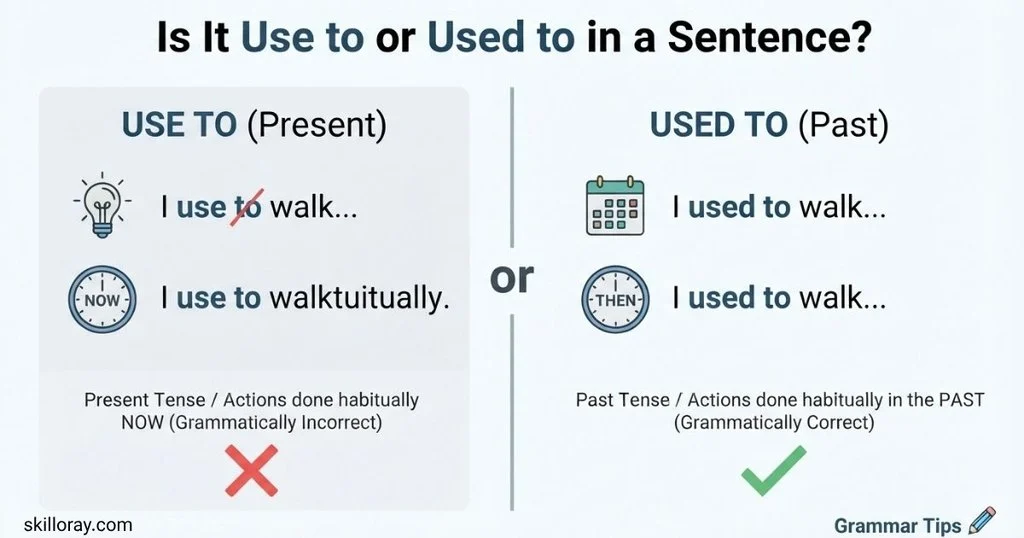
Use used to in a normal affirmative statement:
I used to play basketball.
Use use to after did:
Did you use to play basketball?
Use use to after didn’t:
I didn’t use to play basketball.
A useful way to remember it is:
No “did” → used to
With “did” or “didn’t” → use to
This rule is especially useful for English learners who are unsure about questions or negative sentences.
Did You Use to or Did You Used to?
The standard grammatical form is:
Did you use to…?
For example:
- Did you use to live here?
- Did you use to play football?
- Did you use to watch cartoons?
- Did she use to work here?
The reason is that did already marks the sentence as past tense, so use remains in its base form.
Did you used to…? is also heard in informal speech and writing, partly because speakers associate the phrase with used to. However, did you use to…? is the clearest standard form to use in careful English.
Didn’t You Use to or Didn’t You Used to?
The standard form is:
Didn’t you use to…?
Examples:
- Didn’t you use to live in Lahore?
- Didn’t you use to work here?
- Didn’t you use to play cricket?
- Didn’t she use to teach English?
Again, didn’t already contains the past-tense auxiliary, so the following verb is normally the base form use.
Correct and Incorrect Examples
Correct:
Didn’t you use to play tennis?
Less standard:
Didn’t you used to play tennis?
For formal writing or English learning, choose didn’t you use to.
I Am Use to or Used to?
If you want to say that something is familiar to you or no longer feels unusual, use:
I am used to…
Not:
I am use to…
Examples:
- I am used to waking up early.
- I am used to the noise.
- I am used to working under pressure.
- I am used to cold weather.
- I am used to driving in traffic.
Here, used to has a different meaning from the past-habit construction.
I used to wake up early means it was a past habit.
I am used to waking up early means waking up early is familiar or normal for me now.
The grammar after used to is also different:
- used to + base verb → past habit
- be used to + noun or -ing form → accustomed to something
Getting Use to or Getting Used to?
The correct phrase is:
getting used to
For example:
- I am getting used to my new school.
- She is getting used to waking up early.
- We are getting used to the new schedule.
- He is getting used to driving in heavy traffic.
Getting use to is not the standard form when you mean “becoming accustomed to something.”
The structure is:
get + used to + noun or -ing form
Examples:
- get used to the weather
- get used to working late
- get used to living alone
- get used to speaking English
Used to or Be Used to: What’s the Difference?
These two structures look similar but have different meanings.
Used to + base verb describes a past habit or past state.
I used to work at a bank.
This means working at a bank was a past situation.
Be used to + noun or -ing form means being accustomed to something.
I am used to working at a bank.
This means working at a bank is familiar or normal for me.
Notice the grammar:
| Structure | Meaning | Example |
| used to + verb | Past habit or state | I used to work late. |
| be used to + noun | Be accustomed to something | I am used to the noise. |
| be used to + -ing | Be accustomed to an activity | I am used to working late. |
| get used to + noun | Become accustomed to something | I got used to the noise. |
| get used to + -ing | Become accustomed to an activity | I got used to working late. |
This distinction is one of the most important parts of understanding use to or used to.
Use to or Used to in Questions
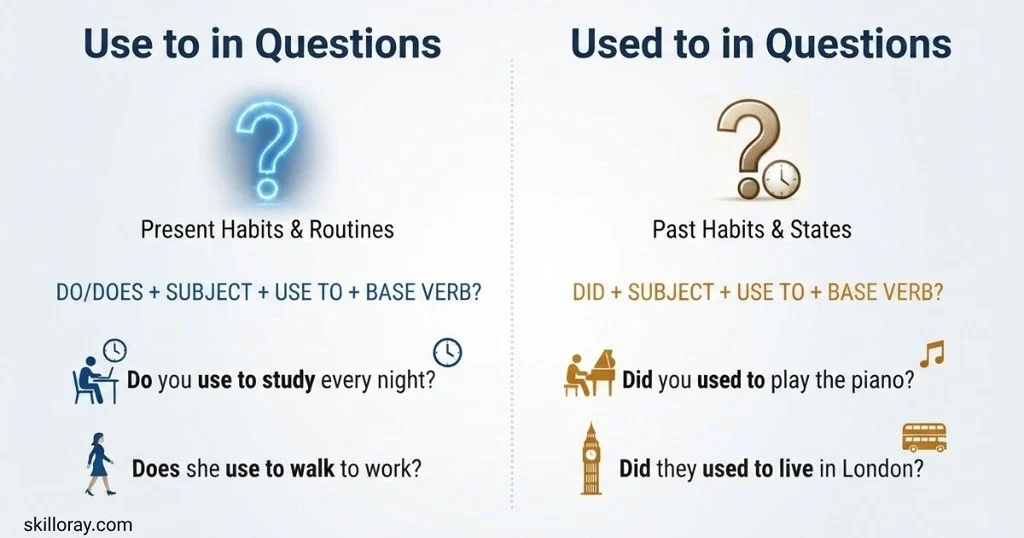
When forming a question about a past habit, use:
Did + subject + use to + base verb?
Examples:
- Did you use to play football?
- Did he use to live in London?
- Did she use to study here?
- Did they use to visit you?
- Did your family use to travel often?
The pattern is simple:
Did + subject + use to + verb?
More Question Examples
- Did you use to watch this show?
- Did your brother use to play cricket?
- Did she use to work at this company?
- Did they use to come here every weekend?
- Did you use to have a dog?
- Did he use to ride a bicycle to school?
- Did your parents use to live nearby?
- Did you use to drink coffee?
- Did she use to teach English?
- Did your friends use to visit you?
Use to or Used to in Negative Sentences
For a negative sentence about a past habit, the usual structure is:
subject + didn’t + use to + base verb
Examples:
- I didn’t use to drink coffee.
- She didn’t use to like spicy food.
- We didn’t use to have a computer.
- He didn’t use to exercise regularly.
- They didn’t use to live here.
The same rule applies: didn’t carries the past tense, so use the base form use afterward.
Use to or Used to Past Tense
Used to itself is a special construction that refers to past habits or past states.
For example:
I used to walk to school.
The phrase tells us that walking to school was a regular past habit.
When you make a question or negative sentence with did, the construction becomes:
Did you use to walk to school?
I didn’t use to walk to school.
So although used to expresses a past meaning, use appears after did or didn’t because the auxiliary already marks the past tense.
Use to or Used to Exercises
Try completing these sentences with use to or used to.
- I ________ play outside every afternoon.
- Did you ________ live in this neighborhood?
- She didn’t ________ like coffee.
- We ________ visit our grandparents every Sunday.
- Did he ________ work at this company?
- They ________ have a small house.
- I didn’t ________ understand English very well.
- My brother ________ play football at school.
- Did your parents ________ travel often?
- There ________ be a restaurant here.
Answers
- used to
- use to
- use to
- used to
- use to
- used to
- use to
- used to
- use to
- used to
The key is to look for did or didn’t. If either one appears, use use to in this past-habit construction.
Use to or Used to Sentences
Here are some natural examples to help you see the difference in context.
Sentences With Used to
- I used to ride my bike to school.
- She used to live near the beach.
- We used to watch movies together.
- He used to play the guitar.
- They used to visit us every summer.
- My sister used to have long hair.
- I used to wake up early.
- There used to be a bookstore here.
- My grandfather used to tell us stories.
- We used to eat dinner together every evening.
Sentences With Use to
- Did you use to play football?
- Did she use to live here?
- Did they use to visit you?
- I didn’t use to enjoy reading.
- He didn’t use to drink coffee.
- Did your father use to work nearby?
- Didn’t you use to study here?
- We didn’t use to have a car.
- Did she use to teach at this school?
- I didn’t use to understand the rule.
Common Mistakes With Use to or Used to
Mistake 1: Using Used After Did
Incorrect for standard usage:
Did you used to play football?
Correct:
Did you use to play football?
After did, use the base form use.
Mistake 2: Writing Use to in an Affirmative Sentence
Incorrect:
I use to play football when I was young.
Correct:
I used to play football when I was young.
Without did, the past-habit construction normally takes used to.
Mistake 3: Saying I Am Use to
Incorrect:
I am use to the cold weather.
Correct:
I am used to the cold weather.
Here, used to means “accustomed to.”
Mistake 4: Saying Getting Use to
Incorrect:
I am getting use to my new schedule.
Correct:
I am getting used to my new schedule.
After get in this meaning, use used to.
Mistake 5: Confusing Used to With Use
These sentences have different meanings:
I used to work here.
This describes a past situation.
I am used to working here.
This means working here is familiar to me.
The first sentence concerns a past habit or state. The second concerns being accustomed to something.
Is Used to Always Followed by a Verb?
No. It depends on which used to construction you are using.
For a past habit:
used to + base verb
She used to dance.
For being accustomed to something:
be used to + noun or -ing form
She is used to dancing.
For becoming accustomed to something:
get used to + noun or -ing form
She is getting used to dancing.
This is why identifying the meaning first makes the grammar much easier.
Can You Use Used to in the Present Tense?
The past-habit construction used to normally refers to the past.
For example:
I used to live in London.
It tells us about a past situation.
For a present situation involving familiarity, use be used to:
I am used to living in London.
These are not interchangeable because they communicate different ideas.
Use to or Used to Pronunciation
In natural speech, used to in the past-habit construction is often pronounced something like “yoosta” because the words are frequently reduced in connected speech.
The construction can be represented approximately as:
used to → /ˈjuːstə/
The exact pronunciation can vary depending on accent and speaking speed.
In be used to, the pronunciation can sound different because used has the meaning of “accustomed”:
I am used to it.
For English learners, the most important point is to recognize that used to in natural conversation may sound much shorter than it looks when written.
A Simple Way to Remember the Rule
Use this three-part pattern:
Past habit:
used to + verb
I used to swim.
Question or negative:
did/didn’t + use to + verb
Did you use to swim?
I didn’t use to swim.
Accustomed:
be/get + used to + noun or -ing
I am used to swimming.
I am getting used to swimming.
Once you recognize which meaning you need, choosing the correct form becomes much easier.
Use to or Used to Worksheet
Complete the following sentences.
- Sarah ________ walk to school every morning.
- Did you ________ collect stamps?
- I didn’t ________ eat vegetables.
- We ________ live in a small apartment.
- Are you ________ working at night?
- He is getting ________ driving in traffic.
- Did they ________ come here often?
- My father ________ read to me before bed.
- I am ________ waking up early.
- There ________ be a park here.
Worksheet Answers
- used to
- use to
- use to
- used to
- used to
- used to
- use to
- used to
- used to
- used to
Use to or Used to: Quick Reference
| If you mean… | Use this structure | Example |
| A past habit | used to + verb | I used to run. |
| A past state | used to + verb | She used to live here. |
| A question about a past habit | did + use to + verb | Did you use to run? |
| A negative past habit | didn’t + use to + verb | I didn’t use to run. |
| Being accustomed to something | be used to + noun/-ing | I am used to running. |
| Becoming accustomed to something | get used to + noun/-ing | I am getting used to running. |
FAQs
Is use to or used to correct?
Both forms can be correct, depending on the sentence. Use used to for an affirmative statement about a past habit or state. Use use to after did or didn’t in standard questions or negative sentences.
Is it did you use to or did you used to?
Did you use to is the standard form. Because did already marks the past tense, the main verb remains in its base form.
Is I am use to correct?
No. If you mean that something is familiar or normal for you, say I am used to.
I am used to working late.
Is getting use to correct?
No, not when you mean becoming accustomed to something. The standard phrase is getting used to.
I am getting used to my new schedule.
Is used to past tense?
Yes, used to + base verb is used to describe a past habit or past state.
We used to live there.
It can also be part of be used to, where it means being accustomed to something rather than describing a past habit.
Do you use use to after didn’t?
Yes. In the standard past-habit construction, use use to after didn’t.
I didn’t use to like coffee.
Can used to describe a past state?
Yes. It can describe a past condition or situation as well as a repeated past action.
She used to be very shy.
There used to be a store here.
What comes after used to when it means accustomed?
When used to means accustomed, it is normally followed by a noun or an -ing form.
I am used to the noise.
I am used to working late.
What is the easiest way to remember use to or used to?
Remember these three patterns:
used to + verb for a past habit or state, did/didn’t + use to + verb for questions or negatives, and be/get used to + noun or -ing for being or becoming accustomed to something.
Conclusion
The choice between use to or used to becomes much easier once you identify the grammar of the sentence. For a normal statement about a past habit or state, use used to: “I used to play tennis.” For a question or negative sentence with did or didn’t, use use to: “Did you use to play tennis?” or “I didn’t use to play tennis.”
Remember that be used to or get used to has a different meaning. These expressions describe being or becoming accustomed to something. With a little practice, these three patterns become easy to recognize and use correctly.

I am James Walker, an English language specialist with extensive experience in grammar, editing, and academic writing. I enjoy helping students, bloggers, and professionals strengthen their writing by explaining grammar concepts in a clear and engaging way. My focus is on providing accurate, practical, and easy-to-follow guidance that helps learners communicate more effectively in everyday and professional situations.
Books: Perfect English Grammar Handbook and Advanced Writing Techniques
 Daniel Carter
 Olivia Brown