Have you ever stopped while writing because you weren’t sure whether to use therefore or therefor? I know how frustrating that small doubt can feel, especially when you want your sentence to sound clear and professional.
You may see therefore often, while therefor looks almost identical and can easily cause confusion. In this guide, I’ll break down the difference in simple terms so you can confidently choose the right word.
By the end, you’ll know what each word means, when you should use it, and how it works in real sentences. You can use the examples below to avoid this common mistake and make your writing more accurate.
Therefore or Therefor: Quick Answer
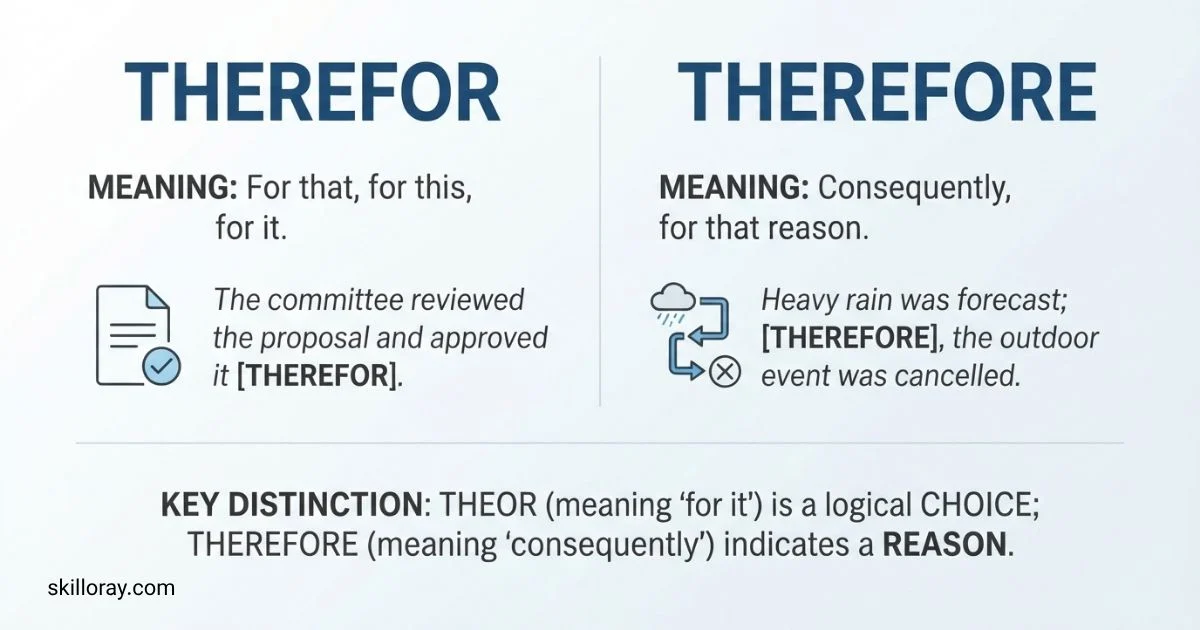
Both “therefore” or “therefor” are correct English words, but they have different meanings and uses.
- Therefore means as a result, consequently, or for that reason.
- Therefor means for that, for it, or in exchange for that and is uncommon in everyday English.
- Therefore is the normal choice in essays, emails, reports, conversations, and general writing when you mean “as a result.”
- Therefor is mainly encountered in formal, legal, technical, or older usage.
Quick comparison
| Form | Meaning | Typical use | Example |
| therefore | as a result; for that reason | General, academic, professional writing | It was raining; therefore, we stayed inside. |
| therefor | for that; for it; in exchange for that | Formal or legal writing | The payment made therefor was recorded. |
The key difference is meaning, not British or American spelling.
What Does Therefore Mean?
Therefore is an adverb used to introduce a result, conclusion, or logical consequence. It can usually be understood as “as a result,” “for that reason,” “consequently,” or “thus.”
For example:
- The store was closed; therefore, we went home.
- She studied hard; therefore, she felt prepared for the exam.
- The evidence was incomplete; therefore, the decision was postponed.
- He was feeling ill and therefore stayed home.
In each sentence, the second idea follows from the first.
Therefore in a sentence
Here are some natural examples:
- The road was flooded; therefore, we took another route.
- I had already finished the work; therefore, I left early.
- The weather was severe; therefore, the event was canceled.
- She missed the bus and therefore arrived late.
- The instructions were unclear; therefore, I asked for help.
- The company reduced its costs; therefore, profits increased.
- He had no valid ticket; therefore, he could not enter.
- The evidence was convincing; therefore, the claim was accepted.
- The machine was damaged; therefore, production stopped.
- We had limited time; therefore, we focused on the most important tasks.
What Does Therefor Mean?
Therefor is a real English word, but it has a very different meaning from therefore.
It can mean “for that,” “for it,” “for this purpose or thing,” or “in exchange for that.” Modern dictionaries describe it as uncommon, archaic in some British usage, or particularly associated with formal and legal language.
For example:
- The applicant submitted the required documents and paid the fee therefor.
- The contract specifies the payment due therefor.
- The parties agreed to compensation therefor.
In ordinary modern English, a writer would often choose a clearer phrase such as “for it,” “for that,” or “for this purpose” instead.
Therefor in a sentence
Examples of legitimate usage include:
- The buyer received the goods and paid therefor.
- The application requires supporting documents therefor.
- The company received compensation therefor.
- The agreement specifies the amount payable therefor.
- The parties accepted the terms and received consideration therefor.
These examples have a formal tone. You are unlikely to need therefor in ordinary conversation.
Is Therefor a Misspelling of Therefore?
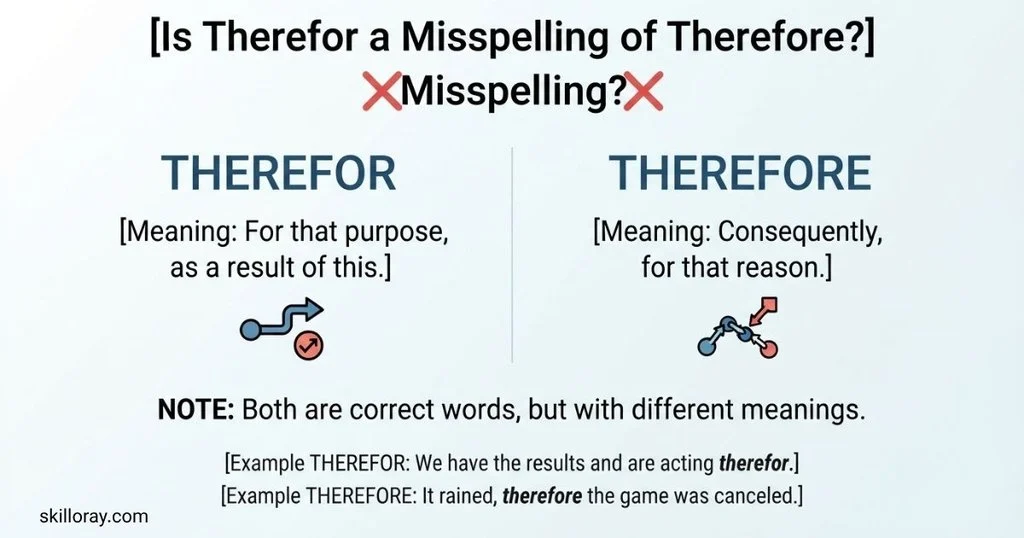
Not necessarily.
This is one of the most important points to remember. Therefor is not simply an incorrect spelling of therefore. The two are separate words with different meanings.
If you write:
The meeting was canceled; therefore, we went home.
You mean “as a result.”
If you write:
The company paid the fee therefor.
You mean roughly “paid the fee for it or for that.”
Therefore, removing the final e can change the word rather than simply create a spelling error.
Therefore or Therefor in UK English
If you are writing in British English, therefore is still the normal word when you mean “as a result” or “for that reason.”
For example:
The train was delayed; therefore, we arrived late.
Therefor also exists in British English, but dictionaries identify it as archaic or uncommon.
So, therefor should not be treated as the British spelling of therefore. The difference is primarily about meaning and usage.
UK examples
Therefore:
The application was incomplete; therefore, it could not be processed.
Therefor:
The required documentation therefor was attached to the application.
The first sentence expresses a consequence. The second uses therefor in a formal sense referring back to something previously mentioned.
Therefore or Therefor in American English
American English also uses both words, but therefore is vastly more common in ordinary writing.
For example:
The deadline had passed; therefore, the application was rejected.
Therefor can appear in formal or legal language:
The payment made therefor was recorded in the agreement.
American dictionaries recognize therefor as a word meaning “for or in exchange for that or this; for it.”
So this is not simply a British English or American English spelling difference.
Therefore or Therefor: Meaning Difference
The easiest way to remember the difference is to connect each word with its meaning.
| Form | Think of it as | Meaning |
| therefore | “for that reason” | as a result |
| therefor | “for that” | for it or for that thing |
Therefore
The store was closed; therefore, we left.
Meaning:
The store was closed; as a result, we left.
Therefor
The buyer received the equipment and paid therefor.
Meaning:
The buyer received the equipment and paid for it.
This simple substitution test can help you choose the right word.
If “as a result” makes sense, use therefore.
If “for it” or “for that” makes sense, therefor may be appropriate.
How Do You Spell Therefore?
The standard spelling for the common adverb meaning “as a result” is:
therefore
It ends with -fore, not simply -for.
Correct:
The weather changed; therefore, we canceled the trip.
Common mistake:
The weather changed; therefor, we canceled the trip.
The second sentence uses a real word, but it does not have the meaning required in that context.
This is why spellcheck can sometimes fail to identify therefor as a spelling error: therefor is itself a legitimate English word.
How Do You Spell Therefor?
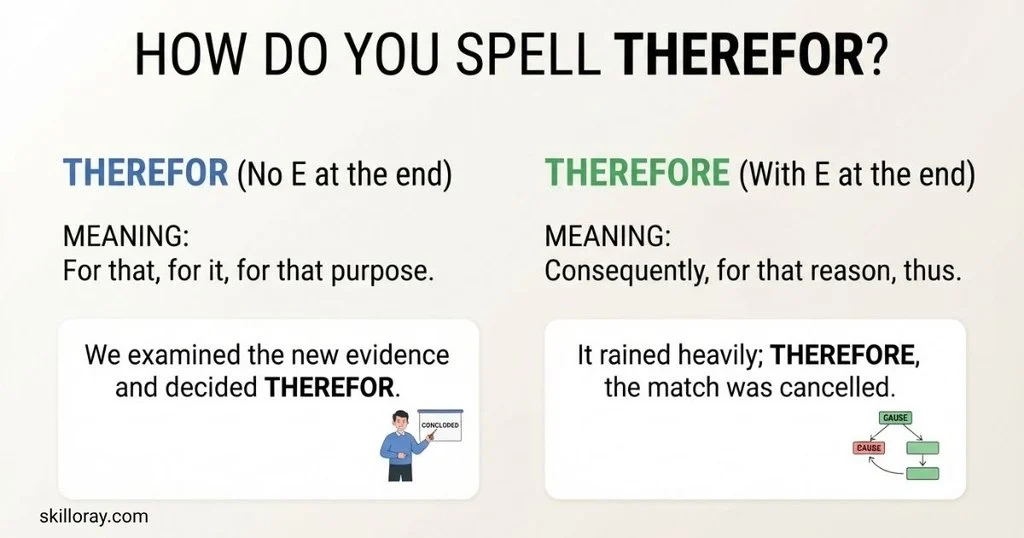
The less common word is spelled:
therefor
It has no final e.
Its meaning is different from therefore, so you should not use it simply as a shortened spelling.
For example:
The payment was made therefor.
Here, therefor refers to something previously mentioned and has the sense of “for it” or “for that.”
How Do You Pronounce Therefore or Therefor?
The words are closely related in pronunciation, but dictionaries distinguish them by stress.
Therefore
- IPA: approximately /ˈðerˌfɔr/ in American English
- The main stress falls on the first part: THERE-for
Therefor
- IPA: approximately /ˌðerˈfɔr/ in American English
- The main stress falls more strongly on the second part: there-FOR
British pronunciation also differs slightly in vowel sounds, but the important point is that the words can be distinguished by their meaning and, in careful pronunciation, by stress.
Is Therefore a Synonym for Therefor?
No.
Although the words look similar and share a historical connection, they are not modern synonyms.
Therefore can be replaced by words or phrases such as:
- consequently
- thus
- hence
- as a result
- for that reason
Therefor has the much narrower sense of:
- for it
- for that
- in exchange for that
- for that purpose or thing
Therefore, you should choose a synonym based on the intended meaning rather than the spelling.
Therefore or Thereby: Which Is Correct?
Therefore or thereby are both correct words, but they have different functions.
Therefore means “as a result” or “for that reason.”
The road was blocked; therefore, we turned around.
Thereby generally means “by that means,” “through that action,” or “as a result of that action.”
She saved money, thereby reducing her expenses.
A useful way to remember the difference is:
- therefore → explains a result or conclusion
- thereby → explains the means by which something happens
Do not use therefor as a substitute for either word.
Common Mistakes With Therefore or Therefor
Mistake 1: Using therefor to mean “as a result”
Incorrect for this meaning:
The road was closed; therefor, we went home.
Correct:
The road was closed; therefore, we went home.
Here, the intended meaning is “as a result,” so therefore is required.
Mistake 2: Assuming therefor is simply a shortened spelling
Therefor is a legitimate word, but it has its own meaning.
The company paid therefor.
This has a formal meaning similar to “paid for it.”
Mistake 3: Thinking therefor is the British form
British English does not use therefor as the ordinary spelling of therefore. Both words exist, but they have different meanings and usage patterns.
Mistake 4: Using therefor in everyday writing to sound formal
Therefor can sound highly formal, legal, or old-fashioned. In most everyday situations, “for it” or “for that” will be clearer.
How to Remember the Difference
A simple memory trick can make this distinction much easier.
Remember “therefore” with “reason”
Therefore = for that reason.
I was tired; therefore, I went to bed.
Remember “therefor” with “it”
Therefor = for it or for that.
The service was provided, and payment was made therefor.
So when you’re deciding between therefore or therefor, ask yourself:
Am I explaining a result?
Use therefore.
Am I referring to something as “for it” or “for that”?
Use therefor, although a clearer modern expression may often be preferable.
Is Therefore or Therefor More Common?
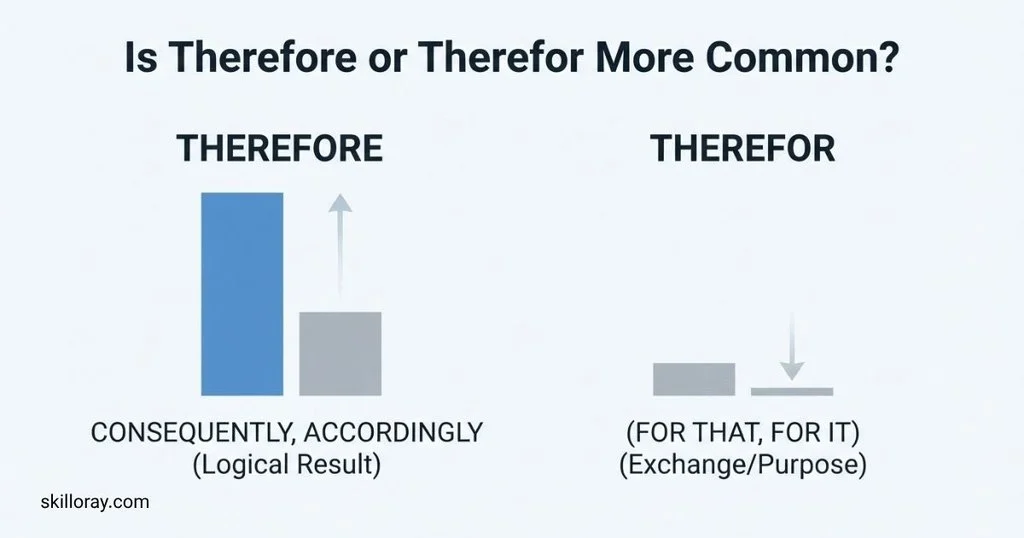
Therefore is much more common in modern general English.
You will frequently see therefore in:
- Academic writing
- Business writing
- Essays
- Reports
- Formal correspondence
- Mathematics
- Logic
- Explanations
- Everyday formal speech
Therefor is comparatively rare and is more likely to appear in:
- Legal documents
- Contracts
- Formal documents
- Older texts
- Specialized writing
Dictionary sources consistently distinguish therefor from the much more common therefore.
Frequently Asked Questions
Is therefore or therefor correct?
Both are correct words, but they have different meanings. Therefore means “as a result” or “for that reason.” Therefor means “for that” or “for it” and is much less common.
Is therefor a word?
Yes. Therefor is a legitimate English adverb. It is uncommon in everyday English and is especially associated with formal or legal language.
Should I use therefore in an essay?
Yes, when you mean “as a result,” “consequently,” or “for that reason.” For example:
The evidence was insufficient; therefore, the claim could not be supported.
Is therefor a misspelling of therefore?
No. Therefor is a real word with a different meaning. However, using it when you mean “as a result” is a word-choice error.
What does therefor mean in legal writing?
In legal writing, therefor generally means “for that,” “for it,” or “in exchange for that.” It can refer back to something previously mentioned in a formal document.
Is therefor used in British English?
Yes, but British dictionaries commonly mark it as archaic. It is not the normal British spelling of therefore.
What is the difference between therefore or therefor?
Therefore expresses a result or conclusion. Therefor means “for that” or “for it.” The difference is one of meaning and usage, not simply spelling.
How do you remember therefore?
Think “therefore = for that reason.” Whenever you’re showing that one fact leads to a conclusion or result, therefore is usually the correct choice.
Can I replace therefor with for it?
Often, yes. In modern general writing, “for it” or “for that” is frequently clearer than the formal word therefor.
Conclusion
When choosing between therefore or therefor, focus on the meaning rather than the spelling.
Use therefore when you mean “as a result,” “consequently,” or “for that reason.” It is the normal choice for modern academic, professional, and everyday formal writing.
Use therefor when you mean “for that,” “for it,” or “in exchange for that.” It is a legitimate word, but it is uncommon and often has a formal or legal tone.
The easiest rule is simple: result or conclusion → therefore; for it or for that → therefor. Once you connect each spelling with its meaning, this commonly confused pair becomes much easier to use correctly.

I am Daniel Carter, a grammar enthusiast and language educator with over 10 years of experience helping students and professionals improve their English writing and communication skills. I enjoy simplifying complex grammar rules into easy-to-understand lessons that anyone can follow. My goal is to help learners write with confidence, avoid common mistakes, and develop strong communication skills for academic and professional success. I regularly create practical grammar guides, writing tips, and language resources that make learning both enjoyable and effective.
Books: Mastering English Grammar and The Complete Guide to Better Writing
 James Walker
 Olivia Brown