
When I hear the words mama or momma, I immediately think of warmth, family, and childhood memories. You may use one of these words every day without ever wondering why there are two spellings.
But if you are writing a message, choosing a word for a caption, or trying to understand American English, you might ask which one is right. I’ll help you see the difference clearly and simply.
By the end, you’ll know what mama or momma mean, how they are used, and when each spelling sounds most natural. You can then choose the word that best fits your meaning and tone.
Mama or Momma: Quick Answer
Mama or momma are both correct spellings. Both can be used as informal terms for a mother. Mama is more common in general English, while momma is an informal spelling variant that can give writing a more conversational or affectionate feel. In many varieties of English, they are pronounced the same or very similarly.
| Form | Meaning | Typical use | Pronunciation |
| mama | Mother | Common informal or affectionate term | Usually two syllables |
| momma | Mother | Informal, affectionate, conversational | Usually two syllables |
| mamma | Mother | Less common English form; also standard in Italian | Depends on the language |
What Does Mama Mean?
Mama is an informal word for one’s mother. It is commonly used by children, families, and adults speaking affectionately about their mother.
For example:
- Mama is making dinner tonight.
- I called Mama after work.
- My mama taught me how to cook.
- I miss my mama.
- Mama always knows what to say.
The word can also be used as a form of direct address:
Mama, can you help me?
Although mama is informal, it isn’t necessarily slang. It is a familiar family term that has been used in English for generations.
The exact feeling associated with the word can vary by family, region, culture, and speaker.
What Does Momma Mean?
Momma is also an informal term for a mother. It is a spelling variant of mama, rather than a completely different word with a different basic meaning.
For example:
- Momma is waiting for us.
- My momma always encouraged me.
- I love my momma.
- Momma made my favorite meal.
- Her momma taught her that recipe.
The extra m can make the spelling look more closely connected to mom, particularly to American readers. It can also give the word a distinctly informal or affectionate tone.
Is Mama or Momma Correct?
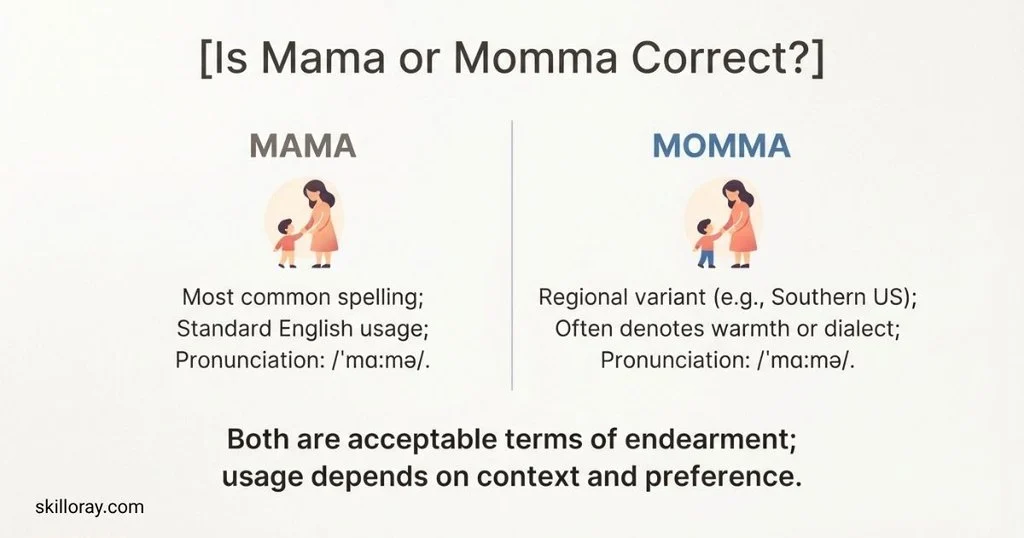
Both mama or momma are correct.
If you want the spelling that is more broadly familiar and generally easier to use in standard informal writing, choose mama.
Choose momma when it reflects your family’s preferred spelling, a character’s natural speech, a regional voice, or an intentionally warm and informal style.
You don’t need to treat momma as a misspelling of mama. It is an established variant.
Which Form Should You Use?
A simple rule is:
- Use mama for the most widely recognizable informal spelling.
- Use momma when the more conversational spelling fits your voice.
- Use the spelling your family traditionally uses when writing personal messages.
- In dialogue, choose the form that best represents the speaker’s natural language.
For most general writing, mama is the simplest choice.
Mama or Momma Meaning in English
In English, both words generally mean mother.
They can refer to a person’s mother or be used when speaking directly to her.
Mama:
My mama lives nearby.
Momma:
My momma lives nearby.
The basic meaning doesn’t change simply because the spelling changes.
The difference is mainly one of spelling, style, familiarity, and personal or regional usage.
Mama or Momma Spelling
The standard spellings mama or momma are both found in English.
Mama is the simpler and more common-looking form. Momma is formed with the familiar American English word mom in mind and is especially associated with informal speech.
Neither spelling should automatically be treated as a spelling mistake.
If you’re unsure which spelling to choose in your own writing, mama is usually the safest general-purpose option.
Mama or Momma Pronunciation
In many English varieties, mama or momma are pronounced the same or nearly the same.
A simple pronunciation guide is:
mama: MAH-muh
momma: MAH-muh
Both normally have two syllables.
The exact vowel sound can change depending on the speaker’s accent. Some speakers may use a vowel closer to the sound in father, while others may pronounce the first syllable differently because of their regional accent.
The spelling momma doesn’t necessarily mean that the word must be pronounced differently from mama.
IPA Pronunciation
A broad pronunciation guide for English mama can be represented approximately as:
/ˈmɑːmə/
However, pronunciation varies across English accents, so this should be treated as a general guide rather than a universal pronunciation.
Is Momma a Slang Word?
Momma is usually better described as an informal or familiar word rather than slang.
It is commonly used in family speech, affectionate expressions, songs, stories, dialogue, and regional varieties of English.
For example:
Momma always told me to be kind.
The sentence sounds informal and personal, but momma isn’t necessarily slang.
If you’re writing a formal document, however, mother is usually more appropriate.
Formal or Informal Usage
| Style | Natural choice |
| Formal writing | mother |
| General informal writing | mama |
| Affectionate family writing | mama or momma |
| Personal dialogue | mama or momma |
| Family nickname | Either, depending on preference |
Is Mama or Momma Used in the South?
Mama or momma can both be used in the American South, but neither spelling belongs exclusively to Southern English.
The word mama has a long history of use across different English-speaking communities. Momma can also appear in Southern speech, writing, literature, songs, and dialogue.
A writer may choose momma to create a warm, homespun, or regional voice, but seeing the spelling does not prove that the speaker is Southern.
For example:
My mama always had coffee ready before sunrise.
or:
My momma always had coffee ready before sunrise.
Both sentences can work naturally. The spelling may contribute to the tone, but the surrounding context usually tells you much more about the speaker’s regional identity.
Mama Bear or Momma Bear?
Mama bear or momma bear can both be used.
The expression mama bear is widely understood as a figurative term for a mother who is strongly protective of her children.
For example:
Don’t underestimate a mama bear protecting her children.
Momma bear is also possible, especially in informal or affectionate writing.
The phrase can be used literally when talking about a female bear with cubs or figuratively when describing a protective mother.
Mama Bear Meaning
The figurative expression mama bear usually describes a mother who becomes especially protective when her children are threatened, criticized, or treated unfairly.
It has become a common informal expression in everyday English.
Mama or Mamma: Are They the Same?
Mama or mamma can refer to the same basic idea, but mamma has additional language and cultural associations.
In English, mamma is an established but less common spelling for mother. It can appear in older, literary, dialectal, or affectionate writing.
In Italian, however, mamma is the normal word for mother.
So if you’re writing in Italian, mamma is the standard choice.
For English writing, mama is generally more familiar to modern readers, while mamma may have a particular stylistic or cultural context.
Mama or Momma in American English
Both forms can appear in American English, particularly in informal contexts.
Mama is broadly recognizable throughout the United States. Momma is also understood but tends to have a more distinctly informal, personal, or conversational feel.
For example:
My mama taught me how to bake.
sounds natural and familiar.
My momma taught me how to bake.
also works, but the spelling can give the sentence a slightly different voice.
Neither form is automatically incorrect because of American English usage.
How Do You Spell Mama as in Grandma?
If you’re referring to the word for your mother’s mother or father’s mother, the usual spelling is grandma, not simply mama.
Grandma is a familiar form of grandmother.
You may also encounter affectionate family terms such as grandmama, but that is a different word from grandma.
For example:
- My grandma lives in Texas.
- I visited my grandmother last summer.
- Grandmama made us dinner.
If you’re asking about the mama part of a word such as grandmama, then mama is spelled with one m at the beginning and one m in the middle: mama.
Mama or Momma as a Noun
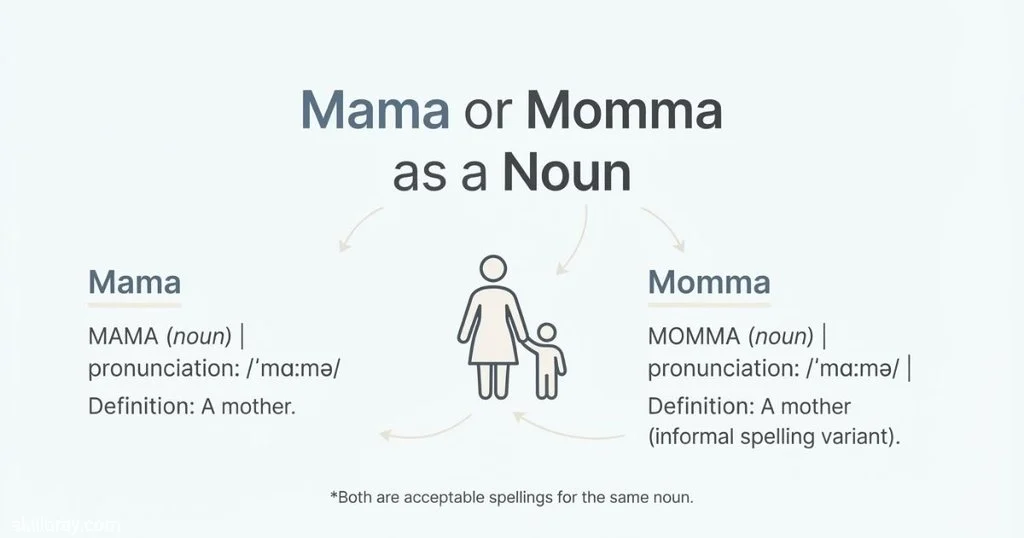
Both mama or momma function primarily as nouns when they mean mother.
Examples:
- Mama is home.
- Momma is home.
- I called Mama.
- I called Momma.
When used as a direct form of address, the word may also appear without an article:
Mama, look at this!
You wouldn’t normally say:
The mama, look at this!
when directly addressing your mother.
Mama or Momma Possessive Form
To show possession, both forms can take an apostrophe plus s:
- mama’s
- momma’s
Examples:
- That is Mama’s recipe.
- I borrowed Momma’s coat.
- Mama’s car is outside.
- Momma’s advice helped me.
The possessive form follows the normal English possessive pattern.
Mama or Momma Plural Form
Although you don’t often need a plural form for the word, both can be pluralized when the context calls for it:
- mamas
- mommas
For example:
The two mamas watched their children play.
Or:
Several mommas gathered at the school.
In ordinary family conversation, however, the singular form is much more common.
Common Mistakes With Mama or Momma
Mistake 1: Treating Momma as Automatically Incorrect
Incorrect assumption:
Momma is always a misspelling of mama.
Better understanding:
Momma is an accepted informal variant.
It may be less common than mama, but less common doesn’t mean incorrect.
Mistake 2: Assuming They Have Different Meanings
Incorrect assumption:
Mama means mother, but momma means something different.
Better understanding:
Both generally refer to a mother. The difference is primarily spelling, style, and usage context.
Mistake 3: Assuming Momma Is Always Southern
Incorrect assumption:
Anyone who says momma must be from the South.
Better understanding:
The spelling can occur in Southern English, but it isn’t exclusive to Southern speakers.
Mistake 4: Using Mother in Every Informal Context
Less natural for an affectionate family message:
I love you, mother.
More natural:
I love you, Mama.
The formal word mother is grammatically correct, but family relationships often use more familiar forms.
When Should You Use Mama?
Use mama when you want a familiar, affectionate, broadly recognizable term for mother.
It works well in:
- Personal messages
- Family conversations
- Children’s speech
- Informal stories
- Poetry
- Songs
- Dialogue
- Social media posts
- Affectionate writing
Examples:
- I love you, Mama.
- Mama always believed in me.
- I’m going to visit Mama this weekend.
- My mama taught me to work hard.
When Should You Use Momma?
Use momma when the spelling fits the speaker, family, character, or tone.
It can work particularly well in:
- Informal dialogue
- Personal writing
- Family nicknames
- Regional storytelling
- Affectionate expressions
- Fictional character speech
Examples:
- Momma said dinner was ready.
- I promised Momma I’d be home early.
- Her momma taught her to be independent.
If you aren’t trying to create a particular voice, mama is usually the more straightforward choice.
Mama or Momma in a Sentence
Here are natural examples using both forms:
Sentences With “Mama”
- Mama is waiting in the kitchen.
- I called Mama after I got home.
- My mama taught me to be patient.
- Mama always made holidays special.
- I bought Mama some flowers.
- Mama knows how much I love her.
- My mama gave me excellent advice.
- I haven’t seen Mama in weeks.
- Mama smiled when she heard the news.
- I wrote Mama a birthday card.
Sentences With “Momma”
- Momma is waiting for us.
- I called Momma before leaving.
- My momma taught me how to cook.
- Momma always encouraged me.
- I bought Momma her favorite flowers.
- Momma gave me some good advice.
- I miss my momma.
- Her momma was proud of her.
- Momma told us to come inside.
- He wrote a letter to his momma.
Is Mama More Common Than Momma?
Generally, mama is more widely recognized and more common in general English writing, while momma is a less common informal variant.
That doesn’t make momma incorrect.
If you’re choosing a spelling for a general audience and have no particular reason to use the variant, mama is usually the simplest option.
If you’re writing dialogue or a personal message, the preferred family spelling can matter more than general frequency.
Can You Use Mama or Momma Interchangeably?
In many informal contexts, mama or momma can be substituted without changing the basic meaning.
For example:
I love my mama.
can become:
I love my momma.
The meaning remains essentially the same.
However, the emotional or stylistic impression may change slightly. A family may strongly prefer one spelling, and a writer may deliberately choose one form to match a character’s voice.
So they are interchangeable in many contexts, but not necessarily identical in style.
Mama or Momma in Formal Writing
For formal writing, mother is usually the most neutral choice.
For example:
My mother attended the meeting.
is more formal than:
My mama attended the meeting.
That doesn’t mean mama is grammatically incorrect. It simply has a more personal and informal tone.
In a formal report, academic paper, business document, or official record, mother will usually fit better.
In a personal letter, story, conversation, or family message, mama or momma may sound more natural.
Mama or Momma: Which One Should You Use?
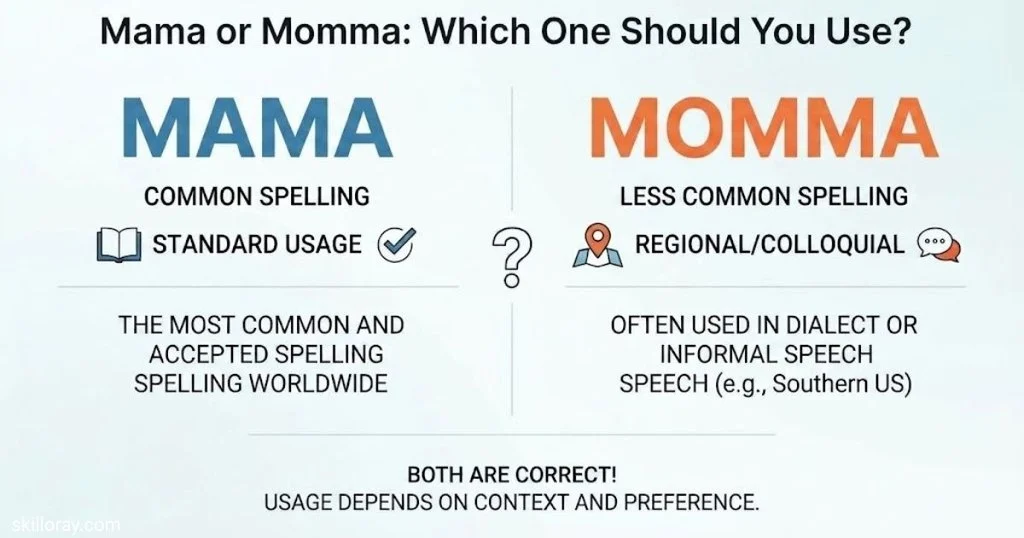
If you’re still unsure, use this simple guide:
Choose “mama” if you want the more familiar, broadly recognized spelling.
Choose “momma” if you prefer the informal variant or it matches your family’s spelling, a character’s voice, or a regional style.
Choose “mother” when you need a neutral or formal term.
There isn’t a universal rule requiring everyone to use one spelling.
Frequently Asked Questions
Is mama or momma correct?
Both mama or momma are correct. They are informal terms for mother. Mama is generally more common, while momma is an accepted informal spelling variant.
Is momma a real word?
Yes. Momma is an established informal word for mother. It isn’t automatically a misspelling of mama.
Is mama a slang word?
Mama is generally an informal or familiar term rather than slang. It is widely used as an affectionate family word for mother.
Is momma a Southern word?
Momma can occur in Southern American speech and writing, but it isn’t exclusively Southern. Speakers from other regions can use it as well.
Are mama or momma pronounced differently?
Usually, mama or momma are pronounced the same or very similarly in English. Accent and regional pronunciation can affect the exact vowel sounds.
Is mama or mamma correct?
Both spellings can occur in English, but mama is more common in modern general English. Mamma also has an important association with Italian, where it is the standard word for mother.
What is the plural of mama?
The usual plural is mamas. The plural of momma is mommas.
What is the possessive of mama?
The possessive form is mama’s. For momma, the possessive form is momma’s.
Is mama or momma more common?
Mama is generally more common in broad English usage. Momma is an accepted but less common informal variant.
Which spelling should I use for my mother?
Use whichever form feels natural to you or matches your family’s preferred spelling. If you have no preference, mama is the safest general informal choice.
Conclusion
Mama or momma are both correct informal terms for a mother. The main difference isn’t grammar or meaning; it is largely a matter of spelling, style, familiarity, and personal or regional usage.
Mama is generally the more common and widely recognized choice. Momma is a legitimate informal variant that can sound especially personal, affectionate, or conversational.
If you’re writing for a general audience, choose mama when you want the simplest option. If your family, character, or personal writing naturally uses momma, there’s no need to treat it as a mistake.

I am James Walker, an English language specialist with extensive experience in grammar, editing, and academic writing. I enjoy helping students, bloggers, and professionals strengthen their writing by explaining grammar concepts in a clear and engaging way. My focus is on providing accurate, practical, and easy-to-follow guidance that helps learners communicate more effectively in everyday and professional situations.
Books: Perfect English Grammar Handbook and Advanced Writing Techniques
 Daniel Carter
 Olivia Brown