Tyres or Tires is a small spelling difference that often makes you stop and wonder which one is correct.I know how confusing it feels when two words look different but seem to mean exactly the same thing.You are not just learning a spelling rule, you are discovering the reason behind everyday language choices.Whether you write for school, work, travel, or daily conversations, this simple difference can help you communicate better.
I created this guide to help you understand the meaning, usage, and history behind these two spellings.
You will finally know when to use “tyres” and when to use “tires” without second-guessing yourself again.By the end, you will feel confident choosing the right word in every situation.
Quick Answer
Tyres and tires refer to the same rubber-covered wheel component used on vehicles. The difference is regional:
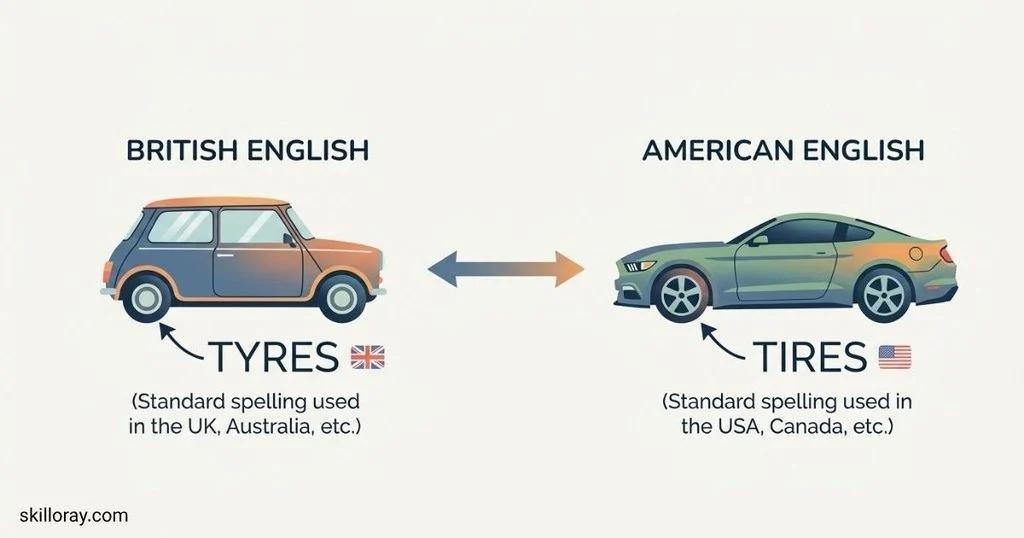
- Tyres is the standard spelling in British English.
- Tires is the standard spelling in American English.
Neither spelling is incorrect. The right choice depends on your audience and the variety of English you’re using.
Quick Comparison Table
| Feature | Tyres | Tires |
| Meaning | Rubber coverings on vehicle wheels | Rubber coverings on vehicle wheels |
| Part of Speech | Noun | Noun |
| Correct Spelling | Yes | Yes |
| British English | Preferred | Rare |
| American English | Rare | Preferred |
| Australian English | Preferred | Rare |
| Canadian English | Usually Tyres | Sometimes Tires |
| Formal Writing | Accepted in UK-based writing | Accepted in US-based writing |
| Pronunciation | Same | Same |
Tyre or Tire Pronunciation
Both words have exactly the same pronunciation.
IPA Pronunciation
| Word | IPA |
| Tyres | /taɪərz/ |
| Tires | /taɪərz/ |
Syllable Breakdown
Tyres: tyre + s
Tires: tire + s
Pronunciation Difference
There is no pronunciation difference.
Whether written as tyres or tires, speakers pronounce the word the same way.
Example:
The car needs new tyres.
The car needs new tires.
Both sound identical when spoken.
Meaning and Usage

Meaning of Tyres
Tyres is the plural form of tyre, the British English spelling for the rubber covering fitted around a wheel.
Examples
- My car needs new tyres before winter.
- Check your tyres regularly for wear.
- The mechanic replaced all four tyres.
Meaning of Tires
Tires has two possible meanings in American English.
Meaning 1: Plural of Tire
The rubber wheel covering.
Examples:
- These tires provide excellent grip.
- Winter tires improve safety.
- The truck requires heavy-duty tires.
Meaning 2: Third-Person Form of “Tire”
As a verb, tires means “becomes tired.”
Examples:
- Running long distances tires him.
- The heat tires the workers quickly.
This dual meaning sometimes creates confusion.
Tyre or Tire: What Is the Difference for Wheels?
Queries covered: Tyre or Tire wheel, car tyres or tires, vehicle tyre or tire
A tyre or tire is the rubber covering fitted around a vehicle’s wheel. It provides traction on the road, helps absorb vibrations, and supports safe handling when properly maintained.
The spelling depends on regional English conventions:
- Tyre: Commonly used in British English and other English varieties that follow British spelling, including Australian and New Zealand English.
- Tire: The standard spelling in American English and commonly used in Canadian English.
Car Tyres or Tires
Both phrases refer to the same automotive component. Use car tyres when writing for a British, Australian, or New Zealand audience, and car tires when targeting American readers.
Examples:
- UK: Check your car tyres before a long journey.
- USA: Check your car tires before a long trip.
Vehicle Tyre or Tire
The same regional spelling rule applies to other vehicles, including trucks, buses, motorcycles, and bicycles.
For example, a British automotive website might use “vehicle tyres,” while an American website would typically use “vehicle tires.” The meaning remains the same.
Placement: Add this after your existing “Meaning and Usage” section. You can replace repetitive examples in the original article with these examples.
Main Difference Between Tyres and Tires
The key distinction is regional spelling.
| Feature | Tyres | Tires |
| English Variety | British English | American English |
| Meaning | Vehicle wheel covering | Vehicle wheel covering |
| Pronunciation | Same | Same |
| Usage in UK | Standard | Uncommon |
| Usage in USA | Uncommon | Standard |
| Usage in Australia | Standard | Rare |
| Usage in New Zealand | Standard | Rare |
| SEO Audience | UK-focused | US-focused |
Grammar Rule Section
Since this is a regional spelling difference rather than a grammar issue, there is no difference in tense, verb form, or sentence structure.
As Nouns
British English
- tyre
- tyres
Examples:
- One tyre is damaged.
- Two tyres need replacement.
American English
- tire
- tires
Examples:
- One tire is damaged.
- Two tires need replacement.
As Verbs
Only tire functions as a verb in standard English.
Examples:
- I tire easily.
- She tires quickly.
The spelling tyre is not used as a verb.
Tyres or Tires Plural: What Is the Correct Form?
Queries covered: Tyres or tires plural, tyres or tires plural UK
Both tyres and tires are plural nouns. Their singular forms differ according to regional spelling conventions: tyre is British English, and tire is American English.
| Singular | Plural | English variety |
| Tyre | Tyres | British English |
| Tire | Tires | American English |
Tyres or Tires Plural in the UK
In the UK, tyres is the standard plural form. For example, “The garage replaced all four tyres.”
In the United States, tires is standard. For example, “The mechanic replaced all four tires.”
Remember that adding -s creates the plural in both varieties. The only difference is the spelling of the singular noun.
Placement: Merge this content with your existing “As Nouns” section under “Grammar Rule Section.”
Tyre or Tire: Which Spelling Came First?

Origin of Tire
The word developed from earlier references to wheel coverings and rims.
By the nineteenth century, tire became the common spelling in English-speaking regions.
Development of Tyre
As British English evolved, the spelling tyre was adopted specifically to distinguish the wheel covering from the verb tire.
This helped reduce ambiguity in written communication.
Language Roots
Both forms ultimately derive from historical English usage and share the same linguistic origin.
Dictionary Comparison
Let’s see how major dictionaries treat these words.
| Dictionary | Tyres | Tires |
| Oxford | British spelling | American spelling |
| Cambridge | British spelling | American spelling |
| Merriam-Webster | Variant spelling | Standard US spelling |
| Collins | British spelling | American spelling |
Oxford Dictionary
Oxford recognizes:
- Tyre (British)
- Tire (American)
Cambridge Dictionary
Cambridge identifies:
- Tyre as British English
- Tire as American English
Merriam-Webster
Merriam-Webster primarily uses tire, reflecting American usage.
Collins Dictionary
Collins recognizes both forms and labels them according to region.
Are Both Words Correct?

Yes.
Both tyres and tires are correct spellings.
The difference is not about right versus wrong.
Instead, it reflects regional conventions.
Use Tyres When
- Writing for UK readers
- Writing for Australians
- Writing for New Zealand audiences
- Following British style guides
Use Tires When
- Writing for American readers
- Publishing in the United States
- Following American style guides
Tyres or Tires in the UK, Australia, and New Zealand
Queries covered: is it tyres or tires UK, tyres or tires Australia, tyres or tires NZ
The preferred spelling varies across English-speaking countries. Knowing the regional convention helps you write naturally for your intended readers.
Tyres or Tires in the UK
In the United Kingdom, tyres is the standard spelling for vehicle wheel coverings.
Example: “Drivers should inspect their tyres regularly.”
Tyres or Tires in Australia
Australian English generally follows British spelling conventions for this word. Therefore, tyres is the usual choice in Australian automotive writing.
Example: “Check your tyres before driving long distances.”
Tyres or Tires in New Zealand
New Zealand English also generally uses tyres for vehicle wheel coverings.
Example: “Winter tyres may be useful in certain driving conditions.”
What About American and Canadian English?
American English uses tires. Canadian English also commonly uses tire, although individual publications and contexts may have their own style preferences.
The easiest rule is to follow the spelling used by reputable publications and organizations in your target market.
Placement: Use this section to combine your existing “British vs American English” and regional usage sections. Avoid repeating the same country comparisons elsewhere.
British vs American English
This is a classic example of regional spelling variation.
Comparison Table
| British English | American English |
| Tyre | Tire |
| Colour | Color |
| Centre | Center |
| Favourite | Favorite |
| Organise | Organize/Organize |
British Example
- Winter tyres improve road safety.
American Example
- Winter tires improve road safety.
Both sentences are equally correct.
Which Form Is More Common?
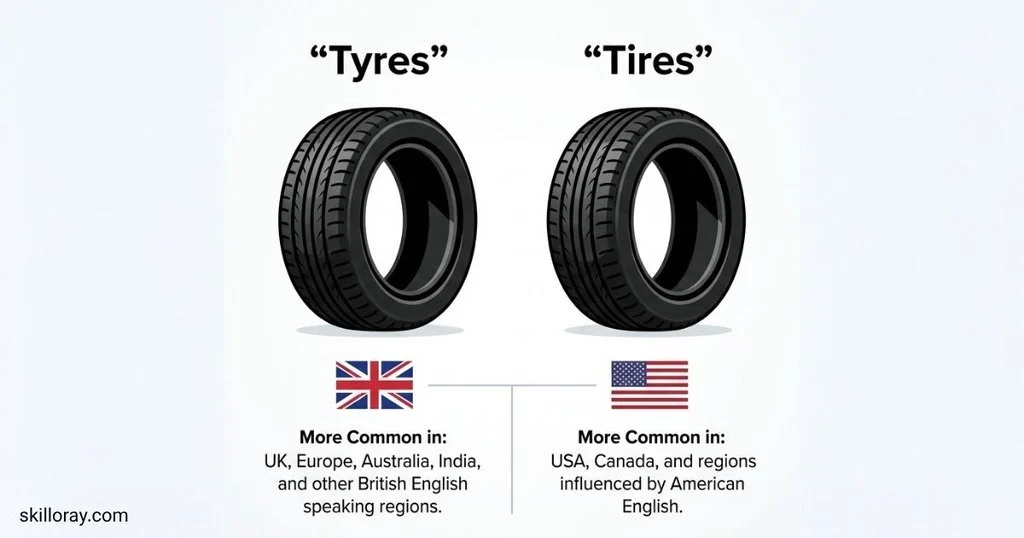
The answer depends on location.
In the United Kingdom
Tyres dominates.
Most:
- Automotive magazines
- Dealers
- Repair shops
- Government publications
use tyres.
In the United States
Tires dominates.
Most:
- Manufacturers
- Retailers
- Automotive websites
- Newspapers
use tires.
On the Internet
Globally, tires appears more frequently because American websites represent a large share of online content.
However, UK searches strongly favor tyres.
When Should You Use Each Word?
Academic Writing
Follow the English style required by your institution.
Examples:
- British university → tyres
- American university → tires
Professional Writing
Match the audience.
Examples:
- UK automotive company → tyres
- US automotive company → tires
Casual Writing
Either spelling is acceptable if it matches your regional English.
Journalism
Journalists should follow the publication’s style guide.
Examples:
- British newspaper → tyres
- American newspaper → tires
Common Mistakes
Mistake 1: Mixing Spellings
Incorrect
- We sell tyres and repair tires.
Correct
- We sell tyres and repair tyres.
- We sell tires and repair tires.
Explanation
Maintain consistency.
Mistake 2: Assuming Tyres Is Wrong
Incorrect Belief
- Tyres is a misspelling.
Correct
- Tyres is standard British English.
Mistake 3: Using Tyre as a Verb
Incorrect
- The long journey tyres me.
Correct
- The long journey tires me.
Explanation
Only tire functions as a verb.
Real-Life Examples
Automotive Advertisement (UK)
- Premium tyres for all weather conditions.
Automotive Advertisement (USA)
- Premium tires for all weather conditions.
Mechanic Shop
- Your tyres need replacement.
- Your tires need replacement.
News Article
- Drivers are advised to inspect their tyres before traveling.
- Drivers are advised to inspect their tires before traveling.
Product Review
- These tyres provide excellent grip.
- These tires offer excellent traction.
Synonyms
Synonyms for Tyres
- Vehicle tires
- Pneumatic tires
- Wheel coverings
- Rubber wheel coverings
- Automotive tires
Synonyms for Tires
- Vehicle tires
- Pneumatic tires
- Wheel coverings
- Automotive tires
- Rubber tires
Antonyms
Since tyres/tires are physical vehicle components, true antonyms do not exist.
However, contrasting terms include:
For Tyres
- Bare wheel
- Rim only
- Wheel without tyre
For Tires
- Bare wheel
- Wheel rim
- Uncovered wheel
Memory Trick
A simple way to remember the difference:
Remember “Y” for UK
TYRES
Think:
The letter “Y” appears in many British spellings and style preferences.
Remember “I” for America
TIRES
Think:
American English typically simplifies spellings.
So:
- UK = Tyres
- USA = Tires
Winter Tyres or Tires: Which Should You Write?
Query covered: winter tyres or tires
Both “winter tyres” and “winter tires” are correct. The choice depends on your target audience rather than the type of tyre or tire being described.
- Winter tyres: Standard wording in British English and commonly used in Australia and New Zealand.
- Winter tires: Standard wording in American English.
Examples:
- UK: Winter tyres can provide improved traction in suitable cold-weather conditions.
- USA: Winter tires can provide improved traction in suitable cold-weather conditions.
When writing automotive content, keep the spelling consistent across headings, product descriptions, image captions, and body text. Also, avoid suggesting that winter tyres or tires are suitable for every winter condition; the right equipment depends on local weather, road conditions, and vehicle requirements.
Placement: Add this as an H3 under your existing “When Should You Use Each Word?” section or your real-life examples section.
Similar Confusing Words
If you’re interested in regional spelling differences, compare:
- Colour vs Color
- Centre vs Center
- Favourite vs Favorite
- Mould vs Mold
- Aluminium vs Aluminum
- Travelling vs Traveling
- Defence vs Defense
- Licence vs License
Why Do People Search “Tyres or Tires”?
Most users search this phrase because they want to know:
- Which spelling is correct
- Whether one spelling is wrong
- Which version should be used in writing
- Differences between British and American English
- SEO keyword targeting for automotive websites
Common Search Queries
- Is tyres or tires correct?
- Why do British people say tyres?
- Is tire American English?
- Are tyres and tires the same?
- Which spelling should I use?
- Tire vs tyre meaning
- Tyres meaning in English
- Tires pronunciation
- British spelling of tire
- American spelling of tyre
Frequently Asked Questions (FAQs)
1. Which word is correct: tyres or tires?
Both are correct. The difference is regional.
2. Is tyres a misspelling?
No. Tyres is the standard British English spelling.
3. Is tires American English?
Yes. Tires is the preferred American spelling.
4. Do tyres and tires mean the same thing?
Yes. They refer to the rubber covering on a vehicle wheel.
5. Are they pronounced differently?
No. Both have the same pronunciation.
6. Which spelling should I use in the UK?
Use tyres.
7. Which spelling should I use in the United States?
Use tires.
8. Can I use both spellings in one article?
It’s better to remain consistent and use only one version.
9. Why did British English adopt “tyre”?
The spelling helped distinguish the wheel covering from the verb tire.
10. Which spelling is better for SEO?
Use the spelling that matches your target audience.
11. Do Australians use tyres or tires?
Australians generally use tyres.
12. Is tire also a verb?
Yes. Tire means to become weary or cause fatigue.
13. Is it tyres or tires in the UK?
Tyres is the standard British English spelling for the rubber covering fitted around a vehicle wheel. Tires is the standard American spelling.
14. Do Australians use tyres or tires?
Australians generally use tyres, following British English spelling conventions.
15. Is it tyres or tires in New Zealand?
Tyres is the usual spelling in New Zealand English.
16. Are tyres or tires plural?
Yes. Tyres is the plural of British English tyre, while tires is the plural of American English tire.
17. How do you spell tyres?
In British English, the vehicle component is spelled tyre in the singular and tyres in the plural. American English uses tire and tires.
18. Which is correct, tyres or tires?
Both are correct. Use tyres for British English and tires for American English.
19. Which came first, tyre or tire?
Both spellings have a long history, and the answer depends on which historical usage is being compared. Consult a historical dictionary for evidence about their earliest recorded forms.
Expert Recommendation
Editors, teachers, dictionaries, publishers, and style guides agree on one principle:
Use the spelling that matches your audience.
Recommended Usage
| Audience | Recommended Form |
| UK Readers | Tyres |
| US Readers | Tires |
| Australian Readers | Tyres |
| New Zealand Readers | Tyres |
| International Audience | Choose one and stay consistent |
Professional writers should avoid mixing spellings within the same document.
Final Verdict
The debate between tyres and tires is not about correctness.
Both spellings are legitimate, widely accepted, and recognized by major dictionaries.
The difference is regional:
- Tyres = British English
- Tires = American English
Key Takeaways
- Both words are correct.
- Both refer to the same vehicle component.
- Pronunciation is identical.
- Tyres is preferred in British English.
- Tires is preferred in American English.
- Neither spelling is grammatically superior.
- Consistency matters more than choosing one over the other.
Practical Usage Advice
If your audience is British, Australian, or New Zealand-based, use tyres.
If your audience is American, use tires.
For international content, choose the spelling that aligns with your brand style guide and use it consistently throughout your writing.

I am Daniel Carter, a grammar enthusiast and language educator with over 10 years of experience helping students and professionals improve their English writing and communication skills. I enjoy simplifying complex grammar rules into easy-to-understand lessons that anyone can follow. My goal is to help learners write with confidence, avoid common mistakes, and develop strong communication skills for academic and professional success. I regularly create practical grammar guides, writing tips, and language resources that make learning both enjoyable and effective.
Books: Mastering English Grammar and The Complete Guide to Better Writing
 James Walker
 Olivia Brown