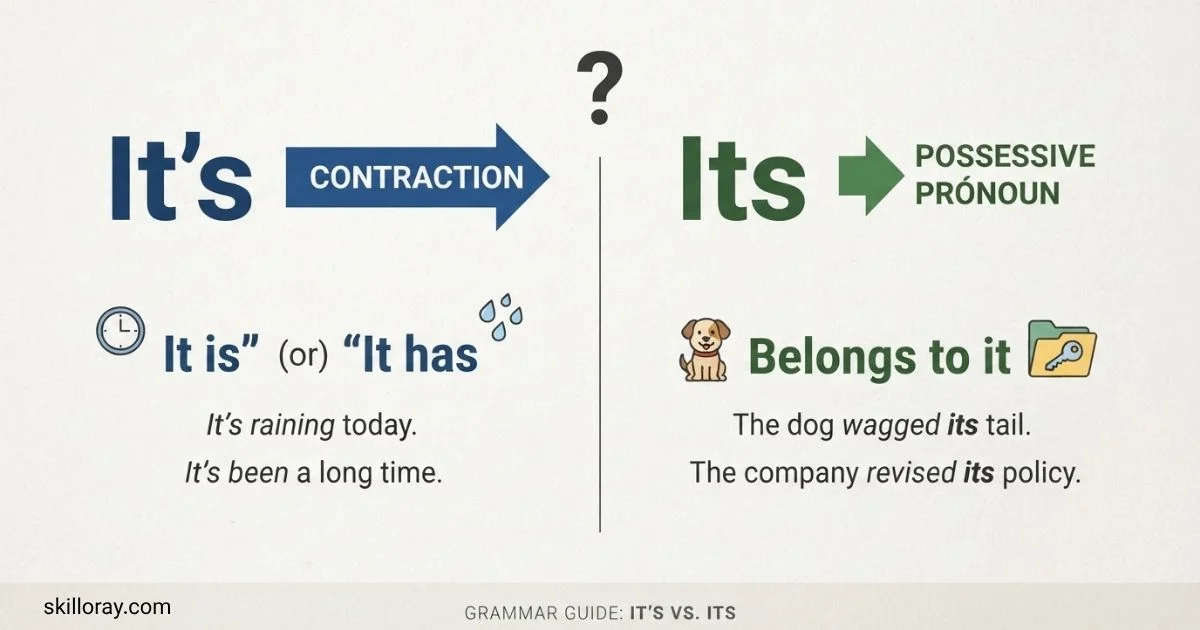
When I see writers hesitate between “it’s” or “its,” I know how confusing this small difference can feel. You may understand the sentence perfectly but still wonder which word belongs there.
The good news is that you don’t need complicated grammar rules to master it. I’ll show you a simple way to understand the difference between “it’s” or “its,” so you can choose the correct word with confidence.
By the end, you’ll have clear rules, practical examples, and easy memory tips you can use in everyday writing. Once you understand what each word actually means, this common mistake becomes much easier to avoid.
It’s or Its: The Quick Answer
Both it’s or its are correct English words, but they have different grammatical functions.
| Form | Meaning or function | Example |
| it’s | Contraction of it is | It’s raining outside. |
| it’s | Contraction of it has | It’s been a long day. |
| its | Possessive determiner | The dog wagged its tail. |
| its | Shows association or ownership | The company changed its policy. |
The easiest test is to expand it’s.
- It’s cold. → It is cold. ✓
- It’s been difficult. → It has been difficult. ✓
- The cat cleaned it’s paws. → The cat cleaned it is paws. ✗
In the last sentence, its is needed because the paws belong to the cat:
- The cat cleaned its paws. ✓
What Does “It’s” Mean?
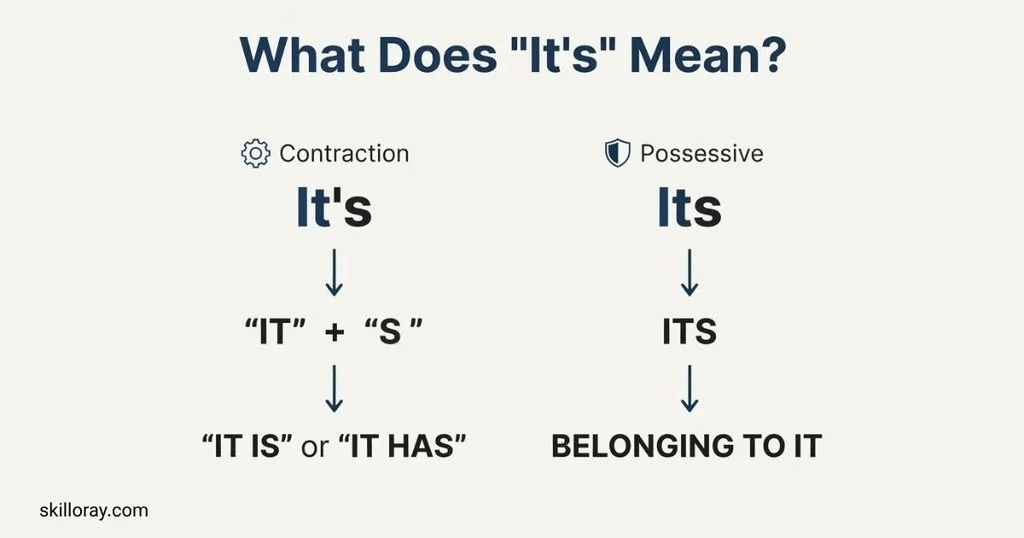
It’s is a contraction. It can represent either it is or it has, depending on the sentence.
“It’s” Means “It Is”
Use it’s when you mean it is.
Examples:
- It’s a beautiful morning.
- It’s too late to leave.
- It’s difficult to explain.
- It’s my favorite book.
- It’s colder today.
- I think it’s ready.
- The movie is long, but it’s interesting.
Try expanding the contraction:
It’s interesting.
→ It is interesting.
Because the expanded sentence works, it’s is correct.
“It’s” Means “It Has”
It’s can also mean it has, especially when has is functioning as an auxiliary verb.
Examples:
- It’s been a busy week.
- It’s already started.
- It’s changed since yesterday.
- It’s become more popular.
- It’s gone too far.
For example:
It’s been raining.
→ It has been raining.
Here, it’s means it has, not it is.
A useful clue is the word that follows it. When it’s is followed by a past participle such as been, changed, started, or become, it may represent it has.
What Does “Its” Mean?
Its is a possessive determiner. It shows that something belongs to, relates to, or is associated with something previously mentioned.
Examples:
- The dog wagged its tail.
- The bird spread its wings.
- The company updated its website.
- The tree lost its leaves.
- The computer needs its battery replaced.
- The country changed its laws.
In each example, its connects something to it.
For example:
The dog wagged its tail.
The tail belongs to the dog, so its is appropriate.
Does “Its” Mean Ownership?
Often, yes, but its can express more than literal ownership. It can show a relationship or association.
Consider:
- The car lost its value.
- The company announced its results.
- The school changed its schedule.
- The phone lost its connection.
A car doesn’t literally possess value in the same way a person possesses an object. Still, its identifies the thing associated with the car.
It’s or Its: The Main Grammar Difference
The easiest way to remember the distinction is:
- It’s = it is or it has
- Its = belonging to or associated with it
Compare these sentences:
It’s raining.
→ It is raining.
The dog is licking its paw.
→ The paw belongs to the dog.
Here’s another pair:
It’s lost.
→ It is lost.
The company lost its money.
→ The money is associated with the company.
The apostrophe in it’s does not indicate possession. It indicates that letters have been omitted from it is or it has.
Why Doesn’t “Its” Have an Apostrophe?
This is one of the most confusing parts of English grammar.
Normally, apostrophes are often associated with possession:
- Sarah’s book
- the teacher’s desk
- the dog’s collar
So it may seem logical that the possessive form of it should be it’s.
However, standard English uses its for the possessive form.
This means:
- The dog hurt its leg. ✓
- The company changed its name. ✓
The form it’s is reserved for the contractions it is or it has.
This is an example of a grammatical pattern that doesn’t follow the simplest apostrophe rule learners may first encounter.
Is “Its” a Word?
Yes. Its is a standard English word.
It functions primarily as a possessive determiner, which means it comes before a noun to show a relationship or possession.
Examples:
- its color
- its shape
- its purpose
- its name
- its owner
- its meaning
- its location
For example:
The phone lost its signal.
Here, its modifies signal.
Is “It’s” a Word?
Yes. It’s is also a standard English form.
It is a contraction of:
- it is
- it has
Examples:
It’s beautiful.
→ It is beautiful.
It’s changed.
→ It has changed.
The apostrophe shows that part of the original expression has been omitted.
When to Use “It’s”
Use it’s when you can replace it with it is or it has without changing the intended meaning.
Use “It’s” for “It Is”
- It’s easy.
- It’s important.
- It’s unusual.
- It’s my turn.
- It’s getting dark.
Use “It’s” for “It Has”
- It’s been repaired.
- It’s already happened.
- It’s changed dramatically.
- It’s become popular.
- It’s stopped working.
A simple substitution test can help:
It’s a good idea.
Replace it’s:
It is a good idea.
The sentence still makes sense, so it’s is correct.
When to Use “Its”
Use its when you are showing that something belongs to or is connected with it.
Examples:
- The dog raised its head.
- The tree stretched its branches.
- The phone lost its charge.
- The business improved its service.
- The museum changed its opening hours.
Try asking yourself:
Whose?
The answer can often be its.
The bird opened its wings.
Whose wings?
→ The bird’s wings.
Therefore, its is correct.
It’s or Its in a Sentence
Seeing the forms in complete sentences makes the difference easier to remember.
Sentences With “It’s”
- It’s a beautiful day.
- I think it’s time to go.
- It’s difficult to know what happened.
- It’s getting late.
- The food looks good, and it’s ready to serve.
- It’s been a long journey.
- It’s already started.
- I know it’s important.
- It’s not as complicated as it seems.
- The weather changed, but it’s still warm.
Sentences With “Its”
- The dog chased its ball.
- The cat cleaned its paws.
- The company updated its logo.
- The tree lost its leaves.
- The phone has lost its signal.
- The bird returned to its nest.
- The school announced its new schedule.
- The machine stopped because its battery was empty.
- The country is known for its natural beauty.
- The website improved its design.
It’s or Its: Common Mistakes
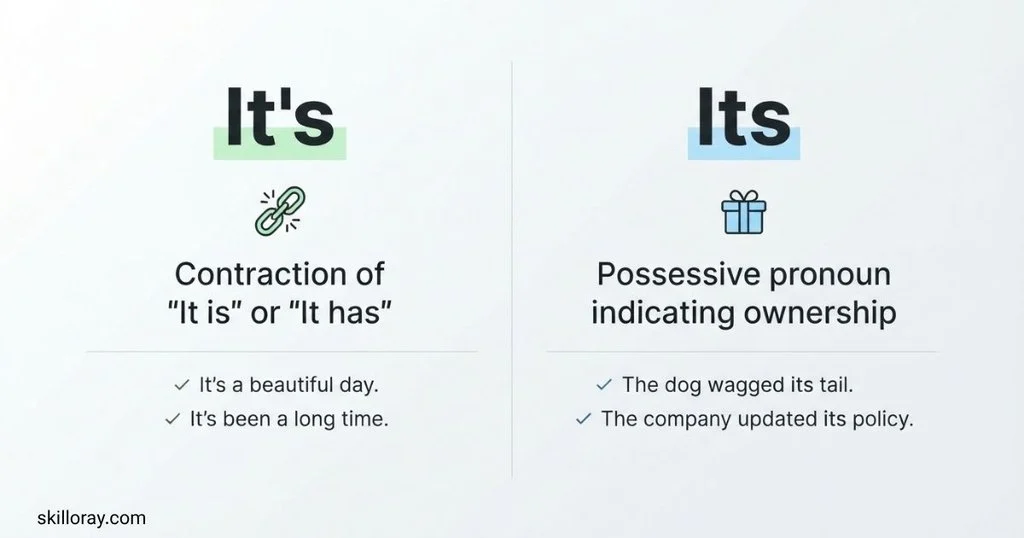
The most common mistake is using it’s when the sentence requires the possessive its.
Incorrect:
The dog wagged it’s tail.
Correct:
The dog wagged its tail.
Why? The tail belongs to the dog. It’s cannot mean possession.
Incorrect:
The company changed it’s name.
Correct:
The company changed its name.
Again, the name is associated with the company, so its is required.
Incorrect:
Its raining outside.
Correct:
It’s raining outside.
Here, it’s means it is:
It is raining outside.
Incorrect:
Its been a difficult day.
Correct:
It’s been a difficult day.
Here, it’s means it has:
It has been a difficult day.
It’s or Its Possessive: Which Form Shows Possession?
Its is the possessive form.
For example:
- The dog ate its food.
- The company released its report.
- The bird built its nest.
It’s does not show possession.
Instead, it is a contraction of it is or it has.
This is especially important because the apostrophe can be misleading. In many other possessive forms, an apostrophe is used, but its is the standard possessive form of it.
What About “It Has”?
A common question is whether it’s can mean it has.
Yes.
For example:
It’s been raining all morning.
This means:
It has been raining all morning.
However, it’s cannot replace every occurrence of it has.
For example:
The company has its own website.
You cannot write:
The company has it’s own website. ✗
Why? Here, has is the main verb, while its is the possessive determiner modifying website.
The correct sentence is:
The company has its own website.
It’s or Its UK: Is There a British English Difference?
There is no British English spelling difference between it’s or its in standard usage.
British English uses:
- it’s for it is or it has
- its for the possessive form
American English follows the same distinction.
For example, these are standard in both varieties:
- It’s a sunny day.
- The dog wagged its tail.
- It’s been a long time.
- The company changed its policy.
Regional spelling differences exist for many English words, but it’s or its is not one of the usual British-or-American spelling differences.
Can “It’s” or “Its” Be Used Interchangeably?
No. They generally cannot be substituted for each other.
It’s expresses it is or it has.
Its expresses possession or association.
Compare:
It’s beautiful.
→ It is beautiful.
Its color is beautiful.
→ The color belongs to or is associated with it.
Changing one form for the other changes the grammar and usually makes the sentence incorrect.
What About “Its'”?
Its’ is not the standard possessive form of it.
The standard forms are:
- it’s = it is or it has
- its = possessive determiner
Therefore:
The animal hurt its leg. ✓
Not:
The animal hurt it’s leg. ✗
Not:
The animal hurt its’ leg. ✗
The form its’ is generally a mistaken attempt to create a possessive form.
It’s or Its or Its’: Understanding All Three Forms
If you encounter all three forms, remember this simple rule:
| Form | Correct standard use | Example |
| it’s | it is or it has | It’s cold. |
| its | possessive determiner | The dog ate its food. |
| its’ | Not standard English | Avoid this form. |
There is no need to add another apostrophe after its to make it possessive.
It’s or Its in “It’s Corn”
The phrase “It’s corn” is grammatically different from “its corn.”
It’s corn means:
It is corn.
For example:
- What is that food? It’s corn.
Its corn would mean that the corn belongs to or is associated with something:
- The farm sells its corn locally.
So the apostrophe changes the grammatical meaning.
A Simple Trick to Remember It’s or Its
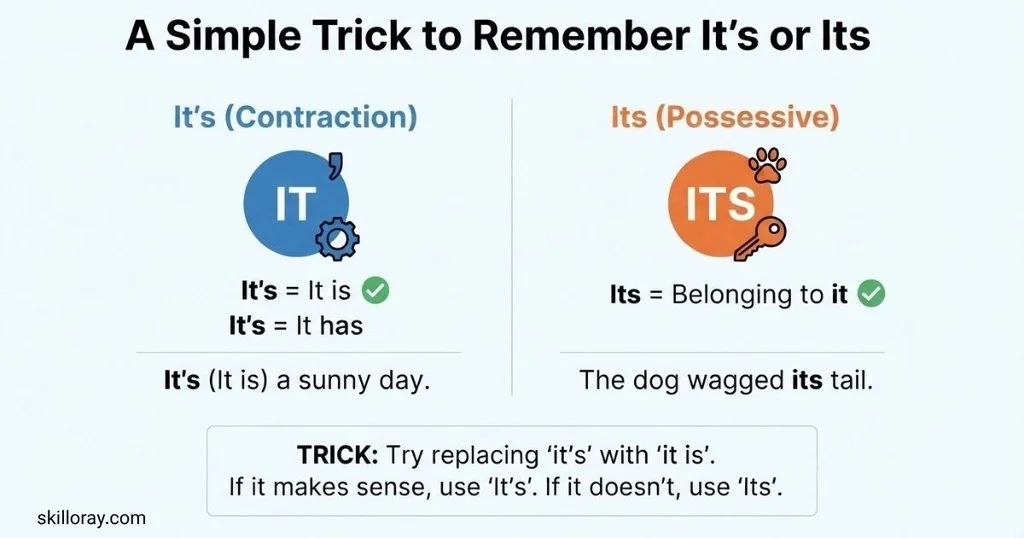
Use the “it is or it has” test.
Step 1: Find “it’s”
Look at the sentence containing it’s.
Step 2: Replace it with “it is”
If the sentence makes sense, it’s is correct.
It’s cold.
→ It is cold. ✓
Step 3: Try “it has” if “it is” doesn’t work
It’s been fun.
→ It has been fun. ✓
Step 4: If neither works, consider “its”
The dog wagged its tail.
Try:
The dog wagged it is tail. ✗
The dog wagged it has tail. ✗
So its is the correct choice.
Quick Memory Rule
You don’t need to memorize a complicated grammar formula.
Just remember:
It’s = it is or it has
Its = belongs to or relates to it
If you can expand it’s into it is or it has, keep the apostrophe.
If you’re showing possession or association, use its.
Frequently Asked Questions
Is “its” grammatically correct?
Yes. Its is a standard possessive determiner in English. It is used to show that something belongs to or is associated with something previously mentioned.
Is “it’s” grammatically correct?
Yes. It’s is correct when it represents it is or it has.
Is “it’s” possessive?
No. In standard English, it’s is a contraction of it is or it has. The possessive form is its.
When should I use “it’s”?
Use it’s when you mean it is or it has.
For example:
- It’s cold. → It is cold.
- It’s been fun. → It has been fun.
When should I use “its”?
Use its when showing possession, association, or a relationship.
For example:
- The cat cleaned its paws.
- The company changed its name.
Is “its” a word in English?
Yes. Its is a standard English word that functions primarily as a possessive determiner.
Can “it’s” mean “it has”?
Yes. For example, “It’s been a long day” can be expanded to “It has been a long day.”
Is “its'” correct?
No. Its’ is not the standard possessive form of it. Use its for the possessive form.
Is there a British English difference between “it’s” or “its”?
No. British English uses the same basic distinction: it’s means it is or it has, while its is possessive.
How can I quickly remember “it’s” or “its”?
Use the expansion test. If you can replace it’s with it is or it has, use it’s. If the sentence expresses possession or association, use its.
Conclusion
The difference between it’s or its comes down to grammar rather than pronunciation. It’s is a contraction meaning it is or it has, while its is a possessive determiner used to show that something belongs to or is associated with something.
The apostrophe can make the choice look harder than it really is. When you’re unsure, expand it’s into it is or it has. If that works, you’ve found the correct form. If you’re showing possession, relationship, or association, use its.
With this simple test, you can avoid one of the most common English word-choice mistakes in everyday writing.

I am James Walker, an English language specialist with extensive experience in grammar, editing, and academic writing. I enjoy helping students, bloggers, and professionals strengthen their writing by explaining grammar concepts in a clear and engaging way. My focus is on providing accurate, practical, and easy-to-follow guidance that helps learners communicate more effectively in everyday and professional situations.
Books: Perfect English Grammar Handbook and Advanced Writing Techniques
 Daniel Carter
 Olivia Brown