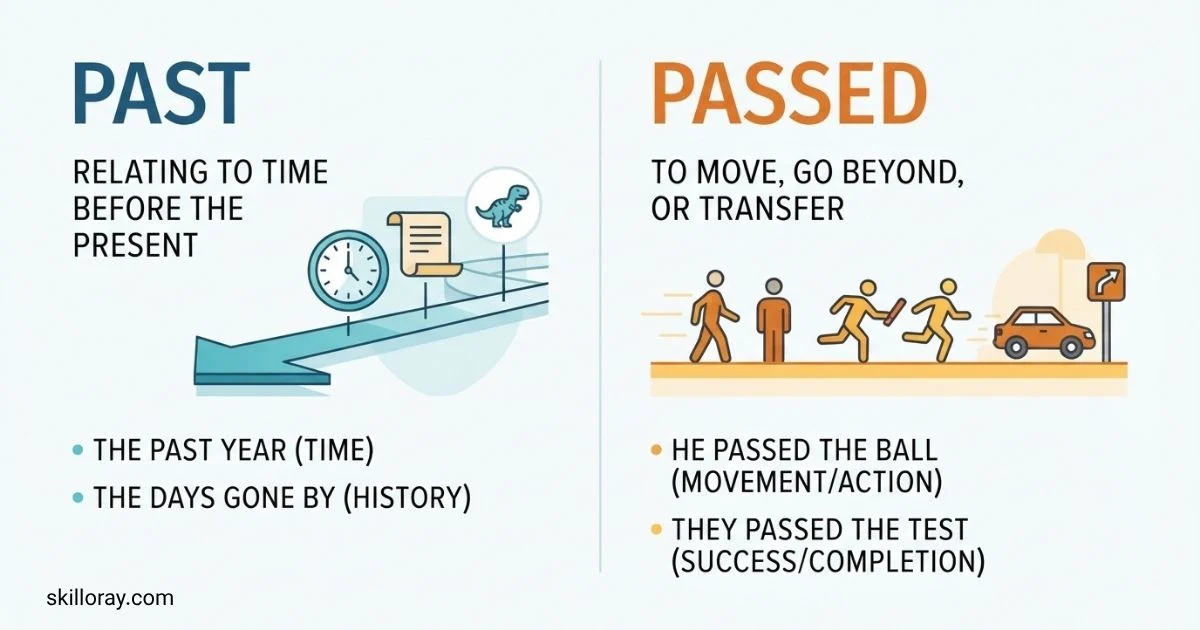
Have you ever stopped mid-sentence wondering whether past or passed is the correct word? You’re not alone—these two words sound similar, but I’ll show you the simple difference so you can choose confidently.
Once you understand how “past” or “passed” work, you can avoid one of the most common word-choice mistakes.I’ll break it down with clear rules and easy examples so you can remember the difference without confusion.
Whether you’re writing a message, school assignment, email, or article, you’ll soon know exactly when to use past and when to use passed.
Past or Passed: (Quick Answer)
Both past or passed are legitimate English words, but you cannot normally substitute one for the other.
| Form | Main Use | Example |
| past | Preposition, adverb, adjective, or noun | We walked past the school. |
| passed | Past tense or past participle of pass | She passed the exam. |
A simple way to remember the difference is:
Past usually relates to time, position, or movement beyond something.
Passed usually describes an action performed by someone or something, because it is the past-tense form of pass.
Past
Use past when you mean a time before now, a position beyond something, or movement beyond a particular point.
- We drove past the library.
- I stayed up past midnight.
- She has learned from her past.
- The train went past us.
Passed
Use passed when pass is the verb.
- He passed the test.
- The car passed our house.
- She passed me the ball.
- Time passed quickly.
Past Meaning
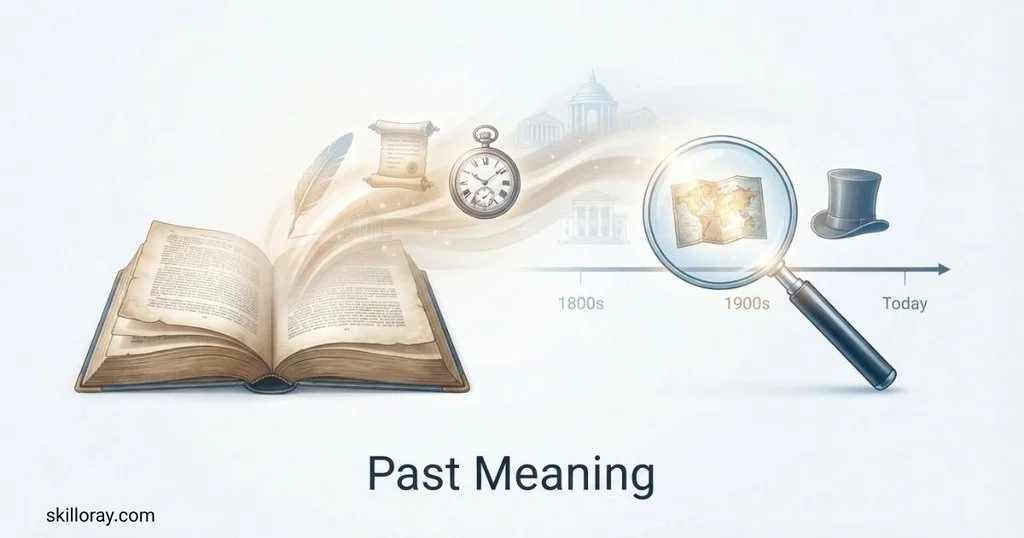
Past has several related meanings.
As a noun, it can refer to an earlier period of time:
- We shouldn’t let the past control our future.
- He often talks about his past.
As a preposition, past can describe movement beyond a place or point:
- I walked past the bank.
- The bus went past our house.
It can also describe something later than a particular time:
- It’s past midnight.
- The children stayed awake past their bedtime.
As an adjective, it can describe something that happened earlier:
- We discussed past mistakes.
- The past year has been busy.
Passed Meaning
Passed is the past tense or past participle of pass.
The verb pass can have several meanings, including moving beyond something, going from one person to another, succeeding in a test, or allowing a period of time to go by.
For example:
- She passed the exam.
- The runner passed another competitor.
- He passed the book to me.
- Three hours passed quickly.
Notice that passed describes an action. That’s an important clue when choosing the correct form.
Past or Passed the Deadline
The correct choice depends on what you mean.
Past the deadline
Use past when something is beyond a deadline or occurs later than it.
- The application was submitted past the deadline.
- We are already past the deadline.
- He finished the project past the deadline.
Passed the deadline
Passed can be correct when pass is being used as the verb.
For example:
- The deadline has passed.
Here, deadline is the subject, and passed means that the deadline has gone by.
This distinction is useful:
- We submitted it past the deadline.
- The deadline passed yesterday.
Past or Passed Examples
Here are some straightforward examples:
- I walked past the store.
- She passed the store on her way home.
- We drove past the stadium.
- The car passed us on the highway.
- It’s past my bedtime.
- The time passed quickly.
- He looked past the problem.
- She passed the exam.
- They moved past their disagreement.
- He passed the ball to his teammate.
The examples show why the words cannot simply be swapped.
Past or Passed Sentences
Sentences With “Past”
- We drove past the school this morning.
- Don’t worry about what happened in the past.
- The temperature stayed past 30 degrees.
- She walked past my desk.
- It’s already past noon.
- The dog ran past the gate.
- He stayed awake past his bedtime.
- We moved past the difficult part of the project.
- The train traveled past the station.
- She looked past the obvious answer.
Sentences With “Passed”
- I passed my driving test.
- The teacher passed the papers around.
- The car passed the truck.
- She passed me on the stairs.
- Two weeks passed before we heard from him.
- He passed the message to his friend.
- The law passed through the required process.
- The storm passed during the night.
- She passed the ball to her teammate.
- The deadline passed without an extension.
I Walked Past or Passed?
The usual correct expression is:
I walked past.
For example:
I walked past the coffee shop on my way home.
Why? Walked is already the main verb. Past tells us where the walking occurred in relation to something.
But passed can also occur with walked when the sentence has a different structure:
I walked until I passed the coffee shop.
Here, passed is the verb meaning that you moved beyond the coffee shop.
So:
- I walked past the coffee shop. ✅
- I walked until I passed the coffee shop. ✅
- I walked passed the coffee shop. ❌
I Drove Past or Passed?
Both expressions can be correct depending on the sentence structure.
Use drove past when past describes movement beyond something:
- I drove past the house.
- We drove past the school.
- She drove past the restaurant.
Use passed when pass is functioning as the verb:
- I passed the house while driving.
- We passed several cars.
- She passed the restaurant without stopping.
A useful pattern is:
drove past + place
but
passed + object
For example:
- I drove past the hotel.
- I passed the hotel.
Both can be grammatical, but the structure is different.
Walked Past or Passed
Walked past is normally the correct phrase when you mean that someone moved beyond a particular place or person.
- He walked past the door.
- She walked past me.
- We walked past the museum.
Passed becomes the verb when the sentence is structured around pass:
- He passed me while we were walking.
- She passed the entrance without noticing it.
The key is to identify whether past is describing position or movement, or whether passed is the action itself.
Move Past or Passed
The expression move past is correct when you mean to progress beyond something.
- It’s time to move past the mistake.
- We need to move past this problem.
- She is trying to move past the disappointment.
Here, move is the verb, while past indicates what you are moving beyond.
Moved past is also correct when moved is in the past tense:
- We moved past the difficult stage.
- She moved past her fears.
- They moved past the disagreement.
Moved passed is not the standard form for this meaning.
Look Past or Passed
Use look past when you mean to see beyond something or ignore something.
- Try to look past the mistake.
- She looked past the obvious answer.
- We need to look past the surface.
Looked past is the past-tense version:
- He looked past the problem.
- She looked past the first impression.
Use passed when pass itself is the verb:
- She passed the building without looking at it.
Drive Past or Passed
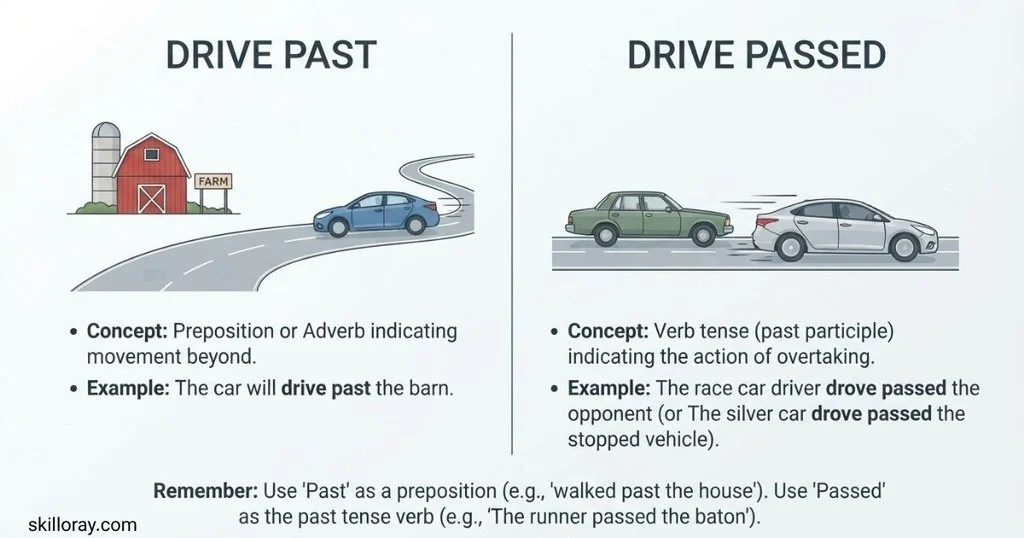
Use drive past when talking about moving beyond a place:
- Drive past the school and turn left.
- We drove past the park.
- I drive past that store every morning.
Use passed when pass is the main verb:
- The car passed the school.
- We passed several shops.
- She passed the other vehicle.
The difference comes from sentence structure rather than spelling alone.
Past or Passed Your Bedtime
The correct expression is:
past your bedtime
For example:
- It’s past your bedtime.
- You stayed up past your bedtime.
- We shouldn’t go past your bedtime.
Here, past means later than a particular time.
You can also say:
- It’s past my bedtime.
- It was past her bedtime.
- We stayed up past our bedtime.
Passed your bedtime does not express this normal meaning.
Go Past or Passed
Use go past when talking about movement beyond something.
- Go past the library and turn right.
- We went past the station.
- Don’t go past the sign.
Use passed when pass is the verb:
- We passed the station.
- She passed the entrance.
- He passed the checkpoint.
So:
Go past the store describes an instruction involving the verb go.
We passed the store uses passed as the main verb.
In Years Past or Passed
The correct expression is:
in years past
For example:
- In years past, people traveled differently.
- In years past, this town was much smaller.
- The tradition was common in years past.
Here, past refers to earlier years.
“In years passed” is not the normal expression when referring to previous years.
Past or Passed My Bedtime
The correct phrase is:
past my bedtime
Examples:
- It’s past my bedtime.
- I shouldn’t stay up past my bedtime.
- We talked until it was past my bedtime.
Again, past means later than the specified time.
Is It Past or Passed?
Ask yourself what role the word is playing.
If you’re talking about earlier time, movement beyond something, or a time later than a point, you usually need past.
If you’re using the verb pass in the past tense, you need passed.
Compare:
- The bus went past me.
- The bus passed me.
Both sentences can be correct. The first uses past after the verb went. The second uses passed as the main verb.
Make It Past or Passed
The correct choice depends on the meaning and sentence structure.
Use make it past when you mean to get beyond something:
- I hope we can make it past the first round.
- She made it past the difficult stage.
- We finally made it past the checkpoint.
Use passed when pass is the past-tense verb:
- She passed the checkpoint.
- He passed the first round.
- They passed the difficult stage.
So make it past is a normal expression when past follows the verb make.
Moved Past or Passed
Moved past is correct when past means beyond something.
- We moved past the issue.
- She moved past the difficult period.
- They moved past their disagreement.
Passed can be correct when pass is the main verb:
- The train passed the station.
- He passed the difficult section.
Do not replace past with passed simply because the sentence is talking about something that happened earlier.
Put It Past or Passed
The expression put it past is correct in phrases such as:
- I wouldn’t put it past him.
- Don’t put it past her to arrive early.
- I wouldn’t put it past them to try again.
Here, put it past someone is an established expression meaning that you consider a particular action possible for that person.
There is also another common expression:
- Let’s put the past behind us.
In this sentence, past refers to earlier events or time.
Past or Passed Away
The correct phrase is:
passed away
Here, passed is the past tense of pass and forms a polite expression meaning that someone has died.
For example:
- Her grandfather passed away last year.
- His uncle passed away peacefully.
- We were sorry to hear that her relative had passed away.
Past away is not the standard expression.
Common Mistakes With Past or Passed
Mistake 1: “I walked passed the store”
Incorrect: I walked passed the store.
Correct: I walked past the store.
Use past after walked when it describes movement beyond the store.
Mistake 2: “The deadline has past”
Incorrect: The deadline has past.
Correct: The deadline has passed.
Here, passed is the verb because the deadline has gone by.
Mistake 3: “It’s passed my bedtime”
Incorrect: It’s passed my bedtime.
Correct: It’s past my bedtime.
Here, past means later than your bedtime.
Mistake 4: “In years passed”
Incorrect: In years passed, the town was smaller.
Correct: In years past, the town was smaller.
When referring to earlier years, use past.
Mistake 5: “She passed away” becoming “She past away”
Incorrect: She past away.
Correct: She passed away.
The expression uses the verb passed.
An Easy Way to Remember Past or Passed
Try this simple test:
Can you replace the word with “went by” or “moved beyond”?
If yes, past may be the right choice when you’re describing a position, direction, or time.
- We walked past the house.
- It’s past midnight.
If the word is the past-tense form of the verb pass, use passed.
- She passed the exam.
- The deadline passed.
- The car passed us.
Another useful trick is to look at the word before it.
walked past
drove past
go past
look past
move past
These commonly use past because another verb is followed by a word describing what lies beyond.
By contrast:
passed the exam
passed the car
passed the deadline
passed away
Here, passed is functioning as a verb.
Past or Passed Quiz
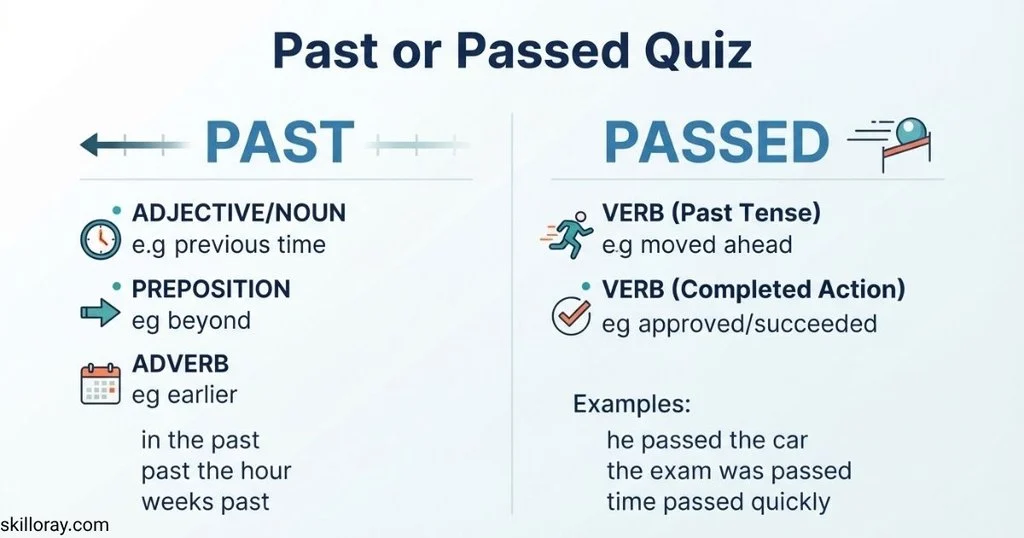
Choose past or passed in each sentence.
- I walked ___ the library.
- She ___ her English exam.
- The deadline has ___.
- It’s ___ my bedtime.
- We drove ___ the stadium.
- The train ___ the station.
- In years ___, this was a busy road.
- He ___ away several years ago.
- We need to move ___ this problem.
- The dog ran ___ the gate.
Answers
- past
- passed
- passed
- past
- past
- passed
- past
- passed
- past
- past
The fastest way to check your answer is to determine whether you’re using past to indicate time or movement beyond something, or passed as the past-tense form of pass.
Frequently Asked Questions
Is “past” or “passed” correct?
Both are correct words, but they have different uses. Past commonly refers to earlier time, a position beyond something, or movement beyond something. Passed is the past tense or past participle of pass.
Is it “I walked past” or “I walked passed”?
The standard expression is I walked past when past describes movement beyond a place or person. For example, “I walked past the store.”
Is it “I drove past” or “I drove passed”?
I drove past is correct when past describes movement beyond a place. For example, “I drove past the school.”
Is it “the deadline has past” or “the deadline has passed”?
The correct sentence is the deadline has passed. Here, passed is the verb meaning that the deadline has gone by.
Is it “past my bedtime” or “passed my bedtime”?
The standard phrase is past my bedtime. Past means later than the stated time.
Is it “in years past” or “in years passed”?
The standard expression is in years past when referring to previous years.
Is “passed away” correct?
Yes. Passed away is a common polite expression referring to someone’s death. Past away is not the standard form.
Is “move past” correct?
Yes. Move past is correct when you mean to progress beyond something, such as “We need to move past this problem.”
How can I remember past or passed?
Remember that passed is a form of the verb pass. Past is commonly used for earlier time or something beyond a particular point or place.
Conclusion
Past or passed are both correct, but they do different jobs. Use past for earlier time, movement beyond something, or a point later than a particular time. Use passed when you need the past-tense or past-participle form of pass.
If you’re writing “I walked past the store,” “it’s past my bedtime,” “in years past,” or “move past the problem,” use past. If you’re writing “the deadline passed,” “she passed the exam,” or “he passed away,” use passed.
The easiest habit is to identify the grammar of the sentence first. Once you know whether you’re describing a position or time, or using pass as a verb, the correct form becomes much easier to choose.

I am Olivia Brown, a professional English editor and grammar writer who believes that great writing begins with a strong foundation in grammar. I have spent years creating educational resources that help students and professionals improve their writing, avoid common errors, and communicate more effectively. I strive to provide clear explanations and practical examples that make grammar easy to understand and apply.
Books: English Grammar Essentials and Modern Writing Success
 James Walker
 Daniel Carter
[…] Here or Hear, Hear: What’s the Difference? Past or Passed: A Simple Guide to Using Them Correctly It’s or Its: Complete Guide to the Difference and Usage Laid Off or Layed Off: Which […]