
If you’ve ever paused while writing “here” or “hear,” you’re not alone. I know how confusing these words can feel because they sound alike but have completely different meanings.
You may also wonder why people say “hear, hear” when they agree with something. I’ll break it all down for you in simple language, with clear examples you can easily remember.
By the end, you’ll know exactly when to use “here,” “hear,” “here, here,” or “hear, hear.” I’ll also show you the common mistakes so you can write with confidence.
Here, Here or Hear, Hear: (Quick Answer)
“Hear, hear!” is the correct expression when you want to show strong agreement or approval. The spelling “here, here” is generally a mistaken version of this phrase.
| Expression | Meaning | Correct use |
| Here | In this place or at this location | “Please stand here.” |
| Hear | To perceive sound | “Can you hear me?” |
| Hear, hear! | An expression of agreement or approval | “Hear, hear! That was an excellent point.” |
| Here, here! | Usually a misspelling of “Hear, hear!” | Avoid when expressing agreement |
So, if someone makes a point you strongly agree with, write:
“Hear, hear!”
Not:
“Here, here!”
What Does Here Mean?
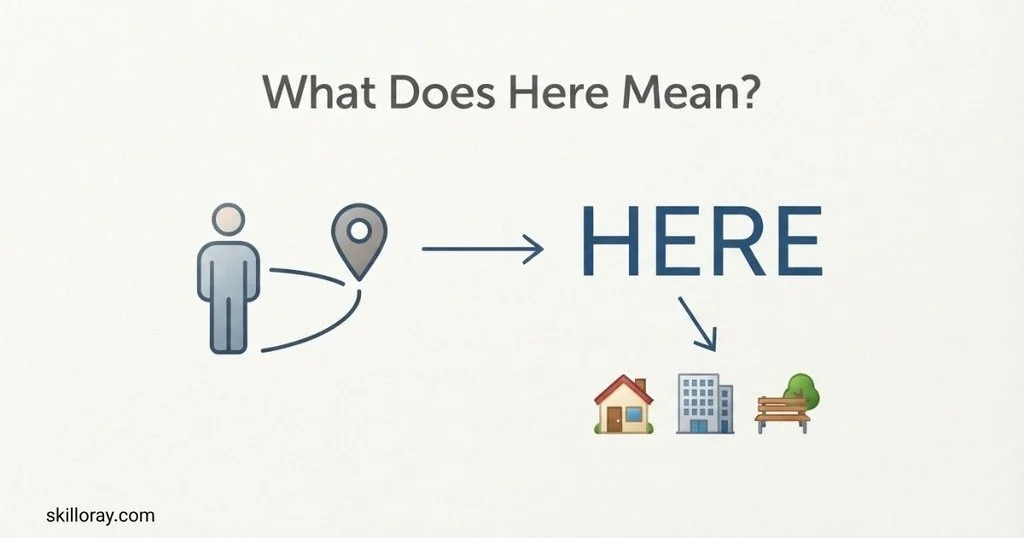
Here is an adverb that refers to a particular place, position, or situation. It tells someone where something is located or where an action is happening.
For example:
- Please come here.
- Your bag is here.
- I live here.
- Put the book here.
- We can wait here.
The opposite of here is often there, depending on the context.
Here in a Sentence
Here are some natural examples:
- Please sit here.
- I left my phone here.
- We should meet here tomorrow.
- Is your brother here?
- Come here for a moment.
- The answer is here on the page.
In all these sentences, here has a connection with location.
What Does Hear Mean?
Hear is a verb related to the sense of sound. It means to perceive or become aware of something through your ears.
For example:
- Can you hear the music?
- I can hear someone outside.
- Did you hear that noise?
- She likes to hear stories.
- We could hear the speaker clearly.
Unlike here, hear describes an auditory experience rather than a location.
Hear in a Sentence
Here are some examples showing the normal use of hear:
- Can you hear me?
- I can hear the birds outside.
- Did you hear the announcement?
- We could hear the rain.
- I didn’t hear what she said.
- She loves to hear live music.
A useful memory trick is:
Here = place
Hear = sound
Why Is It “Hear, Hear” Instead of “Here, Here”?
The spelling comes from the verb hear, because the expression is connected with calling attention to what someone has said.
Think of it as an emphatic way of saying that people should listen to the speaker or recognize the point being made.
Here does not have that meaning. It normally refers to a place.
That is why:
- Hear, hear! = agreement or approval
- Here = a location
- Hear = perceive sound
The two words happen to sound alike, which is why this particular spelling mistake is so common.
Here or Hear in a Sentence
The easiest way to understand the difference is to look at how each word functions in a sentence.
Sentences With “Here”
- Come here when you’re ready.
- Your keys are here.
- I’ve been waiting here for ten minutes.
- We can finish the work here.
- Is anyone here?
In each example, here identifies a place or position.
Sentences With “Hear”
- Can you hear that sound?
- I couldn’t hear the announcement.
- Did you hear the news?
- She can hear music from her room.
- I want to hear your opinion.
In these examples, hear relates to sound, listening, or receiving information through hearing.
“Hear, Hear” in Parliament
“Hear, hear!” is traditionally used in parliamentary settings to express approval or agreement with something that has been said.
You may encounter the expression in reports of parliamentary debates, political speeches, legislative chambers, or other formal proceedings.
A member may say “Hear, hear!” after another speaker makes a statement they support.
The expression isn’t asking someone to physically move to a location. Instead, it functions as an interjection expressing approval.
For example:
Speaker: “We must continue working to improve public services.”
Members: “Hear, hear!”
This is why the spelling hear, hear is particularly important in this context.
Is “Here, Here” Ever Correct?
“Here, here” can technically occur as an ordinary combination of the word “here,” but it is not the standard spelling of the expression used to show agreement.
For example, if someone is identifying two locations, they might say:
- “The problem is here, here, or somewhere nearby.”
In that type of sentence, here retains its normal meaning of location.
However, if you mean “I strongly agree with that!”, the expression is:
“Hear, hear!”
So the context determines whether here is functioning as a location word or hear is functioning as a verb.
Here or Hear Pronunciation
Here or hear are homophones in standard English. That means they have the same or nearly the same pronunciation but different meanings and spellings.
In many varieties of English, both are pronounced approximately:
/hɪr/
In British English, you may commonly hear a pronunciation closer to:
/hɪə/
The important point is that you generally cannot rely on pronunciation alone to decide whether to write here or hear.
You need to understand the meaning.
A Simple Pronunciation Memory Trick
- Here → think about a place
- Hear → think about your ears
The words sound alike, but their meanings are different.
Here, Here or Hear, Hear When You Agree
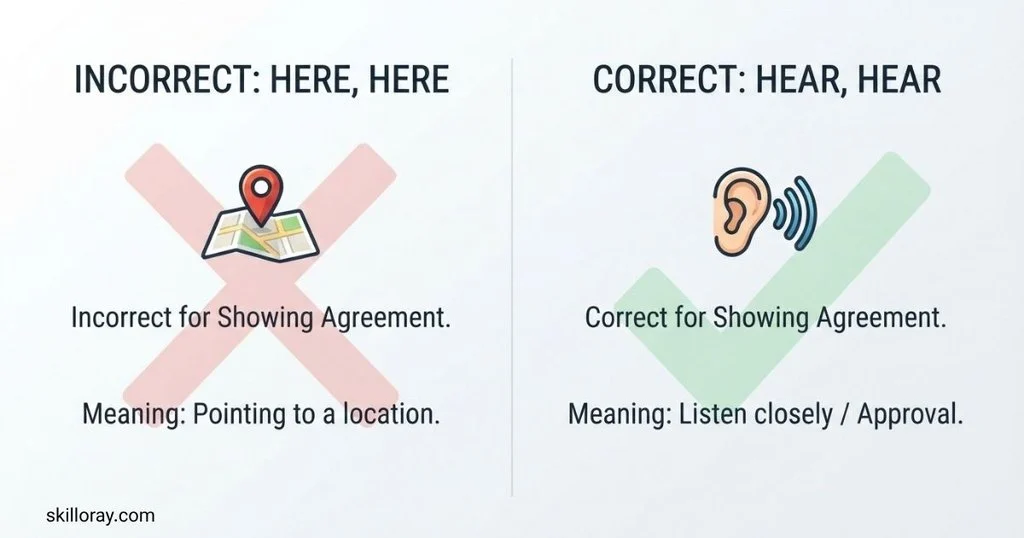
If you want to express agreement with someone, use:
“Hear, hear!”
For example:
- “Everyone deserves to be treated fairly.”
“Hear, hear!” - “We should appreciate the people who help our community.”
“Hear, hear!” - “That was an excellent explanation.”
“Hear, hear!”
The expression can sound formal or slightly traditional, but it is still understood in modern English.
In casual online conversation, people may also use it humorously or enthusiastically.
Is “Hear, Hear” a Phrase?
Yes. “Hear, hear!” is an established English expression used to express agreement or approval.
It is an interjection rather than a normal sentence. The punctuation commonly used is a comma:
Hear, hear!
The repeated word gives the expression its emphatic character.
You may sometimes see “hear hear” written without punctuation, especially in informal digital communication, but “Hear, hear!” is the conventional written form.
Also Check this Post: Past or Passed: A Simple Guide to Using Them Correctly
Common Mistakes With Here or Hear
Because here or hear are homophones, they are frequently confused in writing.
Mistake 1: Using “Here, here!” for Agreement
Incorrect for the agreement expression:
“Here, here! I completely agree.”
Correct:
“Hear, hear! I completely agree.”
The intended meaning is approval, so hear is the appropriate word.
Mistake 2: Using “Hear” for Location
Incorrect:
“Please wait hear.”
Correct:
“Please wait here.”
The sentence refers to a location, so here is required.
Mistake 3: Using “Here” for Sound
Incorrect:
“Can you here me?”
Correct:
“Can you hear me?”
The sentence refers to perceiving someone’s voice, so hear is the correct verb.
A Quick Way to Remember Here or Hear

Use this simple rule:
Here = location
Hear = sound
Hear, hear! = agreement
You can also connect hear with ear because both words relate to sound.
For example:
Can you hear with your ears?
Yes.
Are you standing here?
That describes your location.
This distinction makes the spelling much easier to remember.
Here or Hear: Quick Comparison
| Word or expression | Meaning | Example |
| Here | A place or position | “Come here.” |
| Hear | Perceive sound | “Can you hear me?” |
| Hear, hear! | Agreement or approval | “Hear, hear! I agree.” |
| Here, here! | Usually a mistaken spelling of the expression | Use “Hear, hear!” for agreement |
FAQs About Here, Here or Hear, Hear
What is correct, here here or hear, hear?
“Hear, hear!” is correct when you are expressing agreement or approval. “Here, here!” is generally a misspelling of the expression.
Is it “here here” or “hear hear” when you agree?
Use “Hear, hear!” when you agree with something someone has said. The expression indicates approval or support.
What is the difference between here or hear?
Here refers to a place or position, while hear is a verb related to perceiving sound. They sound alike but have different meanings.
Is “hear, hear” grammatically correct?
Yes. “Hear, hear!” is an established English interjection. It is commonly used to express agreement or approval rather than functioning as a conventional complete sentence.
Why do people say “Hear, hear” in Parliament?
In parliamentary debate, “Hear, hear!” is traditionally used to show approval or agreement with a speaker’s remarks. The expression is associated with formal debate and public speaking.
Is “here, here” ever correct?
It can be correct when here is being used literally to refer to a place or location. However, when you mean the expression of agreement, the standard spelling is “Hear, hear!”
Are here or hear pronounced the same?
Yes, here or hear are homophones in standard English varieties where they have the same pronunciation. Their spelling and meaning are different.
Can I write “hear hear” without a comma?
In informal writing, you may see “hear hear,” but the conventional punctuation is “Hear, hear!” The comma reflects the traditional repeated expression.
Is “Hear, hear!” formal or informal?
It can work in both settings, but it has a somewhat traditional or formal tone. It is especially familiar in debates, speeches, meetings, and parliamentary contexts.
Conclusion
The answer is simple when you separate the meanings. Here refers to a place, while hear relates to sound. When you want to show agreement or approval, the correct expression is “Hear, hear!”
So if someone makes an excellent point and you want to enthusiastically agree, remember:
Hear, hear! ✅
Here, here! ❌ when intended as the agreement expression.

I am Daniel Carter, a grammar enthusiast and language educator with over 10 years of experience helping students and professionals improve their English writing and communication skills. I enjoy simplifying complex grammar rules into easy-to-understand lessons that anyone can follow. My goal is to help learners write with confidence, avoid common mistakes, and develop strong communication skills for academic and professional success. I regularly create practical grammar guides, writing tips, and language resources that make learning both enjoyable and effective.
Books: Mastering English Grammar and The Complete Guide to Better Writing
 James Walker
 Olivia Brown