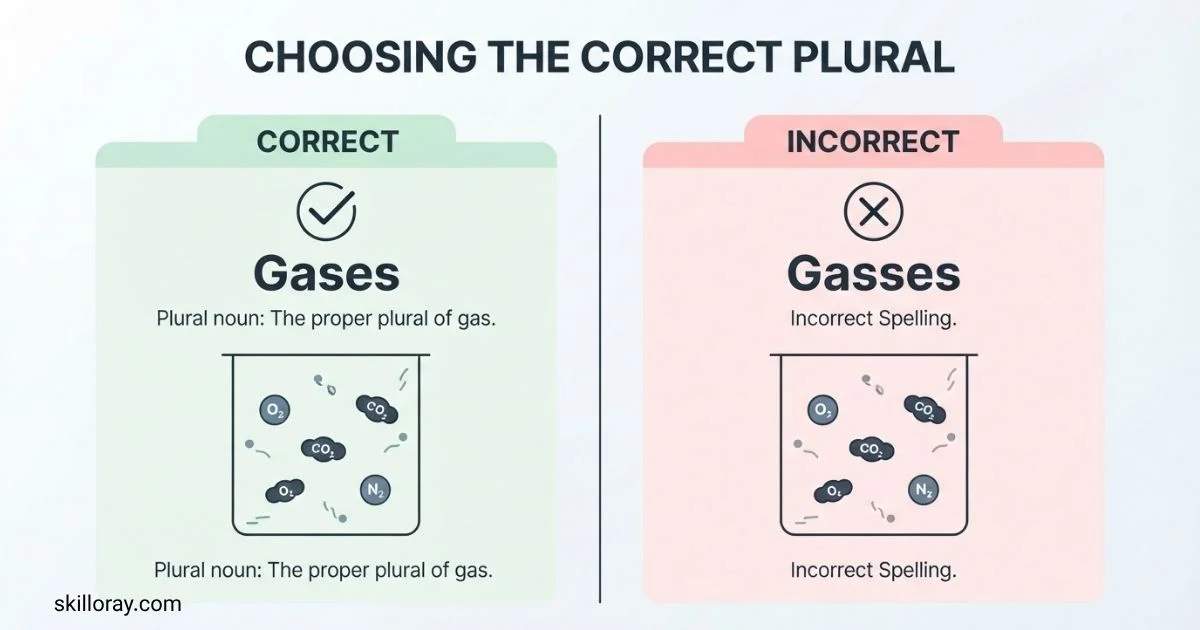
Have you ever stopped while writing and wondered whether gases or gasses is the correct spelling? I know how confusing two similar-looking words can feel, especially when both seem like they could be right.
You may see both forms in English, but their use is not always the same. In this guide, I’ll help you understand the difference so you can confidently choose the right spelling whenever you write.
Whether you’re a student, writer, or simply trying to improve your English, you’ll find a clear and practical answer here. You can quickly learn when to use gases, when gasses may appear, and how to avoid common mistakes.
Gases or Gasses: (Quick Answer)
Gases is the standard and overwhelmingly more common plural spelling of gas.
Gasses is also a legitimate form in some dictionaries, but it is much less frequently used as a plural noun. It can also be the third-person singular form of the verb gas, which makes the spelling potentially confusing.
| Form | Main use | Example |
| gas | Singular noun | Oxygen is a gas. |
| gases | Standard plural noun | Several gases are present. |
| gasses | Less common plural noun or verb | The mixture contains several gasses. |
| gasses | Third-person singular verb | The device gasses the material. |
So, if you simply need the plural of gas, gases is the form you should normally choose.
What Is the Plural of Gas?
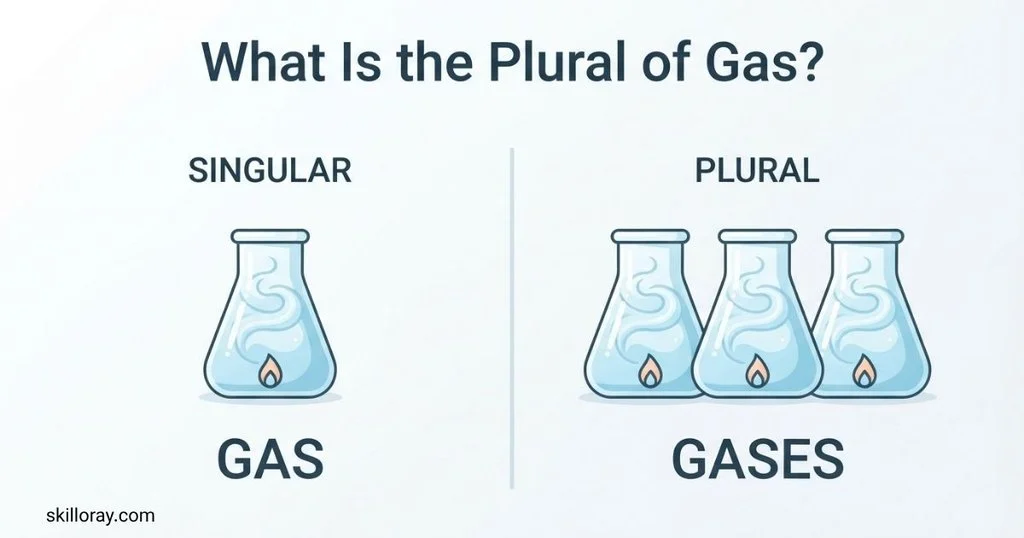
The usual plural of gas is gases.
For example:
- One gas → several gases
- A gas → different gases
- This gas → these gases
- A dangerous gas → dangerous gases
- One greenhouse gas → several greenhouse gases
The spelling changes from gas to gases by adding -es.
This follows a familiar English plural pattern in which certain nouns ending in s take -es rather than simply adding -s.
Why Is It Gases?
The spelling gases helps preserve the pronunciation of the plural form.
The singular word gas is pronounced with a short vowel sound, while gases is commonly pronounced with two syllables:
gas → gases
The plural is pronounced approximately GAS-iz.
The spelling gasses can look like a natural way to create the plural, especially because English has many nouns that form plurals by doubling a final consonant before adding an ending. However, gases is the conventional spelling readers normally expect.
What Does Gases Mean?
Gases is the plural noun form of gas.
A gas is a state of matter in which particles are relatively far apart and can move freely. Gases do not have a fixed shape or fixed volume in the way a solid has a fixed shape.
Examples of gases include:
- Oxygen
- Nitrogen
- Hydrogen
- Helium
- Carbon dioxide
- Water vapor
- Neon
- Argon
The word gases can refer to one or more types of gas or to multiple quantities of gas.
For example:
Different gases have different physical properties.
The laboratory stores several gases for experiments.
Greenhouse gases affect Earth’s climate system.
What Does Gasses Mean?
Gasses has two relevant uses.
First, gasses can appear as a less common plural spelling of gas. Some dictionaries recognize this form, although gases is much more common.
Second, gasses is a verb form. It can be the third-person singular present form of gas.
For example:
The equipment gasses the material.
Here, gasses is functioning as a verb rather than a plural noun.
This second use is one reason the spelling can cause confusion. When you see gasses, look at its position in the sentence and determine whether it is being used as a noun or a verb.
Gases or Gasses in American English
In American English, gases is the normal plural spelling of gas.
You’ll commonly see it in scientific, educational, medical, environmental, and everyday writing:
- greenhouse gases
- exhaust gases
- noble gases
- industrial gases
- toxic gases
- natural gases
Gasses may appear as a plural noun, but it is considerably less common. It is also used as a verb in appropriate contexts.
If you’re writing for an American audience and need the ordinary plural of gas, use gases.
Gases or Gasses in British English
British English also commonly uses gases as the plural of gas.
For example:
Several gases were released during the experiment.
The spelling gasses can be encountered as a less common plural form, but it is not the spelling most readers would normally expect in standard scientific or general writing.
Therefore, British writers who need the ordinary plural of gas will generally use gases.
Gases or Gasses in Canadian English
Canadian English generally follows gases for the ordinary plural of gas.
For example:
The atmosphere contains several different gases.
Canadian English can contain features associated with both British English and American English, but this particular spelling normally does not create a major regional distinction. Gases remains the conventional choice.
Gases or Gasses in Scientific Writing
Gases is strongly preferred in scientific and technical contexts.
You will commonly encounter expressions such as:
- greenhouse gases
- noble gases
- rare gases
- respiratory gases
- volcanic gases
- combustion gases
- atmospheric gases
- inert gases
- toxic gases
For example:
Greenhouse gases absorb and emit infrared radiation.
Noble gases have distinctive chemical properties.
Scientists measured the concentration of several gases in the sample.
Using gases makes the intended plural immediately clear to readers.
Greenhouse Gases or Gasses
The standard expression is greenhouse gases.
You will see this spelling throughout environmental and climate-related writing:
Carbon dioxide and methane are greenhouse gases.
Human activities can increase concentrations of certain greenhouse gases in the atmosphere.
While greenhouse gasses may occasionally be encountered, greenhouse gases is the established form to use in normal scientific and educational writing.
If you’re writing an article, report, assignment, presentation, or research paper, choose greenhouse gases.
Gases or Gasses Examples
Here are examples showing the normal use of gases:
- The atmosphere contains several different gases.
- Oxygen and nitrogen are important gases in Earth’s atmosphere.
- The scientist analyzed the gases inside the container.
- Some gases are invisible to the human eye.
- Greenhouse gases play an important role in Earth’s climate system.
- The laboratory stores gases under controlled conditions.
- Different gases have different densities.
- Certain gases can react with other substances.
- The experiment produced several gases.
- The ventilation system removes unwanted gases from the room.
These examples demonstrate why gases is the natural choice when gas is being used as a plural noun.
Sentences With Gasses
When gasses is used as a plural noun, it has the same basic meaning as the less common plural form of gas:
- The container held several gasses.
- Different gasses were tested during the experiment.
- The process can produce unusual gasses.
- The researcher studied the properties of several gasses.
- Some gasses can be detected with specialized equipment.
However, in ordinary writing, gases would generally be the more familiar choice in these sentences.
Gasses can also be a verb:
- The machine gasses the material.
- The process gasses the product.
- The system gasses the chamber under controlled conditions.
The exact meaning of the verb depends on the context in which gas is being used.
How Do You Spell Gases or Gasses?
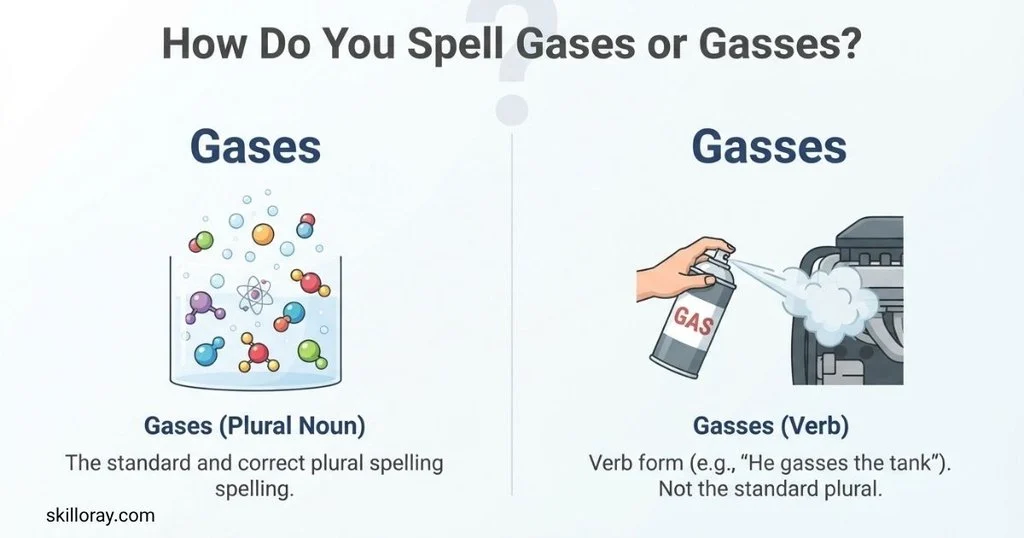
If you’re asking how to spell the usual plural of gas, spell it:
G-A-S-E-S → gases
The word has two syllables and is commonly pronounced approximately GAS-iz.
A common reason for the confusion is that gas ends in s, so it may seem natural to form the plural as gasses. English spelling doesn’t always work by simply adding letters based on appearance, though. In this case, gases is the conventional plural spelling.
Simple Spelling Tip
Think of the basic pattern as:
gas → gases
not:
gas → gasses
when you’re writing the standard plural noun.
How Do You Pronounce Gases?
Gases is commonly pronounced:
GAS-iz
IPA:
/ˈɡæsɪz/
It has two syllables:
gas-es
The first syllable receives the main stress.
The plural ending sounds like -iz, rather than simply adding an s sound to the singular.
For example:
- gas → /ɡæs/
- gases → /ˈɡæsɪz/
The less common plural gasses has the same basic pronunciation when it is used as a noun.
Is Gasses a Word?
Yes. Gasses is a word, but its meaning and frequency depend on context.
It can function as:
- A less common plural form of gas
- A third-person singular present-tense form of the verb gas
For example, as a verb:
The process gasses the material.
Because gasses has a legitimate grammatical use, it shouldn’t automatically be labeled an incorrect spelling.
The important question is what you are trying to say.
If you mean multiple gases, gases is normally the preferred spelling.
Common Mistakes With Gases or Gasses
Mistake 1: Using Gasses as the Default Plural
Less preferred:
The atmosphere contains many gasses.
Preferred:
The atmosphere contains many gases.
The first spelling can be found in English, but gases is the conventional choice for the plural noun.
Mistake 2: Confusing Gasses With a Verb
Consider:
The machine gasses the material.
Here, gasses is a verb.
It does not mean that the sentence contains several gases. The grammatical role is different.
Mistake 3: Writing Greenhouse Gasses in Formal Work
For environmental, scientific, or academic writing, use:
greenhouse gases
This is the standard expression readers are most likely to expect.
Mistake 4: Assuming Gasses Is Always Incorrect
It isn’t accurate to say that gasses can never be used.
Some dictionaries recognize gasses as a plural form of gas, although it is much less common than gases. Context matters, so the spelling should be judged according to its grammatical role and intended meaning.
Gases or Gasses in a Sentence
Here is a simple way to identify the correct form.
If you are talking about more than one gas, use the standard plural:
Several gases were detected.
If gasses is being used as a verb, it may be correct:
The equipment gasses the material.
This gives you a useful test:
Multiple gas substances → gases
A verb describing an action → gasses may be correct
Gases or Gasses: Grammar Explained
The word gas is normally a noun when it refers to a substance or state of matter.
Its ordinary plural is gases.
Singular
The gas escaped from the container.
Plural
The gases escaped from the containers.
The grammatical change is therefore:
gas → gases
The spelling gasses does not usually need to be used when you are simply making gas plural.
Gases or Gasses Possessive Forms
Possessives can create another spelling question.
For the singular noun:
the gas’s pressure
Here, gas’s indicates that something belongs to or is associated with one gas.
For the plural noun:
the gases’ properties
Here, gases’ is the plural possessive form.
Notice that gasses’ would only be appropriate if gasses were intentionally being used as the plural noun.
Examples:
The gas’s temperature was measured.
The gases’ temperatures were measured separately.
The apostrophe placement depends on whether the noun is singular or plural.
Gases List
There are many different gases encountered in science, industry, medicine, and everyday life. Some familiar examples include:
- Oxygen
- Nitrogen
- Hydrogen
- Helium
- Carbon dioxide
- Neon
- Argon
- Krypton
- Xenon
- Radon
- Methane
- Water vapor
- Ozone
These substances have different physical or chemical properties, so the plural word gases is useful when discussing them collectively.
For example:
Oxygen, nitrogen, and carbon dioxide are gases.
Why People Confuse Gases or Gasses
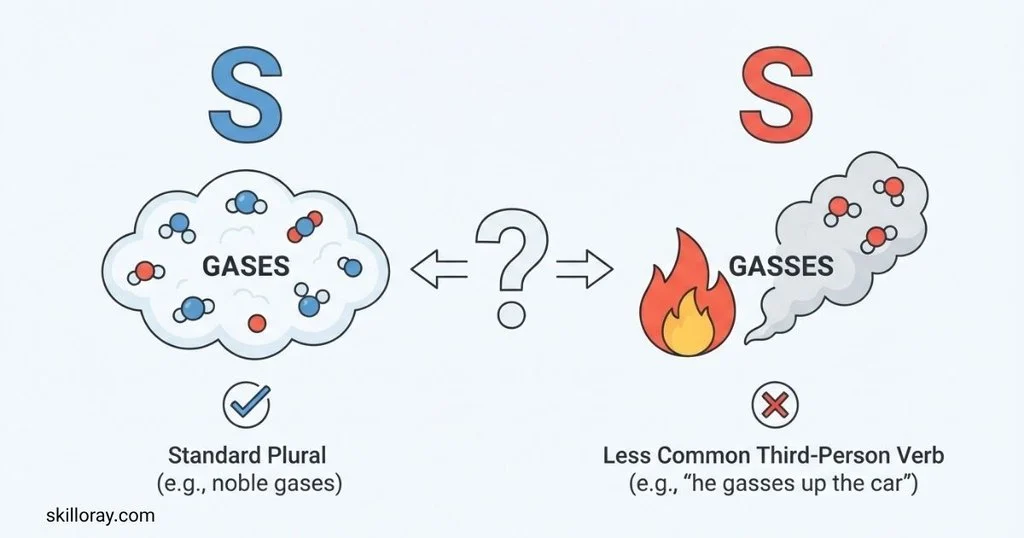
The confusion mostly comes from English spelling patterns.
The singular word gas already ends in s. Because many English plurals are formed by adding -s or -es, writers may naturally wonder whether the plural should contain one s before the ending or two.
The result is two spellings that look plausible:
gases
gasses
Both can be encountered, but they do not have equal frequency or usefulness in ordinary writing.
The simplest practical rule is to remember:
Use gases when you mean more than one gas.
This will be correct for the vast majority of everyday, academic, and scientific situations.
Quick Reference: Gases or Gasses
| Question | Answer |
| What is the usual plural of gas? | Gases |
| Is gases correct? | Yes |
| Is gasses a word? | Yes |
| Is gasses used as a plural noun? | Yes, but less commonly |
| Can gasses be a verb? | Yes |
| Which spelling is standard for scientific writing? | Gases |
| Which spelling appears in greenhouse gases? | Gases |
| How is gases pronounced? | Approximately GAS-iz |
| Is gases used in American English? | Yes |
| Is gases used in British English? | Yes |
| Is gases used in Canadian English? | Yes |
Frequently Asked Questions
Is It Gases or Gasses?
Gases is the standard and much more common plural of gas. Gasses can also be found as a less common plural noun form and is also a verb form of gas.
Which Is Correct: Gases or Gasses?
Both spellings can be legitimate, but they are not equally common. Use gases when you need the ordinary plural noun. Use gasses when the context specifically calls for that less common noun form or the verb form.
What Is the Plural of Gas?
The usual plural is gases.
One gas → several gases
Is Gasses a Misspelling of Gases?
Not necessarily. Gasses can be a legitimate English form. However, it is much less common as a plural noun, so gases is normally the better choice when referring to multiple gases.
How Do You Spell Gases?
Spell the standard plural as gases: G-A-S-E-S.
Is It Greenhouse Gases or Gasses?
The standard expression is greenhouse gases. This is the spelling you should normally use in scientific, educational, environmental, and general writing.
Is Gases Used in American English?
Yes. Gases is the standard plural spelling used in American English.
Is Gases Used in British English?
Yes. Gases is also the usual plural spelling in British English.
Is Gases Used in Canadian English?
Yes. Gases is the conventional spelling for the ordinary plural of gas in Canadian English.
What Is the Pronunciation of Gases?
Gases is commonly pronounced GAS-iz, with two syllables. Its IPA pronunciation is /ˈɡæsɪz/.
Conclusion
When you’re choosing between gases or gasses, the safest general rule is straightforward: use gases for the ordinary plural of gas. It is the standard, familiar spelling used in general, academic, scientific, American, British, and Canadian English.
Gasses isn’t simply an impossible spelling. It can appear as a less common plural noun form, and it also functions as a verb in sentences such as the machine gasses the material. The context therefore matters.
For most readers and most situations, though, remember this simple pattern:
gas → gases
So write greenhouse gases, toxic gases, noble gases, and different gases when you are talking about more than one gas.

I am James Walker, an English language specialist with extensive experience in grammar, editing, and academic writing. I enjoy helping students, bloggers, and professionals strengthen their writing by explaining grammar concepts in a clear and engaging way. My focus is on providing accurate, practical, and easy-to-follow guidance that helps learners communicate more effectively in everyday and professional situations.
Books: Perfect English Grammar Handbook and Advanced Writing Techniques
 Daniel Carter
 Olivia Brown