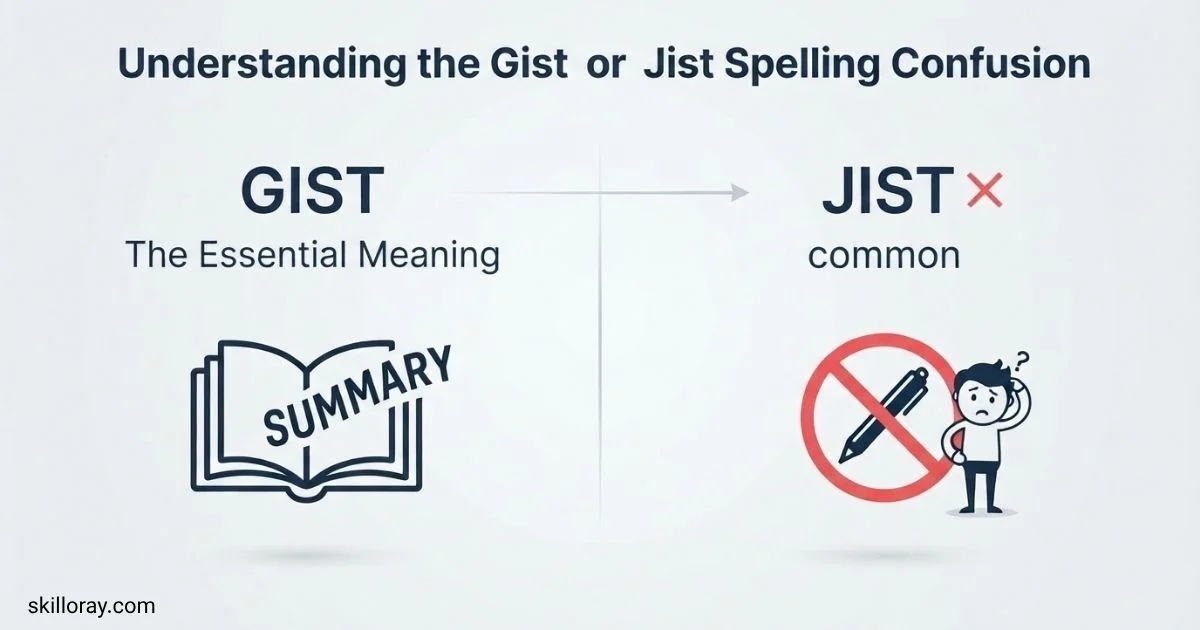
Have you ever written a sentence and suddenly wondered, “Is it jist or gist?” I know how confusing these small spelling differences can feel, especially when both words sound so similar.
You probably want a quick, clear answer without digging through complicated grammar rules. You’ll learn exactly which word is standard, what it means, and how to use it naturally in everyday writing.
By the end, you’ll understand the difference between jist or gist and feel much more confident choosing the right word whenever you write or speak.
What Does Gist Mean in English?
Gist is a noun that refers to the main point, central idea, or essential meaning of something. It helps you describe the most important information without explaining every small detail.
For example, if someone tells you a long story about a problem at work, you might understand the main issue without remembering every conversation. You have understood the gist of the story.
Here are some common meanings of gist:
- Main idea: The central thought of a discussion.
- Essential meaning: The most important part of a message.
- General understanding: The overall point of something, even when you miss a few details.
- Central argument: The key point someone is trying to communicate.
Examples of Gist in Everyday English
- I understood the gist of the teacher’s explanation.
- Can you tell me the gist of the news report?
- She explained the gist of the meeting in two minutes.
- I didn’t understand every word, but I got the gist.
- The gist of his message was that we needed more time.
In each sentence, gist refers to the main meaning rather than every individual detail.
Jist or Gist: Which Is Correct?
Gist is the standard spelling when you mean the main idea, meaning, or essential point of something. Jist is a common misspelling in this context.
| Word | Meaning | Correct usage |
| Gist | The main idea or essential meaning | I got the gist of the conversation. |
| Jist | Common misspelling of gist in this meaning | Write “gist” instead. |
The confusion happens because the initial letter in gist sounds like the English letter J. Although the word starts with G, it is pronounced with a /dʒ/ sound, as in jump.
Remember this simple rule: when you want to talk about the main point of a story, conversation, article, or explanation, write gist.
Why Do People Spell Gist as Jist?
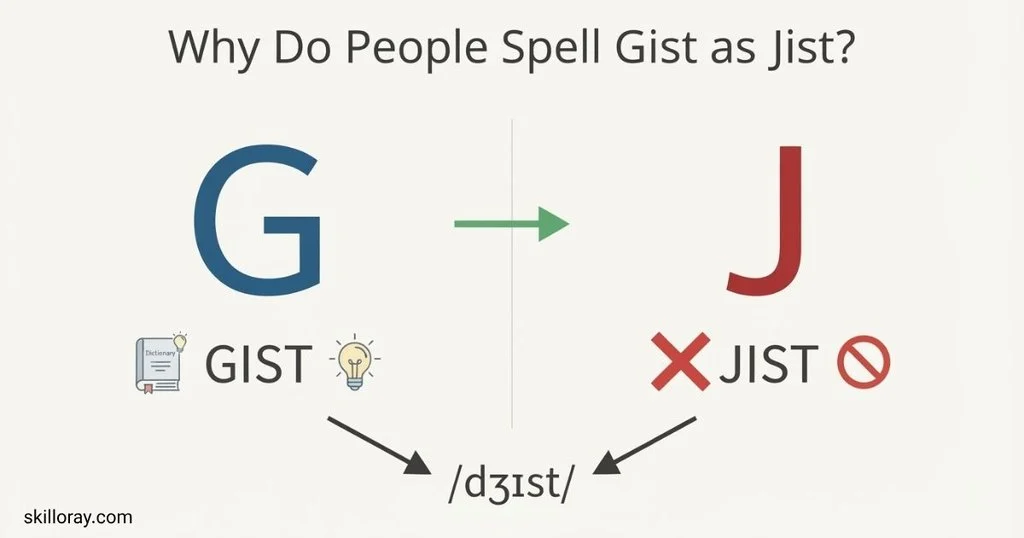
There are several reasons people make this spelling mistake:
- Pronunciation: The G in gist sounds like J, which can make the spelling confusing.
- Phonetic spelling: People sometimes spell words according to how they hear them.
- Informal communication: Quick messages, social media posts, and casual writing can reinforce spelling errors.
- Limited exposure: Someone who has heard the word but rarely read it may not know its standard spelling.
These mistakes are understandable, especially for English learners. However, in school assignments, professional emails, articles, and other formal writing, use the standard spelling gist.
What Is the Meaning of “I Got the Gist”?
The phrase “I got the gist” means that you understood the main point of something, even if you did not catch every word or detail. It is a common expression in everyday English.
For example, imagine that your friend explains a complicated situation involving several people. You might not remember every event, but you understand what happened and why it matters.
You could say:
- I got the gist of what you were saying.
- I got the gist, but I need a few more details.
- I didn’t hear the entire announcement, but I got the gist.
- After reading the introduction, I got the gist of the article.
The phrase is natural in casual conversations as well as many professional settings.
What Does “That’s the Gist of It” Mean?
“That’s the gist of it” means that you have summarized the main point or explained the essential meaning of a situation.
For example:
“First, we reviewed the project, then we discussed the budget, and finally we agreed on a deadline. That’s the gist of it.”
The speaker gives a short summary instead of repeating every detail.
What Does “You Get the Gist” Mean?
“You get the gist” means that you understand the general idea being communicated.
For example:
“The instructions are complicated, but you need to save the file before closing the program. You get the gist.”
The expression is often used when the speaker believes the listener understands enough without needing a lengthy explanation.
Gist Pronunciation: How Do You Say It?
The word gist is pronounced /dʒɪst/ in both standard British English and American English. It sounds like “jist,” even though the correct spelling begins with G.
Pronunciation Breakdown
/dʒɪst/
Sounds like: “jist”
One syllable, with no extra vowel sound.
Sound-by-sound guide
- /dʒ/ — the first sound in jump.
- /ɪ/ — the short vowel sound in ship.
- /s/ — the sound at the start of sun.
- /t/ — the final sound in top.
Is Gist Pronounced With a G Sound or a J Sound?
It is pronounced with a J sound, not a hard G sound as in go. The spelling may seem unusual, but the pronunciation is consistent in standard British and American English.
This is the main reason people sometimes write jist when they mean gist. The pronunciation is not the problem; the spelling is.
Is Gist Pronounced Differently in British English?
No significant difference exists in the standard British and American pronunciations. Both use /dʒɪst/.
You can use the same pronunciation regardless of whether you are speaking British English, American English, or another variety that follows this standard pronunciation.
Gist or Gyst: Which Spelling Should You Use?
Gist is the correct spelling for the main idea or essential meaning of something. Gyst is not the standard spelling of this English word in that sense.
For example:
- Correct: I understood the gist of the discussion.
- Incorrect for this meaning: I understood the gyst of the discussion.
You may occasionally encounter unusual spellings in usernames, brand names, or creative writing. Those uses do not change the standard spelling of gist.
If you are writing an essay, email, report, or everyday message, choose gist whenever you mean the central idea.
Gist Synonyms: What Words Can You Use Instead?
Several English words have a meaning similar to gist. The best choice depends on the sentence and the type of information you want to describe.
| Synonym | Meaning | Example |
| Essence | The most important quality or meaning | She explained the essence of the proposal. |
| Main idea | The central thought | The main idea of the passage is easy to understand. |
| Point | The central message | I understand your point. |
| Substance | The essential content | He summarized the substance of the report. |
| Core | The central or most important part | Trust is at the core of their argument. |
| Summary | A shortened account of information | Please send me a summary of the meeting. |
| Meaning | What something communicates | I understood the meaning of the message. |
| Crux | The most important or decisive point | The crux of the problem is a lack of communication. |
| Takeaway | The main lesson or useful point | My main takeaway was to plan ahead. |
| Kernel | The central part of an idea | There is a kernel of truth in that statement. |
How to Choose the Right Synonym
Use gist when you want to communicate the general meaning of something without including every detail.
Use summary when you are referring to a shortened account of a longer text, event, or discussion.
Use essence when you want to emphasize the fundamental nature or meaning of something.
Use crux when you want to highlight the most important issue in an argument or problem.
For example, “I got the gist of the presentation” sounds natural when you understand its main message. “I read the summary of the presentation” means you read a shortened account of its contents.
Gist Examples: 10 Sentences to Learn the Correct Usage
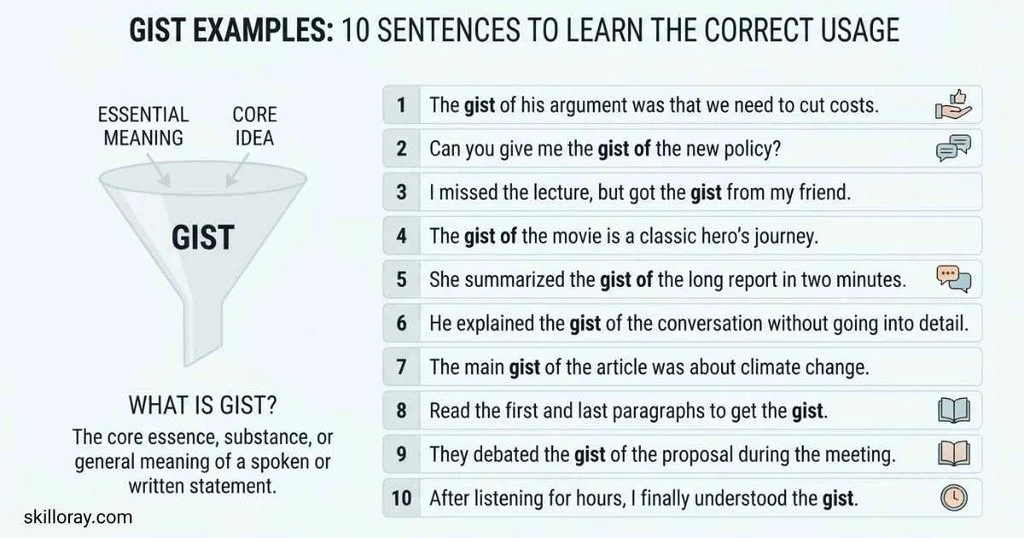
The following sentences show how to use gist naturally in everyday communication, schoolwork, and professional writing.
- I got the gist of the conversation. — I understood the main point.
- Can you explain the gist of the article? — I want to know its central message.
- She quickly understood the gist of the instructions. — She grasped the general meaning.
- I missed the beginning of the lecture, but I caught the gist. — I understood the essential information.
- That’s the gist of what I wanted to say. — That expresses my main message.
- He gave me the gist of the meeting. — He summarized its main points.
- You don’t need to memorize everything; just understand the gist. — Focus on the central idea.
- The gist of the story is about friendship and trust. — Those ideas form the story’s central message.
- After reading the first page, I understood the gist of the report. — I grasped its overall meaning.
- She couldn’t remember every detail, but she remembered the gist. — She retained the essential information.
Common Expressions With Gist
These expressions are useful to remember because they appear frequently in everyday English.
- Get the gist: Understand the main idea.
- Catch the gist: Grasp the general meaning.
- The gist of it: The essential point of a situation.
- Give me the gist: Provide a brief explanation.
- The gist of the matter: The central issue.
- Understand the gist: Recognize the main meaning.
- Miss the gist: Fail to understand the central point.
- Convey the gist: Communicate the essential meaning.
Is Gist a Noun or a Verb?
In standard everyday English, gist is primarily a noun when it means the main idea or essential meaning of something. It generally refers to a concept rather than an action.
Here are some examples:
- Noun: The gist of the email was clear.
- Noun: I understood the gist of the instructions.
- Noun: The gist of his argument was easy to follow.
There is also a verb to gist in West African English, particularly Nigerian usage, where it can mean to chat or gossip. It is a regional usage distinct from the standard everyday noun meaning “main idea.”
For most English writing, you will use gist as a noun.
Is Gist Singular or Plural?
When gist refers to the main idea of a conversation or piece of writing, it is usually treated as a singular or uncountable noun. For example, “I understood the gist” is natural English.
The plural form gists also exists, particularly when referring to the central ideas of multiple matters. However, in ordinary conversation, people generally use gist in the singular.
Examples:
- I understood the gist of the lecture.
- The gist of the message was clear.
- The gists of the two arguments were different.
The third sentence is grammatically possible, but a more natural version in many contexts would be “The main points of the two arguments were different.”
Is Gist or Jist Correct in British English?
Gist is the standard spelling in British English, just as it is in American English. There is no regional spelling difference for the meaning “main idea” or “essential point.”
| English variety | Correct spelling | Pronunciation |
| British English | Gist | /dʒɪst/ |
| American English | Gist | /dʒɪst/ |
| Australian English | Gist | /dʒɪst/ |
| Canadian English | Gist | /dʒɪst/ |
The common misspelling jist does not become standard simply because someone uses British English or another English variety.
For example:
- British English: I got the gist of the conversation.
- American English: I got the gist of the conversation.
Both sentences use the same spelling and meaning.
What Does GIST Mean in Cancer or Medicine?
In a medical context, GIST is an acronym for gastrointestinal stromal tumor, a type of tumor that develops in the digestive tract, most often in the stomach or small intestine. This is a separate meaning from the ordinary English word gist.
The distinction is based on context:
- gist (lowercase): The main idea or essential meaning of something.
- GIST (uppercase): An abbreviation for gastrointestinal stromal tumor in medical writing.
For example:
- Everyday English: I understood the gist of the doctor’s explanation.
- Medical context: The report refers to a GIST.
If you encounter the term in a medical report, its meaning depends on the surrounding medical information. A healthcare professional can explain what a specific report means for an individual patient.
Do not confuse the medical acronym with the common spelling mistake jist. They refer to entirely different things.
Common Mistakes When Using Gist
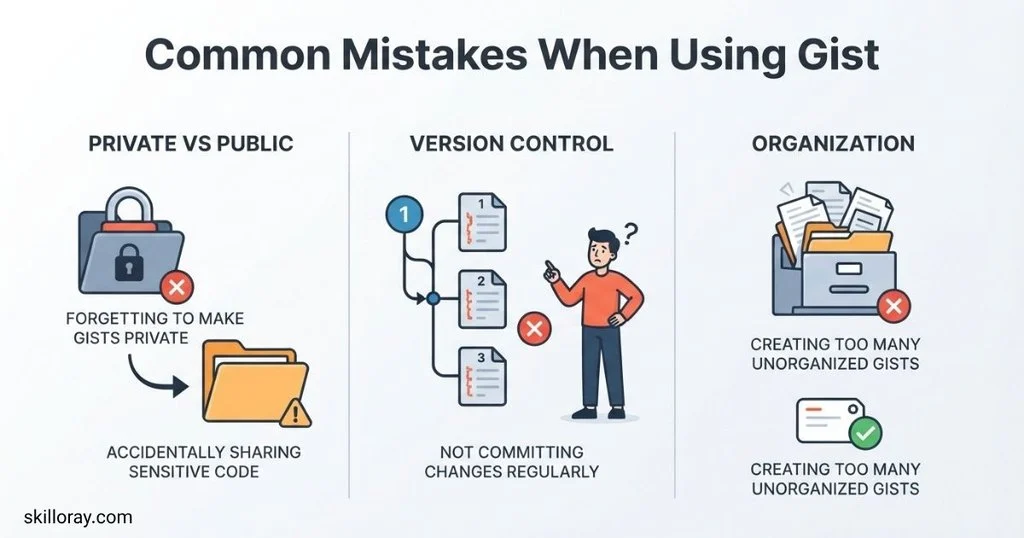
Although gist is a simple word, a few common mistakes can cause confusion. Understanding the correct spelling and usage will help you write more clearly.
Mistake 1: Writing Jist Instead of Gist
- Incorrect: I got the jist of your explanation.
- Correct: I got the gist of your explanation.
The standard spelling begins with G, even though the first sound resembles J.
Mistake 2: Using Gist When You Mean a Detailed Summary
- Less precise: Please send me the gist of the entire 50-page report, including every detail.
- More precise: Please send me a detailed summary of the entire report.
The word gist usually refers to the central idea, not a complete account of every detail.
Mistake 3: Adding Unnecessary Words
- Wordy: I understood the basic gist of the main idea.
- Clearer: I understood the gist.
Because gist already refers to the essential meaning, expressions such as “basic gist” can be repetitive in many contexts.
Mistake 4: Confusing Gist With a Medical Acronym
Use lowercase gist for the main idea in ordinary writing. Uppercase GIST is used for the medical abbreviation when discussing gastrointestinal stromal tumors.
Always consider the context before interpreting the term.
Frequently Asked Questions
1. Is It Jist or Gist?
Gist is correct when referring to the main idea or essential meaning of something. Jist is a common misspelling in this context.
2. Is Jist a Real English Word?
Jist is not the standard spelling for the meaning “main idea.” If you want to express the essential point of a conversation, use gist.
3. What Does “I Got the Gist” Mean?
It means you understood the main point of something without necessarily understanding every detail. For example, you might get the gist of a lecture even if you miss a few sentences.
4. How Do You Pronounce Gist?
Gist is pronounced /dʒɪst/, which sounds like “jist.” The first sound is the same as the J in jump.
5. What Is a Synonym for Gist?
Common synonyms include essence, main idea, point, substance, core, and central meaning. The best synonym depends on the context.
6. Is Gist British or American English?
Gist is standard in both British English and American English. The spelling and standard pronunciation remain the same.
7. Is It “You Get the Jist” or “You Get the Gist”?
The correct expression is “you get the gist.” It means that someone understands the main point of what is being explained.
8. What Does “That’s the Gist of It” Mean?
It means that someone has expressed the main point or essential meaning of a situation, explanation, or discussion without including every detail.
9. Is Gyst a Correct Spelling?
Gyst is not the standard spelling for the meaning “main idea.” In ordinary English writing, use gist.
10. Is Gist a Noun?
Yes. In standard everyday English, gist is primarily a noun referring to the main point or general meaning of something. A separate regional verb usage also exists in West African English.
Conclusion
When deciding between jist or gist, remember that gist is the correct standard spelling for the main idea, essential meaning, or central point of something. Although it sounds like “jist,” it begins with the letter G in both British English and American English.
You can use gist in expressions such as “I got the gist,” “that’s the gist of it,” and “you get the gist.” These phrases are useful in everyday conversations, academic writing, and professional communication.
The easiest way to remember the rule is to focus on the spelling rather than the sound: if you’re talking about the main idea of a story, message, article, or discussion, write gist, not jist.

I am Daniel Carter, a grammar enthusiast and language educator with over 10 years of experience helping students and professionals improve their English writing and communication skills. I enjoy simplifying complex grammar rules into easy-to-understand lessons that anyone can follow. My goal is to help learners write with confidence, avoid common mistakes, and develop strong communication skills for academic and professional success. I regularly create practical grammar guides, writing tips, and language resources that make learning both enjoyable and effective.
Books: Mastering English Grammar and The Complete Guide to Better Writing
 James Walker
 Olivia Brown