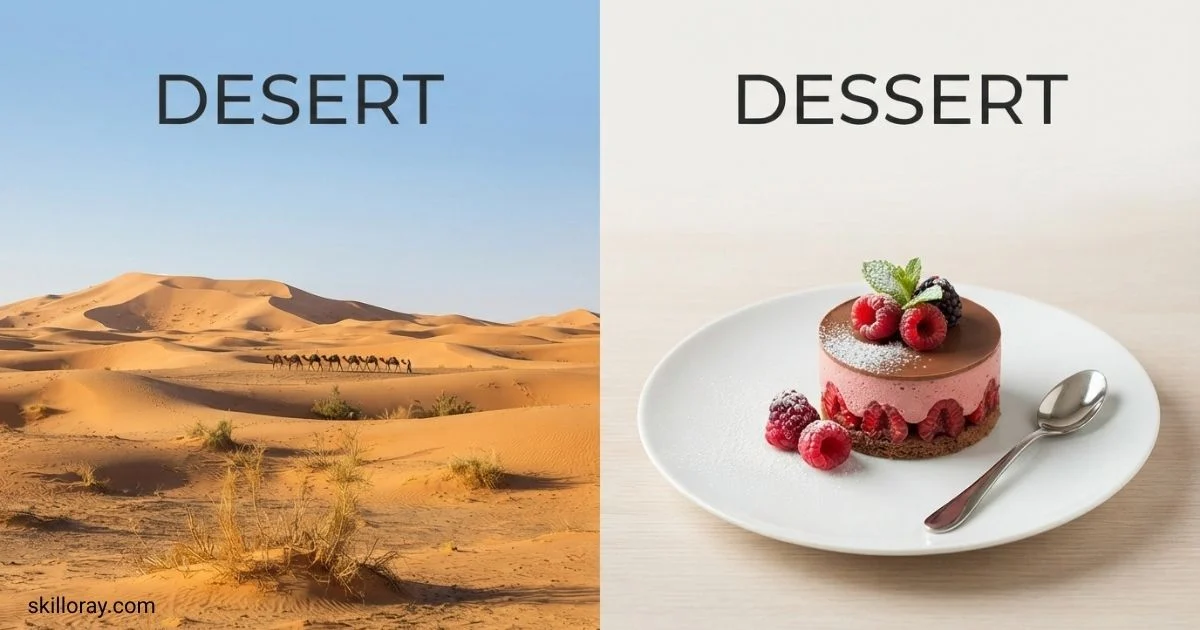
Have you ever paused while writing and wondered whether you need desert or dessert? I know how easy it is to mix up these two words because they look almost identical, yet their meanings are completely different.
If you are trying to remember which spelling means a dry, sandy region and which one refers to a sweet treat, you are in the right place. You can learn the difference in just a few simple steps, and I’ll make it easy to remember.
By the end of this guide, you’ll know exactly when to use desert and when to use dessert, along with clear examples that make the difference stick. Let’s make this common spelling confusion much simpler.
Desert or Dessert: What Is the Difference?
Both desert and dessert are correctly spelled English words, but they have different meanings and pronunciations.
| Word | Meaning | Pronunciation | Example |
| Desert (dry region) | A very dry area of land | DEZ-ert | The Sahara Desert is enormous. |
| Desert (abandon) | To leave someone or something behind | dih-ZURT | Never desert your friends in difficult times. |
| Dessert | A sweet dish eaten after a meal | dih-ZURT | We had chocolate cake for dessert. |
The easiest way to remember the difference is to focus on the spelling and context.
- Desert: One s usually refers to a dry landscape when used as a noun.
- Dessert: Two s letters refer to a sweet treat after a meal.
However, there’s one detail worth remembering: the verb desert, meaning to abandon someone or something, has the same pronunciation as dessert.
What Does Desert Mean?
The word desert has several meanings depending on how you use it in a sentence. It can refer to a dry geographical region or the act of leaving someone or something behind.
1. Desert as a Noun
As a noun, desert refers to a region that receives very little rainfall. Deserts may be hot or cold, sandy or rocky, and they often support plants and animals adapted to dry conditions.
Examples:
- The Sahara Desert is located in North Africa.
- Camels can survive for long periods in desert environments.
- We saw beautiful mountains while crossing the desert.
- Very little rain falls in this desert region.
- Some deserts experience extremely cold temperatures at night.
2. Desert as a Verb
As a verb, desert means to abandon a person, place, responsibility, or cause. It often suggests leaving when someone or something needs support.
Examples:
- He refused to desert his family during a difficult time.
- The soldiers were ordered not to desert their posts.
- She promised she would never desert her friends.
- Some people desert their responsibilities when life becomes difficult.
- The town appeared empty after its residents deserted it.
3. Desert as a Noun Meaning What Someone Deserves
There is another, less common use of desert as a noun. In this sense, it refers to something a person deserves because of their actions or qualities.
This meaning appears in the expression just deserts, which refers to the reward or punishment someone deserves.
Example sentences:
- The dishonest businessman eventually received his just deserts.
- She earned recognition through hard work and received her just deserts.
- Many people believe that everyone should get their just deserts.
Remember that the expression is spelled just deserts, with one s in the middle of the word, even though it has nothing to do with a dry landscape.
What Does Dessert Mean?
Dessert is a noun that refers to a sweet dish usually served at the end of a meal. It can include cakes, ice cream, pudding, fruit-based treats, pastries, and many other sweet foods.
Examples:
- We ordered chocolate cake for dessert.
- My favorite dessert is strawberry ice cream.
- The restaurant serves a different dessert every evening.
- She prepared a delicious dessert for the guests.
- Would you like some dessert after dinner?
Dessert is a common word in everyday conversations, restaurant menus, recipes, and food-related writing.
Common Types of Dessert
Cake
Cakes are popular desserts for birthdays, celebrations, and family gatherings.
Ice Cream
Ice cream is a frozen sweet treat available in many flavors.
Pudding
Pudding is a soft, sweet dish that can be served chilled or warm.
Fruit-Based Desserts
Fruit salad, fruit tarts, and baked fruit dishes can provide a refreshing end to a meal.
How to Spell Desert or Dessert Correctly
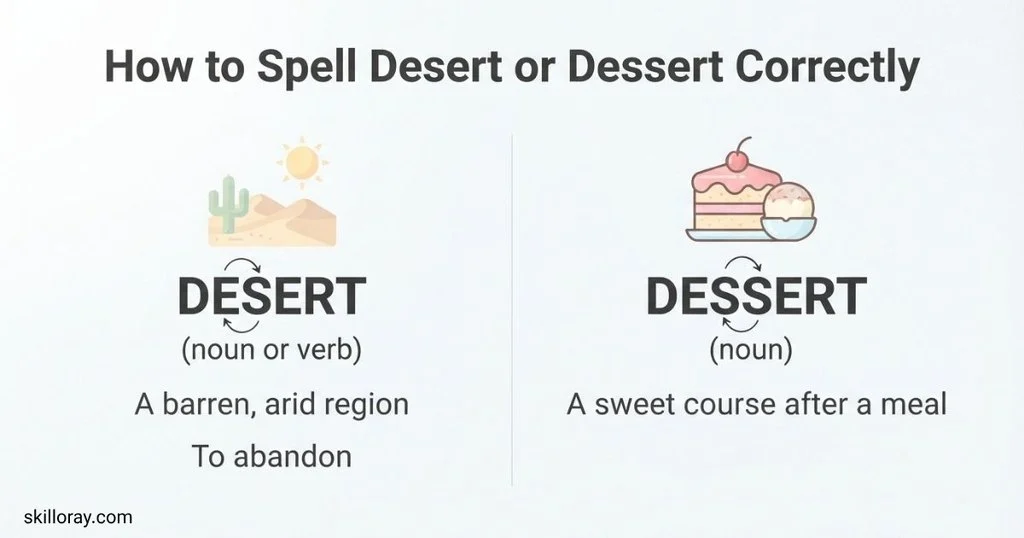
The spelling becomes easier when you connect each word with its meaning.
- Desert has one s in the middle when referring to a dry region or abandonment.
- Dessert has two s letters when referring to a sweet dish.
The main reason people confuse these words is that they look similar and are sometimes pronounced identically.
Here is a simple memory trick:
Dessert has two S’s because you may want a second serving.
Think about having another slice of cake or another scoop of ice cream. The extra s in dessert can remind you of wanting more sweets.
For desert, picture a dry landscape with sand, rocks, and very little rainfall. This mental image can help you remember the spelling with one s.
Correct Spelling Examples
- Correct: We ate ice cream for dessert.
- Correct: The Sahara is a famous desert.
- Correct: The soldiers refused to desert their duties.
- Incorrect: We ate ice cream for desert.
- Incorrect: They crossed the dessert on camels.
The last two sentences use the wrong word for the intended meaning. However, desert or dessert can each be correct in other contexts.
Desert or Dessert Pronunciation
Although the spelling is similar, pronunciation depends on the word’s meaning.
| Word | IPA | Simple pronunciation | Meaning |
| Desert (noun) | /ˈdez.ɚt/ in American English | DEZ-ert | Dry region |
| Desert (verb) | /dɪˈzɝːt/ in American English | dih-ZURT | To abandon |
| Dessert | /dɪˈzɝːt/ in American English | dih-ZURT | Sweet food |
The noun desert, meaning a dry region, has its stress on the first syllable. The verb desert and the noun dessert have their stress on the second syllable.
For example:
- DEZ-ert: The desert was hot and dry.
- dih-ZURT: Never desert your friends.
- dih-ZURT: We ordered dessert after dinner.
The verb desert and the word dessert sound alike in standard American English. The sentence’s meaning tells you which word is intended.
How to Remember the Pronunciation
Try saying these sentences aloud:
- The DEZ-ert has very little rain.
- Don’t dih-ZURT your friends.
- I would like dih-ZURT after dinner.
Practicing the words in complete sentences is often easier than memorizing their pronunciations in isolation.
Is It Desert or Dessert for Food?
Use dessert when you are talking about food served as a sweet course, usually after lunch or dinner.
Examples:
- What is for dessert tonight?
- We had apple pie for dessert.
- The children chose ice cream for dessert.
- My grandmother makes a wonderful dessert.
- The dessert menu includes cheesecake and brownies.
Use desert only when the sentence refers to a dry region, abandonment, or something a person deserves.
Incorrect: We ordered chocolate pudding for desert.
Correct: We ordered chocolate pudding for dessert.
The extra s makes all the difference in this sentence.
Is It Food Desert or Food Dessert?
The correct phrase is food desert, not food dessert, when referring to an area where residents have limited access to affordable, nutritious food.
A food desert is a term used in discussions about food access, public health, transportation, and community resources. It does not refer to an area where sweet foods are unavailable.
Examples:
- The community is working to improve access to fresh food in its food desert.
- Local organizations are helping residents find affordable groceries.
- Transportation can affect access to supermarkets in some neighborhoods.
The word desert is used metaphorically here to suggest scarcity or limited availability. It follows the spelling associated with a dry region.
By contrast, food dessert could be used in a literal context to describe a sweet food item, but it is not the standard term for an area with limited access to groceries.
Desert or Dessert in British English
The spelling distinction is the same in British English and American English.
- Desert: A dry region or the act of abandoning someone or something.
- Dessert: A sweet course served after a meal.
British English does not generally use desert as an alternative spelling of dessert. Both words have distinct meanings in the United Kingdom, the United States, Australia, and other English-speaking regions.
Pronunciation details can vary by accent. However, the difference in stress between the geographical noun desert and the word dessert remains a useful distinction for learners.
Examples in British English:
- We had pudding for dessert after Sunday lunch.
- The Sahara is the world’s largest hot desert.
- The soldier was punished for attempting to desert his post.
The spelling remains consistent regardless of the variety of English you use.
What Does Moral Desert Mean?
The phrase moral desert refers to the idea that a person deserves a particular reward, consequence, or treatment because of their actions, choices, or character.
In philosophy and ethics, desert relates to deserving something. It is not connected to deserts as geographical regions or desserts as sweet foods.
Examples:
- The debate focused on moral desert and personal responsibility.
- Philosophers disagree about what people deserve for their actions.
- The concept of moral desert raises questions about fairness and justice.
In this context, desert is a legitimate noun. It appears in discussions of ethics, punishment, rewards, and responsibility.
Is Dessert Near Me the Correct Search Phrase?
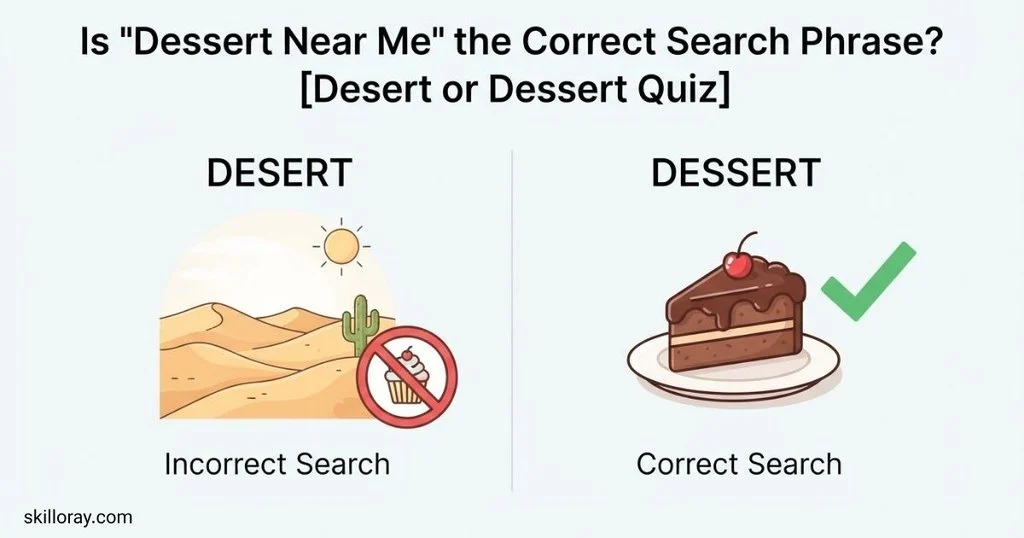
If you’re looking for a place to enjoy cake, ice cream, pastries, or other sweet treats, dessert near me is the appropriate search phrase.
For example, you might search for:
- Dessert near me
- Best dessert shops near me
- Ice cream and dessert places near me
- Restaurants with dessert menus near me
- Chocolate cake for dessert near me
The word dessert refers to sweet food, so it is the natural choice when searching for restaurants, bakeries, cafes, or dessert shops.
Use desert when searching for geographical information, such as desert landscapes, desert tours, or desert wildlife.
Desert or Dessert: Common Mistakes to Avoid
Here are some common spelling mistakes and the correct forms.
| Incorrect usage | Correct usage | Reason |
| Ice cream for desert | Ice cream for dessert | Sweet food requires dessert. |
| Chocolate desert | Chocolate dessert | A sweet dish requires dessert. |
| Sahara Dessert | Sahara Desert | The geographical region is a desert. |
| Don’t dessert your family | Don’t desert your family | The verb meaning abandon is desert. |
| Food dessert | Food desert | The term for limited access to nutritious food is food desert. |
| Moral dessert | Moral desert | The philosophical concept uses desert. |
Why Do People Confuse These Words?
There are three main reasons.
1. Similar spelling: Both words contain nearly the same letters, making it easy to forget the extra s.
2. Similar pronunciation: The verb desert and the word dessert are pronounced alike in standard American English.
3. Different meanings: The words can appear in unrelated contexts, including geography, food, ethics, and everyday conversation.
The simplest solution is to focus on the meaning of the sentence before choosing the spelling.
Examples of Desert in Sentences
Use desert when referring to a dry landscape, abandonment, or deservingness.
- The desert receives very little rainfall.
- We watched the sunset over the desert.
- Many animals have adapted to life in the desert.
- The explorers traveled across the rocky desert.
- She refused to desert her friends during a difficult period.
- The soldiers were warned not to desert their posts.
- The village was deserted after the storm.
- He eventually received his just deserts.
- A desert climate can have extreme temperature changes.
- The discussion explored the meaning of moral desert.
Notice that deserted is the past form or past participle of the verb desert when it means abandoned or left empty.
Examples of Dessert in Sentences
Use dessert when referring to sweet food, usually served after a meal.
- We had chocolate cake for dessert.
- My favorite dessert is vanilla ice cream.
- The restaurant offers three dessert options.
- She prepared a homemade dessert for her family.
- Would you like dessert after lunch?
- The children shared a bowl of fruit salad for dessert.
- He ordered cheesecake from the dessert menu.
- We saved some room for dessert.
- The bakery sells fresh pastries for dessert.
- Our guests brought a delicious dessert to dinner.
These examples show how naturally dessert appears in conversations about meals, celebrations, recipes, and restaurants.
Desert or Dessert Quiz
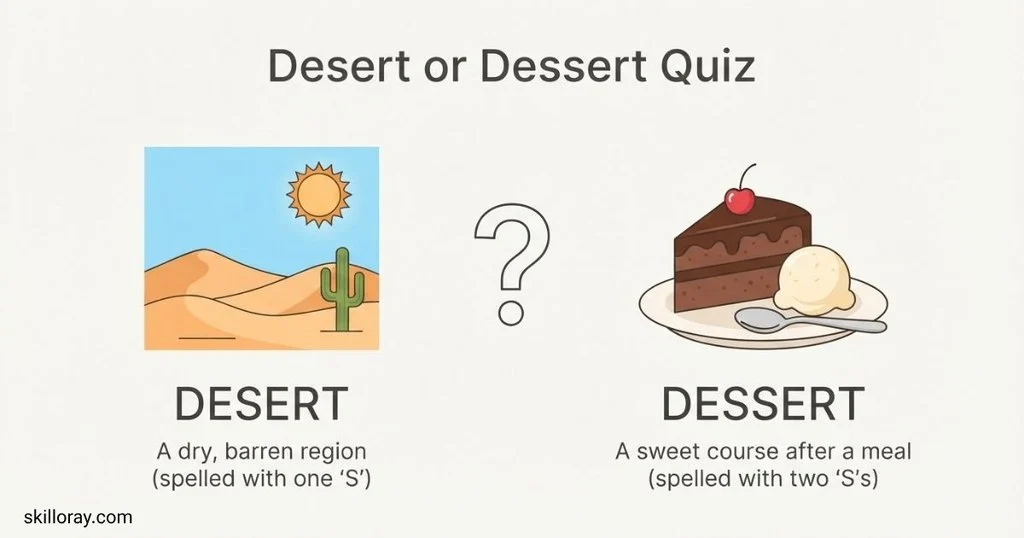
Test your understanding by choosing the correct word for each sentence.
1. We ordered chocolate cake for ___.
desert
dessert
2. The Sahara is a famous ___.
desert
dessert
3. The soldier refused to ___ his post.
desert
dessert
4. Would you like ice cream for ___?
desert
dessert
5. She received her just ___.
deserts
desserts
6. The town was nearly empty because its residents had ___ it.
deserted
desserted
7. The community has limited access to fresh groceries and is described as a food ___.
desert
dessert
Check Answers
Frequently Asked Questions
1. Is it desert or dessert for food?
Use dessert when referring to sweet food served after a meal. For example, “We had ice cream for dessert.” The word desert refers to a dry region or the act of abandoning someone or something.
2. How do you spell desert or dessert correctly?
Both spellings are correct, but they have different meanings. Desert has one s when referring to a dry region, while dessert has two s letters when referring to a sweet dish.
3. Why does dessert have two S’s?
The spelling of dessert is often remembered through the phrase “second serving.” The extra s can remind you that you might want another helping of your favorite sweet treat.
4. Are desert or dessert pronounced the same?
Sometimes. The noun desert, meaning a dry region, is pronounced DEZ-ert. The word dessert is pronounced dih-ZURT. The verb desert, meaning to abandon, is also pronounced dih-ZURT.
5. Is food desert or dessert correct?
Food desert is the correct expression for an area where residents have limited access to affordable, nutritious food. The phrase refers to food accessibility, not sweet dishes.
6. Is moral desert or dessert correct?
Moral desert is correct when discussing what a person deserves based on their actions or character. It is a philosophical term related to responsibility, rewards, punishment, and fairness.
7. Is desert or dessert correct in British English?
Both words are correct in British English, but they have different meanings. Desert refers to a dry region or abandonment, while dessert refers to a sweet course after a meal.
8. How can I remember desert or dessert?
Remember that dessert has two s letters because you might want a second serving. Desert, referring to a dry landscape, has one s. Connecting each spelling with a mental image makes the distinction easier to remember.
9. What is the plural of dessert?
The plural of dessert is desserts. For example, “The restaurant offers several desserts.” The plural of desert, referring to dry regions, is deserts.
10. Is desert or dessert correct when searching for sweets near me?
Use dessert near me when searching for bakeries, cafes, ice cream shops, or restaurants that serve sweet food. Use desert for geographical locations, landscapes, or travel destinations.
Conclusion
Choosing between desert or dessert becomes easy once you understand their meanings. Use desert for a dry region, abandonment, or the idea of deserving something. Use dessert for sweet food served after a meal.
Remember the extra s in dessert with the idea of a second serving. When you’re unsure, read the sentence again and consider what you’re trying to describe. With a little practice, you’ll be able to spell both words correctly and use them confidently in everyday writing.

I am Olivia Brown, a professional English editor and grammar writer who believes that great writing begins with a strong foundation in grammar. I have spent years creating educational resources that help students and professionals improve their writing, avoid common errors, and communicate more effectively. I strive to provide clear explanations and practical examples that make grammar easy to understand and apply.
Books: English Grammar Essentials and Modern Writing Success
 James Walker
 Daniel Carter