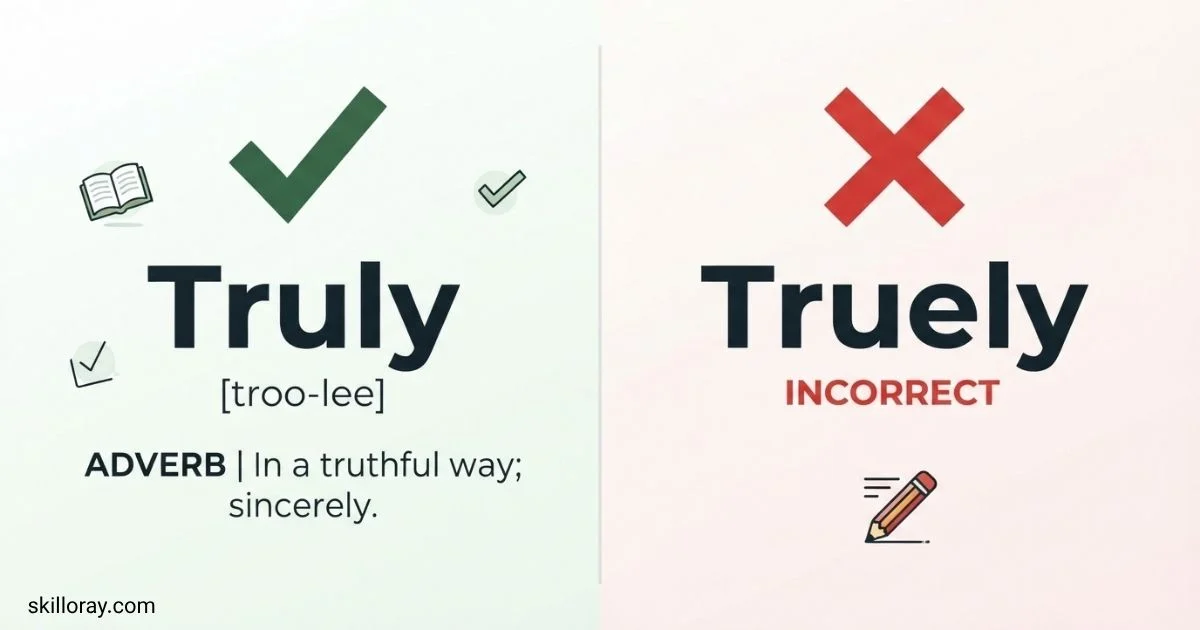
Have you ever typed “truely” and wondered if it actually looks right? I know how easy it is to second-guess a simple word, especially when both spellings seem familiar.
If you are confused about truely or truly, you are not alone. You may see the incorrect form occasionally, but you need to know which spelling is accepted in standard English and why.
In this guide, I’ll make the difference simple for you. You’ll learn the correct spelling, meaning, pronunciation, examples, and an easy way to remember it.
Truely or Truly: (Quick Answer)
Truly is the correct standard spelling.
| Form | Standard modern English? | Meaning | Example |
| truly | Yes | Really, sincerely, genuinely, accurately | I truly appreciate your help. |
| truely | No, except historical or archaic use | Historical form of truly | The spelling may appear in older texts. |
The main reason people write truely is that they start with true and add -ly. That produces a spelling that looks reasonable, but English does not retain the final e in this particular adverb.
So remember:
true → truly
not:
true → truely
Modern dictionaries consistently recognize truly as the standard form.
Truely or Truly Meaning
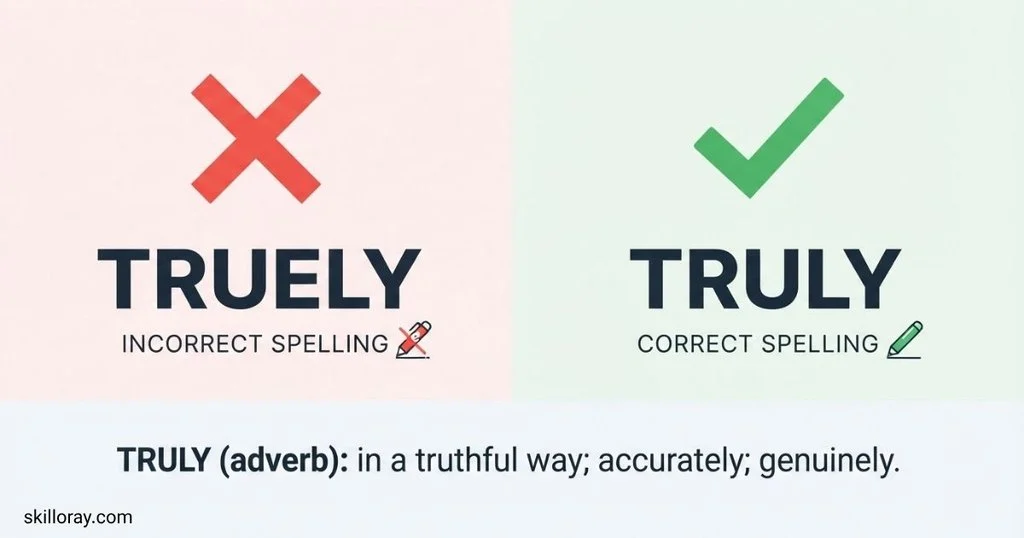
The modern word truly generally means in a truthful, sincere, genuine, or real way. It can also strengthen an adjective or description.
For example:
She is truly talented.
Here, truly strengthens the adjective talented. It tells the reader that the speaker considers her talent genuine or especially clear.
Another example is:
I truly understand your concern.
Here, truly emphasizes that the understanding is genuine.
Truely does not normally have a separate modern meaning. It is usually an incorrectly spelled form of truly. Historically, however, truely did occur as a spelling of the word, which explains why you may occasionally encounter it in older writing.
Why Is Truly Spelled Without the E?
The spelling can feel strange because the adjective true ends in e.
You might expect:
true + ly = truely
But the standard spelling is:
true → truly
The final e is dropped before the -ly ending in this word.
This is one reason truely is such a common spelling mistake. Dictionary.com notes that the historical spelling of the word varied considerably before truly became the standard modern form.
A useful memory trick is simple:
Think of “true” without its final e before adding “ly”: truly.
How Do You Spell Truly?
The correct spelling is:
T-R-U-L-Y
There is no e between the u and l.
Correct
- truly
- truly grateful
- truly sorry
- truly amazing
- truly important
- truly beautiful
Common misspelling
- truely
- truely grateful
- truely sorry
- truely amazing
If you’re writing an essay, email, article, school assignment, or professional message, use truly.
How Do You Pronounce Truly?
Truly is pronounced:
/ˈtruːli/
A simple pronunciation guide is:
TROO-lee
It has two syllables:
truly → TROO-lee
The first syllable receives the main stress.
Oxford gives the pronunciation as /ˈtruːli/.
The spelling truely does not represent a separate standard pronunciation. If someone writes truely intending the modern adverb, they normally mean truly.
Truly as an Adverb
Truly is an adverb. It commonly modifies a verb, adjective, or entire statement.
Modifying a verb
I truly appreciate your help.
Here, truly describes the sincerity of the appreciation.
Modifying an adjective
It was a truly wonderful experience.
Here, truly emphasizes wonderful.
Emphasizing a statement
Truly, this is an impressive result.
Here, truly emphasizes the speaker’s conviction about the statement.
Knowing that truly is an adverb makes it easier to understand why it appears in these positions.
Truly Grateful: Is This Correct?
Yes. Truly grateful is completely natural English.
For example:
- I am truly grateful for your support.
- We are truly grateful for everything you have done.
- She was truly grateful for the opportunity.
- I’m truly grateful that you took the time to help me.
- He said he was truly grateful for the kindness he received.
In truly grateful, the word truly emphasizes the adjective grateful. It shows that the gratitude is sincere.
Do not write:
I am truely grateful.
Write:
I am truly grateful.
Yours Truly or Truely
The correct phrase is yours truly, not yours truely.
Yours truly has two common uses.
First, it can be used as a letter closing:
Yours truly,
Alex
Cambridge describes Yours truly as a phrase used to end a letter, particularly in formal American English.
Second, yours truly can informally or humorously refer to the person speaking or writing:
The person responsible was yours truly.
In this use, it means roughly me or myself. Cambridge and Collins both recognize this informal use.
So the spelling is:
Yours truly ✅
not:
Yours truely ❌
Truly or Truely Synonyms
Since truly can have several meanings, the best synonym depends on the sentence.
When truly means sincerely
Possible alternatives include:
- sincerely
- genuinely
- honestly
Example:
I truly appreciate your help.
Similar:
I sincerely appreciate your help.
When truly means really
Possible alternatives include:
- really
- actually
- genuinely
Example:
She truly enjoyed the experience.
Similar:
She really enjoyed the experience.
When truly means accurately
Possible alternatives include:
- accurately
- correctly
- truthfully
Example:
The description truly reflects what happened.
The exact synonym should fit the intended meaning rather than simply replacing truly in every sentence.
Truely or Truly Examples
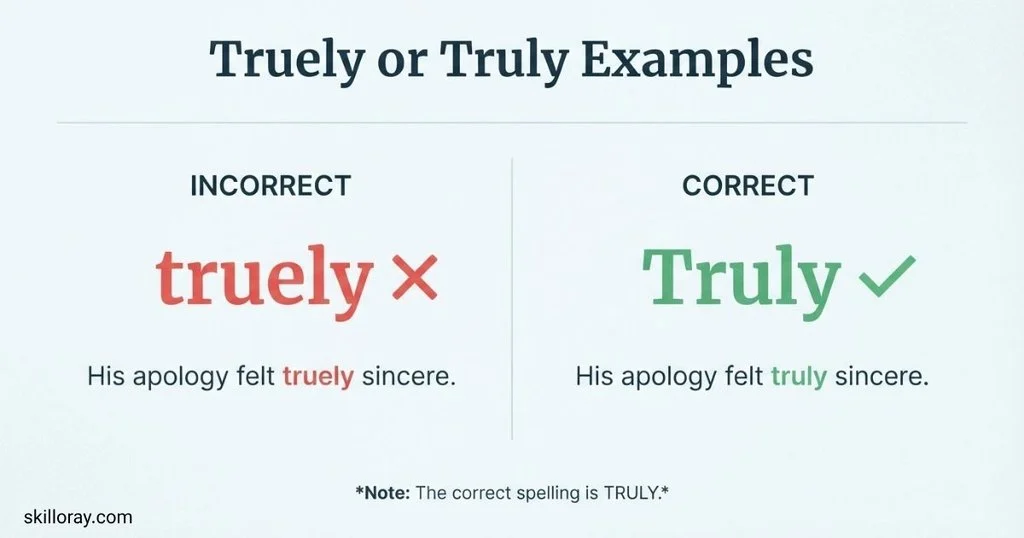
Here are some natural examples using the correct spelling truly:
- I truly appreciate everything you have done.
- She truly believes that things will improve.
- We are truly grateful for your support.
- That was a truly memorable experience.
- He was truly surprised by the news.
- I truly understand how difficult this can be.
- The movie was truly entertaining.
- They truly care about their customers.
- She is truly talented at what she does.
- I’m truly sorry for the misunderstanding.
Each sentence uses truly as an adverb.
Common Mistakes With Truly
Mistake 1: Keeping the E From True
Incorrect:
I am truely sorry.
Correct:
I am truly sorry.
The standard adverb is truly, so the final e from true is not retained.
Mistake 2: Writing Yours Truely
Incorrect:
Yours truely,
Correct:
Yours truly,
The established expression is yours truly.
Mistake 3: Using Truely in Formal Writing
You may occasionally see truely online or in informal writing. That does not make it the standard modern spelling.
For school, professional, academic, or general standard English, use truly.
Is Truely a Word?
This question needs a little historical context.
In modern standard English, truly is the standard spelling. Truely is generally treated as a misspelling when used in current writing. However, historical sources contain truely as an older spelling of truly. Wiktionary lists truely as an archaic form, while Dictionary.com explains that the spelling was historically used before the modern standard became established.
Therefore, it would be too broad to say that the sequence of letters has never existed as an English form. The practical rule for modern writers is simple:
Use truly.
Truely or Truly in the Dictionary
Major modern English dictionaries list truly as the standard adverb.
Oxford gives truly as an adverb with the pronunciation /ˈtruːli/ and provides several meanings related to sincerity, emphasis, and accuracy.
Dictionary and language references discussing truely generally identify it as an old spelling or a modern misspelling rather than the standard contemporary form.
So if you’re checking which spelling to enter in a modern English document, choose truly.
Truely or Truly in Australia
Australian English uses the standard spelling truly.
If you’re writing for an Australian audience, you should write:
I am truly grateful for your help.
The spelling does not change to truely in Australian English.
Australian English has some vocabulary and spelling conventions that can differ from American English, but truly remains the standard spelling of this adverb.
Truely or Truly in the UK
British English also uses truly.
For example:
She truly deserves the recognition.
The spelling truely is not the standard British spelling of the modern adverb.
So whether you’re writing in British English, American English, or Australian English, the normal modern spelling is:
truly
Is It Truely or Truly?
If you’re asking which spelling to use in modern English, choose truly.
Truly is the standard spelling.
Truely is normally a spelling error in contemporary writing, although the historical form can be found in older texts.
A quick memory rule can help:
true → truly
Think of the word as true without the e + ly.
How to Remember the Correct Spelling
If you frequently forget whether the word contains an e, use this simple trick:
TRUE loses E → TRULY
Write it mentally as:
true → tru → truly
Another way to remember it is to associate truly with truth rather than trying to preserve every letter of true.
When you see truely, pause and ask:
Does this need the final e?
For standard modern English, the answer is no.
Truly in Everyday Sentences
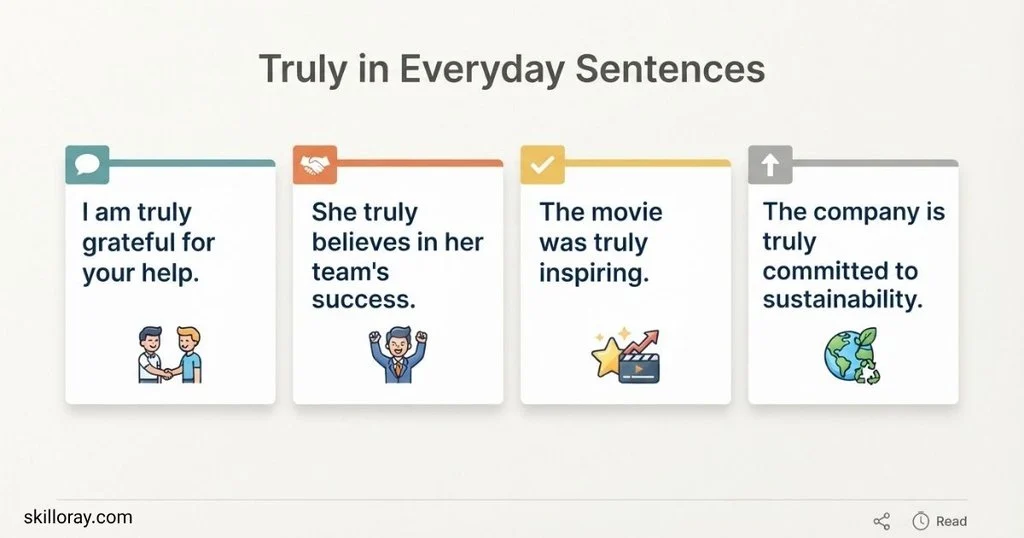
You will often see truly in sentences expressing strong feelings, sincerity, or emphasis.
For example:
- I truly hope everything works out.
- She truly cares about her family.
- That was truly impressive.
- I truly believe you can do it.
- He was truly happy with the result.
- We truly value your feedback.
- This is truly important.
- She truly understood the situation.
The word can make a statement sound more sincere or emphatic without changing the basic meaning of the sentence.
Quick Comparison: Truely or Truly
| Point | Truely | Truly |
| Modern standard spelling | No | Yes |
| Common in modern writing | As a misspelling | Yes |
| Standard dictionary form | No as the normal modern form | Yes |
| Part of speech intended | Adverb | Adverb |
| Pronunciation | Not a separate standard form | /ˈtruːli/ |
| Historical use | Yes, archaic | Yes, standard |
| Use in professional writing | Avoid | Use |
| Use in school writing | Avoid | Use |
FAQs About Truely or Truly
Is truly the correct spelling?
Yes. Truly is the standard modern spelling of the adverb. Truely is generally a misspelling in contemporary English, although it has historical use as an archaic spelling.
Is truely ever acceptable?
In ordinary modern English, you should use truly. You may encounter truely in historical writing because it existed as an older spelling.
Is “I am truly grateful” correct?
Yes. I am truly grateful is grammatically correct and natural. Here, truly is an adverb modifying the adjective grateful.
How do you spell truly?
Spell it T-R-U-L-Y. The standard form does not contain an e after the u.
How do you pronounce truly?
Truly is pronounced approximately TROO-lee, with the IPA pronunciation /ˈtruːli/.
What is the synonym of truly?
Depending on the context, synonyms can include really, genuinely, sincerely, honestly, actually, or truthfully.
Is “yours truly” correct?
Yes. Yours truly is an established phrase used as a letter closing or, informally, as a humorous way to refer to oneself.
Does British English use truly?
Yes. Truly is the standard modern spelling in British English. The same spelling is also used in American English or Australian English.
Why do people spell truly as truely?
The mistake usually happens because the adjective true ends in e, making truely look like a logical spelling. However, the standard adverb is truly, with the final e removed.
Which should I use in formal writing?
Use truly. It is the standard modern spelling and is appropriate for academic, professional, formal, or everyday writing.
Conclusion
The answer is straightforward: truly is the standard spelling to use in modern English.
Although truely has appeared historically as an older spelling, it is generally considered a misspelling in contemporary standard English. The correct adverb is truly, meaning sincerely, genuinely, really, accurately, or completely depending on the context.
The easiest spelling rule to remember is:
true → truly
So write truly grateful, truly sorry, truly amazing, or yours truly.
When you’re writing today, choose truly.

I am James Walker, an English language specialist with extensive experience in grammar, editing, and academic writing. I enjoy helping students, bloggers, and professionals strengthen their writing by explaining grammar concepts in a clear and engaging way. My focus is on providing accurate, practical, and easy-to-follow guidance that helps learners communicate more effectively in everyday and professional situations.
Books: Perfect English Grammar Handbook and Advanced Writing Techniques
 Daniel Carter
 Olivia Brown