I know “anytime” or “any time” can look almost identical, but choosing the right form can be confusing. You may wonder whether they mean exactly the same thing or work differently in a sentence.
You don’t need to memorize complicated grammar rules to understand the difference. I’ll break it down with simple explanations and clear examples so you can quickly see when to use anytime and when to use any time.
By the end, you’ll know which form fits your sentence and avoid one of those small writing mistakes that can make you pause. Let’s make the difference easy to remember.
What Does “Anytime” Mean?
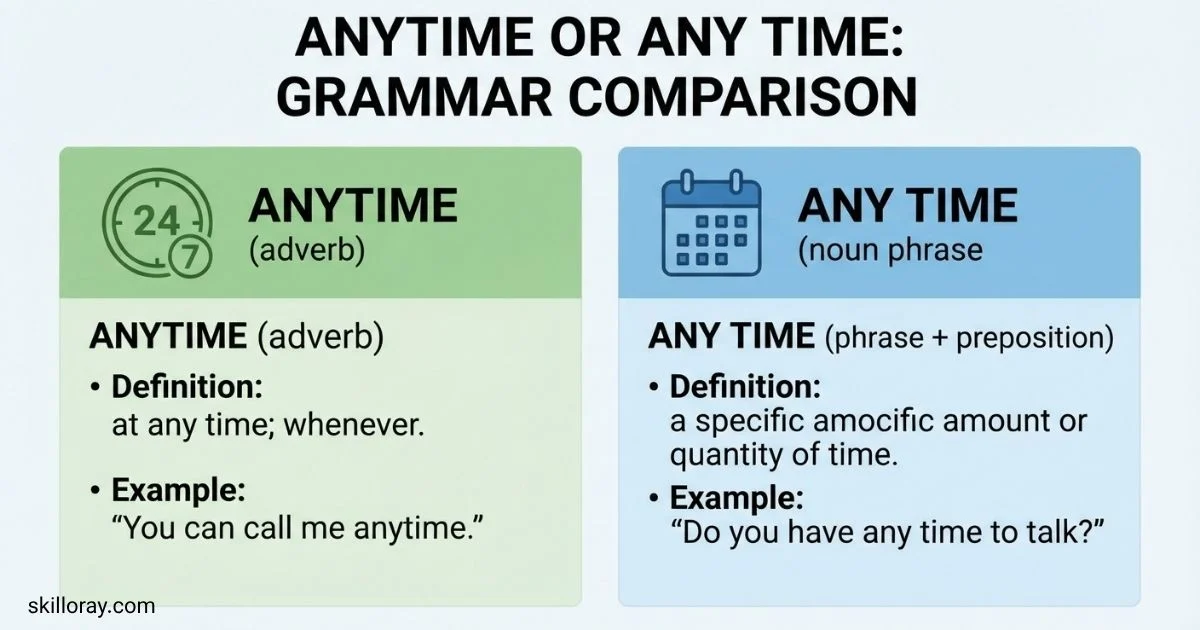
Anytime is a one-word adverb that usually means “whenever” or “at any time.” It tells the reader that something can happen without a specific time being fixed.
You can use it when offering help, inviting someone to visit, discussing availability, or describing something that may happen soon.
Examples of “Anytime” in a Sentence
- You can call me anytime if you need help.
- Feel free to stop by anytime this afternoon.
- I can meet you anytime next week.
- You can reach out anytime you have a question.
- I’m happy to help anytime you need assistance.
- We can discuss the project anytime you’re available.
- The delivery should arrive anytime now.
- I don’t expect the weather to improve anytime soon.
- Anytime you visit, you’re welcome to stay for dinner.
- You can contact our support team anytime during the day.
In these sentences, anytime refers to an unspecified moment or a situation that can occur whenever needed.
Is “Anytime” One Word?
Yes. Anytime is a standard English word, particularly in American English. It is widely used in everyday conversation, emails, text messages, invitations, and informal writing.
For example:
- Message me anytime.
- You’re welcome to visit anytime.
- I’ll be available anytime after lunch.
However, when time refers to an amount of time or follows the preposition at, you generally need the two-word form.
What Does “Any Time” Mean?
Any time is a two-word phrase in which any modifies the noun time. It commonly refers to an unspecified amount of time, a possible time, or a period when something can happen.
You will often see it in sentences about availability, schedules, time limits, or opportunities.
Examples of “Any Time” in a Sentence
- I don’t have any time to finish the assignment today.
- Do you have any time to talk this afternoon?
- We can schedule the appointment at any time.
- You may contact the office at any time.
- She needs any time she can find to prepare.
- Please don’t waste any time on unnecessary tasks.
- Is there any time available for a quick meeting?
- Any time you choose will work for me.
- I would appreciate any time you can spare.
- You can cancel your appointment at any time.
Notice that any time is used when the sentence focuses on time as a resource, a period, or a possible point on a schedule.
For instance, in “I don’t have any time,” you are talking about the amount of time available. In “at any time,” you are referring to an unspecified moment when something may happen.
Anytime or Any Time: What’s the Difference?
The main difference is grammatical rather than pronunciation-based. Both forms sound the same, but their roles in a sentence can differ.
| Feature | Anytime | Any Time |
| Spelling | One word | Two words |
| Main grammatical role | Adverb | Noun phrase |
| Basic meaning | Whenever | Any amount of time or an unspecified time |
| Common use | Offering flexibility | Discussing availability or a time period |
| After “at” | Generally incorrect | Correct |
| Example | Call me anytime. | Call me at any time. |
| Amount of time | Usually not appropriate | Correct |
| Everyday messages | Common | Also common |
The Easiest Way to Remember the Difference
Use this simple test:
- If you can replace anytime with “whenever,” the one-word form will often work.
- If you’re talking about an amount of time, use “any time.”
- If the expression follows the preposition at, write “at any time.”
For example:
Correct: You can reach me anytime.
You can rewrite this as “You can reach me whenever you need to.”
Correct: I don’t have any time to talk.
Here, you are referring to the amount of time you have available.
Correct: You can reach me at any time.
The two-word form follows at.
One useful point: both forms can sometimes be correct in the same general context. For example, “Call me anytime” or “Call me any time” are both acceptable in ordinary English. The one-word form emphasizes the adverbial meaning, while the two-word form remains a noun phrase.
Anytime or Any Time After Thank You?
When responding to someone who says “thank you,” “Any time!” is a common, natural response. It means that you’re happy to help again whenever needed.
For example:
- Person A: “Thank you for helping me with my homework.”
- Person B: “Any time! I’m glad I could help.”
You might also see “Anytime!” in casual messages. This spelling is common in everyday communication, although the two-word form is traditionally preferred for the expression meaning “you’re welcome.”
Here are some natural responses:
- “Any time! Happy to help.”
- “You’re welcome. Any time!”
- “No worries, any time.”
- “Of course! I’m always happy to help.”
- “Any time you need a hand, just ask.”
If you want a conventional spelling for a professional email or a carefully edited piece of writing, “Any time!” is a sensible choice.
Anytime or Any Time You’re Welcome?
If you’re telling someone they’re welcome to visit, contact you, or ask for help whenever they need to, both forms can be appropriate.
Examples:
- You’re welcome to visit anytime.
- You’re welcome to visit any time.
- You’re welcome to contact me at any time.
- You’re welcome here anytime you need a quiet place to study.
The first two examples are both natural. However, the third sentence requires any time because it follows the preposition at.
If you are responding to gratitude, “Any time!” is also a common expression meaning “you’re welcome.”
The correct choice depends on the sentence’s grammatical structure, not simply on the word welcome.
Anytime or Any Time After 2 PM?
When discussing a schedule, you can write either “anytime after 2 PM” or “any time after 2 PM.” Both are acceptable when you mean that a person can arrive, call, or meet at any point after that hour.
Examples:
- You can call me anytime after 2 PM.
- You can call me any time after 2 PM.
- I’m available anytime after 2 PM.
- We can arrange the meeting any time after 2 PM.
- Feel free to stop by anytime after 2 PM.
However, if you use at, the correct form is “at any time after 2 PM.”
For example:
- Correct: You may arrive at any time after 2 PM.
- Incorrect in standard usage: You may arrive at anytime after 2 PM.
If you are writing a formal appointment notice, “at any time after 2 PM” is clear and precise. For a casual text message, “anytime after 2 PM” sounds natural.
Anytime or Any Time Between Two Hours?
Both forms can work when you are giving someone flexibility within a time window.
For example:
- You can call me anytime between 2 PM and 5 PM.
- You can call me any time between 2 PM and 5 PM.
- I’m available anytime between lunch and dinner.
- We can schedule the discussion any time between Monday and Wednesday.
In these examples, both spellings can communicate that the exact moment is flexible.
If you use the preposition at, keep the phrase as two words:
- Correct: You can reach me at any time between 2 PM and 5 PM.
- Incorrect in standard usage: You can reach me at anytime between 2 PM and 5 PM.
For a specific appointment, you may want to provide an exact time instead of an open window. For example, “I’m available at 3 PM” gives a clearer schedule.
Anytime or Any Time Soon?
“Anytime soon” is a common expression, especially in American English. It usually appears in negative sentences or questions to refer to the near future.
Examples:
- I don’t think the bus will arrive anytime soon.
- We aren’t expecting an update anytime soon.
- Will you be visiting anytime soon?
- The weather probably won’t improve anytime soon.
- Is the new version coming out anytime soon?
You may also encounter “any time soon.” It can be used in similar contexts, although anytime soon is especially familiar in modern American usage.
For example:
- I don’t expect the problem to disappear any time soon.
- We won’t need another meeting any time soon.
Both forms are understandable and can be accepted, but the one-word spelling is particularly common in the expression anytime soon.
The phrase generally means “in the near future,” rather than literally referring to every possible moment.
Anytime or Any Time: Happy to Help
When you want to tell someone you’re willing to assist, both spellings may be appropriate, depending on the sentence.
Examples:
- I’m happy to help anytime.
- I’m happy to help any time you need me.
- I’m happy to help at any time during the week.
- Happy to help! Just let me know if you need anything else.
- I’m always happy to help whenever you have questions.
In “I’m happy to help anytime,” the one-word form means that you’re willing to help whenever needed.
In “I’m happy to help at any time,” the two-word form follows at.
If you’re replying to a thank-you message, “Any time! Happy to help” is a natural, friendly response.
Reach Out Anytime or Any Time?
Both spellings can be used in an invitation to contact you.
Examples:
- Feel free to reach out anytime.
- Feel free to reach out any time.
- Please reach out at any time if you need assistance.
- You can reach out anytime during the week.
- Don’t hesitate to reach out any time you have a question.
The difference follows the same grammatical rule. Anytime functions as an adverb, while any time can function as a noun phrase.
For professional emails, either “Feel free to reach out anytime” or “Feel free to reach out at any time” sounds natural. The second option is particularly clear in formal communication.
“I Am Available Anytime” or “I Am Available Any Time”?
Both expressions are commonly understood, but “I am available anytime” is a natural choice when you mean that your schedule is flexible.
Examples:
- I am available anytime this week.
- I’m available any time tomorrow.
- I’m available at any time during normal business hours.
- I am available anytime after my classes.
- I’m available any time you want to discuss the matter.
Use anytime when you mean “whenever.” Use any time when the sentence treats time as a noun phrase or includes the preposition at.
One important detail: saying you’re available anytime can imply that you have complete flexibility. If you have restrictions, mention them clearly, such as “I’m available anytime after 3 PM.”
Call Anytime or Any Time?
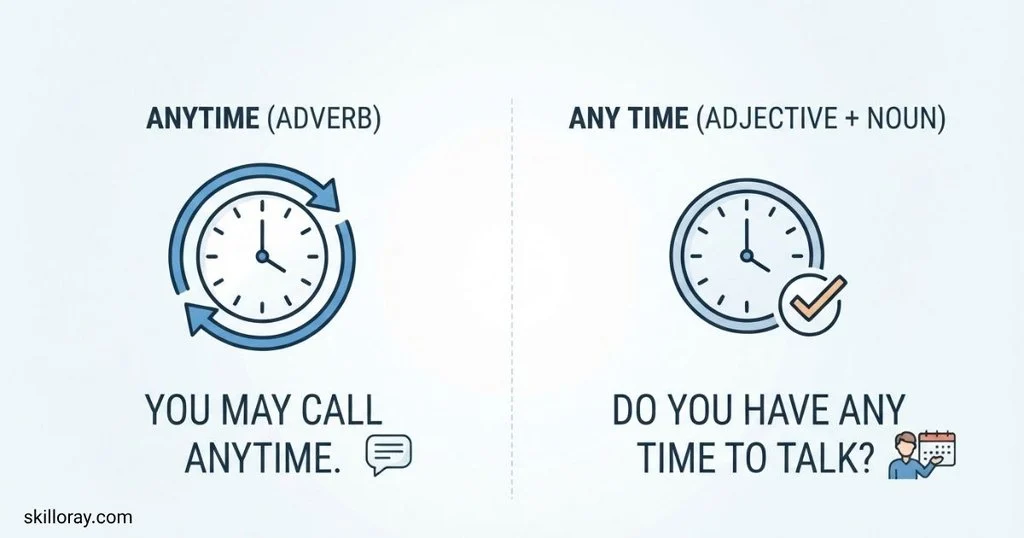
When inviting someone to call, both spellings can be correct.
Examples:
- Call me anytime if you need help.
- Call me any time if you have a question.
- You can call me at any time during the day.
- Feel free to call anytime after 6 PM.
- Call me any time you need advice.
- You can call me at any time that suits your schedule.
The expression call anytime is common in casual communication. The expression call me at any time is also correct and may sound more formal.
Avoid writing “call me at anytime” in standard edited English. After at, the conventional form is any time.
Stop By Anytime or Any Time?
When inviting someone to visit, both forms can be acceptable.
Examples:
- Stop by anytime you’re in the neighborhood.
- Stop by any time you like.
- You’re welcome to stop by anytime after lunch.
- Feel free to stop by at any time during the afternoon.
- You can stop by any time that works for you.
The one-word form works naturally when it means “whenever.” The two-word form is suitable when referring to a possible time or when it follows a preposition.
If you are writing a friendly invitation, “Stop by anytime!” is short, natural, and easy to understand.
Is “Anytime” or “Any Time” Correct?
Both are correct English expressions. Neither spelling is universally wrong; the appropriate form depends on its grammatical role.
Use anytime when it functions as an adverb meaning “whenever” or “at any time.”
- You can email me anytime.
- The package could arrive anytime now.
- Anytime you need support, let me know.
Use any time when time is a noun, especially when referring to an amount of time or following a preposition.
- I don’t have any time to spare.
- We can meet at any time.
- Do you have any time available tomorrow?
Remember the key rule: write “at any time,” not “at anytime,” in standard edited English.
Anytime or Any Time in American English or British English?
The distinction is broadly similar across major varieties of English, although the frequency of the one-word spelling can vary.
| English variety | Common usage |
| American English | Anytime is common as an adverb; any time is used in noun phrases. |
| British English | Any time is widely used, while anytime is also recognized. |
| Canadian English | Both forms appear, depending on the grammatical context. |
| Australian English | Both forms are used, with any time common in noun phrases. |
Major dictionaries recognize anytime as a standard adverb, particularly in American English. British dictionaries also recognize it, although any time is a common alternative.
For formal writing, a reliable approach is to use any time after at or when discussing an amount of time, then use anytime when it naturally means “whenever.”
How Do You Pronounce Anytime or Any Time?
Both expressions are pronounced the same way in ordinary speech. The difference is in spelling and grammar, not pronunciation.
- Pronunciation: EN-ee-time
- IPA: /ˈen.i.taɪm/
- Syllables: Three — en-ee-time
- Stress: The first syllable
The word any is pronounced /ˈen.i/, while time is pronounced /taɪm/.
Because the two forms sound alike, you usually cannot identify the correct spelling by listening alone. You need to consider how the phrase functions in the sentence.
Common Mistakes When Using Anytime or Any Time
Even experienced writers sometimes confuse these forms because their pronunciation is identical. The following examples show how to choose the appropriate spelling.
Mistake 1: Writing “At Anytime”
Incorrect: You can contact me at anytime.
Correct: You can contact me at any time.
The preposition at is followed by the noun phrase any time.
Mistake 2: Using “Anytime” for an Amount of Time
Incorrect: I don’t have anytime to finish the project.
Correct: I don’t have any time to finish the project.
The sentence refers to the amount of time available, so the two-word form is appropriate.
Mistake 3: Assuming “Anytime” Is Always Incorrect
Incorrect assumption: Anytime is never proper English.
Correct explanation: Anytime is a recognized English adverb. It works naturally in sentences such as “Call me anytime” or “I don’t expect the situation to change anytime soon.”
Mistake 4: Using the Two-Word Form Incorrectly After “At”
Incorrect: Please arrive at anytime after 2 PM.
Correct: Please arrive at any time after 2 PM.
The correct construction uses at any time.
Mistake 5: Confusing Availability With Available Time
Consider these examples:
- Correct: I’m available anytime tomorrow.
- Correct: I don’t have any time tomorrow.
- Correct: I’m available at any time tomorrow.
The first and third sentences discuss when someone is available. The second refers to an amount of time that the person does not have.
Mistake 6: Adding an Unnecessary Hyphen
Incorrect: Call me any-time you need assistance.
Correct: Call me anytime you need assistance.
Neither any-time nor a similar hyphenated form is normally needed in standard English.
A Simple Trick to Remember Anytime or Any Time
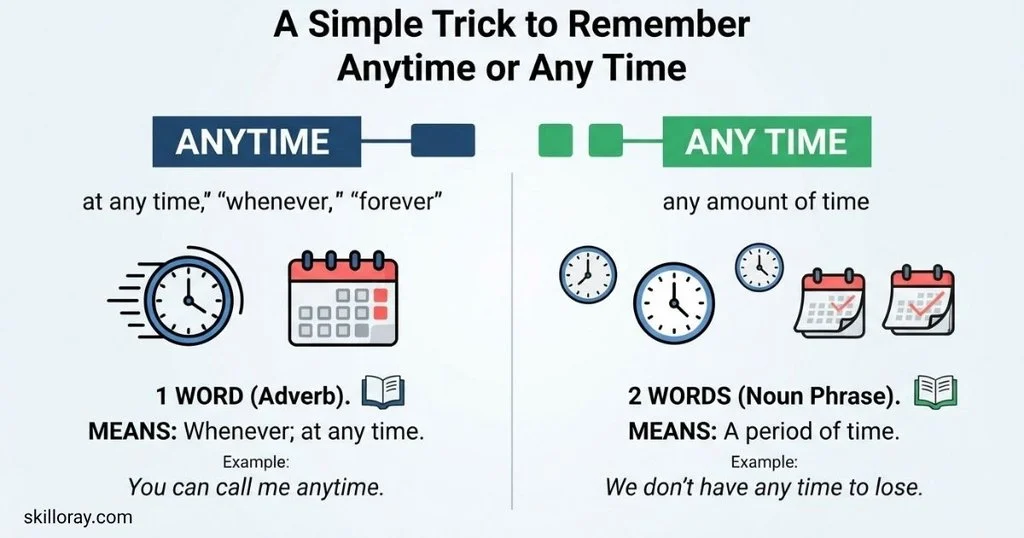
If you’re unsure which spelling to choose, use these three steps.
Step 1: Try replacing it with “whenever.”
If the sentence still makes sense, anytime is often appropriate.
Example: You can call me anytime → You can call me whenever you need to.
Step 2: Check whether you’re talking about an amount of time.
If you mean the time someone has, needs, or can spare, use any time.
Example: I don’t have any time to spare.
Step 3: Look for the preposition “at.”
In standard usage, write at any time, never at anytime.
Example: You may leave at any time.
These steps cover most everyday situations, including messages, emails, invitations, appointment schedules, and professional communication.
Frequently Asked Questions
1. Is anytime one word or two words?
Both forms are correct. Anytime is usually an adverb meaning “whenever,” while any time is a noun phrase used when discussing an amount of time or following a preposition such as at.
2. Should I say “thank you, anytime” or “thank you, any time”?
If you’re responding to someone who thanks you, “Any time!” is a conventional spelling for the expression meaning “you’re welcome.” Anytime! is also seen in casual messages, but the two-word form is a safe choice for edited writing.
3. Is “anytime after 2 PM” grammatically correct?
Yes. “Anytime after 2 PM” is grammatically correct when you mean that something can happen at any point after that hour. You can also write “any time after 2 PM.” If you use at, write “at any time after 2 PM.”
4. Is “reach out anytime” correct?
Yes. “Reach out anytime” is a natural expression that invites someone to contact you whenever they need help or information. “Reach out at any time” is also correct.
5. Is “call me anytime” correct English?
Yes. “Call me anytime” is grammatically correct and commonly used in conversation, text messages, and emails. “Call me any time” is also acceptable in this context.
6. Is “anytime soon” correct?
Yes. Anytime soon is a common expression referring to the near future, particularly in negative statements or questions.
For example: “I don’t expect the results to arrive anytime soon.”
7. Can I write “I’m free anytime”?
Yes. “I’m free anytime” is a natural way to express flexible availability. You can also write “I’m free any time” or “I’m free at any time,” depending on the sentence.
8. Is “at anytime” ever correct?
In standard edited English, use “at any time.” The word anytime functions primarily as an adverb, whereas at any time uses a noun phrase after the preposition at.
9. Is anytime formal or informal?
Anytime is a standard English word, not merely slang. It is common in conversational and professional communication when used correctly. Any time is necessary in noun phrases such as “I don’t have any time” or “at any time.”
10. Do anytime or any time sound different?
No. They are normally pronounced identically. You distinguish them through their grammatical function and the context of the sentence rather than their pronunciation.
Conclusion
Choosing between anytime or any time becomes easier once you understand how each form works. Both spellings are correct, but they are not interchangeable in every sentence.
Use anytime when you mean “whenever,” as in “Call me anytime.” Use any time when referring to an amount of time, as in “I don’t have any time,” or after a preposition, as in “You can call me at any time.”
For everyday messages, invitations, or offers to help, either form can work in suitable contexts. When writing formally, pay attention to the grammatical structure rather than relying on how the phrase sounds. This simple habit will help you choose the correct spelling confidently.

I am Daniel Carter, a grammar enthusiast and language educator with over 10 years of experience helping students and professionals improve their English writing and communication skills. I enjoy simplifying complex grammar rules into easy-to-understand lessons that anyone can follow. My goal is to help learners write with confidence, avoid common mistakes, and develop strong communication skills for academic and professional success. I regularly create practical grammar guides, writing tips, and language resources that make learning both enjoyable and effective.
Books: Mastering English Grammar and The Complete Guide to Better Writing
 James Walker
 Olivia Brown