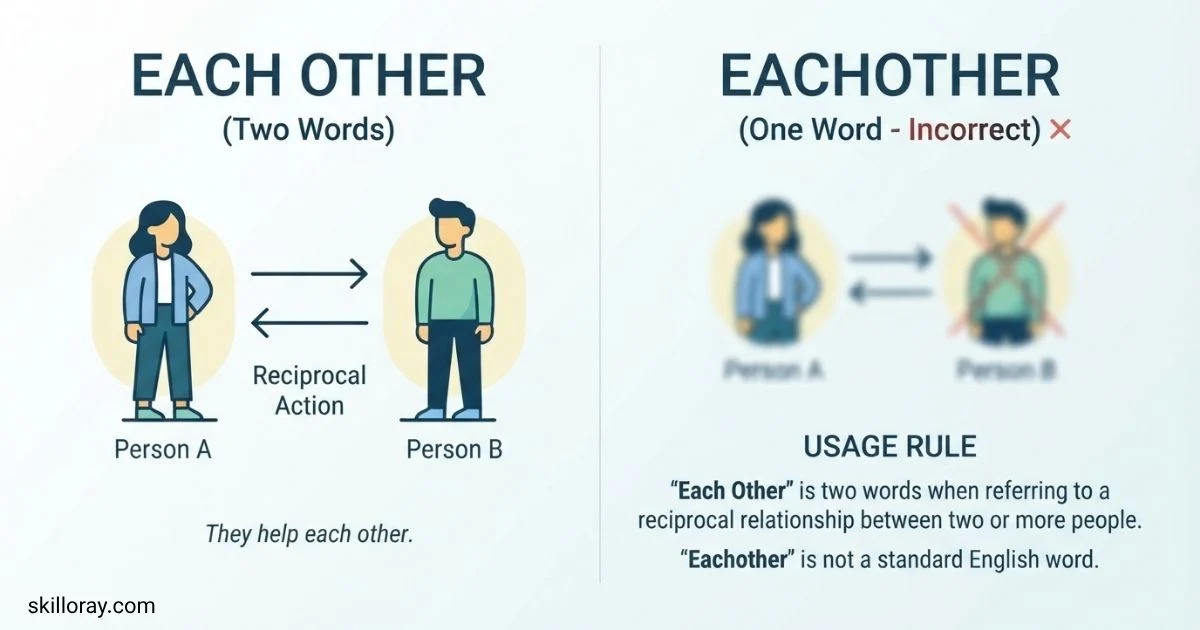
I know how easy it is to hesitate when you see “each other” or “eachother” used in different places. You may wonder whether both forms are acceptable or if one is simply a common spelling mistake.
If you have ever stopped while writing and thought, “Which one should I use?” you are not alone. I’ll explain the difference clearly, so you can understand the correct form without getting lost in complicated grammar rules.
By the end, you’ll know exactly when to use each other, why eachother is generally not standard English, and how to use the phrase naturally in your own sentences.
Each Other or Eachother: Quick Answer
“Each other” is the correct standard English spelling. “Eachother” written as one word is a misspelling in ordinary modern English.
The expression “each other” is a reciprocal pronoun phrase. It describes an action, feeling, or relationship that goes in both directions between two or more people, animals, or things.
For example:
- Correct: The two friends help each other with homework.
- Incorrect: The two friends help eachother with homework.
The correct expression always contains two words: “each” followed by “other.” This spelling is standard in American English, British English, Canadian English, and Australian English.
Although people sometimes type “eachother” online, in text messages, or in informal writing, that does not make it an accepted standard spelling.
What Does “Each Other” Mean?
“Each other” means that two or more people, animals, or things perform an action toward one another or share a mutual feeling, relationship, or quality.
It is commonly used to describe cooperation, communication, affection, disagreement, or shared experiences.
Examples:
- The students respect each other.
- My neighbors often visit each other.
- The two dogs chased each other around the garden.
- We should listen to each other carefully.
- The team members encouraged each other during the competition.
In each example, the action or relationship is reciprocal. The people or animals involved are connected through the same action or feeling.
Is “Eachother” a Real Word?
No. “Eachother” is not a standard English word. The accepted spelling is “each other,” with a space between the two words.
People may accidentally combine the words because they are frequently used together in a sentence. However, frequent use as a phrase does not mean the words should be joined.
For example:
- Correct: We should trust each other.
- Incorrect: We should trust eachother.
When writing emails, school assignments, blog posts, professional documents, or social media captions, always use “each other.”
Grammar Rules for Using “Each Other”
Understanding how “each other” works in a sentence can help you avoid spelling mistakes and grammatical confusion.
1. Use “Each Other” for Reciprocal Actions
Use “each other” when two or more people or things perform an action toward one another.
Examples:
- The siblings support each other.
- The colleagues exchanged ideas with each other.
- The children waved at each other.
- The two friends called each other after school.
The phrase communicates a mutual relationship rather than an action directed at only one person.
2. Use “Each Other” After a Verb
“Each other” frequently appears after verbs that describe communication, relationships, feelings, or actions.
Common verbs used with the phrase include:
- Help each other
- Love each other
- Understand each other
- Know each other
- Respect each other
- Support each other
- Trust each other
- Encourage each other
- Meet each other
- Recognize each other
Examples:
- We understand each other very well.
- They encouraged each other before the presentation.
- The neighbors help each other whenever necessary.
- The classmates recognize each other from school.
These expressions are natural in everyday English.
3. Use “Each Other’s” to Show Possession
When you want to show that something belongs to or is associated with another person in a reciprocal relationship, use “each other’s.”
The possessive form includes an apostrophe followed by the letter s.
Examples:
- The children borrowed each other’s books.
- We know each other’s names.
- The students checked each other’s answers.
- The friends respected each other’s opinions.
- The teammates remembered each other’s responsibilities.
Notice that “each other’s” indicates a mutual connection involving possession, knowledge, or association.
Common mistake:
Incorrect: They borrowed eachothers books.
Correct: They borrowed each other’s books.
The correct spelling uses two words, followed by an apostrophe and s.
4. Can “Each Other” Be Used for More Than Two People?
Yes. Although “each other” is traditionally associated with two people, it is widely used for groups of three or more.
Examples:
- The five classmates helped each other prepare for the exam.
- The team members congratulated each other after the match.
- Everyone in the group introduced themselves to each other.
For a group, the phrase can describe a relationship in which members interact mutually. In some sentences, “one another” is another suitable expression.
Each Other or Eachother: Examples in Sentences
The easiest way to remember the correct spelling is to see how it works in ordinary sentences.
Here are ten natural examples using “each other” correctly:
- My best friend and I always support each other.
- The students shared their notes with each other.
- We should respect each other’s opinions.
- The children introduced themselves to each other.
- The two teams congratulated each other after the game.
- My grandparents have known each other for decades.
- The neighbors helped each other during the storm.
- The classmates asked each other questions during the activity.
- Good friends listen to each other without judging.
- The family members called each other throughout the holiday.
Each sentence uses “each other” as two separate words. When possession is involved, “each other’s” includes the possessive apostrophe.
More Examples for Everyday Conversations
You can also use “each other” in casual conversations, messages, and social media posts.
- We miss each other when we’re apart.
- They always make each other laugh.
- We need to understand each other better.
- The two friends promised to help each other.
- They looked at each other and smiled.
These examples show how naturally the phrase fits into everyday English.
Each Other or One Another: What Is the Difference?
“Each other” or “one another” are both standard English expressions used to describe reciprocal relationships. In most modern contexts, they are interchangeable.
A traditional grammar guideline suggests using “each other” for two people and “one another” for more than two. However, this distinction is not a strict rule in contemporary English.
| Expression | Meaning | Example |
| Each other | A mutual action or relationship | The two friends trust each other. |
| One another | A mutual action or relationship | The team members support one another. |
Both expressions can describe relationships involving two people or larger groups.
For example:
- The sisters helped each other.
- The sisters helped one another.
- The students exchanged ideas with each other.
- The students exchanged ideas with one another.
All four sentences are grammatically acceptable.
Which should you use? “Each other” is a natural, widely used choice in everyday English. “One another” is equally acceptable and may sound slightly more formal in some contexts.
Is “Each Other” One Word or Two Words?
“Each other” is always written as two separate words in standard modern English.
The phrase consists of:
- Each: A word referring to individual members of a group.
- Other: A word referring to a different person or thing within a relationship.
Together, they express a reciprocal connection.
Correct examples:
- We understand each other.
- They helped each other.
- The children played with each other.
- We learned from each other.
Incorrect examples:
- We understand eachother.
- They helped eachother.
- The children played witheachother.
Remember that the space is part of the correct spelling. Writing the phrase as one word is a spelling error, even when the intended meaning is clear.
Why Do People Write “Eachother” as One Word?
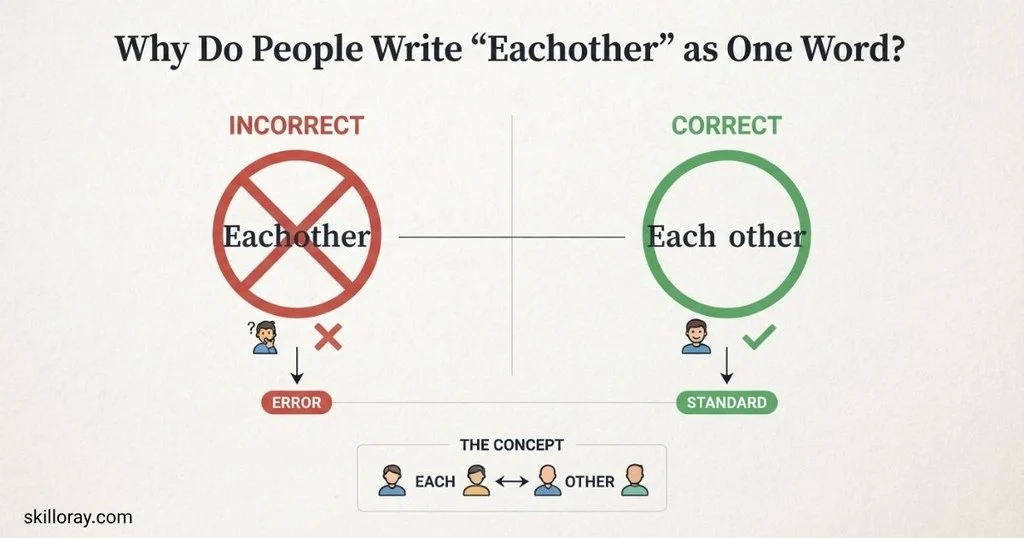
There are several reasons people accidentally write “eachother” instead of “each other.”
1. The phrase sounds like a single expression. When people speak quickly, the two words often flow together, making them seem like one word.
2. The words frequently appear together. Because “each other” is a common phrase, writers may mistakenly combine the words.
3. Informal typing encourages shortcuts. In text messages, online comments, and social media posts, people sometimes make spelling errors without noticing them.
4. Writers may confuse it with compound words. English contains many words formed by combining separate words, but “each other” retains its two-word spelling.
A useful way to remember the rule is to think of the phrase as two independent words working together to express a mutual relationship.
Is “Each Other” Correct in British, American, Canadian, or Australian English?
Yes. “Each other” is the standard spelling in American English, British English, Canadian English, and Australian English.
Unlike regional spelling differences such as “color” or “colour,” the phrase “each other” does not change its spelling based on the country.
| English variety | Correct form | Example |
| American English | Each other | We help each other. |
| British English | Each other | We help each other. |
| Canadian English | Each other | We help each other. |
| Australian English | Each other | We help each other. |
The same spelling rule applies in formal writing, academic work, business communication, and everyday conversation.
You do not need to change the spelling to match a British, American, Canadian, or Australian audience.
How Do You Pronounce “Each Other”?
The phrase “each other” is pronounced as two words that often flow together in natural speech.
- Each: /iːtʃ/
- Other: /ˈʌðər/ in many American pronunciations; /ˈʌðə/ in many British pronunciations.
- Each other: /ˌiːtʃ ˈʌðər/ in a common American pronunciation.
A simple pronunciation guide is “eech UTH-er.”
The main stress generally falls on the first syllable of “other,” although the precise rhythm can vary with sentence stress and speaking speed.
Examples:
- They understand each other.
- We met each other yesterday.
- The children looked at each other.
The pronunciation does not change the spelling. Even when the phrase sounds connected in conversation, it remains two separate words in writing.
What Are Some Synonyms for “Each Other”?
The best alternative depends on the sentence. “Each other” describes a reciprocal relationship, so there is not always a single-word synonym that preserves the exact meaning.
Here are several alternatives you can consider:
| Alternative | Example |
| One another | The friends encouraged one another. |
| Together | The children worked together. |
| Mutually | They mutually agreed to cooperate. |
| Reciprocally | The two groups reciprocally supported their efforts. |
| Among themselves | The students discussed the problem among themselves. |
These expressions are not always interchangeable.
For example, “work together” emphasizes cooperation, while “respect each other” describes a mutual feeling. Choose the expression that communicates the intended meaning naturally.
Common Mistakes When Using “Each Other”
Even though the spelling rule is simple, a few mistakes occur frequently in everyday writing.
Mistake 1: Combining the Words
Incorrect: We should always help eachother.
Correct: We should always help each other.
Why? “Each other” is a two-word expression, not a single compound word.
Mistake 2: Forgetting the Possessive Apostrophe
Incorrect: They borrowed each others notebooks.
Correct: They borrowed each other’s notebooks.
Why? The possessive form requires an apostrophe before the final s.
Mistake 3: Using the Phrase Without a Clear Reciprocal Meaning
Incorrect: Sarah gave each other a gift.
Correct: Sarah and Emily gave each other gifts.
Why? The subject must make sense with the reciprocal action. A single person generally cannot perform a mutual action alone.
Mistake 4: Assuming “One Another” Is Always More Correct
Incorrect assumption: “Each other” is only for two people, so it cannot describe a group.
Correct: The classmates helped each other with their projects.
Why? Modern English commonly uses “each other” for groups of three or more. The traditional distinction between the two expressions is not a strict grammatical rule.
Each Other or Eachother Quiz
Test your understanding with these five questions. Choose the correct answer for each sentence.
1. The two friends always support ___.
eachother
each other
eachothers
2. We borrowed ___ books.
eachothers
each other’s
eachother’s
3. Which spelling is standard English?
Eachother
Each other
Eache other
4. The students helped ___ prepare for the exam.
one another
onean other
oneanothers
5. Which English variety uses “each other”?
American English only
British English only
All listed varieties
Check Answers
Frequently Asked Questions
1. Is it “eachother” or “each other”?
“Each other” is correct. It is written as two separate words in standard English. “Eachother” is a common misspelling.
2. Why is “eachother” not a word?
English treats “each other” as a two-word reciprocal expression. Although the words frequently appear together, they have not combined into a standard single word in modern English.
3. What does “each other” mean in a sentence?
“Each other” describes a mutual action, feeling, or relationship. For example, “The friends trust each other” means that the friends have mutual trust.
4. Is “each other’s” grammatically correct?
Yes. “Each other’s” is the possessive form of “each other.” For example, “They remembered each other’s birthdays.”
5. Is “each other” formal or informal?
“Each other” is appropriate in both formal and informal English. You can use it in academic assignments, professional emails, everyday conversations, and creative writing.
6. Can I use “each other” for three or more people?
Yes. Modern English regularly uses “each other” for groups of any size. For example, “The team members encouraged each other.”
7. Is “each other” correct in British English?
Yes. “Each other” is standard in British English, just as it is in American, Canadian, and Australian English.
8. Is “one another” more grammatically correct than “each other”?
No. Both are correct expressions. The traditional guideline that reserves “each other” for two people and “one another” for larger groups is not a strict rule in modern English.
9. What is a synonym for “each other”?
“One another” is the closest common alternative. Depending on the sentence, “together,” “mutually,” or “among themselves” may also communicate a related meaning.
10. How do I remember the correct spelling?
Remember to leave a space between “each”or “other.” A simple sentence such as “We help each other” can help you remember the correct form.
Conclusion
The correct spelling is “each other,” not “eachother.” Although the two words often sound connected when spoken, they remain separate in standard English.
Use “each other” to describe mutual actions, feelings, relationships, or interactions. When you need to show possession, write “each other’s,” with an apostrophe before the final s.
The same spelling applies in American, British, Canadian, and Australian English. Once you remember the two-word rule, you’ll be able to use the expression confidently in everyday conversations, school assignments, professional writing, and online content.

I am Olivia Brown, a professional English editor and grammar writer who believes that great writing begins with a strong foundation in grammar. I have spent years creating educational resources that help students and professionals improve their writing, avoid common errors, and communicate more effectively. I strive to provide clear explanations and practical examples that make grammar easy to understand and apply.
Books: English Grammar Essentials and Modern Writing Success
 James Walker
 Daniel Carter