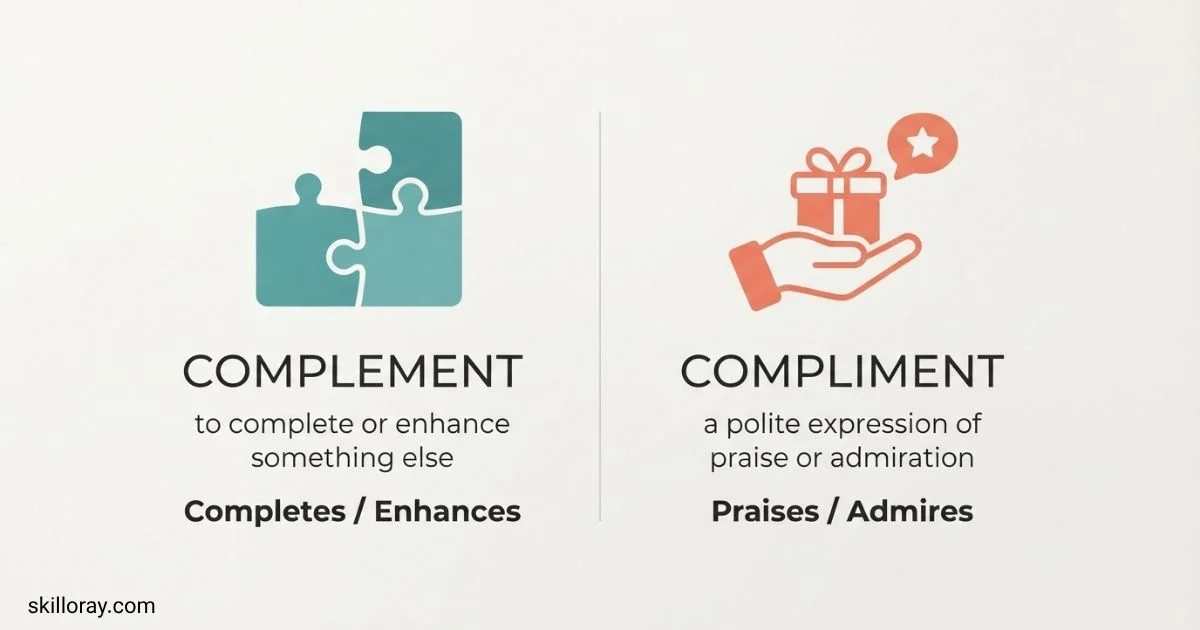
I know complement or compliment can be confusing because these two words look and sound almost identical. You may even pause while writing and wonder which one actually fits your sentence.
You’re not alone. I’ll break down the difference in a simple, practical way so you can quickly understand when to use each word without second-guessing yourself.
By the end, you’ll know exactly when to use complement and when to use compliment, with clear examples that make the distinction easy to remember.
Complement or Compliment: Meaning and Definition
The easiest way to understand the difference is to look at what each word communicates.
| Word | Meaning | Part of speech | Example |
| Complement | Something that completes or enhances another thing | Noun or verb | This scarf complements your coat. |
| Compliment | Praise or an expression of admiration | Noun or verb | She complimented my presentation. |
| Complementary | Completing, balancing, or enhancing something | Adjective | The colours are complementary. |
| Complimentary | Expressing praise or provided free of charge | Adjective | The hotel provides complimentary breakfast. |
These definitions apply in American English, British English, Australian English, and other standard varieties of English. The main distinction is meaning, not regional spelling.
What Does Complement Mean?
Complement can be a noun or a verb.
As a noun, it describes something that completes a whole, adds a useful element, or makes another thing more effective.
Examples:
- The green curtains are a perfect complement to the cream walls.
- Fresh fruit makes a delicious complement to breakfast.
- The new software is a useful complement to our existing system.
- We finally have a full complement of employees.
As a verb, complement means to enhance, improve, balance, or go well with something.
Examples:
- Her blue shoes complement her dress.
- The lemon flavour complements the fish.
- His practical experience complements his academic knowledge.
- The new course complements the training programme.
In each example, the word refers to something that adds value, creates balance, or makes a whole more complete.
Compliment can also be a noun or a verb, but its meaning relates to praise, appreciation, or polite admiration.
As a noun, a compliment is something positive that you say about a person, their work, or something they have done.
Examples:
- Your teacher gave you a compliment about your essay.
- I received a lovely compliment on my presentation.
- Thank you for the compliment.
- His kind words were a welcome compliment.
As a verb, compliment means to express praise or admiration.
Examples:
- I complimented her on her excellent work.
- The manager complimented the team on its progress.
- They complimented the chef on the meal.
- She complimented her friend on the beautiful painting.
Whenever you are talking about praising someone or expressing admiration, compliment is the correct choice.
Complement or Compliment: Which One Should You Use?
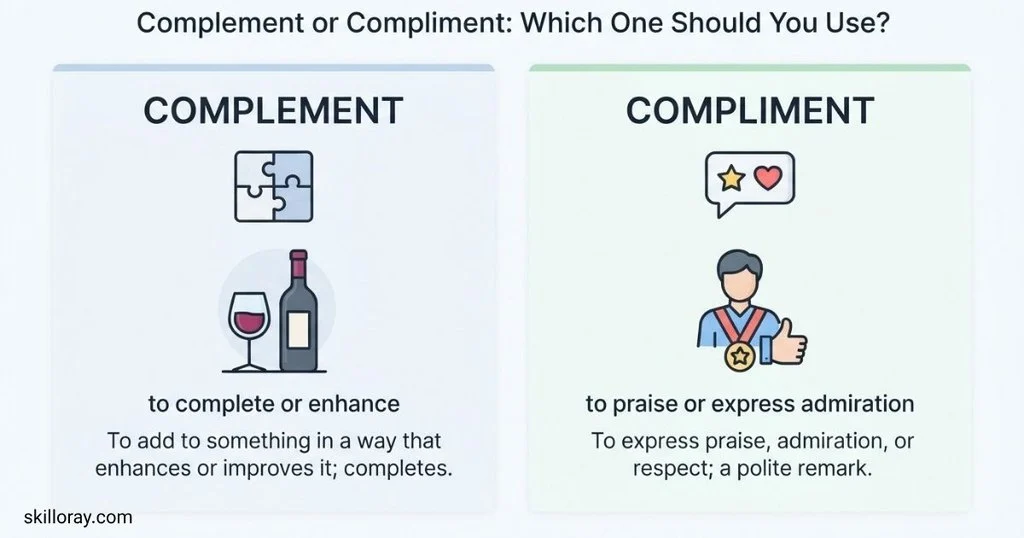
The correct choice depends on the meaning of your sentence. Ask yourself whether you are describing praise or something that enhances or completes another thing.
Use compliment when expressing praise.
Example: “My supervisor complimented me on my report.”
The supervisor said something positive about the report.
Use complement when describing something that enhances another thing.
Example: “The report complements our earlier research.”
The report adds useful information to the existing research.
Here is another way to remember the difference:
- If you mean praise, choose compliment.
- If you mean complete, enhance, or go well with, choose complement.
The same rule applies when the words are used in the past tense or as adjectives.
Complement or Compliment: Pronunciation
One reason these words are frequently confused is that they are pronounced alike in many varieties of English.
- Complement: /ˈkɒmplɪmənt/ in British English; /ˈkɑːmpləmənt/ in many American pronunciations.
- Compliment: /ˈkɒmplɪmənt/ in British English; /ˈkɑːmpləmənt/ in many American pronunciations.
The first syllable carries the main stress in both words. The spelling differs, but the pronunciation is generally the same.
A simple way to practise is to say each word aloud in a complete sentence:
- “That jacket complements your outfit.”
- “I complimented you on your jacket.”
Because the sound does not usually help you distinguish the words, focus on the meaning when writing.
Complement or Compliment in a Sentence: Examples
The following examples show how each spelling works in everyday English.
Sentences With Complement
Use complement when something completes, improves, balances, or goes well with another thing.
- The blue cushions complement the grey sofa.
- Her calm personality complements his energetic nature.
- The sauce complements the flavour of the chicken.
- This additional chapter complements the original book.
- The new employee’s skills complement the existing team’s abilities.
- The painting is a perfect complement to the living room.
- A light jacket complements the outfit on a cool evening.
- The practical lesson complements the theory taught in class.
- The full complement of staff arrived before the meeting.
- The two musical instruments complement each other beautifully.
Sentences With Compliment
Use compliment when you are praising someone or expressing admiration.
- I complimented my friend on her presentation.
- He gave his colleague a compliment about her hard work.
- Thank you for the kind compliment.
- The teacher complimented the students on their improvement.
- She received a compliment from the customer.
- My parents complimented me on my exam results.
- He paid the chef a compliment after dinner.
- The coach complimented the players on their teamwork.
- I took his comment as a compliment.
- She complimented her brother on his creative idea.
These examples also show that either word can appear in different grammatical positions. The surrounding sentence tells you which meaning is intended.
What Does “Staff Complement” Mean?
The correct expression is staff complement, not staff compliment, when you are referring to the number of employees required, expected, or available to fill an organisation’s positions.
A staff complement is the full group of employees or the number of staff members assigned to a workplace, department, organisation, or project.
Examples:
- The hospital has a full complement of nursing staff.
- We are currently operating with a reduced staff complement.
- The department needs to recruit three more employees to reach its approved staff complement.
- The school has a complete staff complement for the new academic year.
- The company expects to maintain its current staff complement throughout the year.
In these sentences, complement refers to a complete or required group. It does not refer to praise.
What Does “Full Complement” Mean?
A full complement means the complete number or set of people or things required for a particular purpose.
The expression is common in workplaces, the military, healthcare, education, transport, and other organisational settings.
Examples:
- The restaurant has a full complement of kitchen staff.
- The aircraft departed with its full complement of crew members.
- The department now has a full complement of employees.
- The school appointed enough teachers to achieve a full complement of teaching staff.
Remember that full complement describes completeness or the required number. If you are talking about praising employees, use compliment instead.
Compliments of the Season or Complements of the Season?
The traditional expression is “Compliments of the season.”
It is a polite seasonal greeting commonly associated with Christmas or the New Year, particularly in British English usage. The word compliments refers to courteous greetings or good wishes.
Examples:
- Compliments of the season to you and your family!
- Please accept our compliments of the season and best wishes for the New Year.
- Our team sends you compliments of the season.
- Compliments of the season from everyone at our office.
In this particular expression, use compliments, with an i.
The word complements would suggest things that complete or enhance something, which is not the intended meaning of this greeting.
Complement or Compliment Each Other: Which Is Correct?
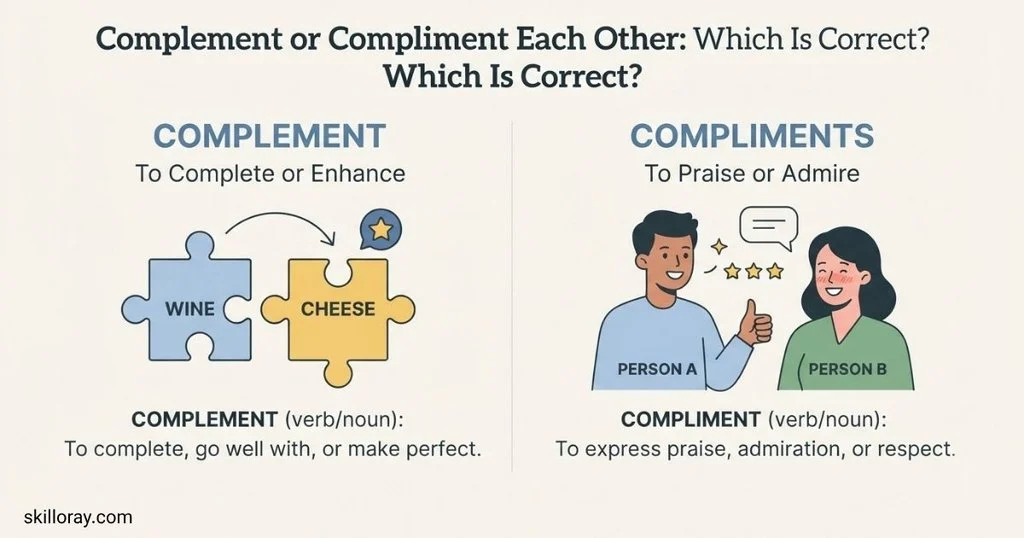
The correct expression is “complement each other” when you mean that two or more people or things work well together because their qualities, features, or abilities enhance one another.
Examples:
- Their different skills complement each other.
- The colours complement each other beautifully.
- The two teaching methods complement each other.
- Their personalities complement each other well.
- The flavours of the herbs complement each other.
Use compliment each other only when you mean that the people involved praise one another.
For example:
– The colleagues compliment each other on their work.
Here, the colleagues express admiration for one another. The verb refers to praise, not to qualities that work well together.
The intended meaning determines the correct spelling.
Complementary or Complimentary: What Is the Difference?
The adjectives complementary or complimentary follow the same basic distinction as the nouns and verbs discussed above, but they have their own common uses.
| Word | Meaning | Example |
| Complementary | Completing, balancing, or enhancing something | The two courses provide complementary skills. |
| Complimentary | Expressing praise | She received complimentary remarks about her work. |
| Complimentary | Free of charge | The hotel offers complimentary tea. |
When to Use Complementary
Use complementary when two things work well together, fill different needs, or enhance one another.
Examples:
- The two departments provide complementary services.
- These colours are complementary.
- The students have complementary strengths.
- The programme offers complementary training sessions.
- The online resources are complementary to the printed textbook.
When to Use Complimentary
Use complimentary when describing praise or something supplied without charge.
Examples:
- The customer left complimentary comments about the service.
- Guests receive complimentary breakfast.
- The hotel provides complimentary toiletries.
- She made complimentary remarks about the presentation.
- We received complimentary tickets to the exhibition.
Memory tip: Complementary relates to completing or enhancing. Complimentary relates to compliments or courtesy items provided free of charge.
Complement or Compliment in Mathematics
In mathematics, complement is the correct term when referring to a complementary angle, a complementary event in probability, or the complement of a set.
It has no connection with giving someone praise.
Complementary Angles
Complementary angles are two angles whose measures add up to 90 degrees.
For example, if one angle measures 35 degrees, its complement measures 55 degrees because:
90∘−35∘=55∘90^\circ-35^\circ=55^\circ90∘−35∘=55∘
The two angles are complementary because their measures total 90 degrees.
Complement of a Set
In set theory, the complement of a set contains the elements within a specified universal set that are not members of the original set.
For example, if the universal set is {1,2,3,4,5}\{1,2,3,4,5\}{1,2,3,4,5} and set A is {1,3,5}\{1,3,5\}{1,3,5}, the complement of A is {2,4}\{2,4\}{2,4}.
Complement in Probability
In probability, the complement of an event consists of all outcomes in which that event does not occur.
If the probability of rain tomorrow is 30%, the probability of no rain is 70%, assuming these are the only two possible outcomes being considered.
In these mathematical contexts, complement refers to a relationship involving completeness, remaining elements, or a total. Compliment is not the appropriate term.
Common Mistakes With Complement or Compliment
Even experienced English writers occasionally confuse these words. Here are some common mistakes to watch for.
Mistake 1: Using Compliment for Something That Matches
Incorrect: The red tie compliments his navy suit.
Correct: The red tie complements his navy suit.
The tie goes well with the suit, so complements is the appropriate verb.
Mistake 2: Using Complement for Praise
Incorrect: My teacher gave me a complement on my essay.
Correct: My teacher gave me a compliment on my essay.
The teacher is expressing praise, so compliment is correct.
Mistake 3: Confusing Complementary With Complimentary
Incorrect: The hotel offers complementary drinks to all guests.
Correct: The hotel offers complimentary drinks to all guests.
The drinks are provided free of charge, so complimentary is the appropriate adjective.
However, complementary drinks could be appropriate in a different context if the drinks were being described as enhancing a meal or experience.
Mistake 4: Misspelling the Seasonal Greeting
Incorrect: Complements of the season!
Correct: Compliments of the season!
The traditional greeting uses compliments because it expresses good wishes.
Mistake 5: Using Compliment for a Complete Group
Incorrect: The company has a full compliment of employees.
Correct: The company has a full complement of employees.
The sentence refers to the complete number of employees required, not to praise.
How Do You Remember Complement or Compliment?
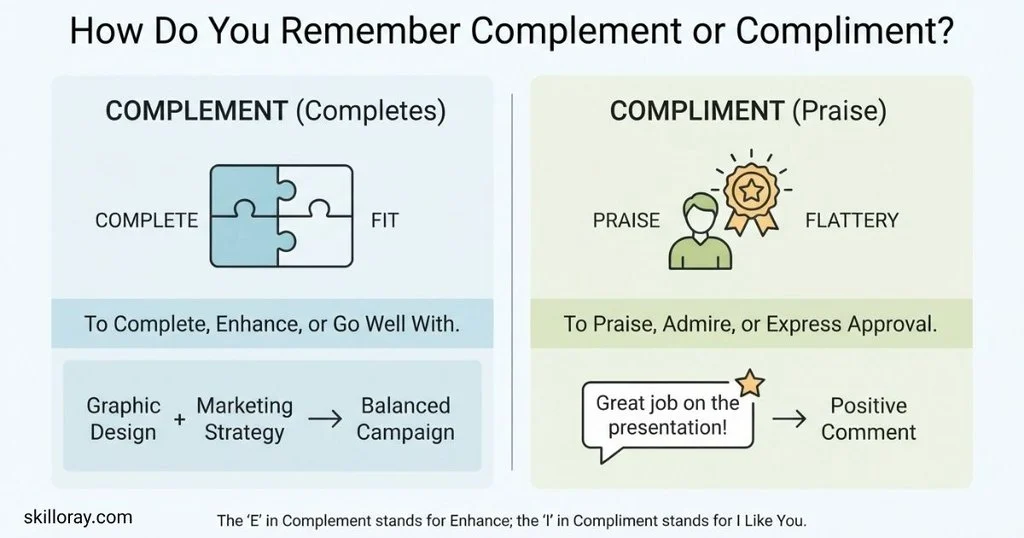
If you frequently mix up these spellings, use the following memory tricks.
Complement = Complete
Both words contain the letter e after the initial “compl” sequence. Think of completing a set, enhancing an outfit, or balancing a meal.
Compliment = Praise
Think of the i in compliment as a reminder of saying, “I like your work!” This helps you associate the spelling with appreciation.
You can also ask yourself two quick questions before writing:
- Am I expressing praise or admiration? Use compliment.
- Am I describing something that completes, balances, or enhances something else? Use complement.
With a little practice, choosing the correct spelling becomes much more natural.
Frequently Asked Questions
1. Is it complement or compliment?
Both spellings are correct English words, but they have different meanings. Use complement for something that completes or enhances another thing. Use compliment for praise or admiration.
2. What is the main difference between complement or compliment?
Complement means to complete, improve, or go well with something. Compliment means to praise someone or express admiration. Their pronunciation is generally identical, which is why they are often confused.
3. How do you pronounce complement or compliment?
In many British and American English accents, both words are pronounced similarly, with the main stress on the first syllable. The exact vowel sound can vary by accent.
4. Is it staff complement or staff compliment?
Use staff complement when referring to the full number of employees or the group of staff required by an organisation.
Example: “The department now has a full staff complement.”
5. Is it full complement or full compliment?
Use full complement to describe a complete group or the required number of people or things.
Example: “The school has a full complement of teachers.”
6. Is it “compliments of the season” or “complements of the season”?
The traditional expression is “Compliments of the season.” It is a polite greeting commonly used around Christmas or the New Year, especially in British English.
7. Can you use complement or compliment as a verb?
Yes. Complement means to enhance or complete something, while compliment means to praise someone.
Examples:
- The colours complement the room.
- She complimented me on my presentation.
8. What does “complement each other” mean?
It means that two or more people or things work well together because their qualities, abilities, or features enhance one another.
Example: “Their different skills complement each other.”
9. Is complement or compliment used in mathematics?
Use complement in mathematical contexts, such as complementary angles, set complements, or complementary events in probability. Compliment refers to praise and is not the appropriate mathematical term.
10. Is there a difference in British English, American English, or Australian English?
The fundamental distinction is the same in all three varieties. Complement refers to completion or enhancement, while compliment refers to praise. Neither word is simply a British or American spelling variation of the other.
Conclusion
Choosing complement or compliment becomes much easier when you focus on the meaning of your sentence rather than the similar spelling or pronunciation.
Remember these two simple rules:
- Complement means to complete, enhance, balance, or go well with something.
- Compliment means to express praise, admiration, or appreciation.
Use complement when describing a matching outfit, a full staff complement, complementary angles, or skills that work well together. Use compliment when praising someone’s work, appearance, achievement, or effort.
The next time you hesitate while writing an email, article, greeting, or school assignment, ask yourself what you want to communicate. That small check will help you select the right word with confidence.

I am James Walker, an English language specialist with extensive experience in grammar, editing, and academic writing. I enjoy helping students, bloggers, and professionals strengthen their writing by explaining grammar concepts in a clear and engaging way. My focus is on providing accurate, practical, and easy-to-follow guidance that helps learners communicate more effectively in everyday and professional situations.
Books: Perfect English Grammar Handbook and Advanced Writing Techniques
 Daniel Carter
 Olivia Brown