I know worse or worst can be confusing because these two words look and sound so similar. You may understand the meaning but still pause when deciding which one belongs in your sentence.
If you have ever wondered whether something is getting worse or has become the worst, you are not alone. I’ll make the difference simple so you can recognize the correct word with confidence.
You’ll learn how worse or worst works, when to use each form, and how to avoid common mistakes. By the end, you’ll have a clear rule you can use in everyday writing and conversation.
What Do Worse or Worst Mean?
Although both words describe something bad, they express different degrees of negativity.
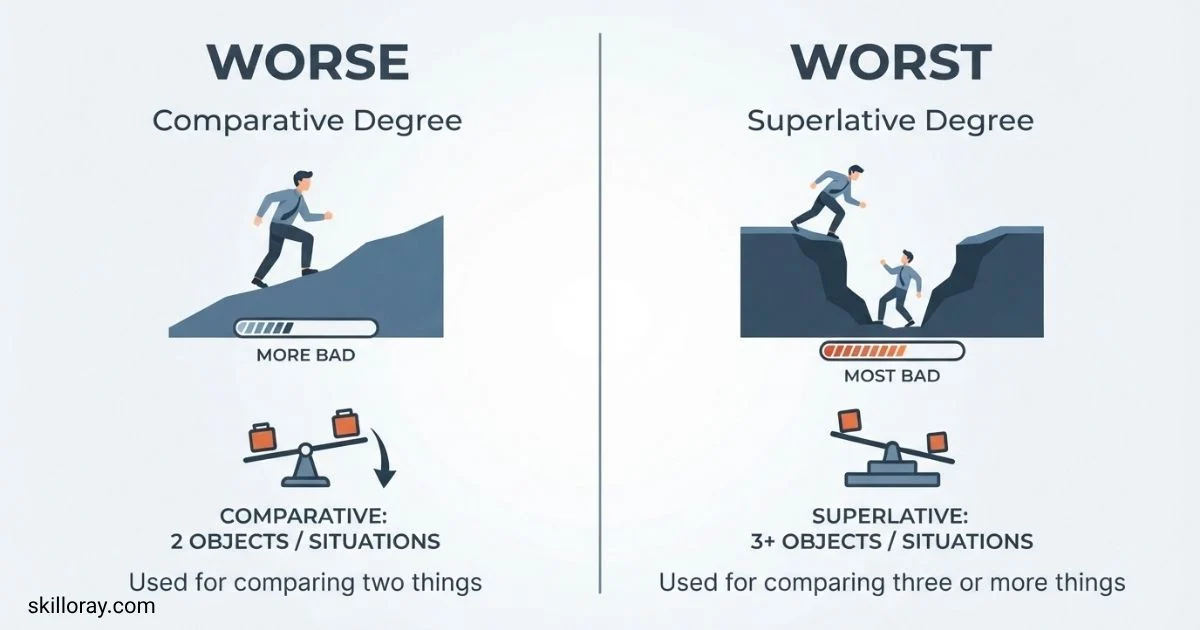
- Worse is the comparative form of bad or badly. It usually describes something that is less good than another thing or a situation that has declined.
- Worst is the superlative form of bad or badly. It describes the least good or most negative option among three or more possibilities, or the greatest degree of something unpleasant.
Consider these examples:
- My headache is worse than it was this morning.
- Monday was the worst day of my week.
- The weather is getting worse.
- That was the worst storm of the year.
The easiest way to remember the distinction is to think of worse as a comparison and worst as the extreme.
Worse or Worst: What Is the Difference?
The main difference is grammatical. Worse is used to compare things, conditions, experiences, or actions. Worst identifies the lowest quality or most unpleasant degree.
| Word | Meaning | Common use | Example |
| Worse | Less good or more unpleasant | Comparing two things or describing a decline | My cold is getting worse. |
| Worst | Least good or most unpleasant | Identifying the most negative option | This is the worst cold I’ve had. |
When Should You Use Worse?
Use worse when one thing is less desirable than another or when a situation becomes more unpleasant than before.
Examples:
- This traffic is worse than yesterday’s.
- My test results were worse than expected.
- His behavior is getting worse.
- The situation became worse after the argument.
- I feel worse today than I did yesterday.
You can also use worse without explicitly naming the thing being compared. For example, “The pain is getting worse” means the pain is increasing in severity compared with its earlier state.
When Should You Use Worst?
Use worst when something represents the lowest quality or the most unpleasant degree in a particular context.
Examples:
- That was the worst meal I’ve ever had.
- She had the worst luck during her trip.
- This is the worst traffic I’ve experienced all year.
- He made the worst decision possible.
- It was the worst moment of my life.
You do not always need to list three or more things to use worst. The group being considered can be understood from the context.
For example, “This is the worst day” can refer to the worst day someone has experienced, even if the other days are not mentioned.
Worse or Worst in a Sentence: Examples
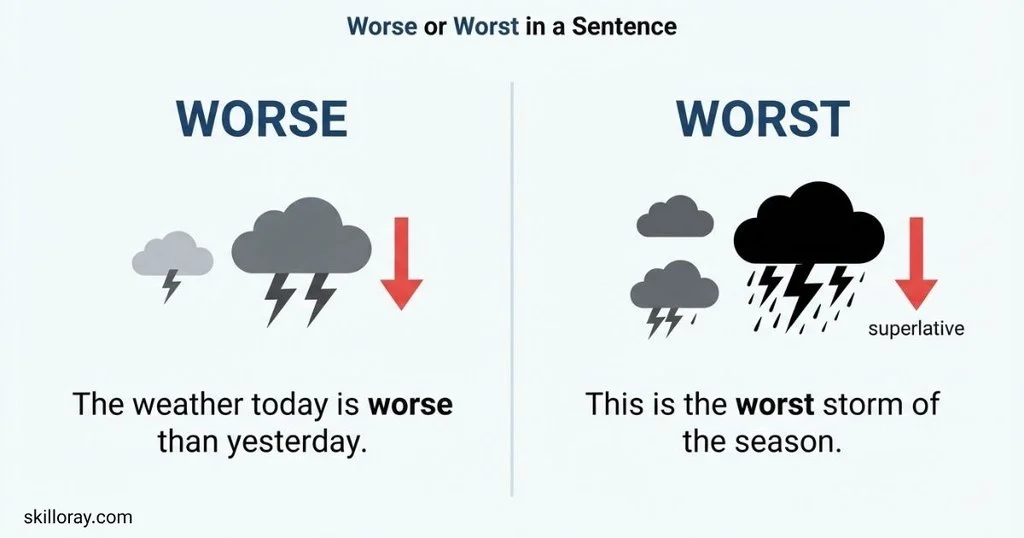
Seeing the words in complete sentences makes their different uses easier to understand.
Sentences With Worse
Here are ten natural examples using worse correctly:
- I feel worse today than I did yesterday.
- The weather is getting worse every hour.
- His second attempt was worse than his first.
- The traffic became worse after the accident.
- My internet connection is worse in the evening.
- Things could get worse if we ignore the problem.
- The situation is worse than we originally thought.
- She performed worse under pressure.
- The food tasted worse after it got cold.
- The company experienced worse sales this quarter.
In each sentence, worse indicates a decline, a comparison, or a more negative condition.
Sentences With Worst
Here are ten examples using worst correctly:
- Yesterday was the worst day of my week.
- That was the worst movie I watched this year.
- He made the worst mistake of his career.
- This is the worst possible outcome.
- She experienced the worst weather during her journey.
- It was the worst performance of the season.
- That restaurant serves the worst coffee in town.
- Missing the train was the worst part of my morning.
- This is the worst headache I’ve experienced.
- The team suffered its worst defeat of the season.
Each sentence identifies something as the most negative or least desirable in its context.
Worse or Worst Case: Which Is Correct?
Worse-case and worst-case may look similar, but the standard expression is worst-case.
The phrase worst-case scenario describes the most unfavorable outcome that could reasonably happen in a particular situation.
Examples:
- We should prepare for the worst-case scenario.
- In the worst case, the project may be delayed.
- The worst-case outcome would be losing the entire investment.
- Let’s consider the worst-case possibility before making a decision.
The phrase is also commonly written as worst case when it is used without a following noun or in constructions such as “in the worst case.”
For example:
- In the worst case, we will have to start again.
- The worst-case estimate is higher than expected.
Why not worse-case?
Worse is comparative, so it normally compares one condition with another. Worst identifies the most unfavorable possibility, which is why worst-case scenario is the established expression.
Worse or Worst Day: Which Should You Use?
Both words can describe a bad day, but the intended meaning determines which one fits.
Use worse day when comparing one day with another.
Examples:
- Today is a worse day for traveling than yesterday.
- I’ve had a worse day before.
- Yesterday was worse than today.
Use worst day when referring to the most unpleasant day within a particular period or experience.
Examples:
- Today is the worst day of my week.
- That was the worst day of my life.
- Monday was the worst day of the entire month.
Remember this simple distinction: a worse day is more unpleasant than another day, while the worst day is the most unpleasant within the relevant context.
Made It Worse or Worst: Which Is Correct?
The standard expression is usually made it worse.
The verb made is followed by worse because the phrase describes how an action caused a situation to deteriorate.
Examples:
- His comment made the situation worse.
- I tried to help, but I made it worse.
- The heavy rain made the traffic worse.
- Her reaction only made things worse.
- The extra work made my stress worse.
Using worst in this construction is generally incorrect when you mean that an action caused a situation to deteriorate.
Incorrect: I made the situation worst.
Correct: I made the situation worse.
However, worst can appear in a different grammatical construction, such as “This was the worst mistake I made.” In that sentence, it identifies the most serious mistake rather than describing a change in condition.
Worse or Worst Person: Which Is Correct?
Both expressions can be grammatically correct, depending on the intended meaning.
Use worse person when comparing someone’s behavior or character with another person’s, or with their previous behavior.
Examples:
- He became a worse person after gaining power.
- I don’t think she is a worse person than her brother.
- His actions made him seem like a worse person.
Use worst person when identifying someone as the least desirable or most unpleasant person within a particular group or context.
Examples:
- He was the worst person to ask for advice.
- She felt like the worst person in the room.
- He was the worst person for the job.
A small but useful distinction: saying someone is a worse person makes a comparison, while calling someone the worst person expresses a superlative judgment within the stated context.
Is It “You Are the Worse” or “You Are the Worst”?
Both constructions can be grammatical, but they communicate different things.
You are the worst is a common expression used to criticize someone’s behavior or to make a strong negative judgment.
Examples:
- You are the worst person to ask for help.
- You are the worst at keeping secrets.
- You are the worst when it comes to remembering birthdays.
You are the worse is less common on its own. It can be correct when the context identifies two people or options and means that one is less desirable than the other.
For example:
– Between the two candidates, you are the worse choice for this particular task.
In ordinary conversation, you are the worst is generally the natural choice when someone wants to express a superlative criticism. The phrase you are the worse usually needs a clear comparison.
I Feel Worse or Worst: Which Is Correct?
“I feel worse” is the standard expression when describing a decline in physical condition, mood, or emotional state.
Examples:
- I feel worse today than I did yesterday.
- I feel worse after staying up all night.
- I feel worse whenever I think about the argument.
- I feel worse than I expected to feel.
The word worse works because you are describing a condition that has become less favorable than before or than expected.
The expression “I feel worst” is not normally used by itself in everyday English. However, worst can be appropriate in a larger construction.
For example:
- I feel worst in the early morning.
- I feel worst when I haven’t slept enough.
In these examples, worst identifies the time or circumstances when the condition is at its most severe.
For most everyday situations, choose “I feel worse.”
Take a Turn for the Worse or Worst
The correct idiom is “take a turn for the worse.”
This expression describes a situation that suddenly becomes more serious, difficult, or unpleasant after previously being stable or improving.
Examples:
- His health took a turn for the worse overnight.
- The negotiations took a turn for the worse.
- The weather took a turn for the worse in the afternoon.
- Their financial situation took a turn for the worse.
- The conversation took a turn for the worse when the argument began.
The phrase “take a turn for the worst” is not the standard idiomatic form.
Why is worse used here? The expression describes a change in condition. The situation has deteriorated from its previous state, so the comparative form is appropriate.
The same rule applies to related expressions:
- Things took a turn for the worse.
- The situation took a turn for the worse.
- Her condition took a turn for the worse.
- The business took a turn for the worse.
In each example, worse describes a decline rather than identifying the most negative possibility.
For the Worse or Worst
The standard expression is “for the worse” when describing an unfavorable change.
Examples:
- His attitude changed for the worse.
- The situation changed for the worse after the announcement.
- Their relationship changed for the worse.
- The decision turned out to be a change for the worse.
The phrase means that something became less favorable than it was previously.
The expression for the worst is not the standard choice for describing this kind of change. However, worst can appear naturally in other expressions, including prepare for the worst.
Examples:
- We should prepare for the worst.
- She feared the worst after hearing the news.
- Hope for the best but prepare for the worst.
These expressions have different meanings. For the worse describes a negative change, while the worst refers to the most unfavorable outcome or possibility.
Even Worse or Worst
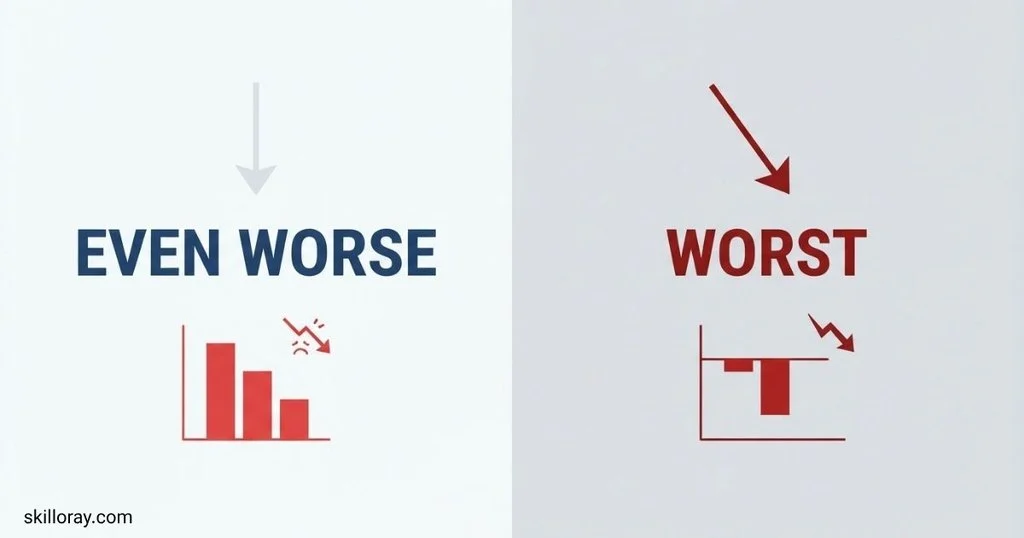
Both expressions are correct, but they are used differently.
Use even worse to emphasize that something is more unpleasant or less desirable than another condition already mentioned or understood.
Examples:
- The traffic was bad, but the rain made it even worse.
- I thought the test was difficult, but the final question was even worse.
- His explanation made the confusion even worse.
- The second version was even worse than the first.
Use even worst only when worst belongs to a construction that is grammatically appropriate, such as an emphatic description involving a superlative in a larger sentence. In ordinary comparative expressions, even worse is the natural choice.
For example:
– This is even worse than I expected.
Not: This is even worst than I expected.
The word than normally signals a comparison, so the comparative form worse is required.
That’s the Worse or Worst
The correct choice depends on whether you are comparing two possibilities or identifying the most negative one.
Use “that’s the worst” when identifying the most unpleasant, undesirable, or serious thing in a given context.
Examples:
- That’s the worst idea I’ve heard today.
- That’s the worst part of the whole experience.
- That’s the worst outcome we could have imagined.
Use “that’s the worse” when referring to the less favorable of two identifiable choices, although the phrase is less common in everyday conversation.
For example:
– Of those two options, that’s the worse choice.
When there is no clear comparison between two specific choices, that’s the worst will usually sound more natural.
Change for the Worse or Worst
The standard expression is “change for the worse.”
It describes a situation, behavior, relationship, or condition that becomes less favorable.
Examples:
- His behavior changed for the worse.
- The new policy resulted in a change for the worse.
- Their relationship took a change for the worse after the disagreement.
A more natural alternative to the last example would be “Their relationship changed for the worse after the disagreement.”
Use worst when describing the most negative possibility or outcome, rather than a general deterioration.
Examples:
- This is the worst change the company has made.
- That was the worst change in the entire process.
The key distinction is that change for the worse is an established expression describing deterioration.
Is It Worse or Worst Case Scenario?
The standard phrase is “worst-case scenario.”
Use it when discussing the most unfavorable outcome that could happen.
Examples:
- What’s the worst-case scenario if we miss the deadline?
- The worst-case scenario is that we lose the entire project.
- We need a backup plan for the worst-case scenario.
However, worse is appropriate when comparing possible scenarios.
Examples:
- This scenario is worse than the one we discussed earlier.
- The new forecast describes a worse outcome than the previous forecast.
The distinction is straightforward: worst-case scenario names the most unfavorable possible outcome, while worse scenario compares one situation with another.
Is It “A Turn for the Worse” or “A Turn for the Worst”?
Use “a turn for the worse.” It is the standard idiom.
Examples:
- The patient’s condition took a turn for the worse.
- The weather took a turn for the worse.
- The discussion took a turn for the worse after the disagreement.
The phrase describes a deterioration in circumstances. The comparative form worse is therefore the natural and established choice.
“A turn for the worst” is a common mix-up, probably because worst is associated with extremely bad situations. However, the idiom uses worse, not worst.
It Got Worse or Worst
The correct expression is generally “it got worse.”
The phrase describes a situation that became more unpleasant, serious, or difficult over time.
Examples:
- The weather got worse during the afternoon.
- My headache got worse after lunch.
- The situation got worse when more people became involved.
- The traffic got worse as we approached the city.
- Things got worse before they eventually improved.
The expression it got worst is generally incorrect when describing a simple change in condition.
However, worst can be used when a sentence identifies the most severe point in a sequence.
For example:
– The situation was at its worst during the final week.
The first expression describes deterioration; the second identifies the point of greatest severity.
Is It Worse or Worst in Questions?
The correct word depends on what the question asks.
Use worse when comparing conditions, choices, or experiences.
Examples:
- Is your headache worse today?
- Is this result worse than the previous one?
- Did the weather get worse overnight?
- Is the situation worse than we expected?
Use worst when asking about the most unfavorable possibility or the highest degree of something negative.
Examples:
- What’s the worst that could happen?
- Is this the worst result possible?
- What’s the worst day of the week for you?
- Was that the worst experience you’ve ever had?
A useful rule is to check whether the question contains an implied comparison or asks for the extreme. Comparisons generally call for worse, while superlative meanings call for worst.
Worse or Worst: Pronunciation Guide
Both words are pronounced with one syllable, but their final consonant sounds differ.
| Word | IPA pronunciation | Simple pronunciation |
| Worse | /wɜːrs/ in American English | WURSS |
| Worst | /wɜːrst/ in American English | WURST |
In American English, worse ends with an /s/ sound, while worst includes an additional /t/ sound at the end.
In many British English accents, the vowel sound differs slightly from American English. However, the grammatical distinction remains the same.
To practice, say these sentences aloud:
- The weather is getting worse.
- This is the worst weather I’ve experienced.
- My performance was worse than before.
- That was my worst performance.
Focus on the final sound of worst so that it doesn’t disappear when you speak quickly.
Common Mistakes With Worse or Worst
Even experienced English speakers occasionally mix up these words, especially in familiar expressions.
Here are some common mistakes to avoid.
| Incorrect or nonstandard usage | Correct usage | Explanation |
| I feel worst today. | I feel worse today. | Use the comparative for a decline in condition. |
| It made the problem worst. | It made the problem worse. | The sentence describes deterioration. |
| A turn for the worst | A turn for the worse | The established idiom uses worse. |
| Worst-case scenario is getting worse than expected. | The worst-case scenario is more serious than expected. | The second sentence expresses the intended comparison more clearly. |
| This is even worst than before. | This is even worse than before. | Use the comparative form with than. |
| Things changed for the worst. | Things changed for the worse. | The established expression is for the worse. |
| It got worst after lunch. | It got worse after lunch. | Use worse to describe a change. |
| That is the worse mistake I’ve ever made. | That is the worst mistake I’ve ever made. | Use the superlative for the most serious mistake in the relevant experience. |
How to Remember the Difference
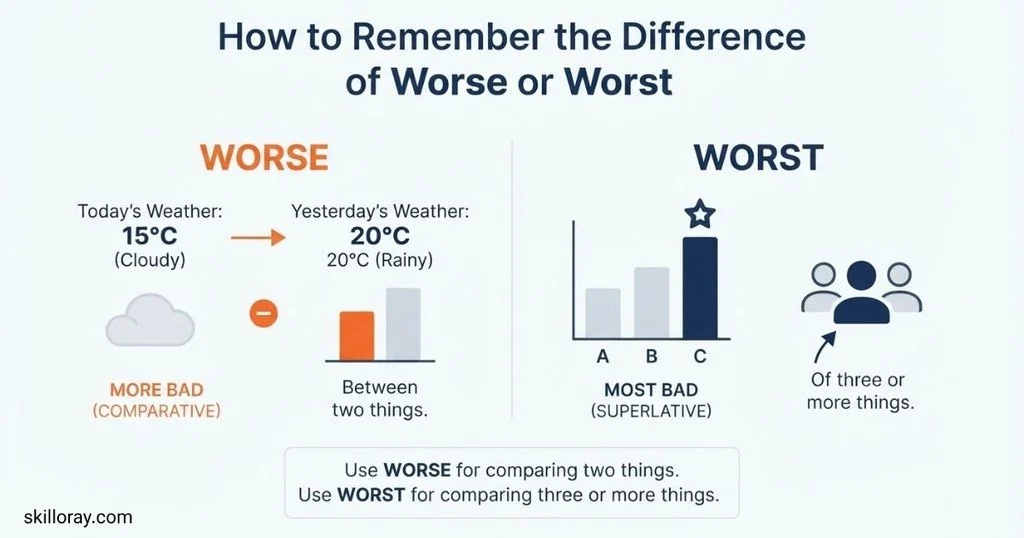
Try these simple memory tips:
- Worse = comparison: One thing is less good than another, or a situation has deteriorated.
- Worst = extreme: Something is the most unpleasant or least desirable in a particular context.
- Worse than: This is a common structure for direct comparisons.
- The worst: This commonly identifies the most negative option.
- For the worse: Remember this fixed expression when describing an unfavorable change.
- Worst-case scenario: Use this expression for the most unfavorable possible outcome.
You can also remember the familiar progression:
Bad → Worse → Worst
For example:
- The weather is bad.
- The weather is worse today.
- This is the worst weather of the month.
This progression is a simple way to recall the comparative and superlative forms of bad.
Frequently Asked Questions
1. Is worse or worst grammatically correct?
Both are grammatically correct. Worse is the comparative form of bad, while worst is the superlative form. The correct choice depends on whether you are describing a decline, making a comparison, or identifying the most negative option.
2. Should I say “I feel worse” or “I feel worst”?
In ordinary conversation, say “I feel worse” when your physical condition or emotional state has deteriorated. Use worst in a construction such as “I feel worst in the morning” when describing the time at which your condition is most severe.
3. Is it “for the worse” or “for the worst”?
The standard expression is “for the worse.” It describes an unfavorable change in a situation, condition, or relationship. For example, “Things changed for the worse after the announcement.”
4. Is it “take a turn for the worse” or “take a turn for the worst”?
The established idiom is “take a turn for the worse.” It means that a situation has suddenly become more serious or unpleasant.
5. Is it “worst-case scenario” or “worse-case scenario”?
“Worst-case scenario” is the standard expression. It refers to the most unfavorable possible outcome of a situation.
6. Can I use worse without saying what I am comparing it with?
Yes. The comparison can be implied by the context. For example, “My cold is getting worse” means your condition is deteriorating compared with how it was previously.
7. Can worst be used without comparing three things?
Yes. You can use worst when the group or situation being considered is understood. For example, “That was the worst experience” does not require you to list every other experience.
8. Is “even worse” correct English?
Yes. Even worse is a standard expression that emphasizes a greater degree of difficulty, unpleasantness, or poor quality. For example, “The delay made the situation even worse.”
9. Is “you are the worse” ever correct?
Yes, in a context that compares two people or options. For example, “Of the two candidates, you are the worse choice for this task.” Without a clear comparison, “you are the worst” is usually more natural when expressing a superlative judgment.
10. What is the easiest way to remember worse or worst?
Remember bad, worse, worst. Use worse for comparisons or deterioration, and worst for the most negative degree or option within a particular context.
Conclusion
Choosing between worse or worst becomes much easier when you understand the difference between comparison and degree.
Use worse when something is less good than another thing or when a situation becomes more unpleasant. Use worst when identifying the most negative option or the highest degree of something bad.
Remember these common expressions:
- I feel worse.
- It got worse.
- Made it worse.
- Even worse.
- A turn for the worse.
- A change for the worse.
- Worst-case scenario.
- The worst day of my life.
- Hope for the best, prepare for the worst.
If you are unsure which word to choose, ask yourself whether you are describing a change or comparison, or identifying the most negative possibility. That quick check will help you use both words correctly in everyday speech, school assignments, professional writing, and online communication.

I am Daniel Carter, a grammar enthusiast and language educator with over 10 years of experience helping students and professionals improve their English writing and communication skills. I enjoy simplifying complex grammar rules into easy-to-understand lessons that anyone can follow. My goal is to help learners write with confidence, avoid common mistakes, and develop strong communication skills for academic and professional success. I regularly create practical grammar guides, writing tips, and language resources that make learning both enjoyable and effective.
Books: Mastering English Grammar and The Complete Guide to Better Writing
 James Walker
 Olivia Brown