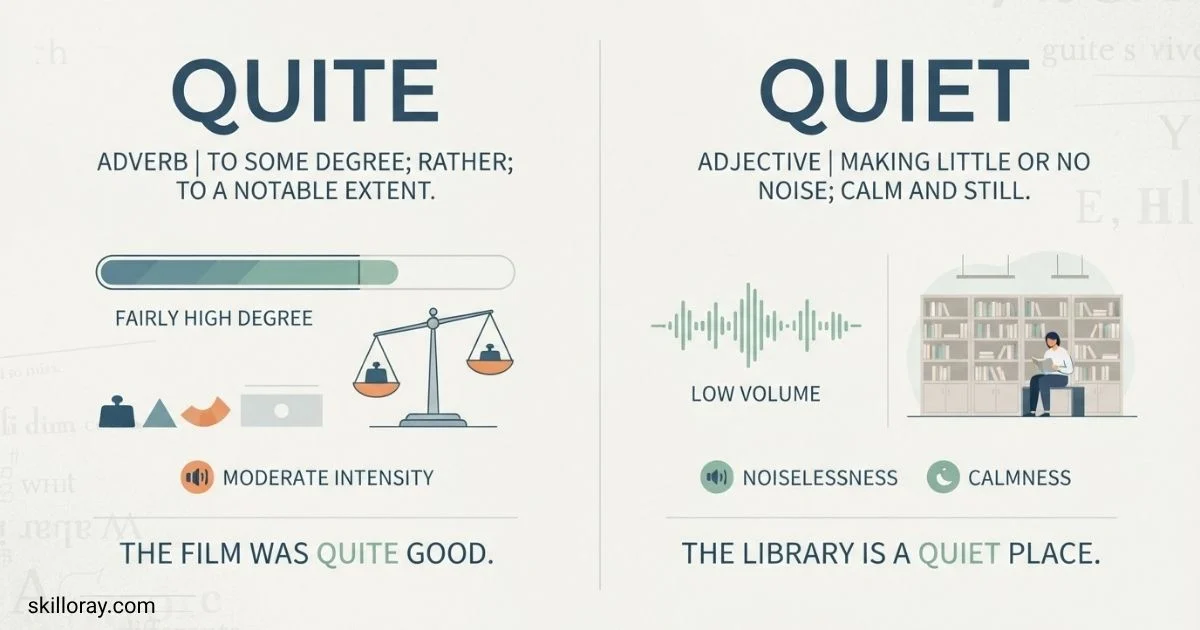
If you have ever paused while writing and wondered whether to use quite or quiet, you are definitely not alone. I know these two words can look confusing because they differ by only one letter, yet they have completely different meanings.
When you understand the simple difference, choosing the right word becomes much easier. I’ll show you how quite or quiet work, and you’ll see clear examples that make the distinction easy to remember.
So, if you want to write with more confidence and avoid this common mistake, you’re in the right place. I’ll break everything down in a simple, practical way so you can use both words correctly.
Quick Meaning of Quite or Quiet
| Word | Part of Speech | Meaning | Example |
| Quite | Adverb | Fairly, very, or completely, depending on context | The test was quite easy. |
| Quiet | Adjective | Making little or no noise; calm or peaceful | The library is quiet. |
| Quiet | Verb | To make someone or something less noisy | The teacher quieted the class. |
| Quiet | Noun | A state of calm or silence | I enjoyed the quiet of the morning. |
The key distinction is simple: quite describes the degree of something, while quiet describes a lack of noise or activity.
What Does Quite Mean?
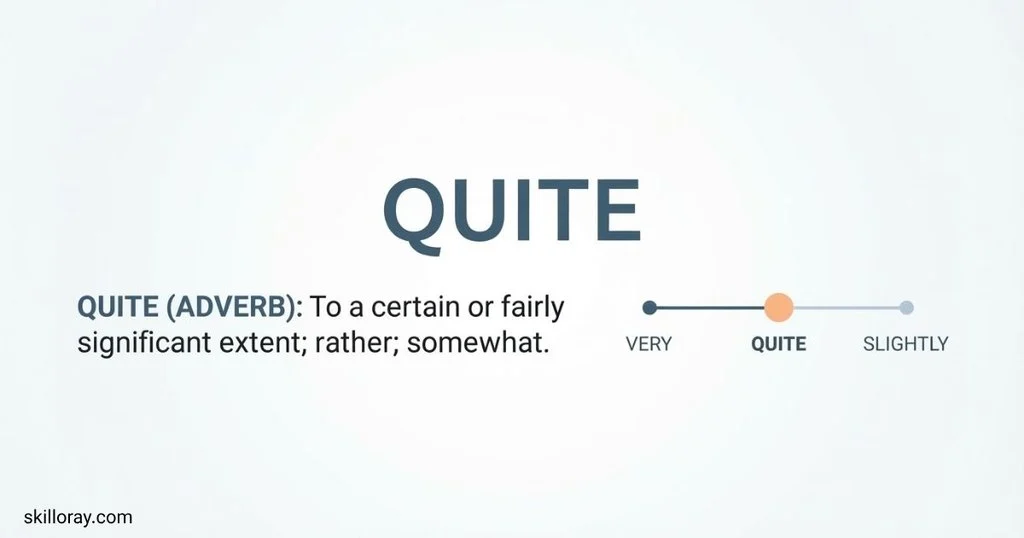
Quite is an adverb used to modify adjectives, other adverbs, and sometimes verbs. It expresses degree, extent, or emphasis.
Depending on the sentence, quite can mean fairly, rather, very, or completely. The exact meaning depends on the context and the word it modifies.
How to Use Quite in a Sentence
Use quite when you want to express how much, how strongly, or to what extent something is true.
Examples:
- The book was quite interesting.
- I am quite happy with my results.
- She speaks English quite well.
- The journey was quite long.
- We are quite certain about the answer.
- That was quite a surprise.
- He is quite good at mathematics.
- The room is quite small.
- I don’t quite understand the instructions.
- The project is not quite finished.
In these sentences, quite adds information about degree or completeness.
Common Meanings of Quite
1. Fairly or moderately
When quite modifies an adjective that describes something measurable, it often means fairly or moderately.
- The weather is quite warm today.
- This exercise is quite difficult.
- The restaurant is quite expensive.
2. Very or completely
With certain adjectives, particularly those expressing an absolute quality, quite can mean completely or entirely.
- Your answer is quite correct.
- I am quite certain.
- The two situations are quite different.
The intended meaning can vary between British English and American English, as well as according to context.
3. To emphasize quantity
Quite a few, quite a lot, and quite a bit commonly refer to a substantial number or amount.
- Quite a few students attended the event.
- We have quite a lot of work to do.
- She spent quite a bit of time preparing.
What Does Quiet Mean?
Quiet usually describes a person, place, situation, or sound with little noise or activity. It can also describe someone who does not speak much or prefers a calm environment.
Unlike quite, which is an adverb, quiet is most commonly used as an adjective. It can also function as a noun or a verb.
How to Use Quiet in a Sentence
Use quiet when describing silence, peacefulness, low noise levels, or a calm personality.
Examples:
- Please be quiet during the lesson.
- The neighborhood is quiet at night.
- She is a quiet and thoughtful student.
- We found a quiet place to study.
- The baby is finally quiet.
- I prefer quiet surroundings when reading.
- The streets were quiet early in the morning.
- He has a quiet personality.
- The room became quiet after the announcement.
- I enjoy the quiet of the countryside.
Each sentence refers to a lack of noise, activity, or unnecessary talking.
Quiet as a Verb
Quiet can also mean to calm someone or reduce noise.
Examples:
- The teacher tried to quiet the class.
- She spoke softly to quiet the nervous child.
- The crowd gradually quieted down.
- He raised his hand to quiet everyone.
Quiet as a Noun
As a noun, quiet refers to a peaceful or silent state.
Examples:
- I enjoy the quiet after a busy day.
- She sat in the quiet of her room.
- The sudden noise disturbed the quiet.
Quite or Quiet: What Is the Difference?
The main difference between quite or quiet is their meaning, pronunciation, and grammatical role. Both are correctly spelled English words, but they are not interchangeable.
| Feature | Quite | Quiet |
| Main part of speech | Adverb | Adjective |
| Other grammatical roles | Generally used as an adverb | Can also be a noun or verb |
| Main meaning | Fairly, very, completely, or to a degree | Silent, peaceful, calm, or not noisy |
| Pronunciation | /kwaɪt/ | /ˈkwaɪ.ət/ |
| Example | The room is quite large. | The room is quiet. |
| Common phrase | Quite good | Keep quiet |
| Common mistake | Using it to describe silence directly | Using it to mean completely or fairly |
Why Do People Confuse Quite or Quiet?
These words look similar because they contain almost the same letters. However, their spelling order and final sounds differ.
- Quite has the letters q-u-i-t-e and ends with a clear /t/ sound.
- Quiet has the letters q-u-i-e-t and includes an additional vowel sound before the final /t/.
Their similar appearance can make typing errors easy, especially when writing quickly.
The best way to avoid confusion is to consider what you want to express. If you mean fairly or completely, choose quite. If you mean silent or peaceful, choose quiet.
Quite or Quiet Pronunciation
Although quite and quiet look similar, they are pronounced differently.
| Word | IPA Pronunciation | Simple Sound | Syllables |
| Quite | /kwaɪt/ | Kwाइट, rhyming with “bite” | 1 |
| Quiet | /ˈkwaɪ.ət/ | KWY-uht | 2 |
How to Pronounce Quite
The word quite has one syllable.
To pronounce it:
- Begin with the /kw/ sound, as in quick.
- Say the long /aɪ/ vowel sound, as in my.
- Finish with a /t/ sound.
The result is kwाइट, rhyming with white, light, and bite.
Example: “The food was quite delicious.”
How to Pronounce Quiet
The word quiet has two syllables, with the stress on the first syllable.
To pronounce it:
- Start with the /kw/ sound.
- Say the /aɪ/ vowel sound.
- Add a short unstressed vowel sound before the final /t/.
The result is approximately KWY-uht.
Example: “Please remain quiet during the presentation.”
An Easy Pronunciation Trick
Say these phrases aloud slowly:
- Quite right.
- Quiet room.
- Quite quiet.
- Stay quiet.
Notice that quite has one syllable, while quiet has two. Practicing the words in short phrases can help you remember their different sounds.
Quite Quiet: Can You Use Both Words in One Sentence?
Yes! You can use quite immediately before quiet because they have different grammatical functions.
In the phrase quite quiet, the word quite is an adverb that modifies the adjective quiet.
For example:
- The classroom is quite quiet today.
- The street becomes quite quiet after midnight.
- My neighborhood is usually quite quiet.
- The library was quite quiet this afternoon.
- The house was quite quiet while everyone was away.
In each example, quite expresses the degree of quietness. It suggests that the place is fairly or very quiet, depending on context.
Other useful expressions include:
- Quite peaceful
- Quite calm
- Quite loud
- Quite busy
- Quiet room
- Quiet street
- Quiet evening
Remember that quite quiet is grammatically correct. The two words work together naturally because one describes the degree of the other.
Quite or Quiet: Which Word Should You Use?
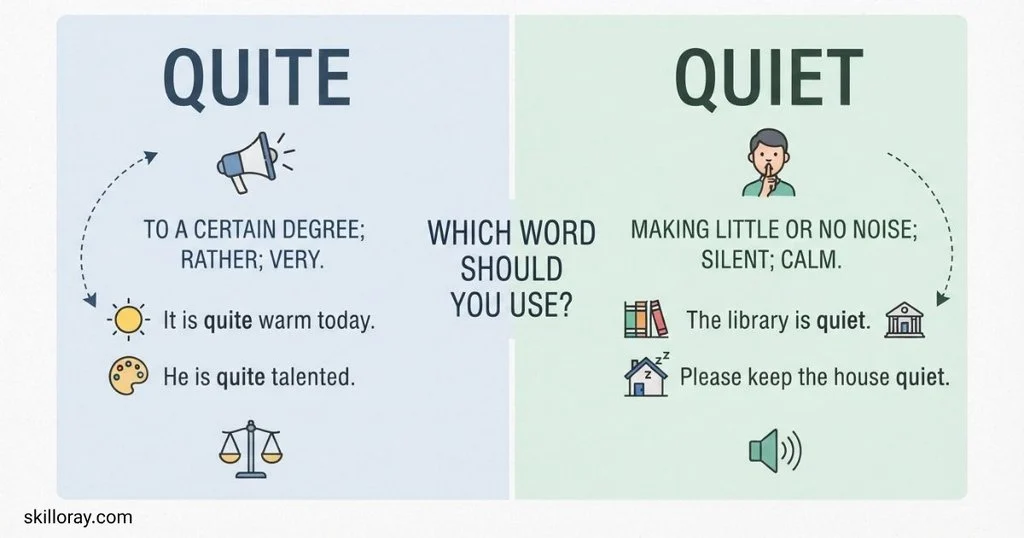
Choosing the right word becomes easier when you identify the meaning you want to communicate.
Use this quick guide.
Choose Quite
When you mean fairly, rather, very, or completely.
Example: The exam was quite easy.
Choose Quiet
When you mean silent, peaceful, calm, or not noisy.
Example: The classroom was quiet.
A Simple Memory Trick
Think of quite as a word that adds emphasis to another word. Think of quiet as a word associated with silence.
For example:
- Quite cold means fairly or very cold.
- Quiet room means a room with little noise.
- Quite quiet means fairly or very silent.
- Quiet down means become less noisy.
This simple distinction works in most everyday situations.
Quite or Quiet or Quit: What Is the Difference?
The word quit is another commonly confused word. It is spelled differently from both quite or quiet, and it has its own meaning.
| Word | Part of Speech | Meaning | Example |
| Quite | Adverb | Fairly, very, or completely | I am quite pleased. |
| Quiet | Adjective, noun, or verb | Silent, peaceful, or to make less noisy | Please be quiet. |
| Quit | Verb | To stop doing something or leave a job or activity | He decided to quit the game. |
When to Use Quit
Use quit when you mean to stop an activity, leave a position, or give something up.
Examples:
- She decided to quit her job.
- Don’t quit when the work gets difficult.
- He quit playing football last year.
- I want to quit wasting time.
- They quit the competition before the final round.
The past tense of quit is usually quit in both American and British English, although quitted also exists in certain uses.
A helpful way to remember the three words is:
- Quite: degree or emphasis.
- Quiet: silence or calmness.
- Quit: stop or leave.
Quite or Quiet Synonyms
Understanding synonyms can help you select the right word when writing sentences, emails, school assignments, or articles.
Synonyms of Quite
The best synonym depends on the sentence because quite can express different degrees of intensity.
| Synonym | Example |
| Fairly | The test was fairly easy. |
| Rather | The weather is rather cold. |
| Pretty | The movie was pretty good. |
| Very | The room is very large. |
| Completely | I completely understand. |
| Entirely | The statement is entirely correct. |
| Somewhat | I am somewhat tired. |
These words are not always interchangeable. For example, completely expresses full extent, while fairly often expresses a moderate degree.
Synonyms of Quiet
Depending on the context, useful synonyms include:
| Synonym | Example |
| Silent | The room was silent. |
| Peaceful | We enjoyed a peaceful afternoon. |
| Calm | The sea was calm. |
| Still | The air was still. |
| Hushed | Everyone spoke in hushed voices. |
| Tranquil | The garden was tranquil. |
| Unruffled | She remained unruffled during the discussion. |
When describing a person, reserved or soft-spoken may also fit, although these words refer more specifically to personality or speaking style.
Common Mistakes With Quite or Quiet
Even experienced English learners can confuse these words, especially in quick messages or informal writing. Here are some common mistakes and how to correct them.
Mistake 1: Using Quiet to Express Degree
Incorrect: The movie was quiet interesting.
Correct: The movie was quite interesting.
Why? The sentence describes how interesting the movie was, so it needs the adverb quite.
Mistake 2: Using Quite to Describe Silence
Incorrect: Please be quite in the library.
Correct: Please be quiet in the library.
Why? The sentence asks people to make little noise, so the adjective quiet is appropriate.
Mistake 3: Confusing Quite Quiet With Quiet Quite
Incorrect: The room is quiet quite.
Correct: The room is quite quiet.
Why? In this sentence, quite modifies the adjective quiet, so it normally appears before it.
Mistake 4: Using Quiet Instead of Quite Before an Adjective
Incorrect: I am quiet sure about my answer.
Correct: I am quite sure about my answer.
Why? The sentence expresses confidence, not silence.
Mistake 5: Using Quite Instead of Quiet to Describe a Person
Incorrect: My brother is very quite during class.
Correct: My brother is very quiet during class.
Why? The sentence describes a person who does not talk much or make noise.
Mistake 6: Confusing Quite With Quit
Incorrect: She decided to quite the competition.
Correct: She decided to quit the competition.
Why? The sentence means that she decided to stop participating. The verb quit expresses that meaning.
The easiest way to prevent these mistakes is to check the intended meaning before choosing the spelling.
Quite or Quiet Examples in Everyday English
The following examples show how to use each word naturally in common situations.
10 Examples Using Quite
- The restaurant was quite busy last night.
- I am quite happy with my progress.
- This book is quite interesting.
- She runs quite fast.
- The instructions are quite simple.
- We had quite a long journey.
- He is quite good at drawing.
- The weather has been quite pleasant.
- I don’t quite understand what you mean.
- The assignment is not quite finished.
10 Examples Using Quiet
- Please keep quiet while the teacher is speaking.
- The park is quiet early in the morning.
- She prefers a quiet place to study.
- My grandfather is a quiet person.
- The children became quiet when the story began.
- We moved to a quiet neighborhood.
- The baby is sleeping, so keep the house quiet.
- I enjoy sitting in the quiet garden.
- The library was quiet during the afternoon.
- The teacher asked everyone to quiet down.
5 Examples Using Quite Quiet
These sentences demonstrate how both words can appear together correctly.
- The office is quite quiet after lunch.
- It was quite quiet outside last night.
- The village is quite quiet during winter.
- The room became quite quiet after the meeting.
- This corner of the library is quite quiet.
Practice Exercises: Quite, Quiet, or Quit
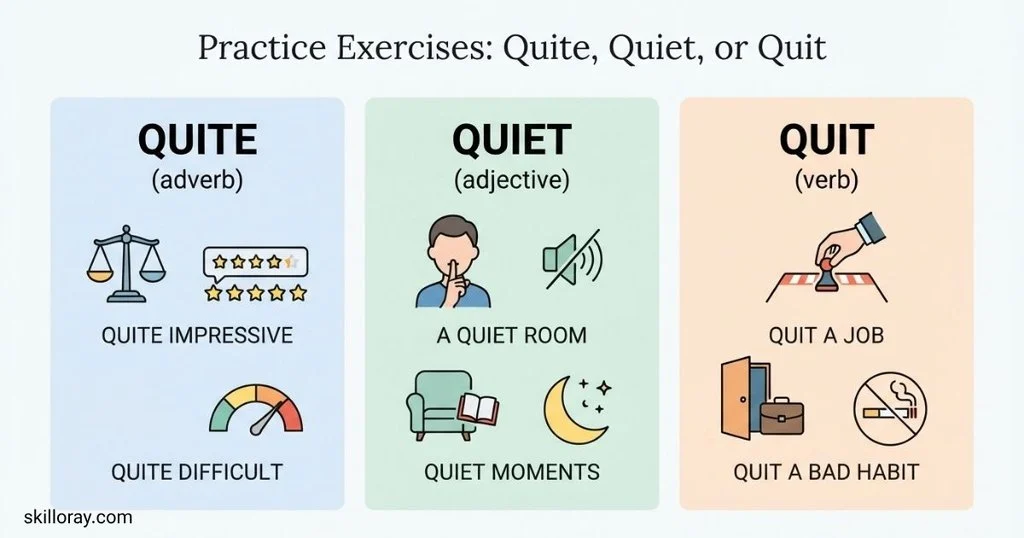
Test your understanding by selecting the correct word for each sentence.
1. The classroom was very ___ during the exam.
quite
quiet
quit
2. The food was ___ delicious.
quite
quiet
quit
3. He decided to ___ the game.
quite
quiet
quit
4. I am not ___ sure about the answer.
quite
quiet
quit
5. Please be ___ in the library.
quite
quiet
quit
6. The street is ___ peaceful in the morning.
quite
quiet
quit
7. She likes to read in a ___ room.
quite
quiet
quit
8. Don’t ___ just because the task is difficult.
quite
quiet
quit
Frequently Asked Questions
1. Which is correct, quite or quiet?
Both quite or quiet are correct English words. Use quite to express degree or extent, such as “quite interesting.” Use quiet to describe silence, calmness, or a lack of noise, such as “a quiet room.”
2. What is the difference between quite or quiet?
Quite is an adverb that usually means fairly, rather, very, or completely. Quiet is most commonly an adjective meaning silent, peaceful, or not noisy. They also have different pronunciations.
3. Is quite a word?
Yes, quite is a standard English word. It is an adverb used to express degree, emphasis, or completeness. For example, “The assignment was quite difficult.”
4. Is quiet a word?
Yes, quiet is a standard English word. It can function as an adjective, noun, or verb. For example, “The room is quiet,” “I enjoy the quiet,” or “Please quiet the crowd.”
5. Are quite or quiet homophones?
No. Quite or quiet are not homophones because they do not have the same pronunciation. Quite has one syllable, pronounced /kwaɪt/, while quiet usually has two syllables, pronounced /ˈkwaɪ.ət/.
6. How do you remember the spelling of quite or quiet?
Remember that quite has one syllable and ends with the sound /t/. Quiet has two syllables and includes an extra vowel sound before the final /t/. You can also associate quiet with silence and quite with degree or emphasis.
7. Can I write quite quiet in a sentence?
Yes. The phrase quite quiet is grammatically correct because quite modifies the adjective quiet. For example, “The house is quite quiet in the afternoon.”
8. What does not quite mean?
Not quite usually means not completely, not entirely, or not yet. For example, “I am not quite ready” means that the person is not fully ready yet.
9. What is the difference between quiet or quietly?
Quiet is commonly an adjective describing a person or place with little noise. Quietly is an adverb describing how an action happens. For example, “The room is quiet” describes the room, while “She spoke quietly” describes how she spoke.
10. Is quite quiet grammatically correct in British English or American English?
Yes. Quite quiet is grammatically correct in both British English and American English. However, the precise intensity of quite can vary depending on the variety of English and the context.
Conclusion
Choosing between quite or quiet is simple once you understand their meanings and grammatical roles. Both are correctly spelled words, but they serve different purposes in a sentence.
Use quite when you want to express degree, extent, or emphasis. Use quiet when describing silence, calmness, or a lack of noise. If you mean to stop an activity, use quit.
Remember these three examples:
- The movie was quite interesting.
- The library was quiet.
- He decided to quit the game.
With a little practice, you’ll be able to recognize the correct spelling and use each word confidently in everyday writing.

I am Olivia Brown, a professional English editor and grammar writer who believes that great writing begins with a strong foundation in grammar. I have spent years creating educational resources that help students and professionals improve their writing, avoid common errors, and communicate more effectively. I strive to provide clear explanations and practical examples that make grammar easy to understand and apply.
Books: English Grammar Essentials and Modern Writing Success
 James Walker
 Daniel Carter