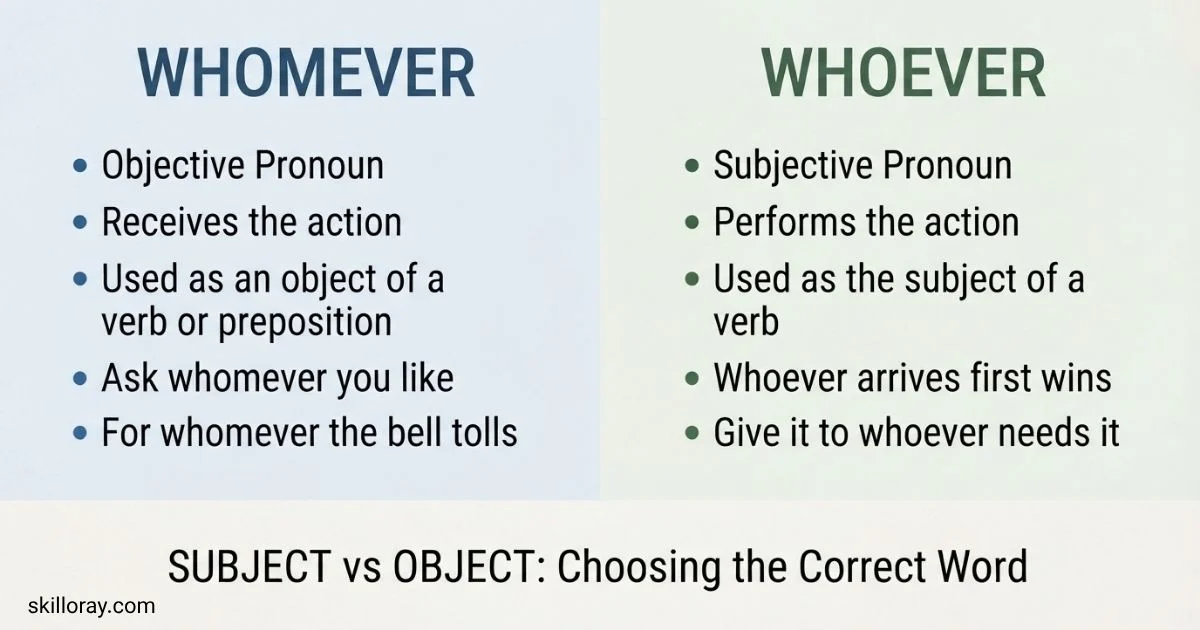
I know Whomever or Whoever can feel confusing, especially when both words seem to fit the same sentence. I’ve found that a few simple grammar rules can make the difference much easier to understand.
You may have wondered which word sounds correct in formal writing or everyday conversation. In this guide, I’ll walk you through the difference between whomever or whoever, with clear examples you can actually use.
By the end, you’ll know how to choose the right word with more confidence. You’ll also see an easy trick for testing each one when you’re unsure.
Whomever or Whoever: Quick Answer
Both whoever or whomever are legitimate English words. The traditional distinction is grammatical rather than a difference in spelling or meaning.
| Form | Grammatical role | Easy test | Example |
| Whoever | Subject | he, she, they | Whoever calls first will get the answer. |
| Whomever | Object | him, her, them | Invite whomever you trust. |
The important point is that you should examine the role of the pronoun inside its own clause. The fact that the whole clause functions as an object does not automatically make the pronoun itself an object.
What Does Whoever Mean?
Whoever is an indefinite relative pronoun referring to an unspecified person or any person who meets a particular condition.
It is normally used when the person represented by the pronoun is the subject of the clause.
For example:
- Whoever arrives first can choose a seat.
- Whoever knows the answer should raise a hand.
- Whoever called earlier left a message.
- I’ll help whoever needs assistance.
In “Whoever arrives first,” the person represented by whoever performs the action arrives. You could mentally replace it with he arrives or they arrive.
That subject function is why whoever is appropriate.
What Does Whomever Mean?
Whomever is the objective form of whoever. It refers to an unspecified person who functions as the object of a verb or preposition within its clause. Dictionaries describe it as a more formal form, and it is less common in everyday conversation.
Examples include:
- Invite whomever you choose.
- I’ll support whomever you recommend.
- Speak with whomever you trust.
- Choose whomever you prefer.
In “whomever you choose,” you performs the action choose, while the person chosen is the object. You choose him, her, or them.
That makes whomever the traditional grammatical choice.
The Whoever or Whomever Trick
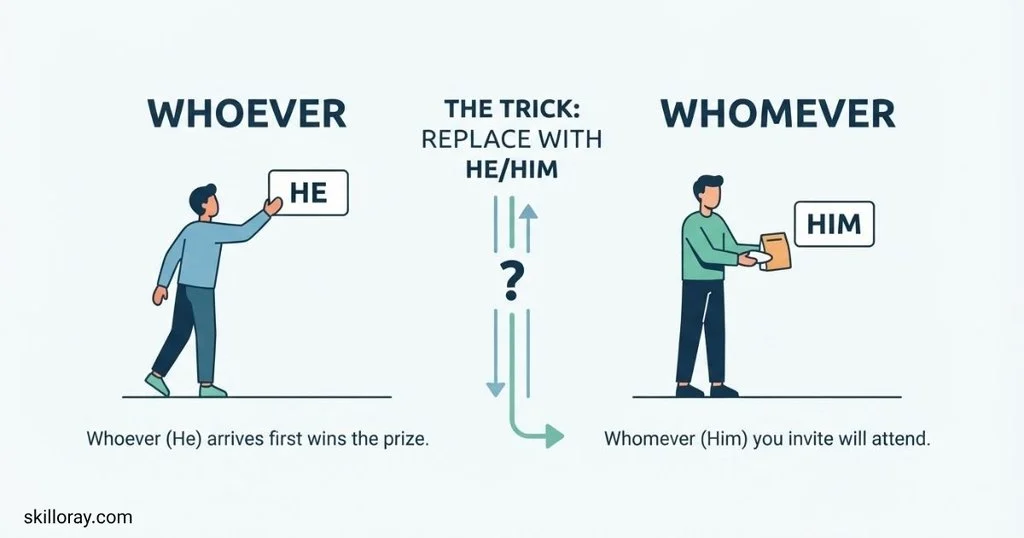
The easiest traditional trick is the he or him test:
- he, she, they → whoever
- him, her, them → whomever
The trick works because whoever corresponds to a subject form, while whomever corresponds to an object form.
Test 1: Whoever
Consider:
Whoever wins will receive the prize.
Ask yourself:
He wins.
That sounds grammatically correct, so use whoever.
Test 2: Whomever
Now consider:
Choose whomever you want.
Ask yourself:
You want him.
That works, so whomever is appropriate under the traditional rule.
The important trick
Don’t replace the word based only on the main verb of the sentence. Look at the smaller clause containing whoever or whomever.
For example:
Give the prize to whoever wins.
It may seem that to should automatically require whomever. But the phrase is actually whoever wins. Within that clause, whoever is the subject of wins.
So whoever is correct.
This point is specifically addressed by the Chicago Manual of Style and Purdue OWL.
When Do You Use Whoever?
Use whoever when the person represented by the pronoun is the subject of the clause.
Examples With Whoever
- Whoever calls first will get the appointment.
- Whoever finishes early may leave.
- Whoever wrote this note should sign it.
- Whoever knows the answer can explain it.
- Whoever arrives first should save a seat.
- Whoever is responsible should report it.
- Whoever wants to participate may join.
- Whoever wins the competition will receive the award.
- Whoever needs help can ask me.
- Whoever made this decision should explain it.
Notice the pattern: the person represented by whoever performs the action or occupies the subject position.
When Do You Use Whomever?
Use whomever when the pronoun functions as an object within its own clause.
Examples With Whomever
- Invite whomever you trust.
- Choose whomever you prefer.
- Contact whomever the manager recommends.
- Support whomever you believe is qualified.
- Thank whomever you think deserves recognition.
- Ask whomever you meet.
- Hire whomever the company selects.
- Follow whomever you choose as your guide.
- Speak to whomever you need to contact.
- Give the document to whomever the director names.
The quickest way to test these is to identify the subject performing the action.
For example:
Invite whomever you trust.
You trust him.
Therefore, whomever is the traditional grammatical form.
Why “To Whoever” Can Be Correct
One of the most confusing parts of this topic is that whoever can appear immediately after a preposition.
Consider:
Give the package to whoever arrives first.
At first glance, to might make you expect whomever. However, whoever arrives first is a complete clause. Inside that clause, whoever is the subject of arrives.
The entire clause is the object of to, not merely the word whoever.
So:
Give the package to whoever arrives first. ✅
is grammatically appropriate under the traditional case rule.
Purdue OWL explains that relative pronouns can function as subjects or objects within their own clauses, while the Chicago Manual of Style specifically notes that the case of whoever is determined by its role inside the subordinate clause.
I Depend on Whomever or Whoever?
The correct choice depends on what follows the pronoun.
I Depend on Whoever
Use whoever when the pronoun is the subject of the following clause.
I depend on whoever is available.
Inside the clause:
whoever is available
the person represented by whoever is the subject of is.
So whoever is correct.
I Depend on Whomever
Use whomever when the pronoun is the object inside its clause.
I depend on whomever I can trust.
Inside the clause:
I can trust whomever
The subject is I, while the person trusted is the object.
Therefore, whomever is the traditional choice.
The same principle applies to:
- I depend on whoever understands the system.
- I depend on whomever you recommend.
- I depend on whoever can help.
- I depend on whomever I hire.
The preposition on does not automatically determine the form. Look inside the clause.
Free to Whomever or Whoever?
Again, the structure determines the answer.
Free to Whoever
This position is free to whoever applies first.
Inside the clause whoever applies first, the pronoun is the subject of applies.
Therefore, whoever is appropriate under the traditional rule.
Free to Whomever
The choice is free to whomever you select.
Inside the clause you select whomever, the pronoun is the object of select.
Therefore, whomever is appropriate.
So neither form should automatically be selected merely because it follows to.
Invite Whomever or Whoever?
The answer depends on the structure.
Invite Whomever You Want
Invite whomever you want.
You want him, her, or them.
The pronoun is the object of want, so whomever is the traditional choice.
Invite Whoever Arrives First
Invite whoever arrives first.
Whoever is the subject of arrives.
Therefore, whoever is correct.
This is one of the clearest examples of why you should examine the clause rather than simply look at the word immediately before the pronoun.
Share With Whomever or Whoever?
Both forms can occur, depending on what follows.
Share the information with whoever needs it.
Here, whoever is the subject of needs.
But:
Share the information with whomever you choose.
Here, whomever is the object of choose.
The same pattern appears after other prepositions. The preposition alone does not settle the question.
To Whomever or Whoever?
There is no universal rule that says to must always be followed by whomever.
Consider these two sentences:
Send the invitation to whoever responds first.
Here, whoever is the subject of responds.
Send the invitation to whomever you select.
Here, whomever is the object of select.
Both constructions can therefore be correct.
This distinction is one of the most commonly misunderstood parts of the traditional whoever or whomever rule.
Please Forward to Whomever or Whoever?
Look at the clause after the pronoun.
Please forward this to whoever handles the request.
Whoever is the subject of handles.
But:
Please forward this to whomever the manager designates.
The manager performs designates, while the person designated is the object.
Therefore, whomever is the traditional choice in the second sentence.
Thank You to Whomever or Whoever?
This depends on the action inside the clause.
Thank you to whoever helped organize the event.
Whoever is the subject of helped.
The person performed the helping, so whoever is appropriate.
Another example:
Thank you to whoever made this possible.
Again, whoever performs the action represented by made.
However, a structure such as:
Give my thanks to whomever you choose.
uses whomever because the pronoun is the object of choose.
Whomever or Whoever It May Concern?
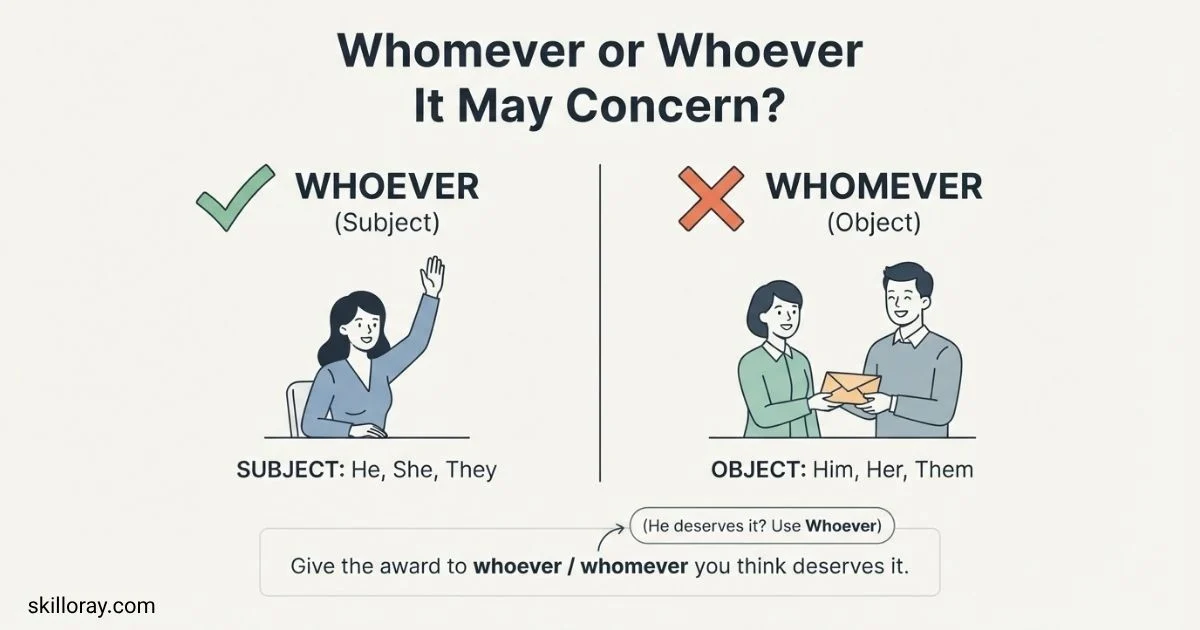
If you’re thinking about the familiar formal letter phrase, the established expression is:
To Whom It May Concern
It is not normally written as To Whoever It May Concern or To Whomever It May Concern.
The phrase uses whom because it follows the preposition to and functions as its object.
For a modern business letter, however, a named recipient is usually more direct when you know the person’s name. If you don’t know the recipient, To Whom It May Concern remains a recognized formal opening.
Whomever or Whoever in a Letter?
The right choice depends on the sentence rather than whether you’re writing a letter.
For example:
Dear whoever is responsible for this department,
Here, whoever is the subject of is responsible.
For a formal unknown recipient, however, you may prefer the established opening:
To Whom It May Concern
If you know the recipient’s name or role, a more specific greeting is generally clearer.
Dear Whomever or Whoever?
Dear whoever… can appear in informal or deliberately generic writing when the following clause makes whoever the subject.
For example:
Dear whoever finds this note,
Here, whoever is the subject of finds.
However, Dear whomever is generally not the natural choice for a standard letter opening. If the recipient is unknown and the context is formal, To Whom It May Concern is the established expression.
Whoever or Whomever in a Sentence
Here are several examples showing the difference:
- Whoever arrives first can choose a seat.
- I’ll help whoever needs assistance.
- Give the package to whoever answers the door.
- Invite whomever you trust.
- Choose whomever you prefer.
- I’ll contact whoever manages the project.
- I’ll contact whomever you recommend.
- Share the file with whoever requests it.
- Share the file with whomever you designate.
- Thank whoever helped you.
A useful pattern emerges: focus on the grammatical role of the pronoun inside its clause.
Common Whoever or Whomever Mistakes
Mistake 1: Assuming “to” Always Requires Whomever
Incorrect under the traditional rule: Give it to whomever arrives first.
Correct: Give it to whoever arrives first.
Why? Whoever is the subject of arrives.
Mistake 2: Using Whoever as the Object
Incorrect under the traditional rule: Invite whoever you trust.
Correct: Invite whomever you trust.
Why? You trust him, her, or them, so the pronoun is functioning as an object.
Mistake 3: Choosing Whomever Because It Sounds More Formal
Some writers use whomever whenever they want their writing to sound sophisticated. That can create grammatical errors.
For example:
Whomever arrives first will receive the prize.
The pronoun is the subject of arrives, so the traditional form is:
Whoever arrives first will receive the prize.
Using a more formal-looking word does not automatically make a sentence more grammatically correct.
Mistake 4: Looking Only at the Main Clause
Consider:
We will hire whomever you recommend.
The entire clause whomever you recommend functions as the object of hire, but that does not by itself determine the case of the pronoun.
Inside the clause, you is the subject of recommend, while the person recommended is the object.
That is why whomever fits the traditional rule.
Is Whomever More Formal Than Whoever?
Generally, yes. Whomever is more formal and less common in ordinary conversation. Collins describes it as a formal form of whoever when it functions as an object.
In everyday speech, many speakers use whoever more broadly, especially in constructions where the traditional distinction is difficult to hear or analyze.
That doesn’t mean the traditional distinction has disappeared from formal English. If you’re writing a formal document and want to follow traditional case rules, the he or him test remains useful.
Is Whomever or Whoever Correct?
Both are correct words, but they are not interchangeable in every formal grammatical construction.
Use whoever when the pronoun is the subject of its own clause.
Use whomever when the pronoun is the object of a verb or preposition within its own clause.
Compare these structures:
- Whoever wins gets the prize.
- Choose whomever you trust.
The first pronoun performs the action. The second receives the action.
Can You Use Whoever in Everyday English?
Yes. In contemporary everyday English, whoever is common and often preferred because it sounds natural.
Purdue OWL notes that whom itself is not used very often in American English and is more formal than who.
That broader decline in everyday use of whom also affects how comfortable people feel with whomever.
Still, if you’re working with formal written English, learning the traditional distinction is useful because whomever remains a standard word.
Is There a Difference in American or British English?
The basic grammatical distinction is not primarily a British or American spelling difference. Whoever or whomever are established forms in both varieties.
The bigger difference is formality and frequency of use. In American English, whom is relatively uncommon in everyday speech, although it remains available in formal writing.
So you don’t need to memorize a separate American spelling or British spelling for these words.
Whomever or Whoever Pronunciation
The pronunciation can vary somewhat by accent.
A simple pronunciation guide is:
- whoever: roughly “hoo-EV-er”
- whomever: roughly “hoo-MEV-er”
Collins gives pronunciation information for whomever, including American English forms.
In natural speech, the difference may be less noticeable than it appears in writing. This is one reason the grammatical distinction can feel difficult when you’re speaking.
Whomever or Whoever in The Office
The sitcom The Office famously used the whoever or whomever question as a comedy moment in the episode “Money.” The scene revolves around a discussion of whether whomever has been used correctly.
The joke works because the grammatical distinction is genuinely tricky. The traditional rule is not simply “use whomever whenever it follows a preposition.” Instead, you have to consider the pronoun’s function inside its own clause.
That makes the scene a memorable example of a real English grammar problem.
A Simple Way to Remember the Rule
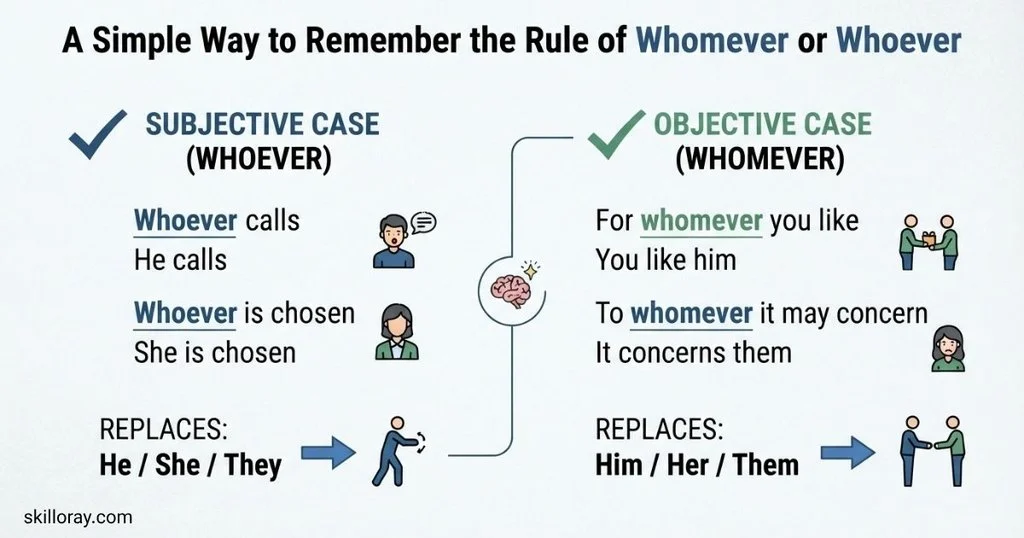
When you’re unsure, don’t stare at the entire sentence. Find the small clause containing whoever or whomever.
Then ask:
Is the person doing the action?
If yes, use whoever.
Is the person receiving the action?
If yes, use whomever.
You can also use the substitution test:
he, she, they → whoever
him, her, them → whomever
For example:
Whoever calls will speak first.
→ He calls.
Use whoever.
Call whomever you trust.
→ You trust him.
Use whomever.
This approach is supported by traditional grammar guidance from Purdue OWL, GrammarBook, and other educational references.
Whoever or Whomever: Quick Reference
| Question | Choice |
| Is the person the subject of the clause? | Whoever |
| Is the person the object inside the clause? | Whomever |
| Can you substitute he, she, or they? | Whoever |
| Can you substitute him, her, or them? | Whomever |
| Does a preposition automatically require whomever? | No |
| Is whomever more formal? | Generally, yes |
| Is whoever common in everyday English? | Yes |
| Is “To Whom It May Concern” the standard formal phrase? | Yes |
FAQs
Is it whomever or whoever?
Both are correct words. Use whoever when it is the subject of its own clause. Use whomever when it is the object of a verb or preposition within its own clause.
When do you use whomever?
Use whomever when you can replace it with him, her, or them inside its clause. For example, “Invite whomever you trust” works because you trust them.
When do you use whoever?
Use whoever when you can replace it with he, she, or they. For example, “Whoever arrives first can choose” works because they arrive first.
Is “I depend on whomever” always correct?
Not always. Look at what follows. “I depend on whomever I trust” uses whomever because the pronoun is the object of trust. “I depend on whoever is available” uses whoever because the pronoun is the subject of is.
Is “free to whoever” correct?
It can be correct when whoever is the subject of the following clause, such as “The position is free to whoever applies first.” If the pronoun is the object inside its clause, whomever may be appropriate.
Is “please forward to whoever” correct?
It can be. For example, “Please forward this to whoever handles the request” uses whoever because the pronoun is the subject of handles.
Should I write “dear whomever”?
Usually not for a standard formal letter. If you don’t know the recipient, To Whom It May Concern is the established formal expression. A more specific greeting is preferable when you know the recipient.
Is whomever outdated?
No. Whomever is still a standard English word, but it is formal and less common in everyday speech.
What is the easiest whoever or whomever trick?
Replace the pronoun with he, she, or they. If that works, choose whoever. Replace it with him, her, or them. If that works, choose whomever.
Conclusion
Whoever or whomever can both be correct. The choice depends on the grammatical role of the pronoun inside the clause where it appears.
Use whoever for a subject: Whoever arrives first gets the seat.
Use whomever for an object: Invite whomever you trust.
The most useful habit is to look inside the clause instead of choosing based only on a nearby preposition or the overall position of the phrase. When in doubt, try the he or him test. If he, she, or they fits, choose whoever. If him, her, or them fits, choose whomever.

I am James Walker, an English language specialist with extensive experience in grammar, editing, and academic writing. I enjoy helping students, bloggers, and professionals strengthen their writing by explaining grammar concepts in a clear and engaging way. My focus is on providing accurate, practical, and easy-to-follow guidance that helps learners communicate more effectively in everyday and professional situations.
Books: Perfect English Grammar Handbook and Advanced Writing Techniques
 Daniel Carter
 Olivia Brown