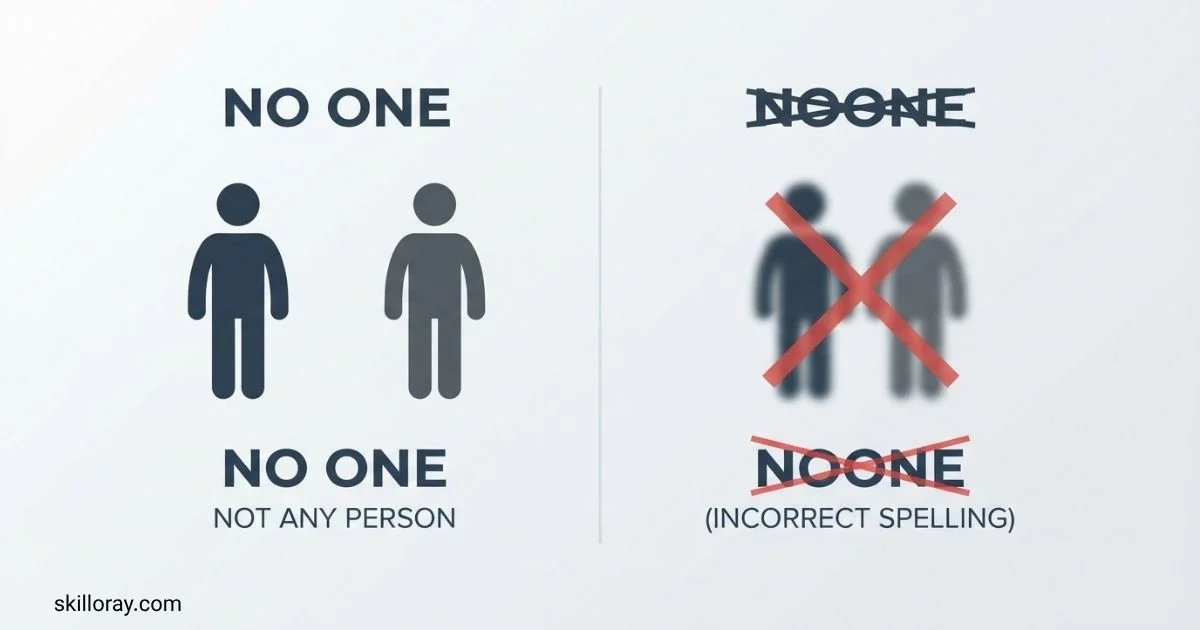
When I first see No One or Noone, I understand why you might pause and wonder which form is correct. They look almost identical, but there is an important spelling difference.
I want to make this simple for you. If you have ever hesitated while writing an email, essay, message, or social post, you are not alone.
By the end, you will know which spelling to use, why it is correct, and how to use it naturally in your own sentences.
No One or Noone:(Quick Answer)
No one is the standard spelling in both American English and British English. It is written as two separate words and refers to not a single person. The hyphenated form no-one is also accepted in some dictionaries, particularly in British English usage, while noone is generally treated as a misspelling.
Here is a quick comparison:
| Spelling | Correctness | Usage |
| No one | Standard | Recommended in general writing |
| No-one | Accepted variant | Used by some British English writers |
| Noone | Generally incorrect | Avoid in standard writing |
For schoolwork, business communication, academic writing, and website content, use no one. It is widely recognized and avoids unnecessary spelling confusion.
What Does No One Mean?
No one is an indefinite pronoun that means no person, not anybody, or nobody. You use it when you want to say that a person is absent, that nobody did something, or that not a single individual is involved.
For example:
- No one answered the phone.
- No one knows the secret.
- No one was waiting outside.
- No one understood the instructions.
- No one can predict the future with certainty.
In each sentence, the expression refers to the absence of a person or the fact that not a single person performed an action.
Simple Definition of No One
The simplest definition is not a single person.
For example, if you enter an empty classroom and say, “No one is here,” you mean that there isn’t a person in the room.
The expression can also refer to people in a particular group. If you say, “No one on our team agreed,” you mean that none of the team members agreed.
Is No One a Word or Two Words?
The standard spelling consists of two words: no one.
Although the expression has one meaning, it retains a space between “no” and “one.” This is a feature of its established spelling, rather than a rule that every expression with two parts must follow.
Consider these examples:
- Correct: No one called me yesterday.
- Incorrect in standard writing: Noone called me yesterday.
- Accepted variant: No-one called me yesterday.
Remembering the two-word spelling is the easiest way to avoid this common mistake.
Is No One a Pronoun?
Yes. No one is an indefinite pronoun because it refers to an unspecified person or to the absence of any person. You don’t need to identify a particular individual when using it.
For example:
- No one wants to miss the bus.
- No one knows where the keys are.
- I told no one about the surprise.
- No one was available to help.
The expression can function as the subject or object of a sentence.
As a subject:
“No one understands the problem.”
Here, “no one” performs the role of the subject.
As an object:
“I invited no one to the meeting.”
Here, “no one” receives the action of the verb “invited.”
This grammatical flexibility makes the expression useful in everyday conversation as well as formal writing.
No One Grammar Rules You Should Know
Understanding the grammar of “no one” helps you use it correctly in different sentences.
1. Use a Singular Verb
“No one” is grammatically singular, so it normally takes a singular verb in the present tense.
Examples:
- No one knows the answer.
- No one is home.
- No one wants to leave early.
- No one has called today.
- No one understands the instructions.
Avoid these mistakes:
- Incorrect: No one know the answer.
- Correct: No one knows the answer.
- Incorrect: No one are at home.
- Correct: No one is at home.
Even when a sentence refers to a group of people, the subject “no one” generally takes a singular verb.
2. Use Singular Agreement With Helping Verbs
The same rule applies when you use auxiliary verbs or modal constructions.
Examples:
- No one has arrived yet.
- No one does that anymore.
- No one was expecting visitors.
- No one can solve every problem alone.
Notice that the verb form follows the grammatical subject, not the number of people who might be involved.
3. Avoid Double Negatives
“No one” already expresses a negative meaning. Adding another negative word to the same clause can create a double negative that changes the intended meaning or makes the sentence confusing.
For example:
- Incorrect for the intended meaning: No one didn’t come.
- Clearer: No one came.
- Clearer alternative: Nobody came.
The last two sentences communicate that nobody attended.
In standard English, pay attention to words such as “not,” “never,” and “hardly” when using a negative pronoun. A sentence may be grammatically possible but convey a different meaning from the one you intended.
No One or No-One: Is the Hyphenated Form Correct?
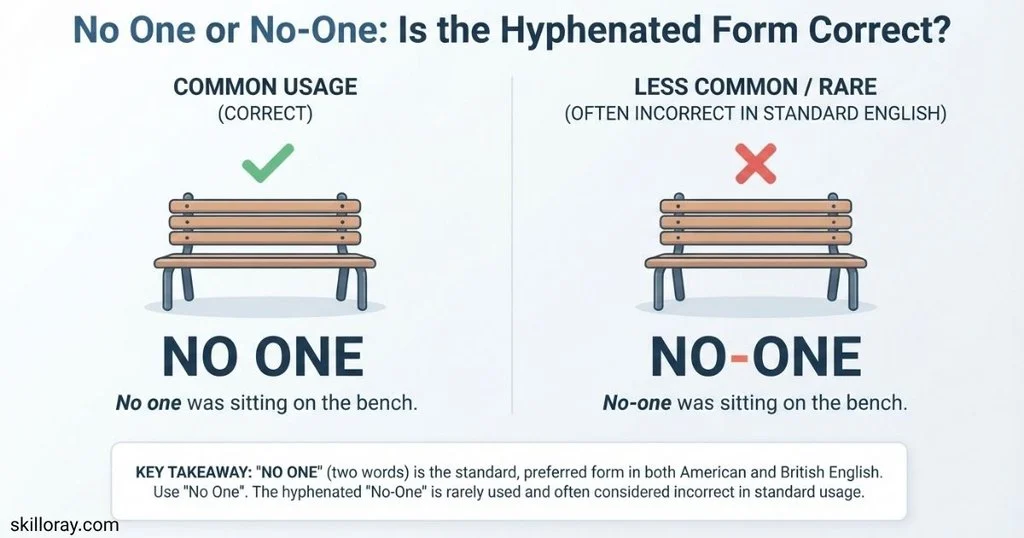
Both no one or no-one are accepted spellings in English dictionaries. The unhyphenated form is the standard choice in general writing, while the hyphenated form appears in British English usage and is also recognized by several major dictionaries.
Examples:
- No one knew about the event.
- No-one knew about the event.
Both sentences communicate the same idea.
However, you should follow the spelling convention required by your school, workplace, publisher, or style guide. If no specific style is required, choose “no one” for consistency.
Why Is Noone Usually Incorrect?
The spelling “noone” combines the two words without a space or hyphen. Although readers can usually understand the intended meaning, it is not the standard spelling recommended for ordinary English writing.
For example:
- Incorrect in standard writing: Noone was at the door.
- Correct: No one was at the door.
The issue is not the meaning. It is the conventional written form of the expression.
No One or Nobody: What Is the Difference?
No one or nobody both mean not a single person. In most sentences, you can use either expression without changing the basic meaning. However, “no one” is often preferred in formal written English, while “nobody” can sound slightly more conversational.
| Expression | Meaning | Example |
| No one | Not a single person | No one answered my question. |
| Nobody | Not a single person | Nobody answered my question. |
Both examples are grammatically correct.
Here are more examples:
- No one was home when I arrived.
- Nobody was home when I arrived.
- No one remembered the appointment.
- Nobody remembered the appointment.
When Should You Use No One?
Use “no one” when you want a clear, neutral expression suitable for essays, reports, emails, articles, and everyday communication.
Example: “No one has submitted the assignment yet.”
When Should You Use Nobody?
Use “nobody” when you prefer a slightly more conversational tone or when it sounds more natural in the sentence.
Example: “Nobody told me about the change.”
The choice is generally stylistic rather than grammatical.
No One in American English or British English
The spelling no one is standard in both American English and British English. The hyphenated spelling no-one is also accepted in British usage, although preferences vary among writers and publications.
Here is a practical guide:
| Variety or context | Recommended spelling |
| American English | No one |
| British English | No one or no-one |
| Canadian English | No one is a suitable general choice |
| Australian English | No one is a suitable general choice |
| Formal international writing | No one |
If you’re writing for an American audience, “no one” is the straightforward choice. For British audiences, “no one” remains appropriate, while “no-one” may appear in publications that follow that convention.
There is no need to change the spelling simply because your readers are from a different English-speaking country.
How Do You Pronounce No One?
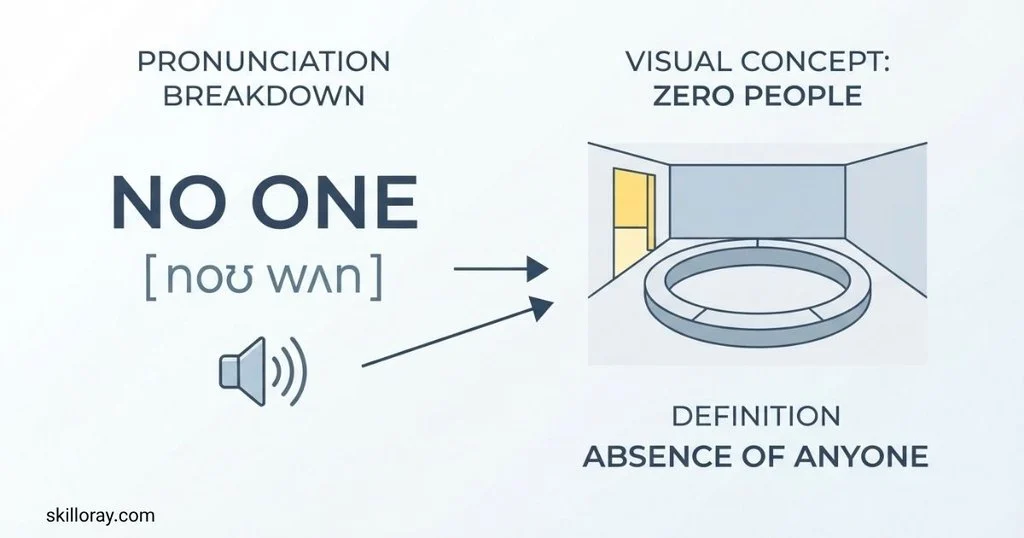
The pronunciation of no one is similar in American English and British English, although the vowel sound in “no” differs between the two varieties.
American English
/ˈnoʊ ˌwʌn/
Sounds approximately like “noh wun”
British English
/ˈnəʊ wʌn/
Sounds approximately like “nəʊ wun”
Pronunciation Tips
- Say “no” first.
- Follow it with “one.”
- Keep the words distinct enough to preserve the intended pronunciation.
- Practise the phrase in a complete sentence.
For example: “No one knows the answer.”
The pronunciation does not change based on whether you write “no one” or “no-one.” Both spellings represent the same expression.
No One or No One Else: Meaning and Usage
The phrase no one else means no other person besides the person or people already mentioned or understood from context.
For example:
- No one else knows my password.
- I wanted to attend the event, but no one else was available.
- She trusted no one else with the information.
- No one else in the class answered correctly.
The word “else” adds the meaning of “other” or “additional.” Without it, “no one” simply means not a single person.
Compare these sentences:
- “No one called me.” This means that not a single person called.
- “No one else called me.” This suggests that another person may already have called or that a particular person is being excluded from the statement.
The surrounding context determines the precise meaning of the second sentence.
No One Person: Meaning and Usage
The phrase no one person emphasizes that not a single individual, considered separately, meets a particular description or performs an action. Its exact meaning depends on the sentence.
Examples:
- No one person can complete this project alone.
- No one person is responsible for every decision.
- No one person knows everything about the subject.
- No one person should have to solve every problem.
In these examples, the phrase emphasizes an individual person rather than a group or an entire organization.
Be careful not to confuse “no one person” with “no one.” The first phrase includes the noun “person” for emphasis, while the second works independently as an indefinite pronoun.
No One in a Sentence: 10 Examples
Here are ten natural sentences showing how to use “no one” correctly in everyday English.
- No one was waiting outside the office.
- No one knows the answer to that question.
- No one has contacted me about the meeting.
- I told no one about my plans.
- No one wants to miss the school trip.
- No one was available to answer the phone.
- No one understood the instructions at first.
- She realized that no one had opened the email.
- No one can predict exactly what will happen.
- No one else wanted to participate in the activity.
These examples show how the expression can function as a subject or object, appear in different tenses, and work with additional words such as “else.”
More Examples With No One Else
If you specifically want to practise “no one else,” these sentences demonstrate its use:
- No one else knew where the documents were.
- I couldn’t find no one else to help.
The second sentence is not recommended in standard English because it contains a double negative. A clearer version is: “I couldn’t find anyone else to help.”
- No one else was interested in the offer.
- She wanted no one else to know her secret.
- No one else could explain the situation.
Common No One Spelling and Grammar Mistakes
Even though “no one” is a simple expression, several common mistakes can appear in everyday writing. Here are the main ones to watch for.
Mistake 1: Writing Noone as One Word
Incorrect: Noone answered the door.
Correct: No one answered the door.
Why? The standard spelling uses two separate words.
Mistake 2: Using a Plural Verb
Incorrect: No one know the truth.
Correct: No one knows the truth.
Why? “No one” normally takes a singular verb.
Mistake 3: Adding an Unnecessary Negative
Incorrect for the intended meaning: No one didn’t respond.
Clearer: No one responded.
Why? The extra negative can create confusion or change the intended meaning.
Mistake 4: Using No One When Referring to Things
Incorrect: No one was left in the refrigerator.
Correct: Nothing was left in the refrigerator.
Why? “No one” refers to people. Use “nothing” when referring to things.
Mistake 5: Inconsistent Hyphenation
If you choose “no-one” in a document that follows a style guide permitting it, use that spelling consistently. Otherwise, “no one” is a straightforward default for general English writing.
Consistency helps readers focus on your message rather than variations in spelling.
Quick Tips to Remember the Correct Spelling
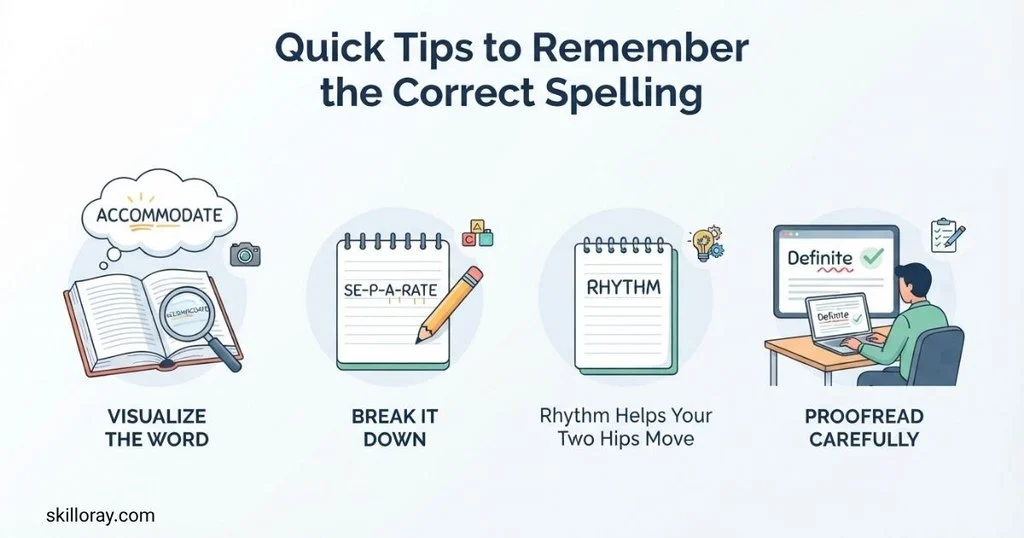
If you often forget whether to write “noone” or “no one,” use these simple reminders:
- Remember the space: Write “no one” as two words.
- Use a singular verb: Write “no one is,” not “no one are.”
- Keep the meaning in mind: The expression refers to not a single person.
- Choose the standard form: Use “no one” in school assignments, business writing, and formal documents.
- Check your writing: Review spelling before submitting important work.
- Use the hyphen only when appropriate: “No-one” is an accepted alternative in some English usage.
These habits will help you recognize the correct spelling more quickly and use the expression naturally.
Frequently Asked Questions
1. Is It Noone or No One?
No one is the standard spelling. It consists of two separate words and means not a single person. “Noone” is generally considered a misspelling in standard English.
2. Is No One One Word or Two Words?
“No one” is written as two words. The hyphenated form “no-one” is also accepted by some dictionaries, but “noone” is not the recommended spelling.
3. Is Noone Ever Correct?
In ordinary English writing, “noone” is generally treated as a spelling error. Although readers may understand what you mean, you should write “no one” in formal or professional communication.
4. Is No One Grammatically Correct?
Yes. “No one” is a grammatically correct indefinite pronoun. For example, “No one knows the answer” is correct because the subject takes a singular verb.
5. Is No One or Nobody More Formal?
“No one” is often preferred in formal writing, while “nobody” can sound slightly more conversational. Both expressions are correct and generally interchangeable when referring to the absence of people.
6. Can I Use No-One in British English?
Yes. “No-one” is accepted in some British English usage. However, “no one” is also standard in British English and is a reliable choice when you are unsure which spelling convention to follow.
7. Does No One Have a Plural Form?
No one does not have a conventional plural form. It refers to zero people, but the expression takes a singular verb, as in “No one is ready.” When referring back to an unknown person, English can use the singular pronoun “they.”
8. What Does No One Else Mean?
“No one else” means no other person. For example, “No one else understood the question” means that nobody apart from the person or people already understood from context understood it.
9. How Do You Use No One in a Negative Sentence?
“No one” already expresses a negative meaning, so you generally do not need to add another negative. For example, write “No one came to the meeting” rather than “No one didn’t come to the meeting” when you mean that nobody attended.
10. Is No One Correct in American English?
Yes. “No one” is the standard spelling in American English. You can use it in essays, professional emails, academic papers, and everyday communication.
Conclusion
The choice between noone or no one is straightforward: use “no one” as the standard spelling. It is an indefinite pronoun meaning not a single person, and it normally takes a singular verb.
The hyphenated form “no-one” is also accepted in some English usage, including British English, but “noone” is generally considered a misspelling.
Remember these simple rules: write “no one” as two words, use a singular verb, and avoid unnecessary double negatives. Once you understand these basics, you can use the expression confidently in everyday conversations, school assignments, emails, and professional writing.

I am Daniel Carter, a grammar enthusiast and language educator with over 10 years of experience helping students and professionals improve their English writing and communication skills. I enjoy simplifying complex grammar rules into easy-to-understand lessons that anyone can follow. My goal is to help learners write with confidence, avoid common mistakes, and develop strong communication skills for academic and professional success. I regularly create practical grammar guides, writing tips, and language resources that make learning both enjoyable and effective.
Books: Mastering English Grammar and The Complete Guide to Better Writing
 James Walker
 Olivia Brown