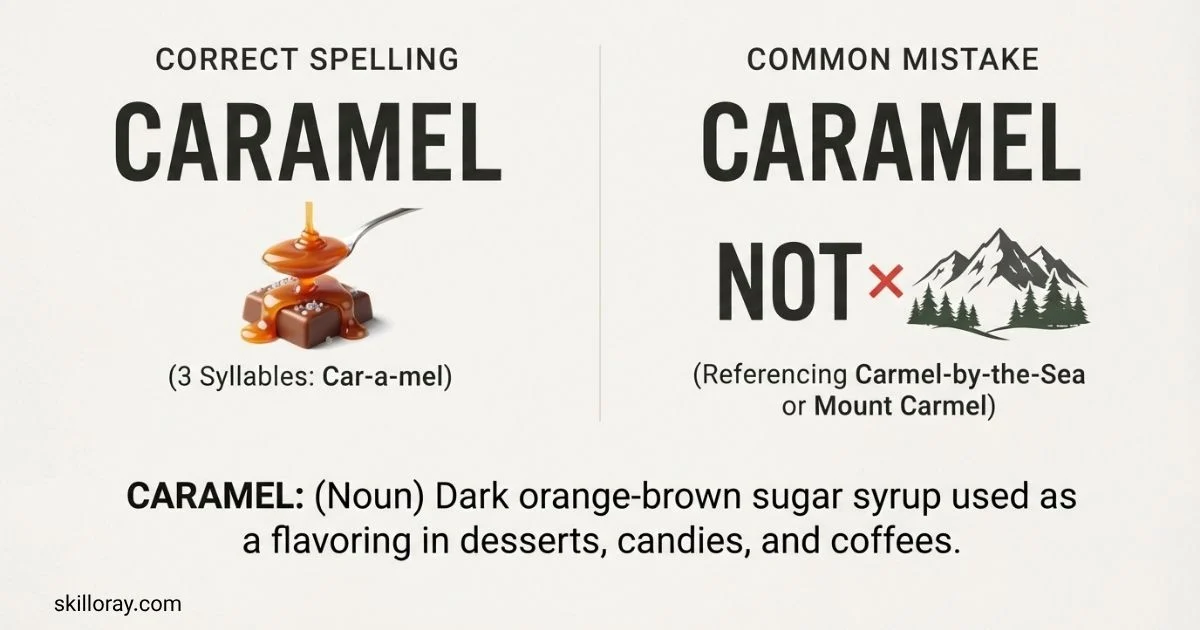
Have you ever paused while writing Carmel or Caramel and wondered which one is actually correct? I understand the confusion because these words look and sound surprisingly similar.
You may see both forms in different places, but they do not always mean the same thing. You deserve a simple explanation that makes the difference easy to understand.
By the end of this guide, you will know when to use Carmel and when to use caramel, along with clear examples that help you remember the difference.
What Is the Difference Between Carmel or Caramel?
The main difference is that caramel is the standard spelling of the sweet substance, candy, sauce, or light brown color, while Carmel is generally a proper noun used for names and places. However, carmel is also recorded as a disputed or nonstandard variant of caramel in some American English references.
| Feature | Caramel | Carmel |
| Standard spelling for the sweet | Yes | Generally no |
| Meaning | Sweet, cooked sugar, candy, sauce, or color | Usually a name or place |
| Part of speech | Noun; sometimes an adjective | Proper noun, typically |
| Pronunciation | Two or three syllables, depending on dialect | Usually two syllables |
| Example | I added caramel to my coffee. | We visited Carmel, California. |
| Use in recipes | Caramel sauce | Not the standard food spelling |
What Does Caramel Mean?
Caramel is a sweet substance made by heating sugar until it develops a golden-brown or darker color and a distinctive flavor. It can refer to cooked sugar itself, a chewy candy, a dessert topping, or a light brown shade.
For example:
- She drizzled caramel over her ice cream.
- I bought a caramel candy after lunch.
- The cake has a rich caramel flavor.
- His jacket is a warm caramel color.
The word can describe a food ingredient or the color associated with it. In both cases, caramel is the conventional spelling.
What Does Carmel Mean?
Carmel is most commonly a proper noun. It appears in geographical names, personal names, and other named places. One familiar example is Carmel-by-the-Sea, a coastal city in California. Mount Carmel is another geographical name associated with Israel.
Examples include:
- Carmel is a beautiful coastal destination.
- My friend Carmel enjoys reading.
- Mount Carmel appears in biblical references.
- We planned a trip to Carmel-by-the-Sea.
Because Carmel is a proper noun, capitalize its first letter when writing a name. If you’re talking about a sweet topping, candy, or recipe ingredient, use caramel.
Carmel or Caramel: Which Spelling Is Correct?
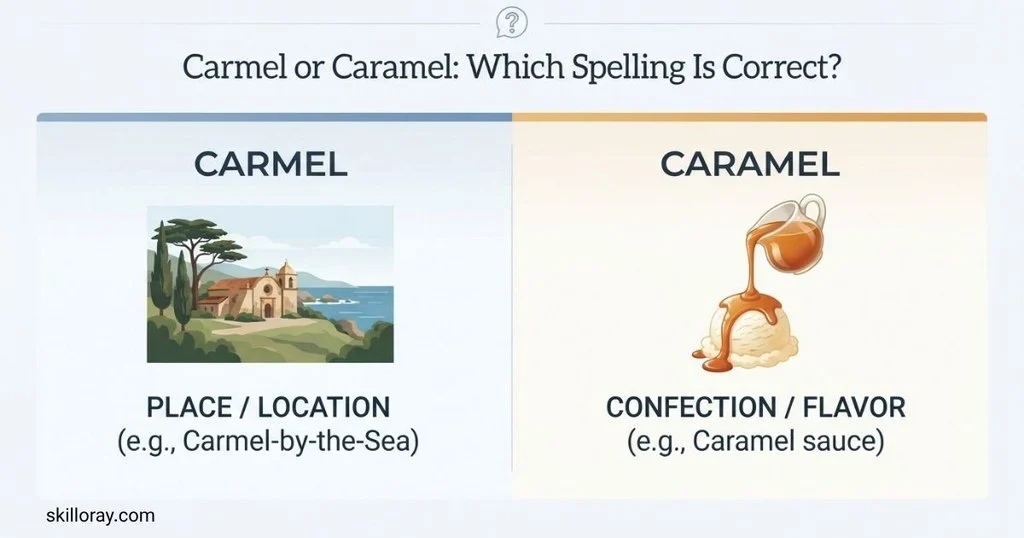
Use caramel when referring to food, candy, sauce, flavoring, or color. Use Carmel when referring to a person, place, or other proper name.
The confusion usually comes from pronunciation. Many American English speakers pronounce caramel with two syllables, making it sound like Carmel. That does not mean the standard food spelling loses its middle a.
Here are some examples to make the distinction clear:
- Correct: I love caramel popcorn.
- Correct: Carmel is a city in California.
- Correct: The recipe calls for caramel sauce.
- Correct: Carmel invited us to dinner.
If you are writing a recipe, restaurant menu, shopping list, or food review, caramel is the spelling to choose. If you’re writing about a person named Carmel or a location with that name, use Carmel.
Carmel or Caramel Pronunciation: How Do You Say It?
The pronunciation of caramel varies across English-speaking regions and individual speakers. Both two-syllable and three-syllable pronunciations are used in English. Oxford and Cambridge provide pronunciation entries that demonstrate these variations.
Common pronunciations of caramel
2 syllables
KAR-muhl
IPA: /ˈkɑːr.məl/
Common in American English. The middle vowel is reduced or omitted in everyday speech.
3 syllables
KAR-uh-muhl
IPA: /ˈkær.ə.məl/
A pronunciation in which the middle vowel is clearly heard. It is commonly listed in British English references.
Is It Pronounced Carmel or Caramel?
If you’re asking about the sweet food, either common pronunciation of caramel may be acceptable. Some speakers pronounce it like Carmel, while others pronounce all three syllables.
For example, someone might say, “I’d like a KAR-muhl latte,” while another person says, “I’d like a KAR-uh-muhl latte.” Both are referring to the same drink ingredient.
The key distinction is between pronunciation and spelling. You can pronounce caramel with two syllables without changing its standard spelling.
Why Do People Say Carmel Instead of Caramel?
Several factors explain this pronunciation:
- Regional speech: Pronunciation patterns vary by location.
- Vowel reduction: Unstressed sounds can become shorter or disappear in natural conversation.
- Everyday speech: People often simplify longer words when speaking quickly.
- Familiarity: Repeated exposure to one pronunciation makes it feel more natural.
These differences are normal features of spoken English. You do not need to correct someone simply because they pronounce caramel differently from you.
Carmel or Caramel in English: Meaning and Usage
In English, caramel is the usual word for the sweet ingredient produced by heating sugar. It can also refer to candy made with sugar, butter, or milk, a flavoring used in desserts, or a yellowish-brown color.
Carmel, by contrast, generally functions as a proper noun. It may be a person’s name or part of a geographical name.
Consider these sentences:
- Food: The bakery sells fresh caramel brownies.
- Drink: I ordered a caramel coffee.
- Color: She painted the wall a soft caramel shade.
- Place: They spent their holiday in Carmel.
- Person: Carmel sent me a birthday card.
The surrounding sentence usually makes the intended meaning clear. However, when you’re writing about food, the standard spelling remains caramel, regardless of how you pronounce it.
Carmel or Caramel Recipe: Which Spelling Should You Use?
When searching for a recipe, use caramel recipe. This is the conventional spelling for recipes that involve heating sugar to create a sweet sauce, topping, filling, or candy.
A caramel recipe might include:
- Granulated sugar
- Butter
- Heavy cream
- A little salt
- Vanilla extract, if desired
For example, a recipe title could be Easy Homemade Caramel Sauce or Soft Caramel Candy Recipe.
Here are some natural sentences using the word:
- I found an easy caramel recipe online.
- This caramel recipe requires only a few ingredients.
- My favorite dessert uses homemade caramel.
- You can add caramel to brownies, cakes, or ice cream.
- The recipe explains how to prepare a smooth caramel topping.
Although some speakers pronounce the word as Carmel, writing Carmel recipe is generally not appropriate when you mean a recipe for the sweet ingredient.
Carmel or Caramel Sauce: What’s the Correct Form?
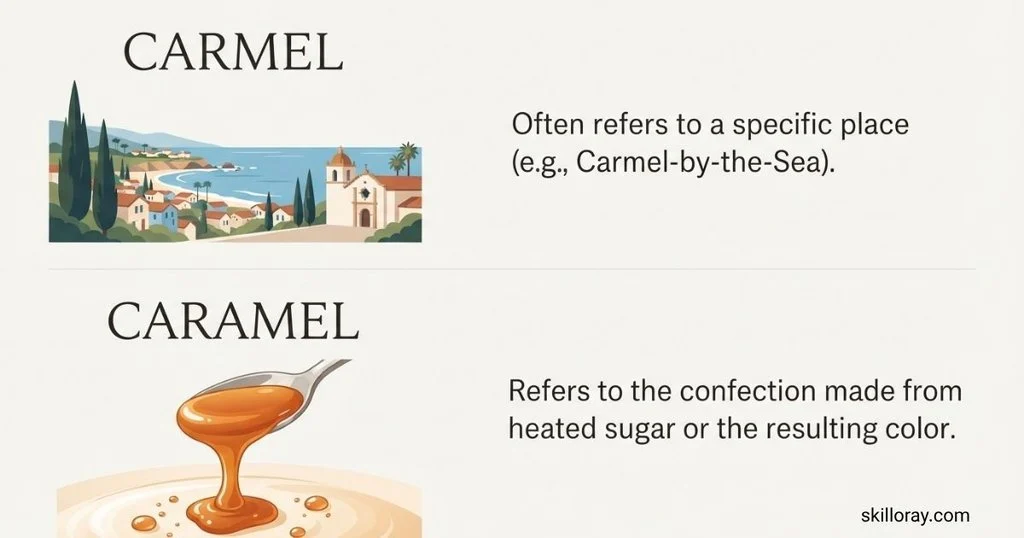
Caramel sauce is the standard spelling for a sweet sauce made using caramelized sugar, often combined with cream or butter.
The sauce can be poured over desserts, stirred into beverages, or used as a filling. It is common in coffee shops, bakeries, ice cream parlors, and home kitchens.
Examples:
- I added caramel sauce to my vanilla ice cream.
- This caramel sauce tastes delicious with pancakes.
- She made homemade caramel sauce for the cake.
- The coffee shop offers a caramel sauce topping.
- You can drizzle caramel sauce over apple slices.
When writing a recipe, ingredient label, or menu description, use caramel sauce. The pronunciation you prefer does not determine how the word should be spelled.
Carmel or Caramel Candy: Which Is Correct?
Caramel candy is the conventional spelling for a chewy sweet made with ingredients such as sugar, butter, and milk. Depending on the recipe, caramel candy may be soft, firm, or slightly sticky.
Examples include:
- She gave me a piece of caramel candy.
- Homemade caramel candy makes a thoughtful gift.
- The store sells individually wrapped caramels.
- I prefer soft caramel candy.
- These caramel candies have a rich buttery flavor.
The plural form is caramels when you mean individual pieces of candy.
For example:
- I bought five caramels from the shop.
- The bowl contains several chocolate-covered caramels.
If you’re referring to a place or a person named Carmel, that spelling is appropriate for the name, not for the usual candy description.
Carmel or Caramel Color: How Is It Written?
Caramel color is the standard American English spelling for the light brown shade associated with caramel. The substance called caramel coloring is also used to give certain foods and beverages a brown appearance.
In British English, colour is generally preferred, so you’ll often see caramel colour in British writing.
Examples:
- The living room has a warm caramel color.
- She chose a caramel-colored handbag.
- The dessert has a golden caramel color.
- The label lists caramel color as an ingredient.
- The shop sells caramel-colored fabric.
Notice that the regional spelling difference concerns color or colour, not the spelling of caramel itself.
Is Carmel a Color?
Carmel is not the standard spelling for the familiar light brown food-related color. Use caramel when describing a shade inspired by the sweet ingredient.
For example:
- Preferred: The sofa is a caramel color.
- Preferred: She wore a caramel-colored coat.
If Carmel appears as a brand name or a named color in a specific product range, follow that official name. Otherwise, caramel is the conventional choice.
Carmel or Caramel on Reddit: Why Are People Confused?
Discussions about caramel pronunciation often revolve around whether the word should have two syllables or three. People may grow up hearing different pronunciations from family members, friends, teachers, or people in their region.
Someone who says KAR-muhl may assume that the three-syllable pronunciation is unnecessary. Another speaker may prefer KAR-uh-muhl because that is what they learned growing up.
Neither preference automatically determines the correct spelling.
Here are three useful points to remember when you encounter these discussions:
- Pronunciation varies: Both two-syllable and three-syllable forms are recognized in English references.
- Context matters: A sentence about a dessert generally signals the food meaning, while a sentence about travel may refer to a place called Carmel.
- Writing follows conventional spelling: When describing candy, sauce, or flavor, use caramel.
If you see a debate about which pronunciation sounds better, remember that personal preference is different from spelling correctness.
Carmel or Caramel: Common Mistakes to Avoid
The most common mistake is writing Carmel when the intended meaning is the sweet food. Another is assuming that a two-syllable pronunciation requires a two-syllable spelling.
Here are some examples to help you avoid confusion.
| Incorrect or unclear usage | Preferred usage | Explanation |
| I bought a Carmel latte. | I bought a caramel latte. | Use the standard food spelling. |
| Add Carmel sauce to the cake. | Add caramel sauce to the cake. | The ingredient is caramel. |
| She made Carmel candy. | She made caramel candy. | The standard spelling refers to the sweet. |
| The walls are painted Carmel. | The walls are painted caramel. | Use caramel for the color unless Carmel is a specific named shade. |
| We visited caramel, California. | We visited Carmel, California. | Use the proper place name. |
Remember These Simple Rules
- Use caramel for food, candy, sauce, flavor, or the familiar light brown color.
- Use Carmel for a person’s name or a place with that official spelling.
- Do not change the spelling of caramel just because you pronounce it with two syllables.
- Capitalize Carmel when it is a proper noun.
- Use caramels for multiple pieces of caramel candy.
These simple distinctions will help you choose the appropriate form in everyday writing.
Frequently Asked Questions
1. Is It Carmel or Caramel?
Caramel is the standard spelling for the sweet food, sauce, candy, or color. Carmel is generally used as a proper name for people or places. Although some references record carmel as a disputed variant of the food word, caramel is the conventional choice in standard writing.
2. Is Carmel a Correct Word?
Yes. Carmel is a legitimate proper noun used in geographical names and personal names. Some American English references also record it as a disputed variant of caramel, but it is not the usual spelling for the sweet ingredient.
3. Is It Pronounced Carmel or Caramel?
Both two-syllable and three-syllable pronunciations of caramel are used in English. The two-syllable form sounds like KAR-muhl, while the three-syllable form sounds like KAR-uh-muhl. Pronunciation varies by region and speaker.
4. Why Do Americans Say Carmel Instead of Caramel?
Some American speakers reduce the unstressed middle vowel when pronouncing caramel. As a result, the word sounds like it has two syllables. This is a normal feature of spoken English and does not mean the standard spelling should change.
5. Is It Carmel or Caramel Sauce?
Use caramel sauce when referring to the sweet topping made from caramelized sugar. It is the conventional spelling in recipes, restaurant menus, and food descriptions.
6. Is It Carmel or Caramel Candy?
Caramel candy is the standard spelling for the chewy sweet. When referring to individual pieces, you can use the plural form caramels.
7. Is It Carmel or Caramel Color?
Use caramel color in American English. In British English, caramel colour is the usual spelling. Both describe a brown shade or, in suitable contexts, a food-coloring ingredient.
8. Can I Write Carmel in an Informal Message About Food?
People may understand Carmel in an informal message because the pronunciation can sound identical. However, if you want to follow conventional spelling, write caramel when discussing a dessert, drink, candy, or sauce.
9. What Is the Plural of Caramel?
The plural is caramels when you mean individual candies or pieces. When referring to the substance or flavor in general, caramel is usually uncountable.
Examples:
- I bought three caramels.
- This ice cream contains caramel.
10. Is Caramel a Noun or an Adjective?
Caramel is primarily a noun when referring to the sweet substance, candy, or color. It can also be used attributively to describe something associated with caramel, as in caramel sauce, caramel flavor, or caramel color.
Conclusion
The choice between Carmel or caramel becomes simple once you understand the difference in spelling and meaning.
Use caramel when you’re talking about a sweet ingredient, candy, sauce, flavor, or light brown color. Use Carmel when you’re referring to a person or place with that name.
Remember that pronunciation is a separate matter. You can pronounce caramel with two syllables or three without changing its conventional spelling. If you keep this distinction in mind, you’ll be able to use the word confidently in recipes, everyday conversations, schoolwork, and professional writing.

I am Olivia Brown, a professional English editor and grammar writer who believes that great writing begins with a strong foundation in grammar. I have spent years creating educational resources that help students and professionals improve their writing, avoid common errors, and communicate more effectively. I strive to provide clear explanations and practical examples that make grammar easy to understand and apply.
Books: English Grammar Essentials and Modern Writing Success
 James Walker
 Daniel Carter