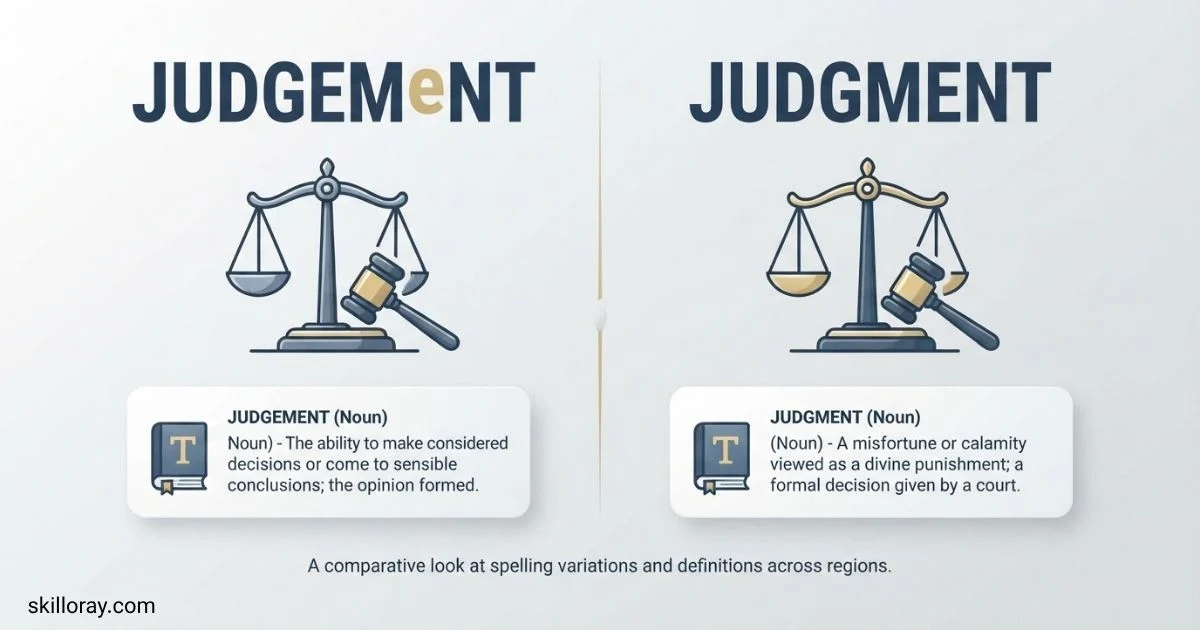
I know that judgement or judgment can be confusing, especially when you see both spellings in English. If you have ever wondered which one is correct, you are not alone.
You may notice judgment more often in American English, while judgement also appears in other varieties of English. I’ll help you understand the difference without making the rule complicated.
By the end, you’ll know which spelling to choose, what each form means, and how to use it naturally. You can write with confidence once you understand this simple spelling difference.
Judgement or Judgment: (Quick Answer)
Both judgement or judgment are accepted English spellings of the same noun. The preferred form depends on your location, the type of writing, and the style guide you follow.
| Spelling | Common Usage | Example |
| Judgment | Standard American English; common in legal writing | She showed good judgment. |
| Judgement | Common in general British English | His judgement was fair. |
| Judgment | Standard in many legal documents internationally | The court issued its judgment. |
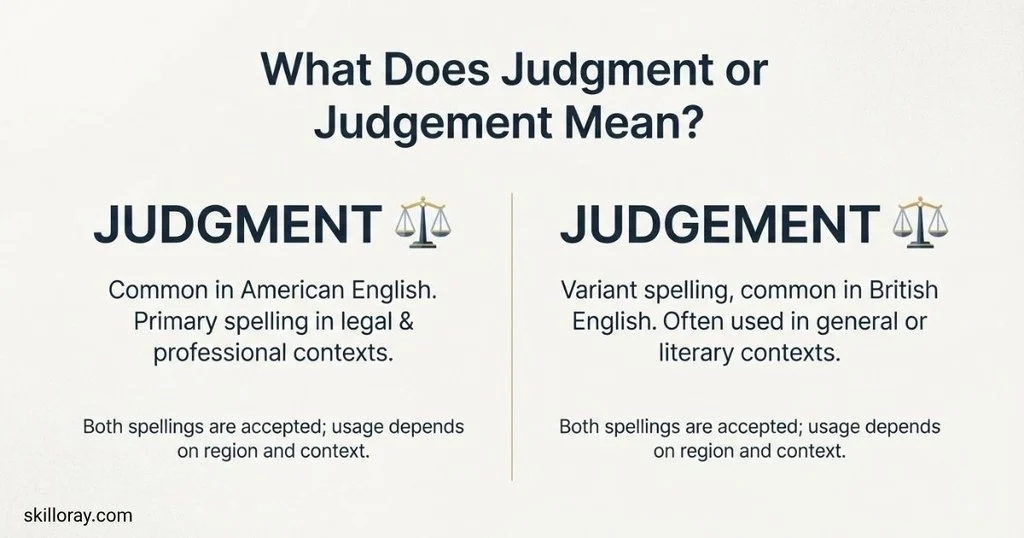
American English generally uses judgment in everyday writing, professional communication, academic work, and legal documents. British English commonly uses judgement in general contexts, although judgment is also accepted and is preferred in many legal settings.
The most practical rule is to follow the spelling convention of your intended audience. If you’re writing for an American publication, use judgment. If you’re writing for a British audience, judgement is a familiar choice for general writing.
What Does Judgment or Judgement Mean?
Judgment or judgement refers to the ability to make a decision, form an opinion, assess a situation, or reach a conclusion after considering the available information.
The word can describe several things:
- Decision-making: The ability to make sensible choices.
- An opinion: A conclusion formed about a person, situation, or idea.
- Assessment: The process of evaluating something carefully.
- A legal ruling: An official decision made by a court.
- Personal evaluation: An opinion about someone’s behavior, actions, or character.
Here are some examples:
- She used good judgment when choosing her university courses.
- His judgement of the situation was accurate.
- The teacher exercised fair judgment when grading the assignments.
- The court delivered its judgment after reviewing the evidence.
- Try not to pass judgement on people before understanding their circumstances.
In each sentence, the noun refers to a decision, an evaluation, or the ability to make a sensible choice. The meaning remains the same regardless of the spelling.
Judgement or Judgment in British English
In British English, judgement is a common spelling for general, non-legal uses of the word. It appears in everyday conversations, books, essays, professional writing, and discussions about personal decisions.
However, British English also accepts judgment, particularly in legal contexts. The shorter form has a long history in legal writing and appears in many official legal publications.
Examples using judgement in general British English:
- Her judgement of character is excellent.
- I trust your judgement on this matter.
- He showed poor judgement during the meeting.
- Good judgement often comes from experience.
- You shouldn’t make a judgement without hearing the full story.
If you’re writing an essay, blog post, or personal article for a British audience, judgement is a suitable choice. Just make sure you follow the spelling conventions used throughout the rest of your document.
Judgment or Judgement in American English
In American English, judgment is the standard spelling in virtually all contexts, including everyday writing, academic assignments, business communication, journalism, and legal documents.
The extra e in judgement is generally unnecessary in American writing. Although readers may recognize it, it can look inconsistent with standard American spelling conventions.
Examples using judgment in American English:
- You should use your best judgment.
- Her judgment was based on years of experience.
- The manager made a reasonable judgment.
- Good judgment helps people solve difficult problems.
- The judge delivered the final judgment.
If your website, school assignment, or publication targets American readers, choose judgment consistently.
Judgment or Judgement in Legal Writing
Legal writing deserves special attention because judgment is the established spelling in many legal systems, including American legal writing and numerous British legal contexts.
In law, a judgment usually refers to a formal decision made by a court. It may explain the court’s reasoning, determine the rights of the parties, or resolve a legal dispute.
Common legal expressions include:
- Summary judgment
- Final judgment
- Court judgment
- Judgment debtor
- Judgment creditor
- Judgment of the court
For example:
- The court entered a final judgment in the case.
- The defendant filed a motion for summary judgment.
- The written judgment explained the court’s decision.
- The parties agreed to comply with the judgment.
In general British writing, judgement remains common for non-legal meanings. However, legal style guides frequently specify judgment for court decisions. The Australian Government’s Style Manual also uses judgment for legal material while recommending judgement for general spelling.
If you’re preparing a legal document, court filing, case summary, or legal article, check the relevant jurisdiction’s requirements rather than relying only on regional spelling habits.
Is Judgment or Judgement Correct in AP Style?
The Associated Press (AP) Stylebook follows American English spelling conventions. Therefore, judgment is the appropriate spelling for AP-style writing.
Use judgment in news articles, press releases, reports, and other content prepared according to AP style.
Examples:
- The judge issued a judgment on Monday.
- She demonstrated excellent judgment during the negotiations.
- The editorial questioned the decision-making judgment of the committee.
If you write for an American newspaper, news website, or publication that follows AP style, use judgment consistently.
How to Pronounce Judgment or Judgement
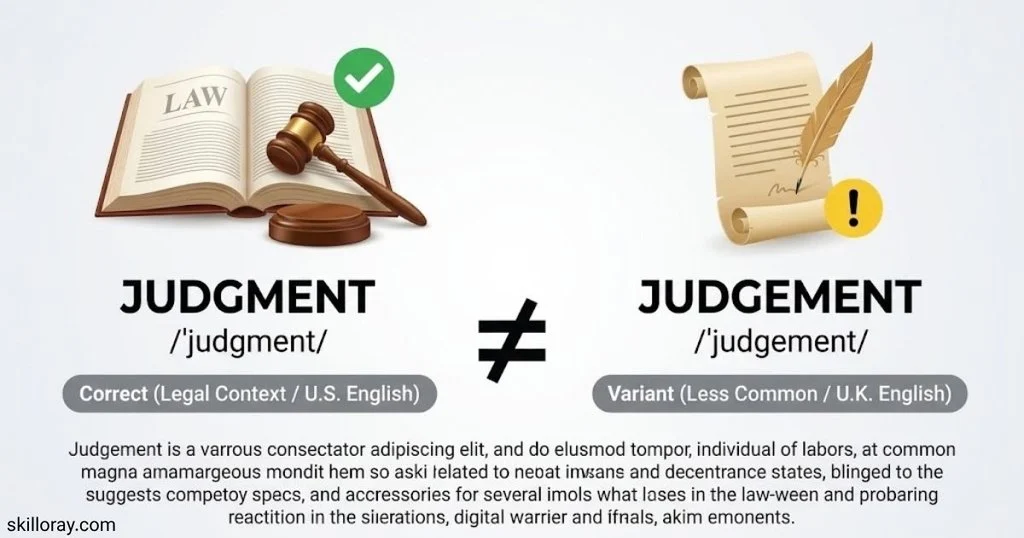
Both spellings have the same pronunciation. The additional e in judgement does not change the way the word is spoken.
- Pronunciation: JUHJ-muhnt
- IPA: /ˈdʒʌdʒmənt/
- Syllables: 2
- Stress: First syllable
The word sounds like judge followed by a short, unstressed ending.
To pronounce it naturally, begin with the sound of judge, then finish with ment. Avoid adding an extra syllable simply because the spelling contains an additional letter.
Example:
“Her judgment helped the team make a better decision.”
You would pronounce judgment the same way regardless of whether the text uses the spelling judgement.
Judgment or Judgement: Grammar and Word Forms
Both spellings function as nouns. They can describe a person’s ability to make decisions, an opinion, an assessment, or a formal legal ruling.
The spelling does not change the grammatical role of the word.
| Word Form | Usage | Example |
| Judgment | Singular noun | His judgment was fair. |
| Judgments | Plural noun | Her judgments were well considered. |
| Judgement | Singular noun | I respect your judgement. |
| Judgements | Plural noun | Their judgements differed. |
| Judgmental | Adjective | Avoid being judgmental. |
| Judgemental | Alternative adjective spelling | She disliked his judgemental attitude. |
The plural form follows the spelling selected for the singular noun. If you choose judgment, write judgments. If you choose judgement, write judgements.
Is Judgment a Noun or a Verb?
Judgment is a noun, not a verb. The related verb is judge.
Examples:
- Noun: Her judgment was thoughtful.
- Verb: I judge the situation carefully.
- Adjective: He made a judgmental comment.
You can use judgment to describe the result of an evaluation or the ability to make decisions. Use judge when describing the action of evaluating something.
What Is the Difference Between Judgment and Judgemental?
Judgment or judgement is a noun, while judgmental or judgemental is an adjective describing someone who tends to judge other people, often critically.
Examples:
- She showed good judgment when handling the disagreement.
- He sounded judgmental when criticizing his colleague.
- A judgemental attitude can make open conversations difficult.
The spelling conventions generally follow the same regional preferences, although individual dictionaries and style guides may differ.
Judgment or Judgement: Example Sentences
Here are ten natural examples showing how the word is used in everyday writing, education, business, and legal contexts.
- She used her best judgment to solve the problem.
- His judgement improved as he gained experience.
- Good judgment is essential when making important decisions.
- The teacher exercised fair judgment when evaluating the students.
- Try not to pass judgement on someone without knowing the facts.
- The court issued its judgment after reviewing the evidence.
- Her professional judgment earned the team’s trust.
- Poor judgement can sometimes lead to unnecessary complications.
- The final judgment resolved the dispute between the parties.
- Learning from past mistakes can improve your future judgment.
All ten sentences use the word as a noun. The choice of spelling depends on the intended regional convention or the applicable style guide.
Common Mistakes With Judgment or Judgement
Although both spellings are accepted, a few common mistakes are worth avoiding.
1. Mixing Regional Spelling Conventions
Less consistent: The article uses judgment in one paragraph and judgement in the next without a reason.
Better: Choose one spelling convention and use it throughout the article.
Mixing accepted spellings is not necessarily a grammatical error, but it can make your writing look inconsistent.
2. Using Judgement in Standard American Writing
Preferred in American English: The manager showed good judgment.
Less conventional in American English: The manager showed good judgement.
For American readers, the spelling without the extra e is the standard choice.
3. Confusing Legal Judgment With Personal Judgment
A legal judgment is an official court decision. Personal judgment refers to someone’s ability to assess situations or make decisions.
Examples:
- Legal: The court issued a judgment.
- Personal: She used sound judgment.
The same spelling can serve both meanings in American English. In British English, legal writing commonly uses judgment, while general writing often uses judgement.
4. Assuming Judgement Is Always Incorrect
It is incorrect to label judgement universally wrong. The spelling is accepted in British English and appears in other English-language publications.
The appropriate choice depends on the audience, context, and style requirements.
Summary Judgment or Summary Judgement: Which Is Correct?
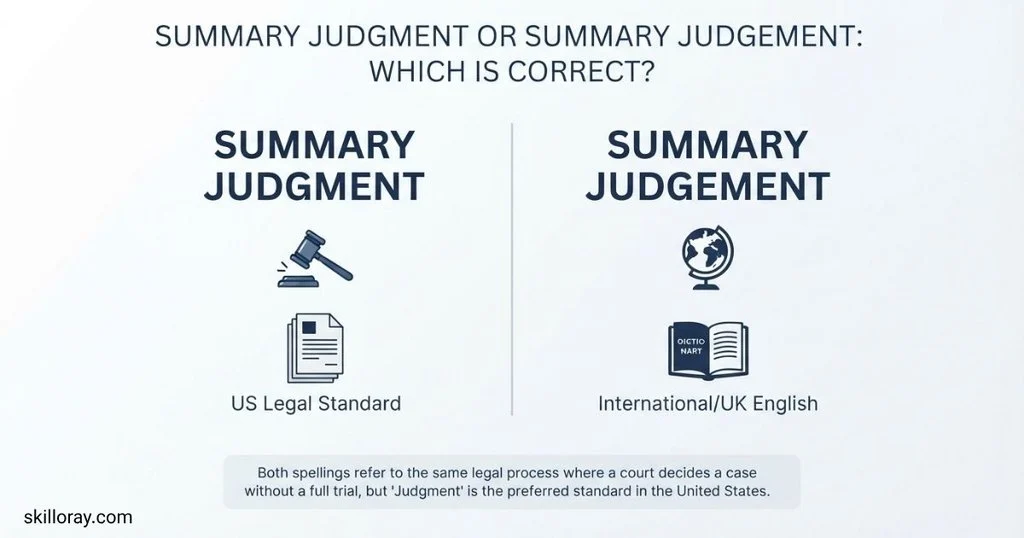
Summary judgment is the standard legal term in American English. It refers to a court decision resolving a claim or part of a case without a full trial when the applicable legal requirements are met.
The phrase is also commonly written as summary judgment in British legal contexts, although legal terminology and procedural rules vary by jurisdiction.
Examples:
- The defendant requested summary judgment.
- The judge granted the motion for summary judgment.
- The court denied the application for summary judgment.
For legal writing, use summary judgment unless the relevant court, jurisdiction, or official document specifies a different form. The Connecticut Judicial Branch’s style manual, for example, uses summary judgment in its legal writing guidance.
Frequently Asked Questions
1. Is it judgement or judgment?
Both spellings are accepted. Judgment is standard in American English and common in legal writing. Judgement is widely used in general British English.
2. Which spelling is correct in the UK?
Both forms are used in the UK. Judgement is common in general writing, while judgment is frequently preferred in legal contexts. Follow your publication’s style guide.
3. Which spelling is correct in the US?
Judgment is the standard American English spelling. Use it for schoolwork, business writing, journalism, and legal documents.
4. Is judgement grammatically correct?
Yes. Judgement is an accepted spelling, particularly in British English. It is not inherently a grammatical mistake.
5. Does judgment have an extra E?
No. The standard spelling judgment does not contain an e between the g and m. The alternative spelling judgement includes that letter.
6. Is judgment the correct legal spelling?
Judgment is the established spelling in American legal writing and is widely used in British legal contexts. Always check the relevant jurisdiction’s legal style requirements.
7. How do you spell judgment in AP style?
AP style uses judgment, following standard American English spelling conventions.
8. Is it summary judgment or summary judgement?
Summary judgment is the standard form in American legal terminology and is also widely used in British legal writing.
9. Are judgment or judgement pronounced differently?
No. Both spellings have the same pronunciation: /ˈdʒʌdʒmənt/. The additional letter in judgement does not create another syllable.
10. What is the plural of judgment?
The plural is judgments. For the alternative spelling judgement, the plural is judgements.
Conclusion
Both judgement or judgment are accepted spellings, but the right choice depends on your audience and writing context. American English generally uses judgment, while British English commonly uses judgement in general writing. Legal writing frequently prefers judgment, including in many British legal publications.
For the most consistent results, follow your preferred dictionary or publication style guide. If you are writing for an American audience, choose judgment. For general British writing, judgement is a familiar option. Above all, use your chosen spelling consistently throughout the document.

I am Daniel Carter, a grammar enthusiast and language educator with over 10 years of experience helping students and professionals improve their English writing and communication skills. I enjoy simplifying complex grammar rules into easy-to-understand lessons that anyone can follow. My goal is to help learners write with confidence, avoid common mistakes, and develop strong communication skills for academic and professional success. I regularly create practical grammar guides, writing tips, and language resources that make learning both enjoyable and effective.
Books: Mastering English Grammar and The Complete Guide to Better Writing
 James Walker
 Olivia Brown