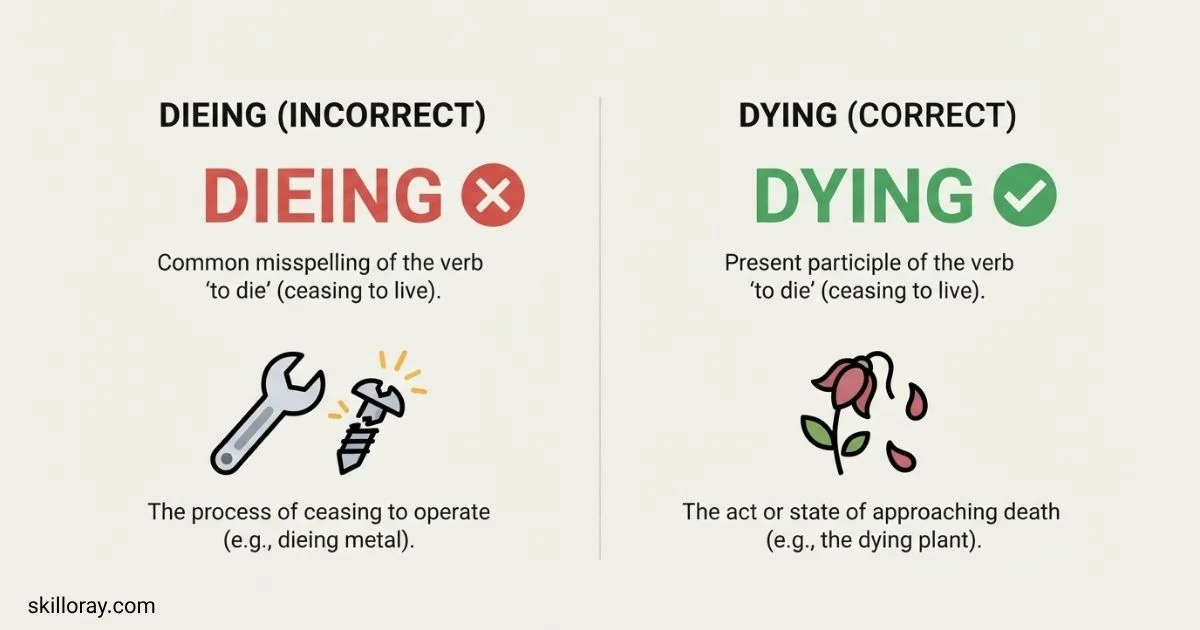
Have you ever stopped while writing and wondered whether dieing or dying is the correct spelling? I know this small spelling difference can be surprisingly confusing, especially when both forms look almost identical.
If you are unsure which word to use, you are not alone. You may see “dying” everywhere, while “dieing” sometimes appears online, making it difficult to know what is actually correct.
In this guide, I’ll explain dieing or dying in simple terms, show you the correct usage, and give you clear examples so you can confidently choose the right word whenever you write.
Dieing or Dying: (Quick Answer)
Dying is the correct spelling when you mean the process of losing life, something fading away, or something coming to an end. Dieing is generally considered a misspelling when used with this meaning in modern English. A specialized use of dieing may appear in manufacturing contexts involving a die, a tool used to shape material, but it is not the usual spelling for everyday writing.
Here is a quick comparison to help you remember the correct form.
| Word | Meaning | Correct example |
| Dying | Losing life or coming to an end | The flowers are dying. |
| Dieing | Usually a misspelling of dying | Incorrect: The flowers are dieing. |
| Dyeing | Changing something’s color | She is dyeing her hair. |
The key is to identify what you want to express before choosing the spelling.
What Does Dying Mean?
Dying is the present participle of the verb die. It can describe the process of losing life, something gradually disappearing, or a machine that is about to stop working. It can also appear in informal expressions that emphasize a strong feeling or desire.
1. Dying as a Verb
As a verb, dying describes an ongoing action or process. It commonly appears with forms of be, such as is, are, was, or were.
Examples:
- The old tree is dying because it lacks water.
- The flowers are dying in the summer heat.
- The battery is dying, so I need to charge my phone.
- The plants were dying before we moved them into the shade.
- Several traditions are slowly dying out.
In each sentence, dying describes something that is losing life, energy, or existence.
2. Dying as an Adjective
Dying can also describe something that is nearing its end or is associated with the final stage of life.
Examples:
- She wanted to fulfill her grandfather’s dying wish.
- The firefighters watched the dying embers of the fire.
- Traditional letter writing is becoming a dying art.
- The team scored during the dying moments of the match.
In these examples, dying helps describe the final stage of a person, activity, or process.
3. Dying in Informal Expressions
English speakers often use dying figuratively to express a strong desire or an intense reaction. These expressions usually aren’t meant literally.
Examples:
- I’m dying to know what happened.
- She is dying for a cup of coffee.
- We were dying laughing at his joke.
- He is dying to see the new movie.
The spelling remains dying even when the expression is humorous or exaggerated.
What Does Dieing Mean?
In everyday English, dieing is generally a misspelling of dying. If you are writing about death, fading plants, a failing battery, or something gradually disappearing, use dying.
There is a specialized manufacturing context involving the noun die, which refers to a tool used to cut, shape, or stamp material. In some technical or historical contexts, dieing may be used as a verb form related to that process. However, modern technical writing commonly uses clearer terms such as die cutting, die casting, or die forming.
For everyday writing, you generally don’t need to use dieing.
Examples of the common spelling mistake:
- Incorrect: My phone is dieing.
- Correct: My phone is dying.
- Incorrect: The grass is dieing.
- Correct: The grass is dying.
- Incorrect: He is dieing to meet you.
- Correct: He is dying to meet you.
The easiest approach is to use dying whenever you mean the verb die in ordinary conversation, schoolwork, emails, or articles.
Why Is Dying Spelled With a Y?
The spelling becomes easier to understand once you learn a common English spelling rule.
When a verb ends in -ie, the final -ie usually changes to -y before adding -ing. This is why die becomes dying rather than dieing.
Here are some examples:
| Base verb | Correct -ing form |
| Die | Dying |
| Lie | Lying |
| Tie | Tying |
| Vie | Vying |
For example:
- The plant is dying.
- He is lying on the sofa.
- She is tying her shoes.
- Both teams are vying for the trophy.
Notice the pattern: the final ie changes to y, and then ing is added.
This spelling pattern helps explain why dying is standard English. Writing dieing simply follows a different pattern that does not apply to the ordinary verb die.
Dying or Dyeing: What Is the Difference?
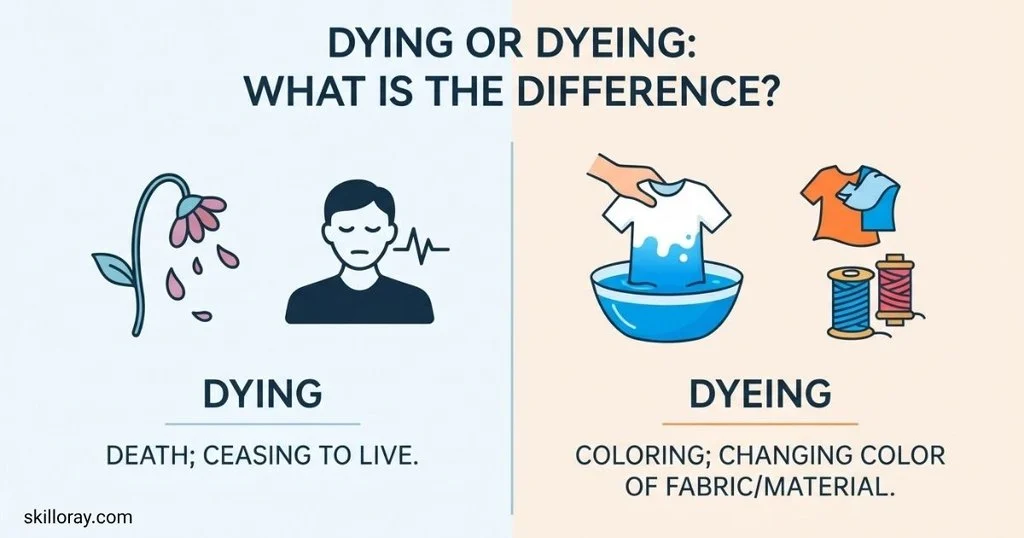
One of the most common sources of confusion is the word dyeing. Although it sounds similar to dying, it has a completely different meaning.
- Dying means losing life, fading, or coming to an end.
- Dyeing means changing the color of something by using a dye.
The distinction matters when discussing hair, clothes, fabrics, or Easter eggs.
| Word | Meaning | Example |
| Dying | Losing life or fading | The plant is dying. |
| Dyeing | Coloring something | I am dyeing my shirt blue. |
| Dieing | Usually a misspelling in ordinary English | Incorrect: I am dieing. |
Is It Dying or Dyeing Hair?
If you are talking about changing your hair color, the correct word is dyeing.
Examples:
- I am dyeing my hair brown this weekend.
- She is dyeing her hair blonde.
- He considered dyeing his hair red.
- My sister enjoys dyeing her hair different colors.
If you write, “I am dying my hair,” the sentence suggests that your hair is losing life rather than having its color changed. The intended meaning is usually dyeing.
Is It Dying or Dyeing Clothes?
Use dyeing when you mean changing the color of clothing or fabric.
Correct examples:
- She is dyeing her old jeans black.
- I am dyeing a white shirt blue.
- They are dyeing the fabric for a new dress.
- We spent the afternoon dyeing cotton scarves.
Use dying when something is fading, deteriorating, or losing life.
For example: “The color of my old shirt is dying” may be understood informally as the color fading, but “The fabric is dyeing” does not normally express that meaning.
Is It Dying or Dyeing Eggs?
When coloring eggs for Easter or another celebration, the correct spelling is dyeing eggs.
Examples:
- We are dyeing eggs for Easter.
- The children enjoyed dyeing eggs in bright colors.
- She is dyeing the eggs blue and green.
- They prepared natural dyes for dyeing eggs.
Remember that dyeing involves adding color. Dying describes a process of losing life or coming to an end.
Dying Laughing: What Is the Correct Phrase?
The correct expression is dying laughing or, more commonly, dying of laughter. Both expressions are informal ways to say that something is extremely funny.
You may also hear the expression I nearly died laughing. In this context, the speaker is exaggerating to emphasize how funny something was.
Examples:
- I was dying laughing at that video.
- We were dying of laughter during the comedy show.
- She said something so funny that I nearly died laughing.
- He was dying laughing at his friend’s impression.
- Everyone was dying of laughter after the punchline.
Do not write dieing laughing when expressing amusement.
Is It “I’m Dieing” or “I’m Dying”?
The correct spelling is I’m dying.
The contraction I’m means I am, so the sentence uses the present continuous form of the verb die.
Examples:
- I’m dying to know the answer.
- I’m dying to see the finished project.
- I’m dying laughing at this joke.
- I’m dying of thirst after the long walk.
The meaning depends on the context. The expression can refer to a literal condition, a strong desire, or a humorous exaggeration.
Is It “He Is Dieing” or “He Is Dying”?
The correct everyday spelling is he is dying.
Examples:
- He is dying to hear the results.
- He is dying of laughter.
- He is dying to visit his favorite city.
- The character in the story is dying.
Because is is followed by the present participle, the correct spelling is dying.
How to Spell Dying as in Death
If you are referring to the process of death, the correct spelling is dying.
The verb forms are:
| Verb form | Spelling | Example |
| Base form | Die | All living things eventually die. |
| Third-person singular | Dies | The plant dies without water. |
| Past tense | Died | The plant died last winter. |
| Past participle | Died | The flowers have died. |
| Present participle | Dying | The plant is dying. |
These forms are useful when writing sentences about life, nature, fictional characters, or events.
Example Sentences About Death
Here are several natural examples showing how dying is used:
- The elderly tree is dying after years of neglect.
- The doctor explained that the plant was dying from a lack of water.
- The story describes a dying kingdom.
- The animal appeared to be dying.
- The dying character shared a final message.
- Some languages are slowly dying out.
- The fire was dying down as the evening progressed.
- The old tradition is dying in many communities.
- The battery is dying, and the screen is getting dim.
- His interest in the subject was dying.
These examples show that dying can describe living things, figurative endings, and objects or processes that are losing their ability to function.
Is Dying the Correct Spelling in British English?
Yes. Dying is the standard spelling in both British English and American English when it refers to the verb die.
There is no ordinary regional spelling difference that makes dieing correct in British English.
| Variety of English | Correct spelling | Example |
| American English | Dying | The flowers are dying. |
| British English | Dying | The flowers are dying. |
| Australian English | Dying | The flowers are dying. |
| Canadian English | Dying | The flowers are dying. |
You can use dying in school assignments, business writing, emails, social media posts, and other everyday contexts regardless of which of these English varieties you follow.
The separate word dyeing also retains its spelling across these varieties when referring to changing the color of an object.
Dying or Dieing Pronunciation
Both spellings may lead readers to imagine the same sound, but only dying is the standard spelling for the usual meaning of the verb die.
The pronunciation of dying is:
- IPA: /ˈdaɪ.ɪŋ/
- Simple pronunciation: DYE-ing
- Syllables: Two
- Stress: First syllable
The word sounds like “dye-ing,” with a long i sound in the first syllable followed by a short ending.
Examples:
- Dying: pronounced DYE-ing.
- Dyeing: also pronounced DYE-ing.
Although dying and dyeing sound alike, their meanings differ. The context of your sentence tells the reader which word you intend.
Common Mistakes When Using Dying
Many spelling mistakes happen because people assume that every verb forms its -ing version by simply adding those four letters to the base word.
Here are common mistakes to avoid.
| Incorrect or confusing usage | Correct usage | Explanation |
| The plant is dieing. | The plant is dying. | Use dying for the process of losing life. |
| I’m dieing to know. | I’m dying to know. | Dying expresses a strong desire. |
| He is dieing laughing. | He is dying laughing. | Dying is used in this informal expression. |
| I am dieing my hair. | I am dyeing my hair. | Dyeing means changing hair color. |
| We are dieing eggs. | We are dyeing eggs. | Dyeing means adding color to eggs. |
| She is dieing her clothes. | She is dyeing her clothes. | Dyeing means coloring fabric. |
A simple proofreading habit can prevent these errors: check whether you mean death, a figurative ending, or the act of coloring something.
Quick Tips to Remember the Correct Spelling
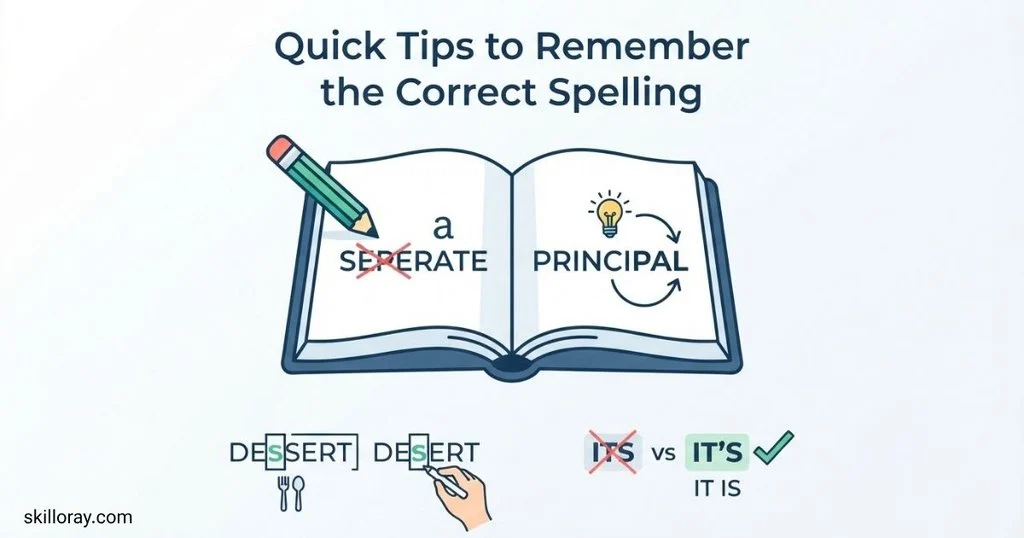
If you regularly confuse these words, use the following reminders.
- Dying: Think of the verb die. When something is losing life, fading away, or coming to an end, use dying.
- Dyeing: Think of the word dye, which is used to change color. Use dyeing for hair, fabric, clothes, or eggs.
- Dieing: Avoid this spelling in ordinary writing about death. It is generally treated as a misspelling in that context.
You can also remember the spelling rule: die changes to dying when the -ing ending is added.
Frequently Asked Questions
1. Is it dieing or dying?
Dying is the standard spelling when referring to death, something fading away, or something coming to an end. Dieing is generally considered incorrect for these meanings in modern everyday English.
2. How do you spell dying as in death?
The correct spelling is dying. For example, “The plant is dying because it hasn’t received enough water.”
3. Is dieing a real word?
Dieing is not the standard spelling of the present participle of die. Specialized manufacturing usage related to a tool called a die may occasionally use the form, but modern technical writing generally favors terms such as die cutting or die forming.
4. Is it dying or dyeing hair?
Dyeing hair is correct when you mean changing its color. For example, “She is dyeing her hair brown.” Dying refers to losing life or fading away.
5. Is it dying laughing or dieing laughing?
Dying laughing is the standard spelling. It is an informal expression used when something is extremely funny.
6. Is it I’m dieing or I’m dying?
I’m dying is correct. The phrase can describe a literal situation or express a strong desire, as in “I’m dying to see the results.”
7. Is it he is dieing or he is dying?
He is dying is correct. The present participle of die is dying, so it follows the verb is in this sentence.
8. Is dying correct in British English?
Yes. Dying is the standard spelling in British English, American English, Australian English, and Canadian English for the usual meaning of the verb die.
9. Is it dying eggs or dyeing eggs?
Dyeing eggs is correct when you mean coloring eggs for Easter or another celebration. Dying refers to losing life or coming to an end.
10. What does dying mean in a sentence?
Dying can mean losing life, gradually disappearing, or stopping functioning. It can also express a strong desire in informal phrases such as “I’m dying to know.”
Conclusion
When choosing dieing or dying, remember that dying is the correct spelling for the ordinary meaning of the verb die. It describes the process of losing life, something fading away, or something gradually coming to an end.
Use dyeing when you mean changing the color of hair, clothing, fabric, or eggs. Although dieing may appear in specialized manufacturing contexts, it is generally not appropriate for everyday writing about death.

I am Olivia Brown, a professional English editor and grammar writer who believes that great writing begins with a strong foundation in grammar. I have spent years creating educational resources that help students and professionals improve their writing, avoid common errors, and communicate more effectively. I strive to provide clear explanations and practical examples that make grammar easy to understand and apply.
Books: English Grammar Essentials and Modern Writing Success
 James Walker
 Daniel Carter