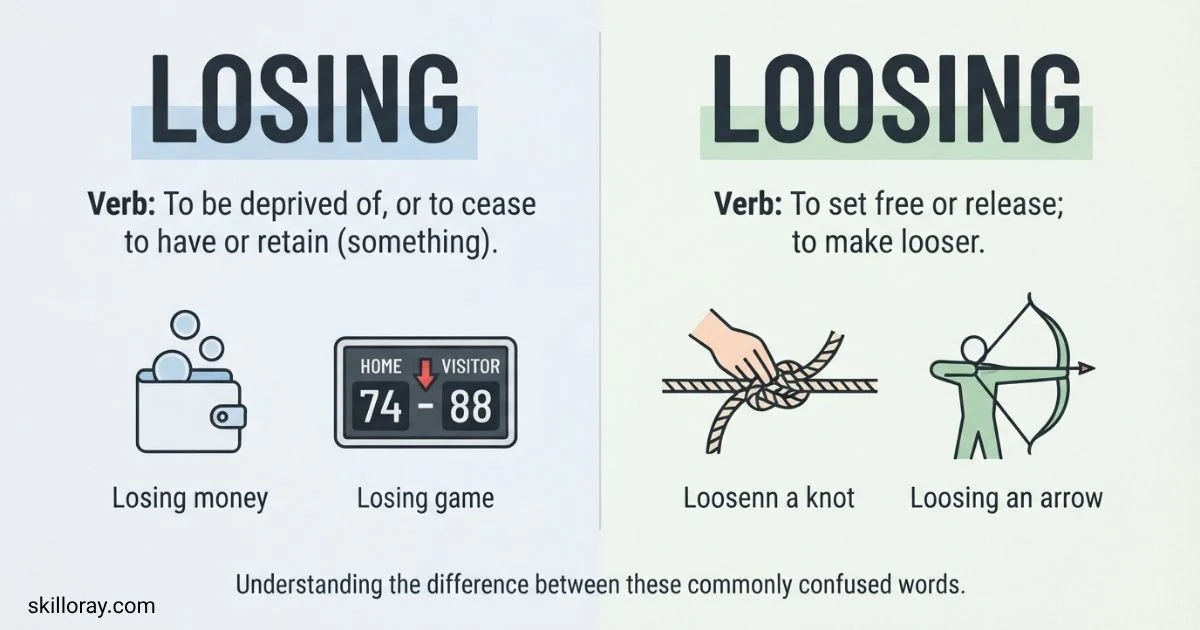
Have you ever paused while writing and wondered whether losing or loosing is the right word? I know how confusing these two spellings can be because they look almost identical but have very different meanings.
You might see “losing” and “loosing” used incorrectly online, which makes the choice even harder. I’ll help you understand the difference in a simple way, so you can choose the right word with confidence.
By the end, you’ll know exactly when to use each word, what they mean, and how to avoid this common spelling mistake. You can also use the examples as a quick reference whenever you’re unsure.
Losing or Loosing: What Is the Difference?
Losing is the correct spelling when you mean failing to win, misplacing something, experiencing a loss, or gradually no longer having something. Loosing usually means releasing, freeing, or allowing something to move without restraint.
Here is a quick comparison to help you remember the difference.
| Word | Meaning | Example |
| Losing | Experiencing a loss or no longer having something | I am losing interest in the game. |
| Loosing | Releasing or setting something free | The hunter is loosing the arrow. |
The easiest way to remember the rule is to connect losing with loss and loosing with loose. If you are talking about losing weight, losing a game, losing hair, or losing hope, use losing.
What Does Losing Mean?
Losing is the present participle of the verb lose. It can also function as a gerund, which means a verb form used as a noun.
The verb lose has several meanings, including:
- To misplace something: I keep losing my keys.
- To fail to win: Our team is losing the match.
- To experience the death of someone: She is afraid of losing a loved one.
- To stop having something: He is losing confidence.
- To have less of something: I’m losing weight.
- To waste or fail to retain something: We are losing valuable time.
Examples of losing in sentences:
- I am losing my patience with this situation.
- She is losing interest in the project.
- They are losing hope after several setbacks.
- He keeps losing his phone.
- Our team is losing the game by two points.
In all these examples, losing describes a loss, a decline, or a failure to keep or win something.
What Does Loosing Mean?
Loosing is the present participle of the verb loose, which means to release, free, or allow something to move without restraint. It is a legitimate English word, but it appears much less frequently in everyday writing.
You might encounter loosing in literary writing, historical descriptions, archery, or expressions involving the release of something.
Examples of loosing in sentences:
- The archer is loosing an arrow toward the target.
- The handler is loosing the dogs from their restraints.
- The story describes a warrior loosing his hounds.
- The character is loosing a flock of birds into the sky.
In these sentences, loosing refers to the act of releasing something.
Remember that loosing does not normally mean becoming loose or making something less tight. For those meanings, other forms of loose are usually more natural, such as loosening.
Losing or Loosing Weight: Which Is Correct?
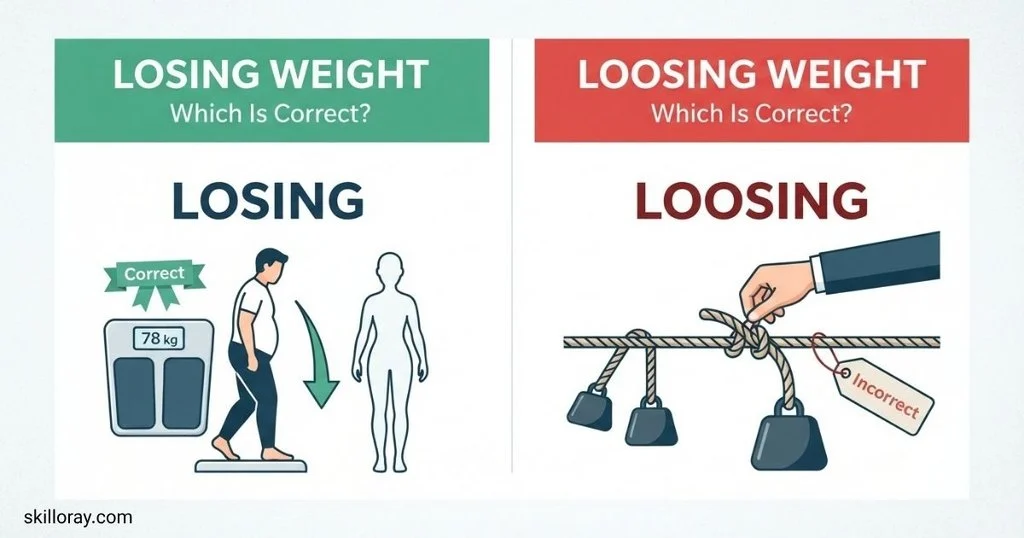
Losing weight is the correct expression when you mean a reduction in body weight.
The phrase comes from the verb lose, so the correct form is losing. Writing loosing weight is generally a spelling mistake in this context.
Examples:
- She is losing weight gradually.
- I am losing weight as part of a health plan.
- He has been losing weight over the past few months.
- Losing weight is not always a straightforward process.
- They are losing weight under the guidance of a healthcare professional.
Incorrect: I am loosing weight.
Correct: I am losing weight.
A simple memory trick is to remember that the noun is loss, as in weight loss. The related verb is lose, making the correct form losing weight.
Losing or Loosing Someone: Which Is Correct?
Losing someone is the correct expression when you mean being separated from someone, fearing their departure, or experiencing their death.
Examples:
- I am afraid of losing someone I love.
- She worries about losing her closest friend.
- He is struggling with the thought of losing a family member.
- Losing someone important can be emotionally difficult.
- They fear losing someone who has supported them for years.
The expression can describe an actual loss, a fear of separation, or the possibility of a relationship ending.
Loosing someone would generally mean releasing that person from restraint, which is a different and unusual meaning. It is not the correct choice when discussing grief, relationships, or emotional loss.
Losing or Loosing Interest: Which Is Correct?
Losing interest is the correct expression when someone becomes less interested in a person, activity, subject, or situation.
Examples:
- I am losing interest in this television show.
- She is losing interest in learning the language.
- He started losing interest in the conversation.
- The students are losing interest in the lesson.
- They are losing interest in the project because progress has slowed.
The word losing describes a gradual decline in interest or enthusiasm.
Incorrect: I am loosing interest in this topic.
Correct: I am losing interest in this topic.
Use losing interest whenever you mean that someone’s attention, curiosity, or enthusiasm is fading.
Losing or Loosing My Mind: Which Is Correct?
Losing my mind is the standard expression when you want to describe feeling overwhelmed, confused, extremely stressed, or unable to think clearly.
Examples:
- I feel like I am losing my mind trying to finish this project.
- She thought she was losing her mind during the stressful week.
- I am losing my mind trying to remember where I put my keys.
- He joked that he was losing his mind after working all night.
This expression is often used informally or figuratively. It does not necessarily mean that someone is experiencing a mental health condition.
Loosing my mind is not the standard spelling for this expression because the intended meaning is a loss of control or clarity, not the release of something.
Losing or Loosing Your Voice: Which Is Correct?
Losing your voice is the correct expression when your voice becomes weak, hoarse, or temporarily unavailable, often because of illness, vocal strain, or irritation.
Examples:
- I am losing my voice after cheering at the match.
- She is losing her voice because of a sore throat.
- He started losing his voice during the presentation.
- I keep losing my voice after speaking for long periods.
- Losing your voice can make everyday communication difficult.
The phrase uses losing because it describes the temporary loss of a normal ability.
Incorrect: I am loosing my voice.
Correct: I am losing my voice.
Losing or Loosing Hope: Which Is Correct?
Losing hope is the correct expression when someone begins to feel less confident that a desired outcome will happen.
Examples:
- She is losing hope of finding a solution.
- I refuse to keep losing hope during difficult times.
- They were losing hope after several unsuccessful attempts.
- He is losing hope that the situation will improve.
- Losing hope can make a difficult situation feel even harder.
In this phrase, losing describes the gradual disappearance of hope, confidence, or expectation.
Use losing hope when discussing disappointment, uncertainty, setbacks, or difficult circumstances.
Losing or Loosing a Game: Which Is Correct?
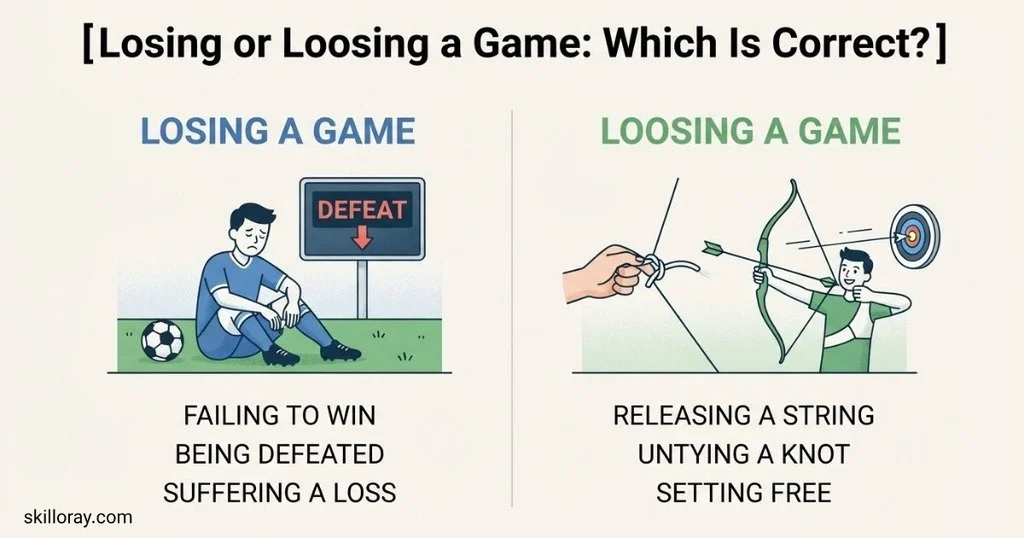
Losing a game is the correct expression when a player or team is failing to win or is being defeated.
Examples:
- Our team is losing the game.
- She hates losing a game because of a simple mistake.
- They were losing the match until the final minutes.
- He is learning how to handle losing a game gracefully.
- We are losing the game, but there is still time to improve our performance.
The verb lose is used when someone fails to win a competition, contest, or match.
Incorrect: Our team is loosing the game.
Correct: Our team is losing the game.
Use losing for sports, board games, video games, competitions, and other contests.
Losing or Loosing Hair: Which Is Correct?
Losing hair is the correct expression when you mean that hair is falling out or becoming thinner.
Examples:
- I am losing hair more than usual.
- She noticed that she was losing hair after a stressful period.
- He is worried about losing his hair.
- Some people experience hair loss as they get older.
- Losing hair can have several possible causes.
The phrase uses losing because it refers to a reduction or loss of something you previously had.
Incorrect: I think I am loosing hair.
Correct: I think I am losing hair.
You may also see the noun phrase hair loss, which uses the noun loss rather than the verb lose.
How Do You Spell Losing or Loosing?
The correct spelling depends on what you want to express.
- Losing: L-O-S-I-N-G. Use this for experiencing a loss, failing to win, or no longer having something.
- Loosing: L-O-O-S-I-N-G. Use this when describing the act of releasing or setting something free.
The confusion often happens because the words look and sound similar. However, they come from different base words:
| Base word | Correct form | Meaning |
| Lose | Losing | Experiencing a loss |
| Loose | Loosing | Releasing something |
Notice the spelling difference. Losing has one o after the initial l, while loosing has two.
A useful way to remember the spelling is to connect losing with lose and loosing with loose.
Losing or Loosing: Pronunciation Guide
The words losing and loosing have different pronunciations, even though they are easy to confuse in writing.
| Word | IPA pronunciation | Simple guide |
| Losing | /ˈluːzɪŋ/ | LOO-zing |
| Loosing | /ˈluːsɪŋ/ | LOO-sing |
The main difference is the middle consonant sound:
- Losing has a /z/ sound, like the sound at the beginning of zoo.
- Loosing has an /s/ sound, like the sound at the beginning of sun.
Both words have two syllables, with the stress on the first syllable.
For most English learners, practicing the middle sound is a helpful way to remember which word they are saying.
Is Losing or Loosing Correct in British English?
The distinction is essentially the same in British English or American English. There is no standard regional spelling rule that makes loosing the preferred form for the usual meanings of losing.
Use losing for expressions such as:
- Losing weight
- Losing interest
- Losing a game
- Losing hope
- Losing hair
- Losing someone
Use loosing when you genuinely mean releasing or setting something free.
The choice depends on the meaning of the sentence, not the country in which the English is being used.
Common Mistakes With Losing or Loosing
The most common mistake is using loosing when the intended meaning is experiencing a loss.
Here are some examples of incorrect usage with the corrected forms.
| Incorrect sentence | Correct sentence |
| I am loosing weight. | I am losing weight. |
| She is loosing interest. | She is losing interest. |
| We are loosing the game. | We are losing the game. |
| He is loosing hope. | He is losing hope. |
| I am loosing my voice. | I am losing my voice. |
| She is loosing her hair. | She is losing her hair. |
| I am afraid of loosing someone. | I am afraid of losing someone. |
| I feel like I am loosing my mind. | I feel like I am losing my mind. |
These corrections work because the sentences describe a loss, a decline, or a failure to retain something.
How to Avoid This Spelling Mistake
Try these simple tips whenever you are unsure which form to use:
- Think of the word loss. If the sentence involves a loss, losing is usually the right choice.
- Identify the intended meaning. Ask yourself whether something is disappearing or being released.
- Remember the base verb. Losing comes from lose, while loosing comes from loose.
- Read the sentence aloud. The /z/ sound in losing can help you distinguish it from the /s/ sound in loosing.
- Check common expressions. Phrases such as losing weight, losing hope, and losing a game use the same spelling pattern.
With regular practice, choosing the correct form becomes much easier.
Examples of Losing or Loosing in Sentences
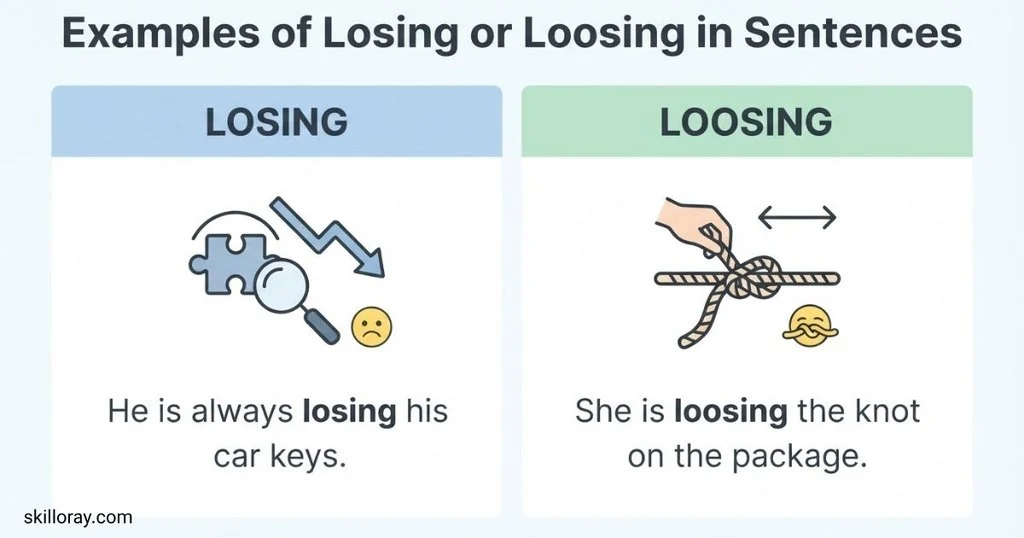
The following sentences show how each form works in everyday English.
Sentences With Losing
- I am losing patience with the repeated delays.
- She is losing confidence in her abilities.
- We are losing valuable time.
- He is losing interest in the discussion.
- They are losing the match by one point.
- I keep losing my keys around the house.
- She is losing hope of finding a quick solution.
- He is worried about losing his job.
- I am losing my voice after speaking all day.
- The company is losing customers because of poor service.
Sentences With Loosing
- The archer is loosing an arrow at the target.
- The story describes a knight loosing his hounds.
- The handler is loosing the horses into the open field.
- The historical account mentions soldiers loosing their arrows.
- The character is loosing a bird from its cage.
The examples show that losing is common in ordinary conversation, while loosing is more specialized and generally describes an act of release.
Frequently Asked Questions
1. Is it losing or loosing?
Both are legitimate English words, but they have different meanings. Losing refers to experiencing a loss or failing to win, while loosing means releasing or setting something free. For most everyday expressions, losing is the correct spelling.
2. Which is correct: losing weight or loosing weight?
Losing weight is correct. The phrase refers to a reduction in body weight, so it uses the verb lose in its -ing form. Loosing weight is generally a spelling mistake in this context.
3. How do you spell losing correctly?
The correct spelling is L-O-S-I-N-G. It comes from the verb lose. Remember that the word has one o, as in lose, rather than the two o letters in loose.
4. Is loosing a real English word?
Yes, loosing is a real English word. It is the -ing form of loose, meaning to release, free, or let something go. For example, an archer can be described as loosing an arrow.
5. Why do people confuse losing with loosing?
The words look similar, share several letters, and have related-looking base forms. People may also assume that loosing is the correct form because loose contains two o letters. Remembering the meanings of lose or loose helps prevent this mistake.
6. Is losing grammatically correct?
Yes. Losing is grammatically correct when used as the present participle or gerund of lose. Examples include I am losing my keys or Losing patience makes the situation harder.
7. Do losing or loosing have different pronunciations?
Yes. Losing is pronounced /ˈluːzɪŋ/, with a /z/ sound. Loosing is pronounced /ˈluːsɪŋ/, with an /s/ sound. Both have two syllables, with stress on the first.
8. Should I write losing hope or loosing hope?
Write losing hope. This expression means that someone is becoming less hopeful about a situation or outcome. Loosing hope is not the standard spelling for this meaning.
9. Is losing or loosing used in American or British English?
Both forms exist in American English or British English, but their meanings remain essentially the same. Use losing to describe a loss, while loosing refers to releasing something. Neither form is a regional spelling alternative for the other.
Conclusion
Choosing losing or loosing becomes simple once you understand the meaning of each word. Use losing when you are talking about losing weight, losing interest, losing a game, losing hope, losing hair, losing your voice, or losing someone you care about. Use loosing when you mean releasing something or allowing it to go free.
The easiest memory trick is to associate losing with lose and loosing with loose. When your sentence describes a loss, losing is usually the word you need. When it describes an act of release, loosing may be appropriate.
Keep this distinction in mind, and you’ll be able to spell these words correctly in everyday writing, schoolwork, emails, and social media posts.

I am James Walker, an English language specialist with extensive experience in grammar, editing, and academic writing. I enjoy helping students, bloggers, and professionals strengthen their writing by explaining grammar concepts in a clear and engaging way. My focus is on providing accurate, practical, and easy-to-follow guidance that helps learners communicate more effectively in everyday and professional situations.
Books: Perfect English Grammar Handbook and Advanced Writing Techniques
 Daniel Carter
 Olivia Brown