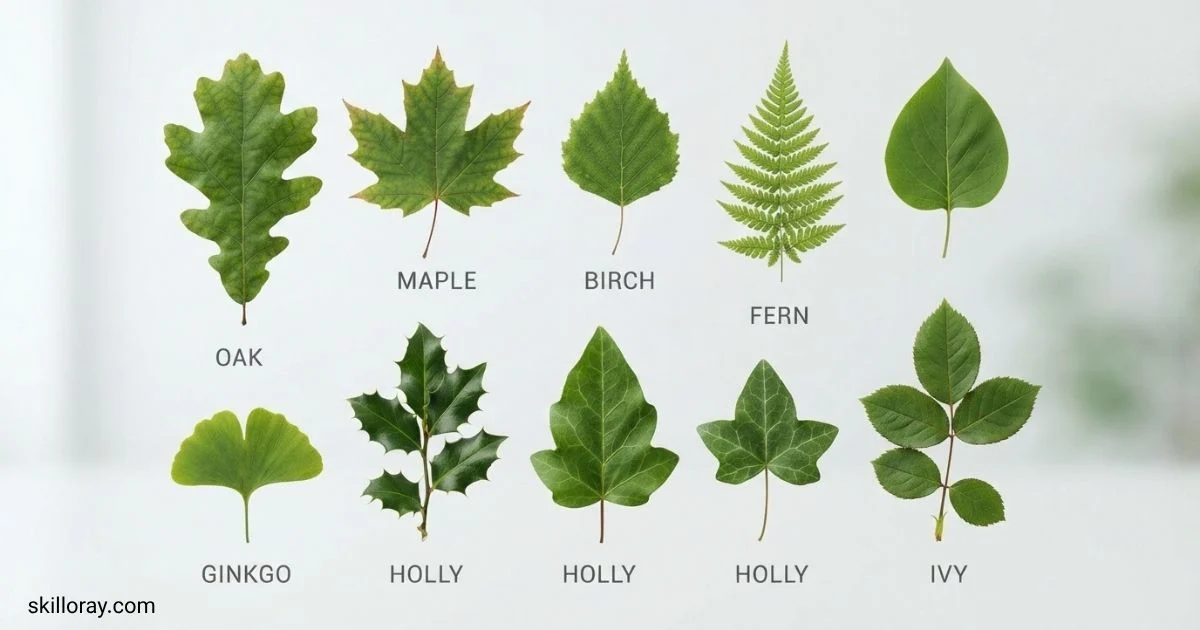
Have you ever paused while writing and wondered whether “leafs” or “leaves” is the correct word? I know how confusing small spelling differences can feel, especially when both forms look almost right.
You may already know that “leaves” is the usual plural of leaf, but “leafs” can appear in a specific context. Understanding why these forms differ can help you write with confidence and avoid a common grammar mistake.
In this guide, I’ll explain leafs or leaves in a simple way, with clear meanings, examples, and practical rules. By the end, you’ll know exactly when you should use each form.
Leafs or Leaves: (Quick Answer)
Both “leafs” and “leaves” are correct English words, but they have different uses. Use leaves as the standard plural of the noun leaf when referring to the green parts of plants or trees. Use leafs when referring to the verb leaf in the third-person singular or when writing an established proper name, such as the Toronto Maple Leafs.
Here’s a quick comparison:
| Word | Meaning or Usage | Example |
| Leaves | Plural noun referring to plant foliage | The leaves are turning yellow. |
| Leafs | Verb meaning turns pages or moves through pages | She leafs through the magazine. |
| Leafs | Part of a proper name | The Toronto Maple Leafs played last night. |
The easiest way to remember the distinction is to consider the sentence. If you’re talking about several parts of a plant, use leaves. If you’re describing someone turning pages or referring to a specific name, leafs may be correct.
What Does Leaf Mean?
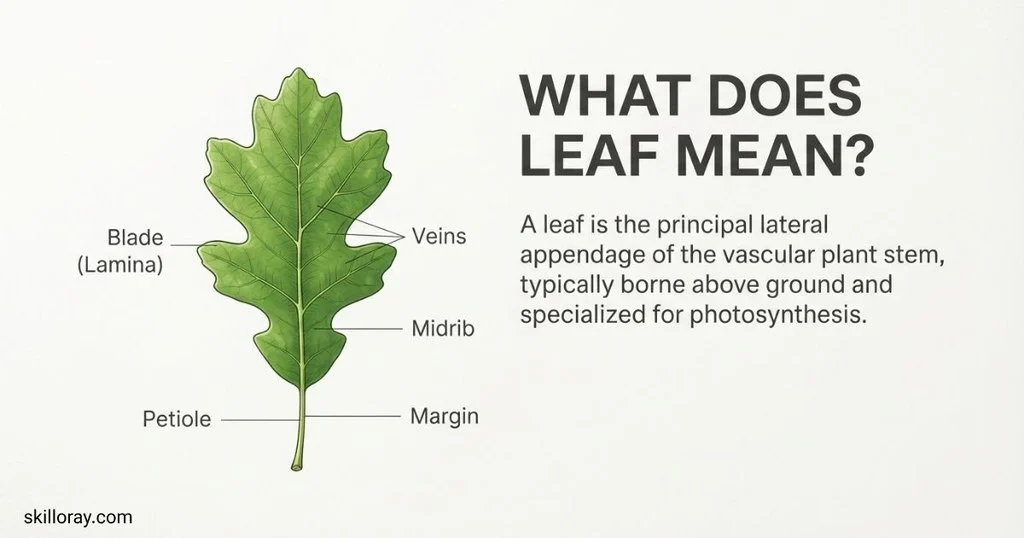
The word leaf is a noun that refers to the usually flat part of a plant that grows from a stem or branch. Leaves play an important role in photosynthesis, the process through which plants use sunlight to produce food.
However, the word leaf has other meanings, too. It can refer to a sheet in a book, a removable extension of a dining table, or a movable panel in a door or gate.
Here are some common uses:
- Plant: A green leaf grows from the branch.
- Book: The old book has a torn leaf.
- Table: The dining table has an extra leaf for guests.
- Door: The double door has two movable leaves.
- Metal: Gold leaf is used to decorate the frame.
When you refer to more than one of these items, leaves is generally the standard plural form.
Why Is the Plural of Leaf Leaves?
The plural of leaf is leaves because English has a group of nouns that change their final -f or -fe to -ves when they become plural.
Instead of adding only an s, the spelling changes slightly.
For example:
| Singular | Plural |
| Leaf | Leaves |
| Knife | Knives |
| Wife | Wives |
| Wolf | Wolves |
| Shelf | Shelves |
| Loaf | Loaves |
| Life | Lives |
This pattern is common, but it isn’t a rule that applies to every noun ending in f. For example, chief becomes chiefs, while roof usually becomes roofs.
That’s why you shouldn’t assume that every noun ending in f follows the same plural spelling pattern.
For leaf, however, the standard plural is leaves. This remains true whether you’re talking about a maple tree, a houseplant, a book, or a folding table.
How to Remember the Plural Rule
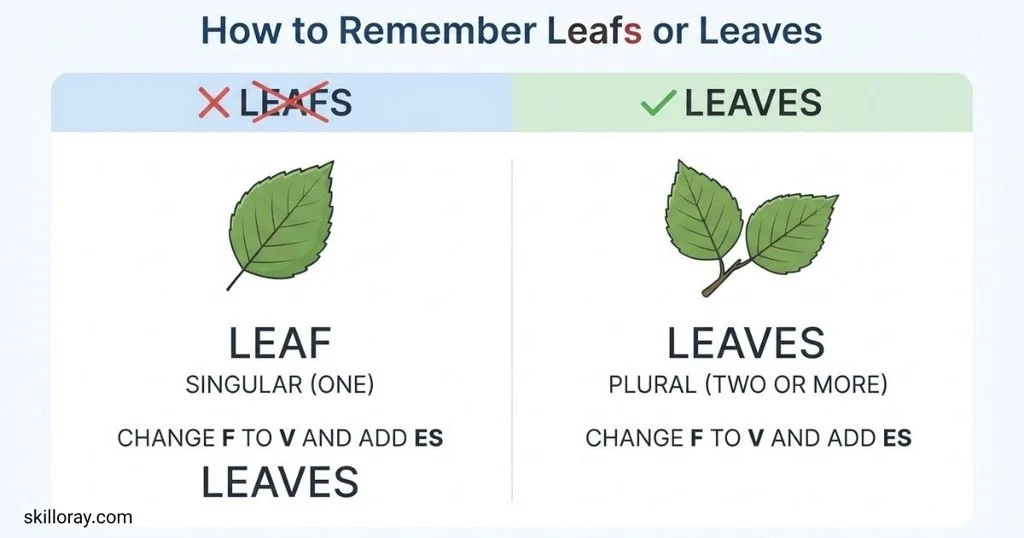
A simple way to remember the spelling is to learn the singular and plural forms together:
- One leaf, two leaves.
- One knife, two knives.
- One shelf, two shelves.
- One wolf, two wolves.
Reading these forms aloud can help you remember the spelling when writing sentences.
Leafs Meaning: When Is It Correct?
Although leaves is the standard plural noun, leafs is also a valid English word in specific situations.
1. Leafs as a Verb
Leafs is the third-person singular present-tense form of the verb leaf. It commonly describes someone turning or browsing through the pages of a book, magazine, or document.
Examples:
- She leafs through the magazine while waiting.
- He leafs through the old family album.
- My teacher leafs through the assignments before class.
- The librarian leafs through the catalog to find a title.
- Daniel leafs through the report before the meeting.
In these sentences, leafs describes an action. It doesn’t refer to multiple plant leaves.
The verb can also describe a plant developing leaves, although expressions such as leafs out are more specialized.
For example:
- The young tree leafs out in spring.
- The plant leafs out when the weather becomes warmer.
2. Leafs in Proper Names
Leafs also appears in established proper names. A well-known example is the Toronto Maple Leafs, a professional ice hockey team.
Examples:
- The Toronto Maple Leafs have a large fan base.
- My brother bought a Toronto Maple Leafs jersey.
- The Maple Leafs played a home game last night.
The team’s official name uses Leafs, so you should preserve that spelling when referring to the team.
A proper name doesn’t have to follow the usual plural spelling rule for the underlying noun.
3. Leafs as a Technical or Specialized Plural
In some specialized contexts, leafs may appear as a plural noun, particularly when referring to movable panels or particular technical structures. You may encounter it in older documents, technical descriptions, or specialized terminology.
However, leaves remains the safer, more widely accepted choice in ordinary writing when referring to multiple items called a leaf.
For schoolwork, professional writing, or general English, use the standard plural unless a specific technical convention or official name requires another form.
Leafs or Leaves Pronunciation
The words leafs and leaves look similar, but their final sounds are different.
| Word | IPA Pronunciation | Simple Pronunciation |
| Leafs | /liːfs/ | leefs |
| Leaves | /liːvz/ | leevz |
| Leaf | /liːf/ | leef |
All three forms begin with the same long ee sound.
The main difference is at the end:
- Leafs: Ends with an unvoiced /fs/ sound.
- Leaves: Ends with a voiced /vz/ sound.
- Leaf: Ends with an unvoiced /f/ sound.
To pronounce leaves, place your upper teeth lightly against your lower lip and make a voiced /v/ sound before finishing with /z/.
For leafs, use the unvoiced /f/ sound followed by /s/.
Which Pronunciation Should You Use?
Use the pronunciation that matches the spelling and grammatical role of the word in your sentence.
For example:
- The leaves are green. Pronounce leaves as “leevz.”
- She leafs through a book. Pronounce leafs as “leefs.”
- One leaf fell from the tree. Pronounce leaf as “leef.”
Practicing these sentences aloud can help you recognize the difference naturally.
Is It Leafs or Leaves on a Tree?
When talking about a tree, leaves is the correct plural form.
Examples:
- The tree has thousands of green leaves.
- The leaves turn orange in autumn.
- New leaves appeared after the rain.
- Strong winds blew the leaves across the yard.
- The branches were covered with fresh leaves.
You should not normally write leafs when describing the foliage on a tree.
Incorrect: The tree has lost most of its leafs.
Correct: The tree has lost most of its leaves.
The same rule applies to flowers, shrubs, vegetables, houseplants, and other plants.
What About Maple Leafs or Maple Leaves?
Use maple leaves when referring to the foliage of a maple tree.
For example:
- The maple leaves turned bright red.
- We collected maple leaves during our walk.
- The ground was covered with fallen maple leaves.
Use Maple Leafs when referring to the Toronto hockey team.
The context determines which form you need.
Door Leafs or Leaves: Which Is Correct?
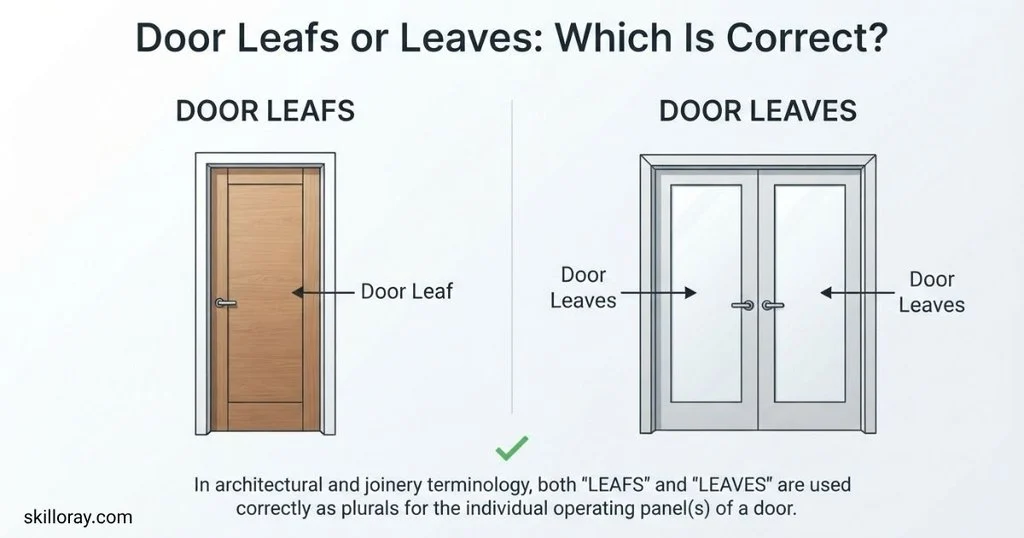
When referring to the movable panels of a door, door leaves is the standard plural form in general English and architectural terminology.
A door leaf is one movable panel within a door assembly. A single door may have one leaf, while a double door may have two.
Examples:
- The building has two large door leaves.
- Each door leaf must fit securely within the frame.
- The contractor replaced the damaged door leaves.
- The entrance has a pair of glass door leaves.
- The fire-rated door leaves must meet the required specifications.
In technical documents, you may occasionally see door leafs, but door leaves is the conventional plural in standard writing.
Is It Door Leafs or Door Leaves in Technical Writing?
For ordinary writing, product descriptions, construction reports, and most architectural documents, choose door leaves.
For example:
Less conventional: The door leafs require replacement.
Standard: The door leaves require replacement.
If a manufacturer or a specific technical document uses an established term, follow its terminology when reproducing that source. Otherwise, door leaves is the appropriate choice.
Gate Leafs or Leaves: Which Form Should You Use?
The same general rule applies to gates. When leaf refers to a movable panel of a gate, its conventional plural is leaves.
A single-leaf gate has one movable panel, while a double-leaf gate has two panels that typically open from the center.
Examples:
- The property has a double-leaf entrance gate.
- Both gate leaves need adjustment.
- The metal gate has two heavy leaves.
- One gate leaf opens toward the driveway.
- The installer checked the alignment of the gate leaves.
In technical specifications, gate leaf is a useful term for an individual panel. When referring to multiple panels, gate leaves is the usual standard form.
You may encounter gate leafs in specialized material, but it isn’t the preferred spelling for general English writing.
Table Leafs or Leaves: What Is the Correct Spelling?
When talking about an extension panel used to enlarge a dining table, the standard plural is table leaves.
A table leaf is an additional section that can be inserted into a table to increase its length or seating capacity. Some tables have one extension leaf, while others have several.
Examples:
- The dining table has two removable leaves.
- We stored the table leaves in a cupboard.
- The antique table came with an extra leaf.
- She inserted the table leaves before dinner.
- The wooden leaves made the table large enough for the family.
Why Do People Search for Table Leafs?
The confusion comes from the fact that most English nouns form their plural by adding -s. Since the singular word is leaf, it may seem logical to write leafs.
However, the established plural is leaves in this furniture-related meaning, just as it is for the foliage of a plant.
For standard writing, use:
- One table leaf
- Two table leaves
- Several table leaves
This spelling is appropriate for furniture descriptions, online product listings, instruction manuals, and everyday conversations.
Leafs or Leaves: Examples in Sentences
The easiest way to understand the correct usage is to see each word in context. The following examples cover plants, furniture, books, proper names, and verb usage.
Examples of Leaves as a Plural Noun
- The leaves on the oak tree turned brown.
- Fresh leaves covered the garden after the storm.
- I collected colorful leaves during my walk.
- The plant needs enough sunlight to grow healthy leaves.
- The maple leaves looked beautiful in autumn.
- She placed dried leaves inside her notebook.
- The tea leaves settled at the bottom of the cup.
- The dining table has three removable leaves.
- The double doors have two separate leaves.
- The gate leaves were painted black.
Examples of Leafs as a Verb
- She leafs through the newspaper every morning.
- He leafs through the textbook before an exam.
- My father leafs through old photographs on weekends.
- The editor leafs through the manuscript before publication.
- The student leafs through the notes to find an answer.
- She leafs through the catalog to choose a gift.
- The young plant leafs out in warm weather.
- The tree leafs out earlier than expected.
Examples of Leafs in Proper Names
- The Toronto Maple Leafs are based in Toronto.
- He follows the Maple Leafs throughout the season.
- She wore a Toronto Maple Leafs cap.
- The Maple Leafs logo appeared on the merchandise.
These examples show that leafs isn’t always incorrect. Its appropriateness depends on whether it functions as a verb, appears in an official name, or is used in a specialized context.
Common Mistakes When Using Leafs or Leaves
Even experienced English writers can hesitate over irregular plurals. Here are some common mistakes to watch for.
Mistake 1: Using Leafs as the Plural of Leaf
Incorrect: The garden was covered with fallen leafs.
Correct: The garden was covered with fallen leaves.
Use leaves when referring to multiple plant leaves.
Mistake 2: Using Leaves as a Verb for Turning Pages
Incorrect: She leaves through the magazine while waiting.
Correct: She leafs through the magazine while waiting.
In this example, leafs describes the action of browsing through pages. The word leaves is usually a form of the verb leave, which has a different meaning.
Mistake 3: Changing an Official Name
Incorrect: The Toronto Maple Leaves played last night.
Correct: The Toronto Maple Leafs played last night.
The spelling of an official team name should remain unchanged.
Mistake 4: Using Leafs for Table Extensions
Less conventional: The dining table has two extra leafs.
Standard: The dining table has two extra leaves.
When referring to table extension panels, leaves is the conventional plural.
Mistake 5: Assuming Every Word Ending in F Changes to VES
English plural rules have exceptions. For example, chief becomes chiefs, while leaf becomes leaves.
Learn the plural form of each word rather than applying one rule to every noun ending in f.
How to Remember Leafs or Leaves
Here are three simple ways to remember which spelling to use.
1. Think about plants. If you’re describing several plant leaves, use leaves.
2. Think about actions. If someone is browsing through a book, use leafs.
3. Remember official names. If you’re referring to the Toronto Maple Leafs, preserve the team’s spelling.
You can also use this simple memory sentence:
Trees have leaves, readers leafs through pages, and hockey fans support the Maple Leafs.
For natural grammar, remember that leafs through pages is the verb expression. In the sentence above, readers leafs should actually be readers leaf through pages, because the subject readers is plural.
A grammatically correct version is:
Trees have leaves, readers leaf through pages, and hockey fans support the Maple Leafs.
This sentence demonstrates the three different contexts in which the words appear.
Frequently Asked Questions
1. Is It Leafs or Leaves?
Leaves is the standard plural of leaf when referring to multiple plant leaves, book leaves, table extensions, or door panels. Leafs is correct as a verb, as in “She leafs through a book,” or as part of an official name, such as the Toronto Maple Leafs.
2. How Do You Spell the Plural of Leaf?
The correct spelling is leaves. The word changes from leaf to leaves instead of simply adding an s. For example, “One leaf fell from the tree” becomes “Several leaves fell from the tree.”
3. Why Does Leaf Become Leaves?
English has an irregular plural pattern in which certain nouns ending in -f change to -ves. This is why leaf becomes leaves, just as knife becomes knives and shelf becomes shelves. However, not every noun ending in -f follows this pattern.
4. Is Leafs a Real Word?
Yes, leafs is a real English word. It is the third-person singular present-tense form of the verb leaf, meaning to browse through pages or, in some contexts, to develop leaves. It also appears in proper names such as the Toronto Maple Leafs.
5. Is It Leafs or Leaves on a Tree?
Use leaves when referring to the foliage on a tree. For example, “The tree has green leaves.” The spelling leafs isn’t the standard plural for plant foliage.
6. Is It Leafs or Leaves for a Table?
Use leaves when referring to removable extension panels on a dining table. For example, “The table has two extra leaves.” This is the conventional spelling in standard English.
7. Is It Door Leafs or Door Leaves?
Door leaves is the standard plural in general English and architectural writing. A door leaf refers to one movable panel within a door assembly. For example, “The double doors have two door leaves.”
8. Is It Gate Leafs or Gate Leaves?
Gate leaves is the conventional plural when referring to movable gate panels. For example, “Both gate leaves need adjustment.” Use this spelling in ordinary writing unless a specific technical convention requires another form.
9. Are Leafs or Leaves Pronounced Differently?
Yes. Leafs is pronounced /liːfs/, which sounds like “leefs.” Leaves is pronounced /liːvz/, which sounds like “leevz.” The main difference is the final consonant sounds: /fs/ in leafs and /vz/ in leaves.
10. Is It Toronto Maple Leafs or Toronto Maple Leaves?
The official team name is Toronto Maple Leafs. Use that exact spelling when referring to the professional hockey team. When talking about the foliage of a maple tree, use maple leaves instead.
Conclusion
The choice between leafs or leaves becomes much easier once you understand the grammatical role of the word.
Leaves is the standard plural of leaf. Use it when talking about trees, plants, table extensions, door panels, gate panels, or sheets in a book.
Leafs is correct when used as a verb, such as “She leafs through a magazine,” or as part of an official name, such as the Toronto Maple Leafs.
Remember the basic rule: one leaf, several leaves. If you’re writing about plant foliage or ordinary objects called leaves, leaves is the spelling you will usually need.

I am Daniel Carter, a grammar enthusiast and language educator with over 10 years of experience helping students and professionals improve their English writing and communication skills. I enjoy simplifying complex grammar rules into easy-to-understand lessons that anyone can follow. My goal is to help learners write with confidence, avoid common mistakes, and develop strong communication skills for academic and professional success. I regularly create practical grammar guides, writing tips, and language resources that make learning both enjoyable and effective.
Books: Mastering English Grammar and The Complete Guide to Better Writing
 James Walker
 Olivia Brown