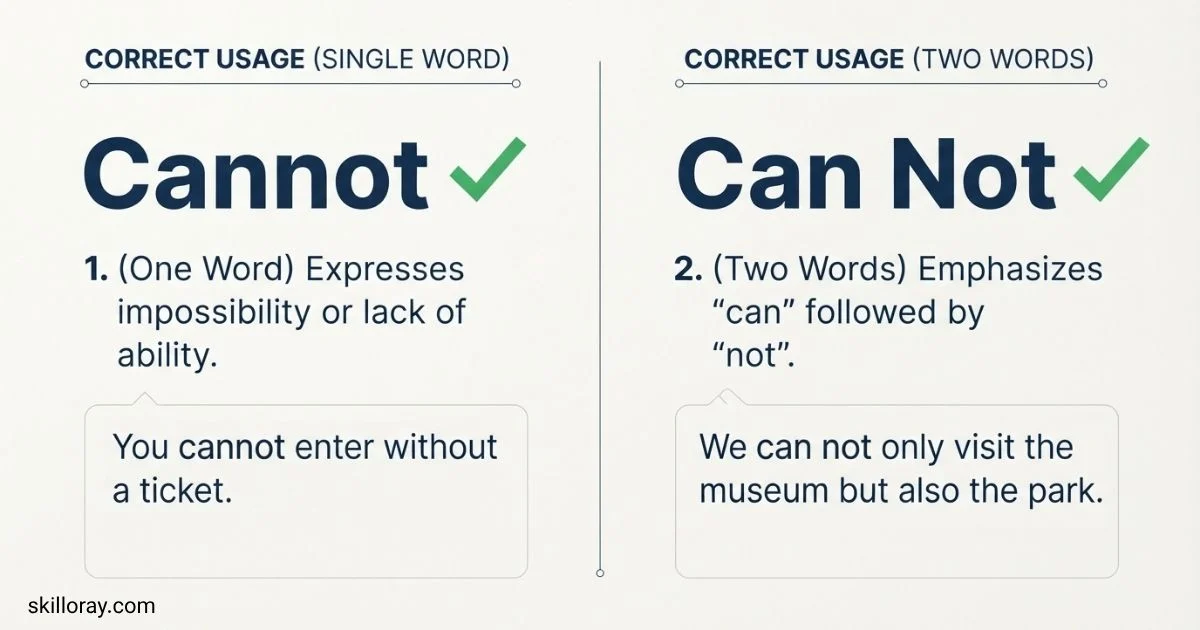
Have you ever paused while writing because you were unsure whether to use “can not” or “cannot”? I know how confusing these two forms can seem, especially when both appear in English writing.
You want your sentence to sound natural and grammatically correct, but the small difference can make you second-guess yourself. I’ll break it down in a simple way so you can use the right form with confidence.
By the end, you’ll understand when to write “cannot” and when “can not” may be appropriate. You’ll also see clear examples that make the rule easy to remember.
What Does Cannot Mean?
Cannot is the negative form of the modal verb can. It expresses an inability, a lack of permission, or something that is not possible.
It is written as one word, without a space or an apostrophe. The shorter form is can’t, which is common in everyday conversation.
Here are the main ways to use cannot:
- Inability: I cannot swim very well.
- Impossibility: This cannot be the correct answer.
- Lack of permission: Visitors cannot enter this room.
- Logical conclusion: She cannot be at home because I just saw her at the library.
- General limitations: We cannot control every situation in life.
In each example, cannot makes the statement negative. It tells the reader that an action is not possible, is not permitted, or is not believed to be true.
What Does Can Not Mean?
Can not is a legitimate two-word construction in English, but it is less common than cannot. It is useful when not belongs to a separate grammatical structure or when the writer wants to emphasize the option of not doing something.
For example:
- Not only: She can not only read Spanish but also speak it fluently.
- A choice: You can attend the meeting, or you can not attend if you are busy.
- Emphasis: I can NOT believe how quickly the year has passed! (Informal, emphatic writing.)
The first example uses the established expression not only … but also. The second presents two possible choices. The third uses capitalization for emotional emphasis, which is more suitable for casual writing than formal documents.
The important point is that can not is not automatically a spelling mistake. Its suitability depends on the sentence’s grammatical structure and intended meaning. The Language Portal of Canada explains these distinctions in its official writing guidance.
Can Not or Cannot: Which Is Correct?
Both forms are correct, but cannot is the usual spelling when you mean “am not able to,” “is not possible,” or “is not permitted to.” Use can not when the construction specifically calls for the separate word not.
| Form | Main use | Example |
| Cannot | Standard negative form of can | I cannot attend today. |
| Can not | Part of a separate grammatical construction | She can not only sing but also dance. |
| Can not | Emphasizing a choice not to act | You can help, or you can not help. |
| Can’t | Informal contraction of cannot | I can’t attend today. |
When Should You Use Cannot?
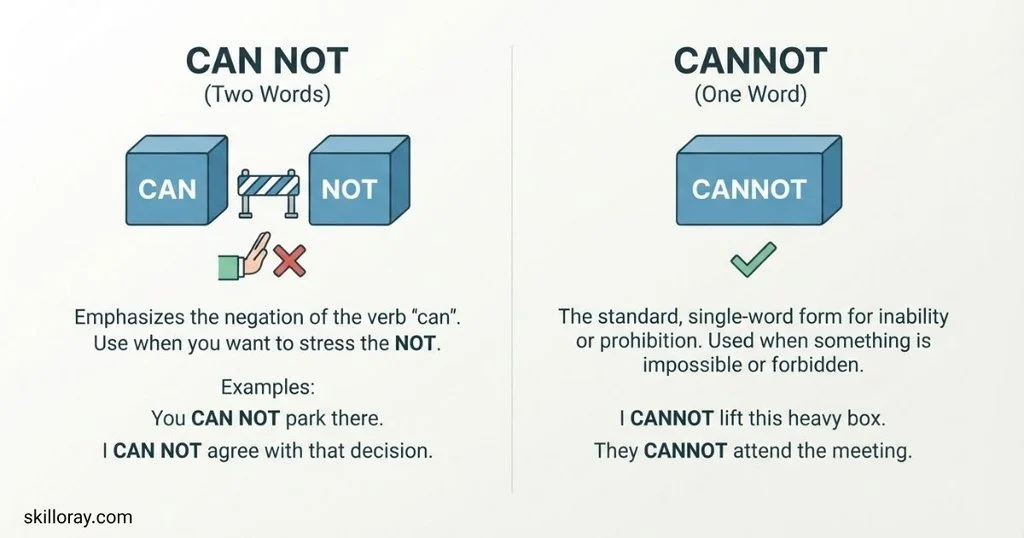
Choose cannot for most negative statements in everyday writing, school assignments, professional emails, academic papers, and formal documents.
Examples:
- We cannot accept applications after the deadline.
- I cannot understand the instructions.
- You cannot park your car here.
- The results cannot be confirmed yet.
- Students cannot use their phones during the examination.
These sentences express inability, prohibition, or impossibility. The one-word spelling is the conventional choice.
When Should You Use Can Not?
Use can not when the grammar or intended meaning calls for two separate words.
Examples:
- She can not only cook but also bake.
- You can choose to participate, or you can not participate.
- I can decide not to join the discussion.
In the final example, not belongs to the phrase not to join. The sentence expresses a choice rather than simply stating an inability.
When a sentence feels awkward or confusing, consider rewriting it for clarity. For instance, “You can choose whether to participate” is often simpler than “You can participate, or you can not participate.”
Can Not or Cannot in a Sentence: 10 Examples
The following sentences show how the two forms work in natural English.
- I cannot attend the class tomorrow because I have another appointment.
- We cannot finish this project without the required information.
- She cannot believe how much her English has improved.
- You cannot enter the building without permission.
- They cannot find the address on the map.
- He can not only play the guitar but also compose his own music.
- You can stay at home, or you can not attend the event if you prefer.
- The team cannot complete the task before the deadline.
- Students cannot submit their work after the portal closes.
- She can not only understand the instructions but also explain them to others.
Notice that most examples use cannot. The two-word form appears where not has a separate grammatical role or where the sentence explicitly presents a choice.
Can Not or Cannot Wait: Which Is Correct?
“Cannot wait” is the standard expression when you are excited about something or eager for it to happen.
For example:
- I cannot wait to see you tomorrow.
- We cannot wait for the holidays to begin.
- She cannot wait to start her new job.
- I can’t wait to hear your news.
In these sentences, cannot wait expresses excitement, anticipation, or eagerness.
You may occasionally see can not wait in creative writing or a sentence that emphasizes the option of not waiting. However, when expressing enthusiasm, write cannot wait or the conversational contraction can’t wait.
Is Cannot Wait Grammatically Correct?
Yes. The construction consists of the modal verb can, its negative form cannot, and the base verb wait. The verb wait remains in its base form.
Correct: I cannot wait to visit my grandparents.
Incorrect: I cannot to wait to visit my grandparents.
After can or cannot, use the base form of the following verb without to. The phrase to visit is correct because it follows wait, not cannot.
Can Not or Cannot in British English
In British English, cannot is the standard spelling for the negative form of can. The two-word form can not is also possible in specific grammatical contexts.
Examples in British English:
- I cannot come to the office today.
- You cannot leave your luggage unattended.
- She can not only speak English but also understand French.
The same general spelling principles apply in British English, American English, Canadian English, and Australian English. There is no major regional spelling distinction that requires British writers to use can not while American writers use cannot.
If you are writing for a British audience, use cannot in ordinary negative statements unless the sentence structure calls for can not.
Can Not or Cannot in American English
American English generally uses cannot as the standard negative form of can. The contraction can’t is also widely used in conversational writing.
Examples:
- I cannot access my account.
- We cannot change the booking.
- You cannot park in this area.
- I can’t remember his name.
American writers may use can not in constructions such as can not only … but also. However, using two words in a simple negative statement is generally unnecessary.
For example:
Preferred: I cannot attend the conference.
Less conventional for this meaning: I can not attend the conference.
Both may be understood, but cannot is the conventional choice for standard American English writing.
Can Not or Cannot in IELTS
For IELTS Writing Task 1, Writing Task 2, or other formal English assessments, use cannot when expressing inability, impossibility, or prohibition.
IELTS assesses language accuracy, grammatical range, vocabulary, coherence, and other writing skills. Choosing the conventional spelling helps you produce clear, standard written English.
Examples suitable for formal writing:
- Governments cannot solve every environmental problem independently.
- Individuals cannot prevent all forms of pollution.
- Students cannot develop strong writing skills without regular practice.
- A single study cannot provide a complete explanation of a complex issue.
- Economic growth cannot guarantee equal opportunities for everyone.
Use can not when the grammatical construction genuinely requires it, such as in can not only improve but also transform. Do not insert a space simply to make a sentence look more formal.
Can Not or Cannot in Academic Writing
In academic writing, cannot is normally the preferred form for a straightforward negative statement. It is concise, familiar, and consistent with standard English usage.
Consider these examples:
| Sentence | Explanation |
| The findings cannot establish causation. | Standard negative form |
| This method cannot account for every variable. | Standard negative form |
| The results can not only support the hypothesis but also reveal limitations. | Correct not only … but also construction |
| Researchers cannot draw a firm conclusion from limited evidence. | Standard negative form |
Academic writers should focus on grammatical accuracy, consistency, and clarity rather than trying to make the writing sound formal by avoiding contractions alone.
For most academic papers, use cannot in the main text. If your institution or publisher provides a style guide, follow its specific requirements. Avoid using can’t in formal academic prose unless the context calls for a conversational tone or a direct quotation.
Can Not or Cannot According to Oxford and AP Style
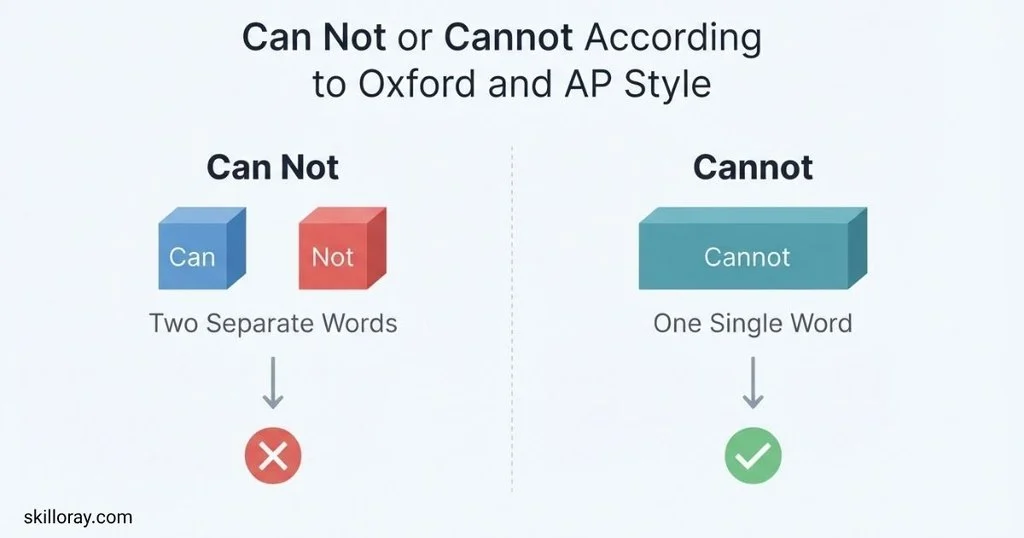
When writing for publication, the safest approach is to follow the relevant dictionary or editorial style guide.
The general grammatical guidance is straightforward:
- Cannot: The conventional negative form of can.
- Can not: Appropriate in constructions where not functions separately, such as not only … but also.
- Can’t: The contracted form of cannot, generally more conversational.
The Chicago Manual of Style explains that cannot is the negative form of can, while can not may be appropriate in particular constructions.
For AP-style or Oxford-style editing, consult the current edition or official guidance if you need to comply with a particular publication’s rules. Regardless of the style guide, using cannot for ordinary negative statements is a reliable default.
Can Not or Cannot Synonyms
If you want to avoid repeating cannot, you can use another expression that preserves the intended meaning. The most suitable synonym depends on the context.
| Alternative | Meaning | Example |
| Can’t | Informal negative form | I can’t attend the event. |
| Am unable to | Lack of ability | I am unable to access the file. |
| Is unable to | Lack of ability | She is unable to travel today. |
| Is not able to | Inability | He is not able to complete the task. |
| Must not | Prohibition or obligation not to act | Visitors must not enter this area. |
| Is impossible to | Something cannot be done | It is impossible to finish everything in one minute. |
| May not | Lack of permission or possibility, depending on context | You may not enter without authorization. |
These expressions are not always interchangeable. For example, must not usually communicates a prohibition, whereas cannot may describe either a prohibition or an inability.
Choose the expression that conveys your intended meaning rather than replacing cannot mechanically.
How to Pronounce Cannot or Can Not
The pronunciation of cannot is generally the same as the pronunciation of can not when the two words are used in a sentence. However, speakers may emphasize not when they want to stress a choice or contrast.
Common pronunciation:
- Cannot: /ˈkæn.ɒt/ in many British pronunciations.
- Cannot: /ˈkæn.ɑːt/ or /ˈkæn.ɑːt/ with regional variation in American English.
- Can’t: /kænt/ in many accents, with some regional differences.
The exact vowel sound varies by accent. In ordinary speech, cannot is often pronounced as two syllables: can-not.
Examples:
- I cannot swim. — A regular negative statement.
- I can NOT attend. — The word not receives extra emphasis.
- I can’t swim. — A shorter, conversational form.
The spelling choice does not usually change the basic pronunciation. Sentence stress, however, can affect how a listener understands the speaker’s intended meaning.
Common Mistakes When Using Cannot or Can Not
Although the spelling rule is simple, several mistakes occur frequently in everyday writing.
1. Adding a Space in an Ordinary Negative Sentence
Incorrect: I can not understand this question.
Preferred: I cannot understand this question.
The first version may be acceptable in a context that emphasizes a separate not, but cannot is the conventional spelling for an ordinary statement of inability.
2. Adding “To” After Cannot
Incorrect: She cannot to finish her homework.
Correct: She cannot finish her homework.
The modal verb can takes the base form of the following verb without to.
3. Using “Do Not Can”
Incorrect: I do not can speak French.
Correct: I cannot speak French.
The negative form of can is cannot or can’t. Do not use do or does to form its ordinary negative.
4. Confusing Cannot With Can’t
Both forms express a negative meaning, but they differ in style.
- Formal: I cannot attend the meeting.
- Conversational: I can’t attend the meeting.
Use cannot when you want a more formal tone. Use can’t in casual conversations, informal messages, or dialogue when appropriate.
5. Misusing Can Not Only
Incorrect: She can not only speaks English but also writes it well.
Correct: She can not only speak English but also write it well.
After can, use the base form of the verb. In a not only … but also construction, keep the grammatical structure parallel where possible.
Cannot or Can Not Quiz
Test your understanding with these five questions. Choose the spelling that best fits each sentence.
1. I _____ attend the appointment tomorrow.
cannot
can not
2. She can _____ only sing but also dance.
not
cannot
3. We _____ complete the work without more information.
cannot
can not
4. You can choose to join us, or you can _____ join us.
not
cannot
5. He _____ wait to see the results.
cannot
can not
Check Answers
Frequently Asked Questions
1. Is It Can Not or Cannot?
Both forms are grammatically possible, but cannot is the standard spelling for ordinary negative statements. Use can not when not belongs to a separate construction, such as can not only … but also.
2. Is Cannot One Word?
Yes. Cannot is conventionally written as one word when expressing inability, impossibility, or lack of permission. It does not contain a space or an apostrophe.
3. Is Can Not Ever Correct?
Yes. Can not is correct in specific grammatical contexts. For example, “She can not only read the language but also write it.” It can also express the option of not doing something.
4. Is Cannot More Formal Than Can’t?
Generally, yes. Cannot is the full form and is often preferred in formal or academic writing. Can’t is a contraction commonly used in conversation, informal emails, and dialogue.
5. Should I Use Cannot in a Formal Email?
Yes, cannot is a suitable choice for formal emails when expressing inability or explaining a restriction.
Example: “Unfortunately, I cannot attend the scheduled meeting.”
6. Is Cannot Correct in British English?
Yes. Cannot is standard in British English. The same basic spelling convention applies in American English, Canadian English, and Australian English.
7. Is Cannot Wait Grammatically Correct?
Yes. Cannot wait is a common expression used to communicate eagerness or excitement about an upcoming event.
Example: “I cannot wait to start my new course.”
8. Is Cannot Acceptable in Academic Writing?
Yes. Cannot is appropriate in academic writing for expressing impossibility, inability, or a limitation. Follow any specific spelling or style requirements set by your institution or publisher.
9. What Is the Difference Between Cannot or Can’t?
Cannot is the full negative form of can, while can’t is its contraction. Both generally express the same negative meaning, but the full form is often preferred in formal writing.
10. What Is the Opposite of Cannot?
The affirmative form can is the usual opposite of cannot. Depending on the context, alternatives include is able to, is permitted to, or is possible to.
For example:
- Negative: I cannot attend the class.
- Affirmative: I can attend the class.
Conclusion
When deciding whether to write can not or cannot, remember that cannot is the standard choice for most negative statements. It expresses inability, impossibility, or a lack of permission and is appropriate for everyday communication, professional documents, academic writing, and IELTS responses.
Use can not when the sentence requires a separate not, particularly in constructions such as can not only … but also, or when expressing a choice not to do something. If you’re unsure which form fits your sentence, choose cannot for an ordinary negative statement.
Understanding this simple grammar rule will help you write more clearly, avoid common spelling mistakes, and use English with greater confidence.

I am Olivia Brown, a professional English editor and grammar writer who believes that great writing begins with a strong foundation in grammar. I have spent years creating educational resources that help students and professionals improve their writing, avoid common errors, and communicate more effectively. I strive to provide clear explanations and practical examples that make grammar easy to understand and apply.
Books: English Grammar Essentials and Modern Writing Success
 James Walker
 Daniel Carter