
Have you ever stopped while writing and wondered whether it should be travelling or traveling? I know this spelling difference can be confusing, especially when both forms appear in books, websites, and everyday writing.
You may see one spelling more often depending on where English is used. If you want a clear answer without complicated grammar rules, you’re in the right place.
I’ll explain the difference between travelling or traveling, where each form is used, and which spelling you should choose for American English.
Quick Meaning of Travelling or Traveling
| Feature | Travelling | Traveling |
| Standard spelling | British English | American English |
| Meaning | Moving from place to place | Moving from place to place |
| Pronunciation | Same | Same |
| Part of speech | Verb form | Verb form |
| Present participle | Travelling | Traveling |
| Past tense | Travelled | Traveled |
| Person who travels | Traveller | Traveler |
| Correct spelling? | Yes | Yes |
Both forms are grammatically correct. The main difference is regional spelling preference, so your choice should depend on your intended audience and the style of English you follow.
What Does Travelling or Traveling Mean?
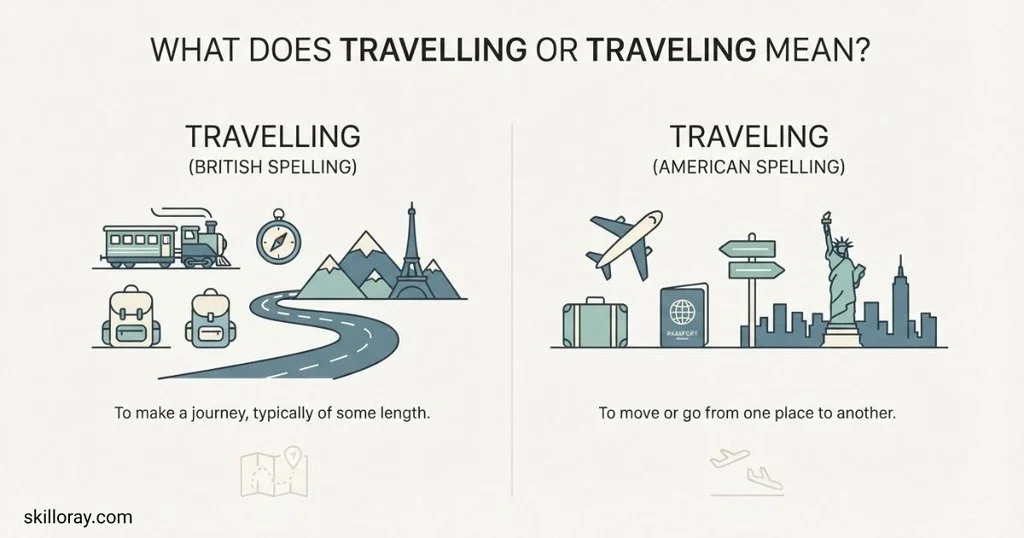
Travelling or traveling describes the action of moving from one place to another. This may involve a short journey, a long-distance trip, commuting, visiting another country, or moving between places for work.
The word comes from the verb travel. Adding the suffix -ing creates the present participle, which can appear in continuous verb tenses or function as a gerund.
For example:
- I am travelling to London next week.
- She is traveling across the United States.
- Travelling by train can be relaxing.
- He enjoys traveling to new places.
Each sentence is correct. The spelling changes according to the English variety, but the meaning remains the same.
Travelling or Traveling: Which Is Correct?
Both travelling or traveling are correct spellings. Use travelling when following British English spelling conventions and traveling when following American English conventions.
Here is a simple guide to choosing the appropriate spelling.
- Use travelling: When writing in British English, Australian English, or a Canadian style that follows the double-L convention.
- Use traveling: When writing in American English or following a US publication’s style guide.
- For international writing: Choose one spelling system and apply it consistently throughout your work.
Neither spelling is inherently incorrect. The important thing is to use the form that fits your audience or your chosen writing style.
Examples of Travelling in British English
- We are travelling to Scotland during the summer holidays.
- She enjoys travelling by train.
- Travelling abroad has helped him learn about other cultures.
- They were travelling through Europe when they received the news.
- I prefer travelling in the early morning.
Examples of Traveling in American English
- We are traveling to California next month.
- She enjoys traveling with her family.
- Traveling abroad has helped him learn about other cultures.
- They were traveling through the country when they received the news.
- I prefer traveling in the early morning.
Notice that the sentence structure, meaning, and grammar remain unchanged. Only the spelling differs.
Travelling or Traveling in British English
In British English, travelling with two Ls is the standard spelling. British spelling conventions generally double the final l in words such as travel when adding endings like -ing or -ed.
Examples include:
- I am travelling to Manchester tomorrow.
- We travelled to Wales last weekend.
- She is a frequent traveller.
- They are travelling by bus today.
- He enjoys travelling during the holidays.
The same spelling pattern appears in other words:
| Base word | British English form |
| Travel | Travelling |
| Cancel | Cancelling |
| Label | Labelling |
| Model | Modelling |
| Fuel | Fuelling |
These examples illustrate a common British spelling pattern, although the rules for doubling consonants can vary from word to word.
Travelling or Traveling in American English
In American English, traveling with one L is the standard spelling. American spelling conventions generally do not double the final L in travel when adding -ing because the stress falls on the first syllable.
Here are some examples:
- I am traveling to New York next week.
- We traveled across the country last summer.
- She is a frequent traveler.
- They are traveling for business.
- He enjoys traveling during his vacation.
American English follows this spelling pattern in related words as well:
| Base word | American English form |
| Travel | Traveling |
| Travel | Traveled |
| Travel | Traveler |
| Cancel | Canceling |
| Label | Labeling |
| Model | Modeling |
There are exceptions to American consonant-doubling patterns, so it is best to learn the conventional spelling of each word rather than assume that every verb follows the same rule.
Travelling or Traveling in Australia
In Australian English, travelling with two Ls is the usual spelling. Australian English generally follows British-style spelling conventions for this word.
For example:
- We are travelling to Sydney for our holiday.
- She loves travelling around Australia.
- They travelled along the coast last summer.
- My brother is travelling for work.
- Travelling by train is a convenient option.
If you are writing a school assignment, travel blog, email, or article for an Australian audience, travelling, travelled, and traveller are suitable choices.
Consistency is still important. If your organisation or publication has its own style guide, follow its instructions.
Travelling or Traveling in Canada
In Canadian English, travelling with two Ls is commonly used, although Canadian spelling includes some variation depending on the word and style guide.
Examples:
- We are travelling to Toronto this weekend.
- She travelled across Canada by train.
- He is a frequent traveller.
- They enjoy travelling during the summer.
- I am travelling to Vancouver for a conference.
For Canadian schoolwork or professional writing, travelling is a common and appropriate choice. If you are writing for a specific Canadian publication, check its preferred spelling style.
Travelling or Traveling in IELTS
Both travelling or traveling are accepted in IELTS when spelled correctly. IELTS does not require candidates to use only British English or only American English.
However, consistency is a useful writing habit. Choose one variety of English and maintain it throughout your response.
For example, if you choose British English, write:
- I enjoy travelling to different countries.
- We travelled by train last year.
- My favourite destination is London.
If you choose American English, write:
- I enjoy traveling to different countries.
- We traveled by train last year.
- My favorite destination is New York.
Both sets use correct spelling conventions. Avoid mixing regional forms unnecessarily within the same piece of writing.
For IELTS Speaking, the spelling distinction is not relevant to spoken answers. Focus on clear pronunciation, appropriate vocabulary, accurate grammar, and communicating your ideas effectively.
Travelling or Traveling Examples in Sentences
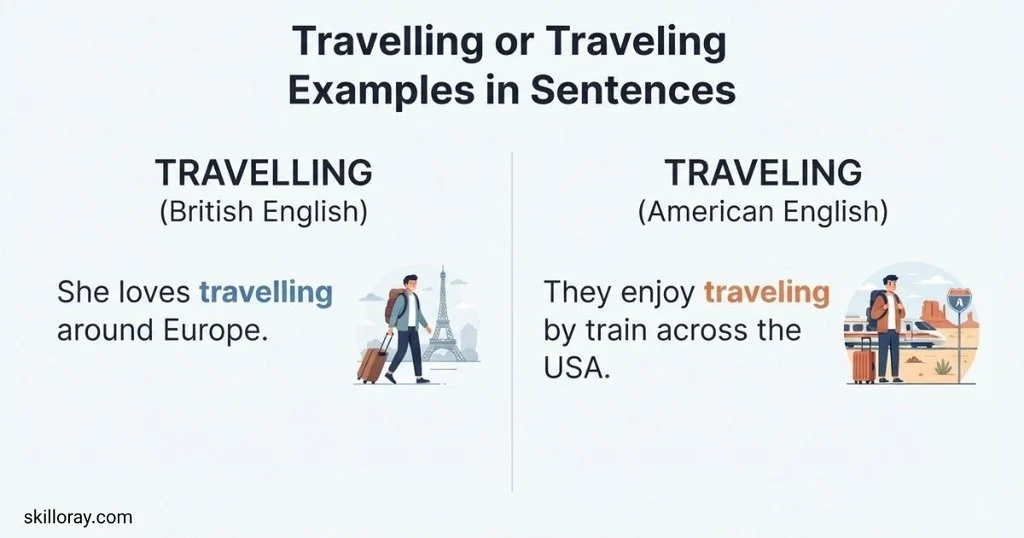
The following examples show how the word works in everyday English. The spelling used in each sentence depends on the intended regional style.
Examples Using Travelling
- I am travelling to another city tomorrow.
- She is travelling with her friends this summer.
- We were travelling when the weather suddenly changed.
- Travelling by train allows you to enjoy the scenery.
- My parents enjoy travelling to historical places.
- He has been travelling for several months.
- They are travelling abroad for educational purposes.
- Travelling alone can help people become more independent.
- The family was travelling through the countryside.
- She dreams of travelling around the world.
Examples Using Traveling
- I am traveling to another city tomorrow.
- She is traveling with her friends this summer.
- We were traveling when the weather suddenly changed.
- Traveling by train allows you to enjoy the scenery.
- My parents enjoy traveling to historical places.
- He has been traveling for several months.
- They are traveling abroad for educational purposes.
- Traveling alone can help people become more independent.
- The family was traveling through the countryside.
- She dreams of traveling around the world.
Both lists demonstrate correct usage. The sentences retain the same meaning regardless of which spelling convention you choose.
Travelling or Traveling: Verb Forms and Related Words
The spelling difference continues across several forms of the verb travel. Learning the related forms makes it easier to write consistently.
| Word form | British English | American English |
| Base verb | Travel | Travel |
| Present participle | Travelling | Traveling |
| Past tense | Travelled | Traveled |
| Past participle | Travelled | Traveled |
| Person who travels | Traveller | Traveler |
| Plural noun | Travellers | Travelers |
Present Participle
The present participle describes an ongoing action or can function as a gerund.
Examples:
- She is travelling through Italy.
- He is traveling across the state.
- Travelling helps me relax.
- Traveling can be an enjoyable experience.
Past Tense
The past tense describes an action that happened in the past.
Examples:
- We travelled to Edinburgh last year.
- We traveled to Boston last year.
- She travelled with her classmates.
- She traveled with her classmates.
Noun Form
The noun traveller or traveler describes someone who travels.
Examples:
- She is an experienced traveller.
- She is an experienced traveler.
- The travellers arrived early.
- The travelers arrived early.
Remember the pattern: British English usually uses a double L in these forms, while American English generally uses a single L in traveling, traveled, or traveler.
Travelling or Traveling: Pronunciation
Both spellings have essentially the same pronunciation. The extra L in travelling does not change the spoken word.
- Word: Travelling or traveling
- IPA: /ˈtræv.əl.ɪŋ/
- Syllables: trav-el-ing
- Stress: First syllable, TRAV
- Simple pronunciation: TRAV-uh-ling
You pronounce both forms in the same way in ordinary speech. Regional accents may affect the exact vowel sounds, but the spelling difference itself does not create a different pronunciation.
For English learners, the main point is to remember that the spelling changes according to regional conventions, not the sound or meaning.
Travelling or Traveling: Synonyms
If you want to avoid repeating the word travelling or traveling, you can use other expressions when they fit the sentence.
| Synonym or related expression | Meaning | Example |
| Journeying | Going from one place to another | They are journeying across the country. |
| Touring | Visiting several places | We are touring historic cities. |
| Commuting | Regularly travelling between home and work or school | She is commuting by train. |
| Exploring | Visiting places to discover more about them | He is exploring the countryside. |
| Roaming | Moving around without a fixed route | They are roaming through the old town. |
| Going abroad | Travelling to another country | We are going abroad this winter. |
| Taking a trip | Going somewhere for a particular purpose | I am taking a trip next week. |
These words are related in meaning, but they are not interchangeable in every sentence. Choose the expression that best describes the type of movement or journey.
Travelling or Traveling in Basketball
In basketball, traveling is the standard spelling used in American basketball terminology. The term refers to a violation involving illegal movement of the feet while holding the ball.
For example, a player may be called for traveling if they move their feet illegally while holding the ball without dribbling, according to the applicable rules.
You may also encounter travelling in writing that follows British English spelling conventions. However, if you are discussing basketball for an American audience, use traveling to match the usual terminology.
Examples:
- The referee called traveling during the game.
- The player was penalized for traveling.
- The coach explained the traveling violation to the team.
This sports usage has a specific meaning. It is related to the verb travel, but it describes a rule violation rather than an ordinary journey.
Common Mistakes When Using Travelling or Traveling
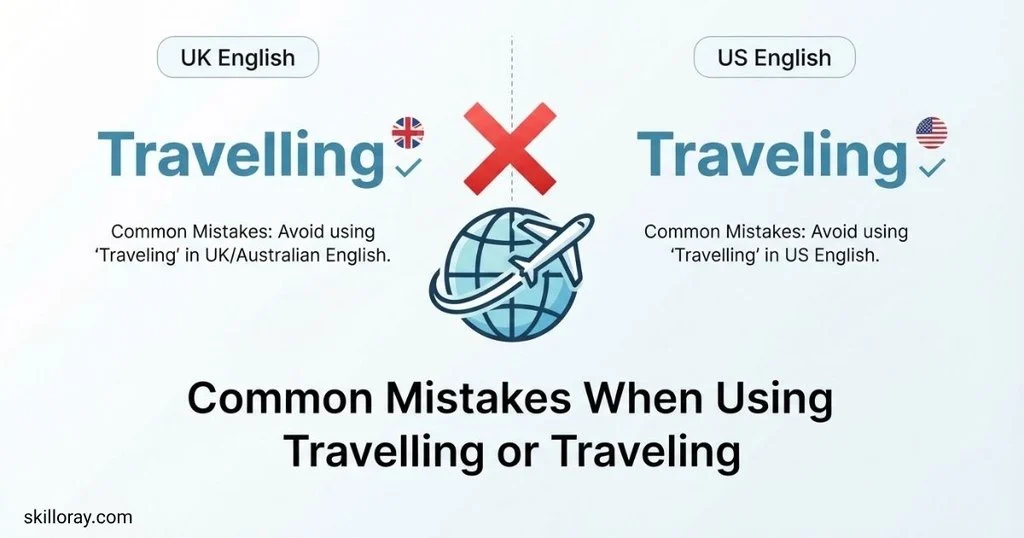
Although both spellings are correct, writers can make mistakes when choosing which form to use.
Mistake 1: Assuming One Spelling Is Always Wrong
Incorrect assumption: Traveling is always a spelling mistake.
Correct explanation: Traveling is standard American English, while travelling is standard British English.
The appropriate form depends on the writing convention you follow.
Mistake 2: Mixing Regional Spellings
For example, a paragraph might use travelling in one sentence but traveled in another.
This combination may look inconsistent if you are trying to follow one regional spelling system. In British English, travelled is generally preferred; in American English, traveled is standard.
Choose a consistent style for formal writing.
Mistake 3: Changing the Meaning Unnecessarily
Some learners think the double L changes the meaning of the word. It does not.
Both forms describe the same action. The difference is spelling, not grammar or meaning.
Mistake 4: Using the Wrong Related Form
Remember that travel is the base verb, while travelling or traveling can function as a present participle or gerund.
Examples:
- Correct: I travel to work every day.
- Correct: I am travelling to work today.
- Correct: I am traveling to work today.
- Incorrect: I am travel to work today.
The last sentence is incorrect because the continuous tense requires a form of be followed by the present participle.
Frequently Asked Questions
1. Is it travelling or traveling?
Both spellings are correct. Travelling is standard in British English, while traveling is standard in American English. Choose the spelling that matches your audience or preferred English style.
2. Is travelling a British spelling?
Yes. Travelling with two Ls is the standard British English spelling. The same spelling is commonly used in Australian English and Canadian English.
3. Is traveling an American spelling?
Yes. Traveling with one L is the standard American English spelling. The related forms are traveled and traveler.
4. Is travelling or traveling correct in Australia?
Travelling is the usual Australian English spelling. If you are writing for an Australian audience, use travelling, travelled, or traveller for consistency.
5. Can I use traveling in IELTS Writing?
Yes. Both traveling and travelling are accepted in IELTS Writing, provided the spelling is correct. It is good practice to maintain a consistent regional spelling style throughout your response.
6. Do travelling or traveling have different meanings?
No. Both spellings have the same meaning: moving from one place to another. The difference is based on regional spelling conventions rather than meaning or grammar.
7. Is travelling grammatically correct?
Yes. Travelling is grammatically correct when used appropriately as a present participle or gerund. For example, “She is travelling abroad” uses the present continuous tense.
8. How do you spell the past tense of travel?
The standard British spelling is travelled, while the standard American spelling is traveled. Both are correct within their respective spelling conventions.
9. Is travelling or traveling used in basketball?
Traveling is the usual spelling in American basketball terminology. It describes a violation involving illegal foot movement while a player holds the ball. Travelling may appear in writing that follows British spelling conventions.
10. Are travelling or traveling pronounced differently?
No. Both forms are normally pronounced the same way, with the stress on the first syllable: TRAV-uh-ling. The extra L affects the written form, not the pronunciation.
Conclusion
The choice between travelling or traveling depends on the English spelling convention you follow. Both forms are correct, carry the same meaning, and are pronounced essentially the same way.
Use travelling for British English, Australian English, and Canadian writing that follows the double-L convention. Use traveling for American English. For school assignments, professional documents, blog posts, or IELTS preparation, choose one spelling style and maintain it consistently.
Once you understand this regional spelling difference, you can use either form confidently without worrying that you are making a grammatical mistake.

I am James Walker, an English language specialist with extensive experience in grammar, editing, and academic writing. I enjoy helping students, bloggers, and professionals strengthen their writing by explaining grammar concepts in a clear and engaging way. My focus is on providing accurate, practical, and easy-to-follow guidance that helps learners communicate more effectively in everyday and professional situations.
Books: Perfect English Grammar Handbook and Advanced Writing Techniques
 Daniel Carter
 Olivia Brown