I know English word choices can feel confusing, especially when two phrases look almost identical. Apart or a Part is one of those small differences that can completely change the meaning of a sentence.
When you understand how each phrase works, you can write and speak with much more confidence. I’ll show you the difference in a simple way, so you can quickly recognize which one fits your sentence.
You don’t need complicated grammar rules to master this distinction. By the end, you’ll know when to use apart and when to use a part, with clear examples you can easily remember.
Apart or a Part: What Is the Difference?
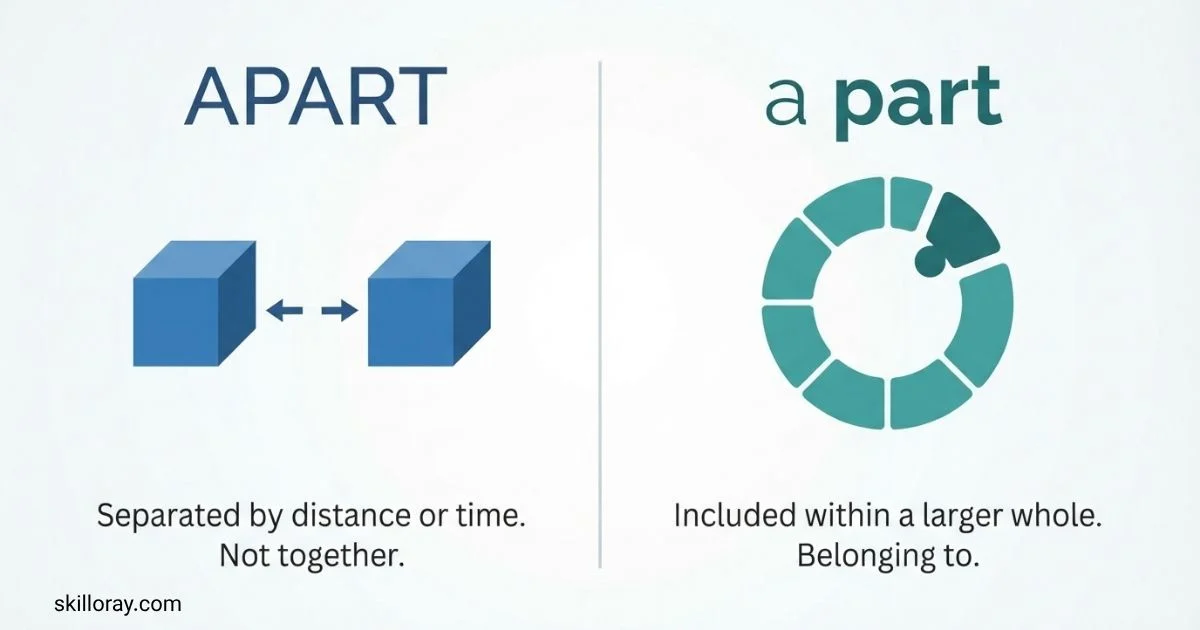
“Apart” means separated or at a distance, while “a part” means one piece of something or someone who belongs to a group. Both forms are correct English, but they serve different purposes in a sentence.
Here is a quick comparison:
| Expression | Meaning | Example |
| Apart | Separated or at a distance | The two friends live apart. |
| A part | A piece of something or a member of a group | I am a part of the team. |
| Falling apart | Breaking down or becoming disorganized | My old shoes are falling apart. |
| Being a part | Belonging to or participating in something | I enjoy being a part of this community. |
| Set apart | To distinguish something from others | Her kindness sets her apart. |
The easiest way to remember the distinction is to focus on the meaning. If you mean separation, use apart. If you mean belonging or inclusion, use a part.
What Does “Apart” Mean?
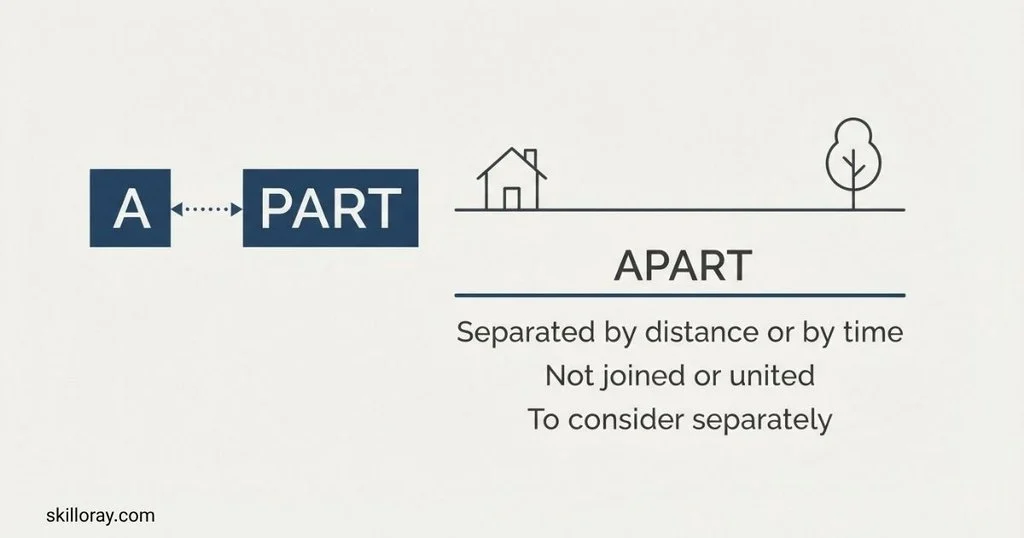
“Apart” is an adverb that describes something separated from another thing, physically or figuratively. It can refer to distance, differences, separation, or the process of breaking into pieces.
When to Use “Apart”
Use “apart” when you want to describe:
- Physical distance between people or objects.
- People who live or spend time separately.
- Differences between two things.
- Something that is breaking down or coming to pieces.
- A person or thing that stands out from others.
Examples of “Apart” in Sentences
- My best friend and I live miles apart.
- The two buildings are only a few feet apart.
- Their opinions are far apart.
- The old wooden chair is falling apart.
- The difficult experience pulled the family apart.
- What sets her apart is her dedication.
- We decided to spend a few days apart.
- The children sat apart from one another.
- The machine started coming apart during the repair.
- Despite the distance, we remain close even when we’re apart.
In these examples, “apart” communicates separation, distance, distinction, or disintegration.
What Does “Falling Apart” Mean?
“Falling apart” is a common expression that describes something physically breaking into pieces or a situation becoming disorganized.
It can also describe emotional overwhelm in everyday conversation.
Examples:
- My old backpack is falling apart.
- The book is falling apart because its pages are loose.
- Their plans started falling apart after the unexpected delay.
- The family business was falling apart because of financial difficulties.
- The team felt that its organization was falling apart.
Remember that “falling apart” describes a process of deterioration or breakdown, not membership in a group.
What Does “A Part” Mean?
“A part” is a phrase consisting of the article “a” followed by the noun “part.” It means one piece, section, element, or member of a larger whole.
Use “a part” when you want to express belonging, participation, contribution, or inclusion.
When to Use “A Part”
Use “a part” when referring to:
- Membership in a team or organization.
- Belonging to a family or community.
- Participation in an event.
- A component of a larger object.
- A contribution to a project or achievement.
- A role in someone’s life.
Examples of “A Part” in Sentences
- I am a part of the school football team.
- She wants to be a part of the family celebration.
- Thank you for being a part of our journey.
- Education is a part of personal growth.
- Everyone played a part in the success of the project.
- He hopes to become a part of the organization.
- Music is a part of my daily routine.
- I would love to be a part of your special day.
- You have always been a part of my life.
- Every employee is a part of the company’s success.
In these sentences, “a part” describes belonging, involvement, or a component of something larger.
Apart or a Part of a Team: Which Is Correct?
When you want to say that you belong to a team, “a part of a team” is the correct expression.
Use “apart” when you mean that team members are separated or working independently.
Examples:
- Correct: I am proud to be a part of this team.
- Correct: She is a part of the school basketball team.
- Correct: The players stood apart during the exercise.
- Correct: We worked hard to become a part of the organization.
- Incorrect for the intended meaning: I am proud to be apart of this team.
The final example is incorrect because “apart of” does not express membership. To communicate belonging, include the article “a” before “part.”
More Examples
- I am grateful to be a part of such a supportive team.
- Being a part of this group has helped me learn new skills.
- Every member is a part of the team’s overall success.
- Although we work apart, we share the same goal.
- I am happy to be a part of this wonderful community.
Quick tip: If you can replace the phrase with “a member of,” you probably need “a part.”
For example, “I am a part of the team” means “I am a member of the team.”
Apart or a Part of the Family?
When you want to describe belonging to a family, use “a part of the family.” When you mean that family members live separately or are emotionally distant, use “apart.”
Examples:
- I am happy to be a part of your family.
- She feels like a part of our family.
- Thank you for making me a part of your family.
- The family members lived apart for several years.
- Even though we live apart, we remain close.
- He wants to be a part of every family gathering.
- Being a part of this family means a lot to me.
The context determines the correct expression.
For example, “I want to be a part of your family” expresses belonging. “I want to live apart from my family” expresses separation.
Apart or a Part of Your Special Day?
When you are talking about attending a wedding, birthday, graduation, or another important occasion, use “a part of your special day.”
This phrase communicates that you want to participate in or share the occasion.
Examples:
- I would love to be a part of your special day.
- Thank you for letting me be a part of your wedding.
- I feel grateful to be a part of this beautiful celebration.
- It means so much to be a part of your graduation day.
- I am happy to be a part of your birthday celebration.
- Thank you for inviting me to be a part of your journey.
- We are delighted to be a part of this memorable occasion.
Using “apart” in these sentences would change the meaning or make the sentence grammatically unsuitable.
For example:
Incorrect: I would love to be apart of your special day.
Correct: I would love to be a part of your special day.
Being Apart or Being a Part: How Do You Choose?
Both expressions are grammatically correct, but they communicate different ideas.
“Being apart” means experiencing separation or distance.
“Being a part” means belonging to a group, relationship, event, or larger whole.
Consider these examples:
| Expression | Example | Meaning |
| Being apart | Being apart from my friends is difficult. | Experiencing separation |
| Being a part | Being a part of this group makes me happy. | Belonging to a group |
| Happy to be apart | I am happy to be apart from the noise. | Pleased to have distance from something |
| Happy to be a part | I am happy to be a part of the team. | Pleased to belong |
| Grateful to be apart | I am grateful to be apart from the conflict. | Thankful for being separated |
| Grateful to be a part | I am grateful to be a part of this community. | Thankful for inclusion |
Notice how adding the article “a” changes the meaning of the sentence.
Is “I Want to Be Apart or a Part” Correct?
Both forms can be correct, depending on what you intend to express.
Use “I want to be apart” when you want distance or separation from something.
Example: I want to be apart from the argument.
Use “I want to be a part” when you want to belong to or participate in something.
Example: I want to be a part of the project.
For most sentences about joining a team, family, community, or celebration, “a part” is the appropriate choice.
Thank You for Being Apart or a Part
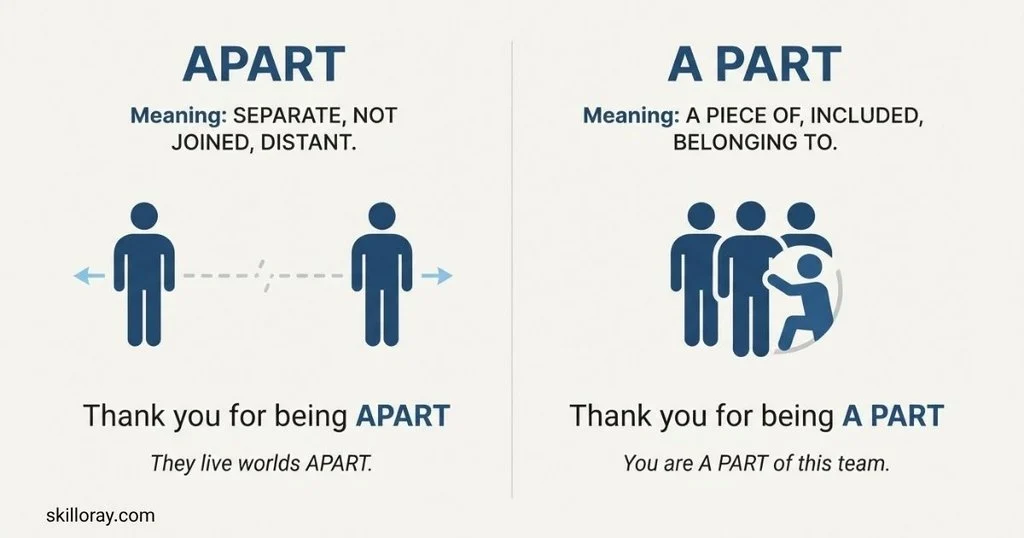
The correct phrase depends on the message you want to communicate.
If you are thanking someone for their involvement or membership, write “Thank you for being a part of…”
Examples:
- Thank you for being a part of our journey.
- Thank you for being a part of our special day.
- Thank you for being a part of this community.
- Thank you for being a part of our success.
- Thank you for being a part of our lives.
- Thank you for being a part of this wonderful experience.
These expressions acknowledge someone’s contribution, presence, or involvement.
By contrast, “Thank you for being apart” would normally refer to someone remaining separate from something. It is not the usual expression for thanking a person for their support or participation.
Is It “Apart Of” or “A Part Of”?
“A part of” is the correct expression when you mean belonging to something. “Apart of” is a common writing mistake caused by confusing the two forms.
Here is how to distinguish them:
| Incorrect usage | Correct usage | Explanation |
| I am apart of the club. | I am a part of the club. | Membership |
| She is apart of the family. | She is a part of the family. | Belonging |
| He wants to be apart of the team. | He wants to be a part of the team. | Participation |
| We are apart of the celebration. | We are a part of the celebration. | Involvement |
| Thank you for being apart of my life. | Thank you for being a part of my life. | Inclusion |
However, remember that “apart from” is a legitimate expression.
For example, “Apart from Monday, I am available every day” means that Monday is excluded.
The problem is not the word “apart” itself. The mistake occurs when you use it in place of “a part” to express belonging.
Is It “Set Apart” or “Set a Part”?
The standard expression is “set apart.” It means to distinguish something from others, separate items, or make something stand out.
Examples:
- Her creativity sets her apart from other artists.
- The teacher set apart a quiet area for reading.
- His honesty sets him apart as a leader.
- The bright colors set the design apart.
- Their commitment to quality sets the company apart.
“A part” is used differently. It can refer to a component of something, but it does not replace the established expression “set apart.”
For example:
- Correct: Her unique style sets her apart.
- Correct: She is a part of the design team.
These sentences communicate two different ideas: distinction or membership.
Is It “Falling Apart” or “Falling a Part”?
“Falling apart” is the correct expression when something is breaking down, deteriorating, or becoming disorganized. “Falling a part” is not the standard expression for this meaning.
Examples:
- My old shoes are falling apart.
- The chair is falling apart after years of use.
- The plan started falling apart at the last minute.
- The company was falling apart because of poor management.
- The book is falling apart because its binding is damaged.
Use “a part” when describing a component or a piece of something.
For example, “A part of the machine is missing” means that one component is absent.
The distinction is straightforward: “falling apart” describes deterioration, while “a part” identifies a piece or member of a whole.
How to Remember the Difference Between Apart or a Part
If you frequently confuse these expressions, use a simple memory trick.
A Part = Belonging
Think of the letter “a” as introducing one piece or member of a larger whole.
Example: I am a part of the team.
Apart = Separation
Think of two things being separated by space or distance.
Example: The two houses are far apart.
You can also test your sentence by replacing the phrase with another expression.
- If “a member of” fits, use “a part of.”
- If “separated” fits, use “apart.”
- If “breaking down” fits, use “falling apart.”
- If “standing out” fits, use “set apart.”
This simple technique works for many everyday writing situations.
Apart or a Part Worksheet: Practice Examples
Try completing the following sentences with the correct form. Choose “apart” or “a part” based on the meaning of each sentence.
- I am proud to be _____ of this organization.
- The two friends live miles _____.
- Thank you for being _____ of our celebration.
- My old bicycle is falling _____.
- Her kindness sets her _____ from others.
- I want to be _____ of the school team.
- The wooden box came _____ during the move.
- We decided to spend a few days _____.
- Every student is _____ of the learning community.
- I would love to be _____ of your special day.
Answers and Explanations
- A part — The speaker belongs to an organization.
- Apart — The friends live at a distance from each other.
- A part — The person is included in the celebration.
- Apart — The bicycle is breaking down.
- Apart — Her kindness distinguishes her from others.
- A part — The speaker wants to join the team.
- Apart — The box broke into pieces.
- Apart — The people chose to spend time separately.
- A part — Each student belongs to the community.
- A part — The speaker wants to participate in the occasion.
Practice helps you recognize the meaning instead of relying on how the phrase looks.
Common Mistakes With Apart or a Part
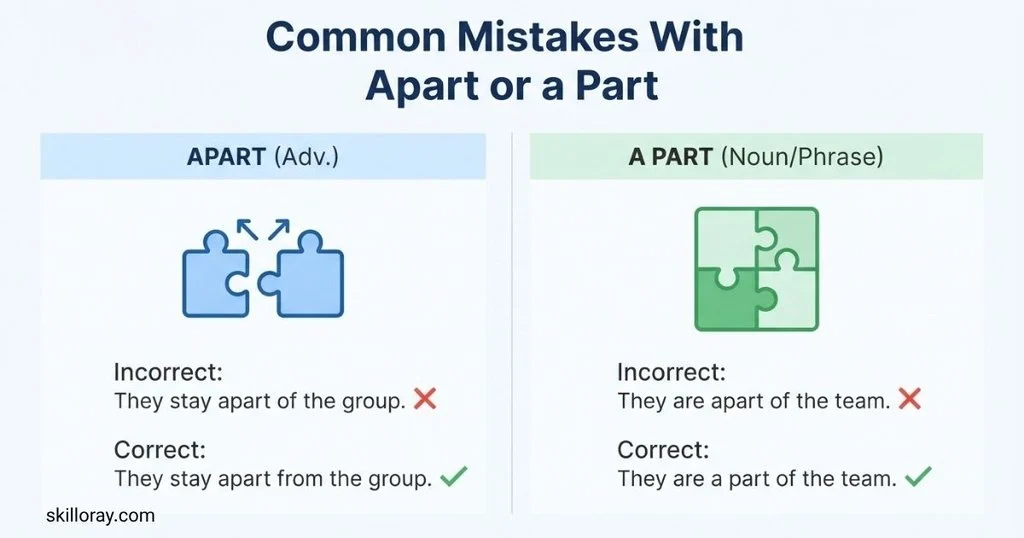
Here are some frequent mistakes to avoid when writing these expressions.
Mistake 1: Writing “Apart Of”
Incorrect: I am apart of this wonderful community.
Correct: I am a part of this wonderful community.
Why? The intended meaning is membership, so the noun “part” needs the article “a.”
Mistake 2: Using “A Part” to Mean Separation
Incorrect: The two houses are a part.
Correct: The two houses are apart.
Why? The intended meaning is physical distance, not membership or a component of something.
Mistake 3: Writing “Falling a Part”
Incorrect: My old phone is falling a part.
Correct: My old phone is falling apart.
Why? “Falling apart” is the established expression for something breaking down.
Mistake 4: Confusing “Set Apart” With Membership
Incorrect: Her dedication sets a part from other employees.
Correct: Her dedication sets her apart from other employees.
Why? “Set apart” expresses distinction. It does not mean belonging to a group.
Mistake 5: Assuming the Expressions Are Interchangeable
Incorrect: I want to be apart of your family.
Correct: I want to be a part of your family.
Why? The first expression does not communicate the intended idea of belonging.
The best way to avoid these mistakes is to check what you actually mean before choosing the phrase.
Frequently Asked Questions
1. Is “Apart” or “A Part” Correct?
Both are correct English expressions, but they have different meanings. “Apart” means separated or at a distance. “A part” means a piece of something or a member of a group.
2. Is It “Apart Of” or “A Part Of”?
Use “a part of” when you mean belonging, membership, or inclusion. For example, “I am a part of the team.” Use “apart from” when you mean separation or exclusion.
3. Is It Correct to Say “I Want to Be a Part of the Team”?
Yes. “I want to be a part of the team” is grammatically correct and expresses a desire to join or belong to the team.
4. Should I Write “Happy to Be Apart” or “Happy to Be a Part”?
Use “happy to be a part” when you are pleased to belong to a group or participate in an event. Use “happy to be apart” when you are pleased to be separated from something.
5. Is “Thank You for Being Apart of My Life” Correct?
Not if you mean to thank someone for their presence or involvement in your life. The correct sentence is “Thank you for being a part of my life.”
6. Is “Falling Apart” One Word or Two Words?
“Falling apart” consists of two words. “Falling” is the verb form, while “apart” describes the process of breaking down or separating.
7. Can “Apart” Mean Different From Others?
Yes. In expressions such as “set apart,” it can mean to distinguish someone or something from others.
Example: Her creativity sets her apart from the crowd.
8. Is “Apart From” Grammatically Correct?
Yes. “Apart from” is a standard English expression that can mean “except for” or “separate from,” depending on the context.
Examples:
- Apart from Tuesday, I am free all week.
- The children sat apart from the adults.
9. How Do You Use “A Part” in a Sentence?
Use “a part” when referring to a component, role, or membership in something larger.
Examples:
- I am a part of the community.
- A part of the engine needs repair.
- She played a part in the project’s success.
10. What Is the Easiest Way to Remember Apart or A Part?
Remember that “apart” refers to separation, while “a part” refers to belonging or a piece of something. If your sentence describes joining a team or participating in an event, “a part” is usually the right choice.
Conclusion
The difference between “apart” or “a part” comes down to meaning. Use “apart” when describing separation, distance, or something breaking down. Use “a part” when describing belonging, participation, or a component of a larger whole.
For example, “I am a part of the team” expresses membership, while “we live miles apart” describes distance. Similarly, “falling apart” describes something deteriorating, while “set apart” means distinguishing someone or something from others.
Before choosing either expression, ask yourself what you want to communicate. If you mean inclusion, choose “a part.” If you mean separation, choose “apart.” With a little practice, you can use both expressions confidently in everyday writing.

I am James Walker, an English language specialist with extensive experience in grammar, editing, and academic writing. I enjoy helping students, bloggers, and professionals strengthen their writing by explaining grammar concepts in a clear and engaging way. My focus is on providing accurate, practical, and easy-to-follow guidance that helps learners communicate more effectively in everyday and professional situations.
Books: Perfect English Grammar Handbook and Advanced Writing Techniques
 Daniel Carter
 Olivia Brown