Have you ever paused while writing and wondered whether flyer or flier is the right spelling? I know how confusing two nearly identical words can feel, especially when both appear in dictionaries and everyday writing.
You may have seen both forms used for advertisements, passengers, or someone who flies. The good news is that you don’t have to guess—the meaning and context can help you choose the form that fits your sentence.
In this guide, I’ll break down flyer or flier in simple terms so you can understand the difference, see how each word is commonly used, and write with confidence.
What Does Flyer or Flier Mean?
Both flyer or flier are nouns that can describe a printed sheet of information, a person who travels by air, or something that flies. The intended meaning usually becomes clear from the context.
A flyer most commonly refers to a printed advertisement, promotional handout, or informational sheet. For example, a business might distribute flyers to announce a sale or promote a new service.
A flier can also refer to a person who flies or a printed handout. It is especially familiar in the expression “take a flier,” which means to take a chance on something uncertain.
Here are the main meanings:
| Word | Meaning | Example |
| Flyer | Printed advertisement or handout | I received a flyer about the concert. |
| Flier | Person who flies; alternative spelling of flyer | He is an experienced flier. |
| Flyer | Person who travels by air | She is a frequent flyer. |
| Flier | A risky attempt or decision in the expression “take a flier” | They took a flier on the new business idea. |
Both spellings are established in English. However, your choice may depend on the intended meaning, your audience, or the style guide you follow.
Flyer or Flier: Which Is Correct?
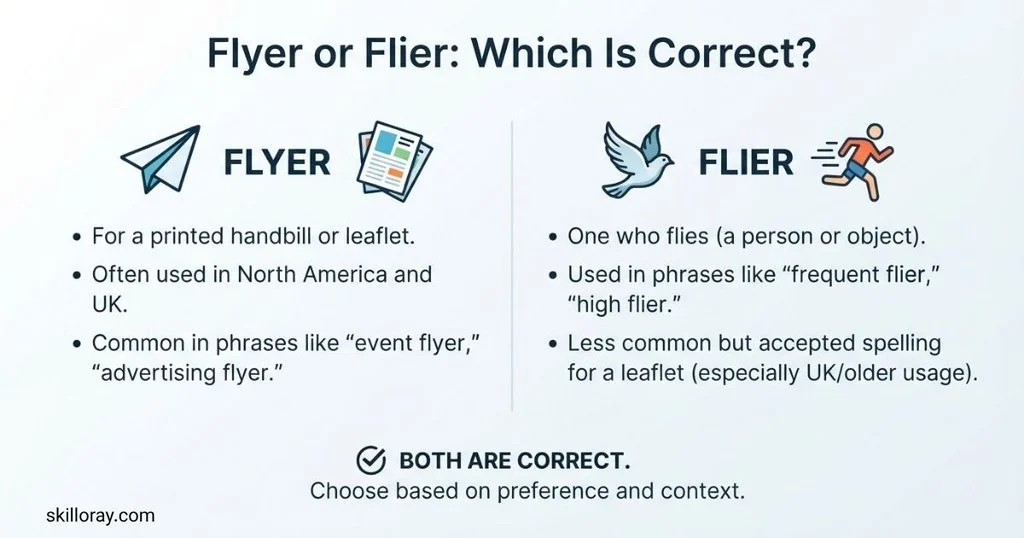
Both flyer or flier are correct spellings. For a printed advertisement, poster handout, or promotional sheet, flyer is generally the clearest and most widely recognized choice. For a person who flies, both forms are acceptable, although flyer is common in modern American English.
The most useful guidelines are:
- Use flyer for advertisements, event announcements, sales promotions, and informational handouts.
- Use flyer for a person who travels by air, including the familiar expression “frequent flyer.”
- Use flier in the expression “take a flier,” meaning to take a risk or try something uncertain.
- Follow your organization’s preferred style guide if you are writing for a newspaper, business, school, or publication.
The distinction is not always strict. Some dictionaries and style guides accept both spellings for several meanings. The Associated Press style guidance, updated in 2017, uses flyer for a person flying in an aircraft or a handbill, while retaining flier in the expression “take a flier.”
When Should You Use Flyer?
Use flyer when you need a straightforward, familiar spelling for everyday writing, advertising, or business communication.
1. For Printed Advertisements
A flyer is usually a single sheet of paper that communicates information about an event, product, service, sale, or announcement.
Examples include:
- A restaurant advertising a special offer.
- A school announcing an upcoming event.
- A business promoting a new product.
- A community organization sharing event details.
- A charity inviting people to a fundraising activity.
Example sentences:
- The store distributed flyers announcing its weekend sale.
- I found a flyer advertising a local music festival.
- Our school printed a flyer about the science fair.
- The company created a colorful flyer for its new product.
- She placed flyers on the community noticeboard.
2. For Posters or Handouts
A flyer can be distributed by hand, placed on a noticeboard, or shared with people at an event. It is generally shorter than a brochure and often focuses on one main message.
Examples:
- The library displayed a flyer about its reading program.
- We handed out flyers at the school entrance.
- The event flyer included the date, location, and ticket information.
- A flyer on the noticeboard announced the community meeting.
A flyer may be printed on one side or both sides of a sheet. It can also be designed digitally and shared online.
3. For Marketing and Business Promotion
In marketing, flyer is a common term for a printed or digital promotional document.
Businesses use flyers to communicate offers, introduce products, advertise services, or encourage customers to attend events.
Examples:
- The marketing team designed a flyer for the product launch.
- Our business needs a flyer for its seasonal discount.
- The designer added the company logo to the promotional flyer.
- The gym distributed flyers advertising its membership options.
For professional marketing materials, marketing flyer is a natural, widely understood expression.
When Should You Use Flier?
Flier is a valid spelling, although its use depends on context and personal or editorial preference. It is particularly useful to recognize in the idiom “take a flier.”
1. For Someone Who Flies
A flier can mean a person who operates an aircraft or travels by air. However, flyer is also accepted in this meaning and is common in modern usage.
Examples:
- He is an experienced flier who travels internationally.
- The nervous flier asked for a window seat.
- Every flier must follow the airline’s safety instructions.
- The young flier enjoyed his first airplane journey.
You may encounter either spelling in books, articles, or other publications. If your writing follows a specific style guide, use its preferred form consistently.
2. In the Expression “Take a Flier”
The expression take a flier means to take a risk, make an uncertain attempt, or try something that may or may not succeed.
It often appears in business conversations, investment discussions, and everyday descriptions of risky decisions.
Examples:
- She decided to take a flier on the new business idea.
- The company took a flier on an untested product.
- He took a flier by applying for a job outside his field.
- They took a flier on the unfamiliar restaurant.
- The entrepreneur took a flier on a promising new concept.
In this expression, flier is the traditional and widely recognized spelling. Take a flyer is also found, but take a flier is preferred in the AP style guidance discussed above.
Flyer or Flier for a Paper Advertisement?
If you are referring to a printed advertisement, flyer is the recommended spelling for most situations.
A paper flyer is usually a single sheet designed to communicate a short message. It might advertise a sale, promote a service, announce a school event, or share information about a community activity.
Examples:
- I picked up a flyer outside the shopping center.
- The restaurant printed 500 flyers for its opening.
- Please give every visitor a flyer about the event.
- The paper flyer includes a discount code.
- We designed a flyer to promote our charity fundraiser.
You can also write flier for a printed handout because the spelling is recognized. Nevertheless, choosing flyer makes your wording consistent with common modern usage.
Is It Flyer or Flier for a Poster?
Use flyer when referring to a promotional sheet that announces an event, sale, or service.
A poster is generally designed to be displayed on a wall or another visible surface, while a flyer is often distributed directly to people. However, the terms can overlap because a printed promotional design may serve both purposes.
Examples:
- The school created a flyer for its annual sports day.
- The event poster was displayed outside the auditorium.
- We printed a flyer to promote the concert.
- The store placed a promotional poster in its window.
If you are naming a downloadable design or printed handout, event flyer or promotional flyer is a clear choice.
Is It Flyer or Flier for a Brochure?
Use flyer if the document is a single promotional sheet. A brochure usually contains more detailed information, often arranged into several sections or folded panels.
For example:
- The company created a flyer announcing its new service.
- The travel agency prepared a brochure describing its holiday packages.
- The school distributed flyers about the open house.
- Visitors received a brochure explaining the museum’s exhibits.
The distinction is mainly about the document’s format and purpose, rather than spelling. A flyer is generally brief, while a brochure usually provides more extensive information.
Flyer or Flier for Advertising and Marketing?
For advertising, flyer is generally the preferred choice. It is a familiar term for a promotional sheet used to communicate an offer or attract attention.
A flyer can advertise:
- Retail discounts
- Restaurant specials
- School activities
- Business services
- Community events
- Concerts and performances
- Fundraising campaigns
- Product launches
- Local services
- Workshops and classes
Examples:
- The agency designed a flyer for the advertising campaign.
- Our business needs a flyer to announce the grand opening.
- The restaurant distributed flyers featuring its new menu.
- The marketing flyer included a website address and contact details.
What Is a News Flyer?
A news flyer is a short printed or digital document that shares news, announcements, or updates with a specific audience.
For example, a school might create a news flyer about upcoming activities, while a community organization could distribute one about local events.
Examples:
- The school sent home a news flyer about upcoming activities.
- The community center printed a flyer announcing its new programs.
- The organization shared a digital flyer with important updates.
The phrase news flyer is understandable, but newsletter may be more appropriate if the publication contains regular news, several articles, or recurring updates.
Flyer or Flier in American English or British English
Both spellings occur in English, and regional preferences can vary. There is no universal rule that makes one spelling exclusively American or the other exclusively British.
In modern American English, flyer is widely used for printed advertisements and people who travel by air. Flier remains a recognized alternative, especially in certain expressions and editorial styles.
British English also uses flyer for promotional leaflets and advertising materials. The spelling flier is understood as a variant.
| Context | Common choice | Alternative |
| American advertising | Flyer | Flier |
| British promotional handout | Flyer | Flier |
| Airline traveler | Frequent flyer | Frequent flier |
| Risk-taking expression | Take a flier | Take a flyer |
| Multiple advertisements | Flyers | Fliers |
If you write for an international audience, flyer is a practical default for advertisements and promotional documents. If you are following a publication’s house style, follow its specific preference.
Flyer or Flier According to AP Style
The Associated Press Stylebook is a reference used by many journalists and news organizations. Its guidance changed in 2017 to favor flyer for a person flying in an aircraft or a printed handbill, while retaining flier in the expression “take a flier.”
Here is how that guidance works in practice:
| Meaning | AP-style choice | Example |
| Printed advertisement | Flyer | The store distributed flyers. |
| Person traveling by air | Flyer | She is a frequent flyer. |
| Taking a risk | Flier | He took a flier on the proposal. |
Older style references may give different recommendations because the guidance has changed over time. If you are editing older material, do not assume that every instance of flier is a spelling mistake.
For current professional writing, consult the edition of the style guide required by your publication or organization.
How to Pronounce Flyer or Flier
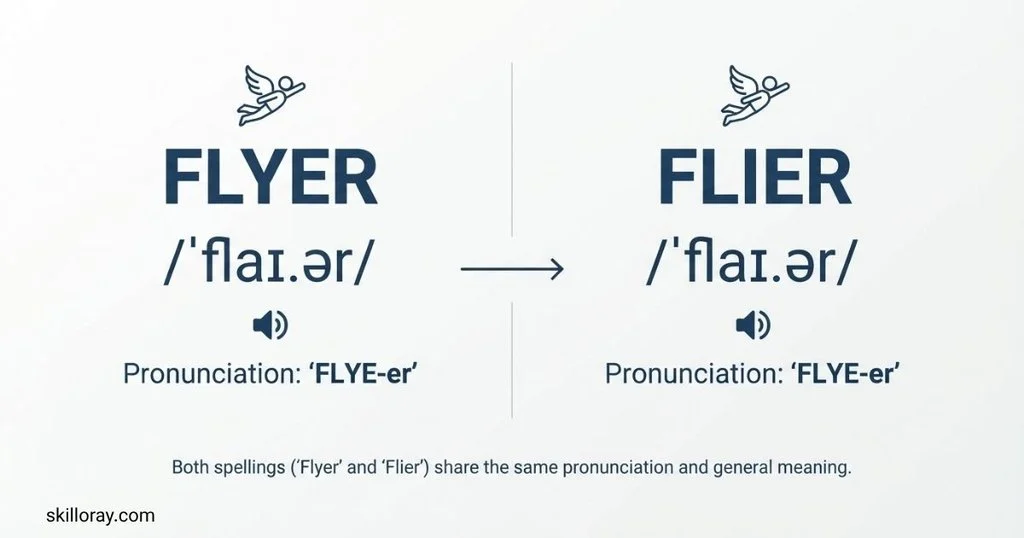
Both words are normally pronounced the same way: FLY-er.
- Flyer: /ˈflaɪ.ər/
- Flier: /ˈflaɪ.ər/
The first syllable carries the main stress. The sound begins like the word fly, followed by a short, unstressed ending.
Examples:
- I received a flyer at the event.
- He is a nervous flier.
- The business printed several flyers.
There is no standard pronunciation difference that helps you determine which spelling to use. You must rely on the context and the spelling convention you prefer.
Fliers or Flyers: What Is the Correct Plural?
Both fliers or flyers are correct plural forms. Each is created by adding the plural ending to its respective singular spelling.
| Singular | Plural | Example |
| Flyer | Flyers | The store printed 200 flyers. |
| Flier | Fliers | The experienced fliers boarded the plane. |
When referring to advertisements, flyers is a clear, familiar choice.
Examples:
- We distributed flyers throughout the neighborhood.
- The school printed flyers for the fundraiser.
- Several flyers advertised the upcoming concert.
- The airline welcomed its frequent flyers.
- The experienced fliers boarded the aircraft.
Remember that the plural spelling should match the singular form you choose. If you use flyer in the singular, use flyers in the plural.
Flyer or Flier Example Sentences
The following sentences show how both spellings appear in everyday English.
Sentences With “Flyer”
- The restaurant distributed a flyer announcing its new menu.
- I found a flyer about the community concert.
- The school created a flyer for its science exhibition.
- She handed me a flyer advertising a summer sale.
- The company designed a flyer to promote its services.
- We placed flyers on the information table.
- The airline offers rewards to frequent flyers.
- He is a confident flyer who enjoys long-distance travel.
- The event flyer included the venue’s address.
- I downloaded a digital flyer from the organization’s website.
Sentences With “Flier”
- He is an experienced flier who travels regularly.
- The nervous flier asked the flight attendant a question.
- Several fliers waited at the airport gate.
- She decided to take a flier on the new business.
- The investor took a flier on an unfamiliar company.
- The organization distributed fliers about the event.
- Experienced fliers often prepare for long journeys.
- The young flier enjoyed the scenic flight.
- He took a flier on a creative idea.
- The publication used the spelling flier throughout its article.
These examples demonstrate that flyer and flier can overlap in meaning, although particular expressions may favor one spelling.
Common Mistakes When Using Flyer or Flier
The most common mistakes involve treating one spelling as universally incorrect or using a word that does not match the intended meaning.
Mistake 1: Assuming “Flier” Is Always Incorrect
Incorrect assumption: “Flier” is not a real English word.
Correct understanding: Flier is an established spelling that can refer to a person who flies, a printed handout, or someone taking a risk in the expression “take a flier.”
Mistake 2: Using “Frequent Flyer” Incorrectly
Correct: She is a frequent flyer.
Incorrect: She is a frequent flyers.
The singular noun flyer should be used after the singular expression a frequent. Use frequent flyers when referring to more than one traveler.
Mistake 3: Confusing a Flyer With a Brochure
A flyer usually presents a short message on a single sheet. A brochure typically offers more detailed information, often in a folded or multipanel format.
Correct: The shop distributed flyers advertising its sale.
Correct: The travel agency prepared a brochure explaining its holiday packages.
Mistake 4: Changing Spelling Without a Reason
Switching between flyer or flier in the same document may look inconsistent, especially in professional writing.
For example, if your advertisement consistently uses flyer, keep using flyer in headings, body text, and plural forms unless a specific expression or style requirement calls for something else.
Mistake 5: Treating the Two Words as Pronunciation Differences
Both forms are pronounced alike in standard English. The difference is primarily spelling and usage preference, not pronunciation.
How to Remember the Correct Spelling
If you are unsure which form to choose, use a simple practical rule.
- Flyer: Think of a printed flyer advertising an event, service, or product.
- Flier: Remember the expression “take a flier,” which means to take a risk.
- Frequent flyer: Use this familiar expression for someone who travels by air regularly.
- Flyers: Use this plural form for multiple promotional handouts.
This approach works for most everyday writing. It also helps you avoid spending unnecessary time deciding between two accepted spellings.
If you are writing for a newspaper, business, or academic publication, check the relevant style guide. Otherwise, choose the spelling that suits your context and use it consistently.
Frequently Asked Questions
1. Is It Flyer or Flier?
Both spellings are correct. Flyer is commonly used for printed advertisements and people who travel by air. Flier is also accepted, particularly in the expression “take a flier,” meaning to take a risk.
2. Is Flyer or Flier Correct for a Paper Advertisement?
Flyer is generally the preferred spelling for a printed advertisement, promotional sheet, or event handout. Flier is also a recognized variant, but flyer is the more familiar choice for most readers.
3. How Do You Spell Flyer or Flier?
Both flyer or flier are valid English spellings. Use flyer for general advertising materials and frequent air travelers. Use flier when it fits your preferred style or in the expression “take a flier.”
4. Is It Frequent Flyer or Frequent Flier?
Frequent flyer is a widely used spelling for someone who regularly travels by airplane. Frequent flier is also found in English, but frequent flyer is a practical choice for general and professional writing.
5. Should I Write Flyers or Fliers?
Both plural forms are correct. Use flyers if the singular form is flyer, or fliers if the singular form is flier. For printed advertisements, flyers is the common choice.
6. Is “Take a Flyer” Correct?
Yes. Take a flyer is an accepted expression meaning to take a chance on something uncertain. However, take a flier is the preferred form in AP style.
7. Is Flyer or Flier More Common in American English?
Flyer is widely used in modern American English, particularly for advertising materials and airline travelers. Flier remains an accepted alternative, and some publications may prefer it in particular contexts.
8. Is Flyer or Flier Correct in British English?
Both spellings are recognized in British English. Flyer is commonly used for promotional leaflets, while flier is understood as a variant. For formal writing, follow the spelling preference of your publication or organization.
9. Is Flyer or Flier Correct for a Poster?
Use flyer when referring to a promotional sheet that announces an event, sale, or service. A poster is usually designed for display, whereas a flyer is often distributed to people, although the formats can overlap.
10. Are Flyer or Flier Pronounced Differently?
No. Both spellings are generally pronounced FLY-er, with the stress on the first syllable. The difference is in spelling and usage, not the standard pronunciation.
Conclusion
Both flyer or flier are correct English words. The best choice depends on what you mean, the context of your sentence, and any style requirements you need to follow.
For a printed advertisement, marketing handout, event announcement, or airline traveler, flyer is a practical default. For the expression meaning to take a risk, take a flier is the preferred spelling in AP style, although take a flyer is also used.
Keep your spelling consistent, consider your audience, and remember that the less common spelling is not automatically incorrect. Once you understand these usage patterns, choosing between flyer or flier becomes much easier.

I am Daniel Carter, a grammar enthusiast and language educator with over 10 years of experience helping students and professionals improve their English writing and communication skills. I enjoy simplifying complex grammar rules into easy-to-understand lessons that anyone can follow. My goal is to help learners write with confidence, avoid common mistakes, and develop strong communication skills for academic and professional success. I regularly create practical grammar guides, writing tips, and language resources that make learning both enjoyable and effective.
Books: Mastering English Grammar and The Complete Guide to Better Writing
 James Walker
 Olivia Brown