
Have you ever stopped while writing and wondered whether to use there or their? I know how confusing these two words can feel, especially when they sound exactly the same.
You may see them everywhere, but each word has a completely different job. Once you understand the simple rule behind them, you can use them with much more confidence.
In this guide, I’ll show you the difference with clear explanations and easy examples. You’ll quickly learn how to choose the right word and avoid this common English mistake.
There or Their: What Is the Difference?
There or their are both correct English words, but they serve different purposes in a sentence. The main difference is that there often refers to a place or existence, while their indicates possession.
| Word | Meaning | Part of Speech | Example |
| There | Refers to a place or indicates existence | Adverb or pronoun in existential constructions | The keys are over there. |
| Their | Shows ownership or possession | Possessive determiner | Their house is beautiful. |
| They’re | Short form of “they are” | Contraction | They’re waiting outside. |
Remember these simple rules:
- Use there when talking about a location or saying something exists.
- Use their when something belongs to people or things.
- Use they’re when you mean “they are.”
What Does There Mean?
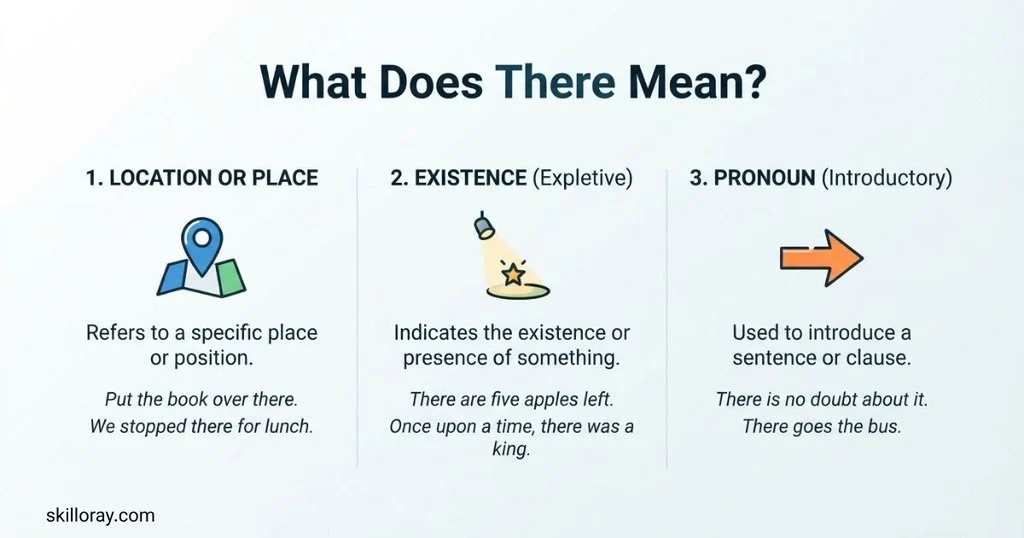
The word there has several uses in English. It can identify a place, point to a location, or introduce a statement about the existence of something.
1. There Refers to a Place
When you use there to describe a location, it usually answers the question “Where?”
Examples:
- Your shoes are over there.
- I left my phone there yesterday.
- We went there during our summer vacation.
- Please put the books there.
- She lives near there.
In these sentences, there identifies a location or refers to a place already mentioned.
2. There Indicates Existence
You can also use there at the beginning of a sentence to say that something exists, happens, or is available.
Examples:
- There is a book on the table.
- There are three students in the classroom.
- There was a problem with my computer.
- There will be a meeting tomorrow.
- Is there enough food for everyone?
In these examples, there introduces information rather than identifying a specific location.
3. There Appears in Common Expressions
The word there also appears in everyday expressions.
Examples:
- There you go!
- There it is.
- There we are.
- I’ll be there soon.
- We’ve been there before.
These expressions are common in conversation, writing, and informal communication.
What Does Their Mean?
Their is a possessive determiner. It shows that something belongs to, is associated with, or relates to a group of people, animals, or things.
Use their before a noun to indicate possession.
Examples:
- Their house is near the park.
- The students finished their homework.
- The children brought their toys.
- Their business is growing quickly.
- The dogs wagged their tails.
In each sentence, their tells you who owns or is associated with something.
1. Their Shows Ownership
The most common use of their is to express ownership.
Examples:
- They parked their car outside.
- The teachers collected their books.
- My friends invited me to their party.
- The workers put on their uniforms.
- The birds returned to their nests.
You can often replace their with a phrase such as “belonging to them” to check whether it makes sense.
For example:
- Their car is new.
- The car belonging to them is new.
Both sentences communicate the same basic idea.
2. Their Can Refer to One Person
Although their commonly refers to multiple people, it can also refer to one person when the person’s gender is unknown, irrelevant, or when that person uses they/them pronouns.
Examples:
- Every student should bring their notebook.
- Someone left their jacket in the classroom.
- Alex said their appointment was at noon.
- Each applicant must submit their application.
- The customer forgot their receipt.
In modern English, singular they and its possessive form their are widely used. This usage is especially helpful when you don’t know who a person is or don’t need to specify their gender.
There, Their or They’re: How to Choose the Correct Word
These three words are frequently confused because they share the same pronunciation. However, their meanings and grammatical functions differ.
| Word | Correct Use | Example |
| There | Place or existence | There is a café nearby. |
| Their | Possession | Their café is popular. |
| They’re | They are | They’re opening a new café. |
Here’s a quick way to remember the difference:
- There: Think of a place, such as “over there.”
- Their: Think of ownership, such as “their belongings.”
- They’re: Replace it with “they are” to see whether the sentence still makes sense.
For example:
- There is a dog outside. (Something exists.)
- Their dog is outside. (The dog belongs to them.)
- They’re outside. (They are outside.)
A useful trick is to expand they’re into “they are.” If the sentence still makes sense, they’re is probably the correct choice.
There or Their Grammar Rules
Understanding the grammatical role of each word will help you choose the right one without having to memorize every sentence.
Grammar Rules for There
There can function as an adverb of place or appear in existential constructions.
As an adverb of place:
- The children are playing there.
- We stayed there for two nights.
- Put your bag over there.
In existential constructions:
- There is a letter for you.
- There are several options available.
- There has been a change in the schedule.
When there introduces an existential sentence, the verb generally agrees with the noun that follows it.
Examples:
- There is one problem.
- There are two problems.
Grammar Rules for Their
Their is a possessive determiner, which means it normally appears before a noun or a word describing a noun.
Examples:
- Their new house
- Their favorite teacher
- Their personal belongings
- Their exciting plans
- Their first experience
You generally cannot use their by itself as a substitute for a possessive pronoun.
For example:
- Correct: This is their book.
- Correct: This book is theirs.
- Incorrect: This book is their.
Use their before a noun, while theirs can stand alone.
Is There or Their Correct in a Sentence?
Both words are correct when used in the appropriate grammatical context. The sentence determines which one you need.
Consider these examples:
- Correct: There is a problem with the printer.
- Correct: Their printer is not working.
- Correct: I will meet you there.
- Correct: I will meet their teacher.
The first word in each sentence serves a different purpose. There refers to existence or location, while their indicates a relationship or possession.
If you’re unsure, identify what the sentence is communicating before choosing a word.
When Do You Use There or Their?
Use there when referring to a location or introducing the existence of something. Use their when showing possession or association.
The following common phrases demonstrate how the correct word depends on the sentence.
Over There or Their
The correct phrase is usually over there when pointing to a location.
Examples:
- The supermarket is over there.
- Look over there near the gate.
- Your friends are standing over there.
- We parked our car over there.
Use their when you are talking about something belonging to people.
Example: Their house is over the hill.
Remember: Over there refers to a place, while their shows possession.
Is There or Their
Use is there when asking whether something exists, is available, or is located somewhere.
Examples:
- Is there a hospital nearby?
- Is there enough time to finish?
- Is there a problem with the order?
- Is there a way to contact them?
Use their when describing something that belongs to someone.
Example: Their house is close to the hospital.
Working There or Their
The correct phrase is working there when referring to a workplace or location.
Examples:
- I am working there this summer.
- She enjoys working there.
- He started working there last month.
- My brother is working there today.
Use their before a noun to express possession.
Example: Their working conditions have improved.
Here, their identifies whose working conditions are being discussed.
I Will Be There or Their
The correct phrase is I will be there when talking about your future location or attendance.
Examples:
- I will be there at 9 a.m.
- Don’t worry; I will be there.
- I will be there for your birthday.
- I will be there when the meeting starts.
You cannot use their in place of there in these sentences because the meaning involves a location or presence, not possession.
Being There or Their
Use being there when talking about someone’s presence at a place or situation.
Examples:
- Thank you for being there for me.
- Being there on time is important.
- I enjoyed being there with my friends.
- Being there made the experience more enjoyable.
Use their when a noun follows and possession is intended.
Example: Their being late caused a delay.
This construction is grammatical, although it may sound more formal than everyday alternatives such as “The fact that they were late caused a delay.”
I Was There or Their
The correct phrase is I was there when referring to a place you visited or where you were present in the past.
Examples:
- I was there yesterday.
- I was there when the announcement was made.
- I was there during the celebration.
- I was there for the entire event.
Use their when describing something that belongs to other people.
Example: Their performance was excellent.
From There or Their
Use from there to describe a starting point, origin, or direction.
Examples:
- We walked from there to the station.
- You can take the bus from there.
- I moved from there last year.
- From there, we continued our journey.
Use their when indicating possession.
Example: Their journey took three days.
In There or Their
Use in there when referring to the inside of a place, container, or enclosed space.
Examples:
- Your keys are in there.
- I think someone is in there.
- Put the documents in there.
- There is a box in there.
The last example contains both words: the first there introduces existence, while the second refers to a location.
Use their before a noun when expressing possession.
Example: Their belongings are in the cupboard.
On There or Their
The phrase on there can be correct when there refers to a website, platform, page, or previously mentioned surface.
Examples:
- I saw the announcement on there.
- You can find the details on there.
- The video is available on there.
In many contexts, a more specific phrase such as “on the website” or “on that page” sounds more natural.
Use their when showing possession.
Example: Their names are on the list.
There or Their Examples: 20 Sentences
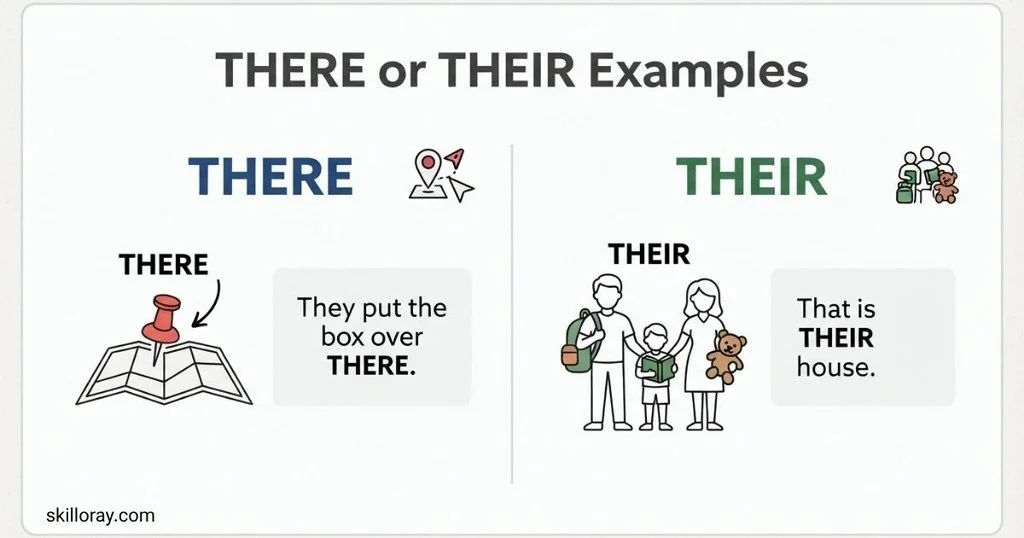
The easiest way to understand the difference is to see both words in everyday situations.
Sentences With There
- There is a new restaurant near my house.
- I left my notebook over there.
- We will be there before sunset.
- There are five students in the room.
- She was there when the news arrived.
- Is there a pharmacy nearby?
- I have never been there before.
- From there, we walked to the market.
- Put your shoes in there.
- There will be a school event next week.
Sentences With Their
- Their children attend the same school.
- The students submitted their assignments.
- Their house has a beautiful garden.
- The employees received their salaries.
- My friends invited me to their wedding.
- The birds built their nests in the tree.
- Their teacher explained the lesson clearly.
- Every participant should bring their identification.
- The players celebrated their victory.
- Their new business opened last month.
Sentences Using There, Their or They’re
These additional examples help you recognize the correct form in context.
- There: There is a message for you.
- Their: Their message was very encouraging.
- They’re: They’re sending you a message.
- There: We stayed there overnight.
- Their: Their hotel was comfortable.
- They’re: They’re staying at a hotel.
- There: Is there a seat available?
- Their: Their seats are near the window.
- They’re: They’re sitting near the window.
Notice how the surrounding words help you determine which form belongs in each sentence.
Common Mistakes With There or Their
Even experienced English speakers occasionally make mistakes with these words, especially when typing quickly. Since the words sound identical, spelling alone can be difficult to judge without considering meaning.
Mistake 1: Using Their to Indicate a Place
Incorrect: I will meet you their tomorrow.
Correct: I will meet you there tomorrow.
Why? The sentence refers to a location, so there is the appropriate choice.
Mistake 2: Using There to Show Possession
Incorrect: There car is parked outside.
Correct: Their car is parked outside.
Why? The car belongs to them, so you need the possessive determiner their.
Mistake 3: Confusing There With They’re
Incorrect: There going to arrive soon.
Correct: They’re going to arrive soon.
Why? The intended meaning is “They are going to arrive soon.” Therefore, they’re is correct.
Mistake 4: Using Their Without a Noun
Incorrect: This jacket is their.
Correct: This jacket is theirs.
Why? Their normally comes before a noun. Theirs is the possessive pronoun used independently.
Mistake 5: Choosing a Word Without Checking Its Meaning
Incorrect: Is their a bank near here?
Correct: Is there a bank near here?
Why? The sentence asks whether a bank exists in the area. The existential construction requires there.
Mistake 6: Assuming Singular Their Is Incorrect
Incorrect assumption: You must always use “his or her” instead of “their” for one person.
Correct: Everyone should bring their own lunch.
Why? Singular their is an established feature of modern English and is widely accepted in everyday writing and many formal contexts.
There or Their Pronunciation
There or their are pronounced the same way in standard English. They are homophones, meaning they have the same pronunciation but different meanings or spellings.
Both words are commonly represented in the International Phonetic Alphabet (IPA) as /ðɛr/ in American English, although pronunciation varies by accent. In many British accents, the vowel may be represented as /ðeə/.
Here is a simple pronunciation guide:
| Word | Common IPA | Pronunciation Hint |
| There | /ðɛr/ | Sounds like “thair” |
| Their | /ðɛr/ | Sounds like “thair” |
| They’re | /ðɛr/ | Sounds like “thair” |
To pronounce these words:
- Place your tongue lightly between your teeth or just behind them.
- Make the voiced “th” sound, as in this.
- Follow it with the vowel sound in air in many American accents.
- Finish with the appropriate ending for your accent.
Because all three words sound alike, pronunciation cannot reliably tell you which spelling to use. You must look at the meaning and grammatical role of the word in the sentence.
Easy Tricks to Remember There or Their
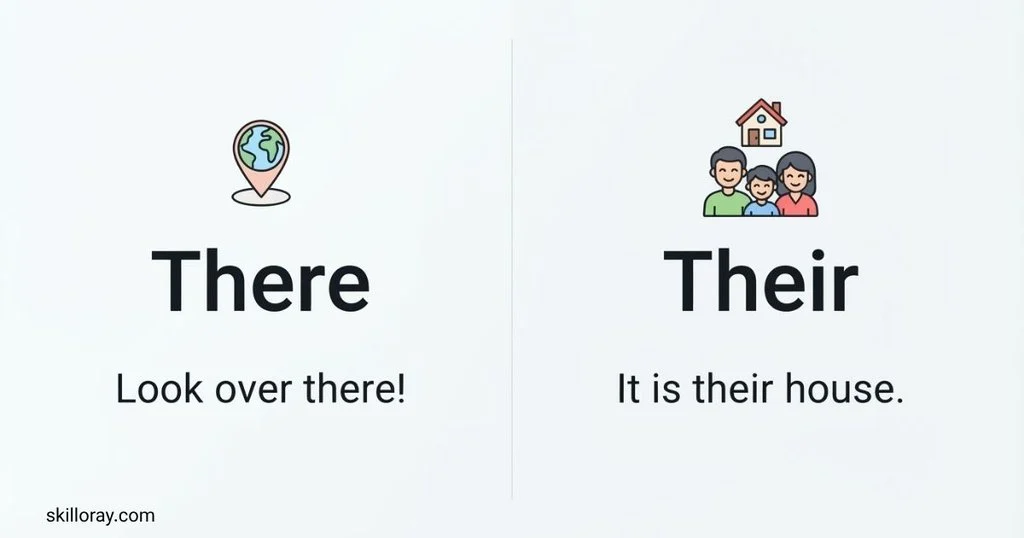
If you frequently confuse these words, try these simple memory tricks.
1. Remember That There Contains “Here”
The word there contains the word here. Both can refer to places.
Examples:
- Come here.
- Go there.
- Leave the bag over there.
This connection can help you remember that there often refers to a location.
2. Remember That Their Shows Ownership
Think of their as a word that answers the question “Whose?”
Examples:
- Whose house? Their house.
- Whose books? Their books.
- Whose responsibility? Their responsibility.
If the sentence describes something belonging to people, their is often the correct choice.
3. Expand They’re Into They Are
Whenever you see they’re, replace it mentally with “they are.”
For example:
- They’re happy. → They are happy.
- They’re waiting. → They are waiting.
- They’re ready. → They are ready.
If the expanded sentence doesn’t make sense, you probably need another word.
4. Check the Sentence Before Submitting It
Before finishing an email, essay, message, or assignment, read the sentence and ask yourself:
- Am I referring to a place or existence?
- Am I showing ownership?
- Do I mean “they are”?
These three questions can help you identify the correct word quickly.
Practice Exercise: Choose There or Their
Test your understanding with these short sentences. Choose the correct word for each blank before checking the answers.
1. I will meet you ___ after school.
there
their
they’re
2. The children forgot ___ backpacks.
there
their
they’re
3. ___ going to the library this afternoon.
There
Their
They’re
4. Is ___ a problem with the computer?
there
their
they’re
5. Everyone should bring ___ own water bottle.
there
their
they’re
6. We stayed ___ for two nights.
there
their
they’re
Check Answers
Frequently Asked Questions About There or Their
1. Which Is Correct, There or Their?
Both words are correct, but they have different meanings. Use there for a place or to indicate existence. Use their to show possession.
Examples:
- There is a book on the desk.
- Their book is on the desk.
2. How Do You Remember There or Their?
Remember that there contains here, which can help you associate it with a location. Use their when answering the question “Whose?” For example, “Their house” indicates that the house belongs to them.
3. Is There or Their Correct for a Person?
Both can be correct, depending on the sentence. Use there to refer to a place where someone is located. Use their to indicate something belonging to a person or group.
Examples:
- The person is standing there.
- The person forgot their bag.
4. Can Their Refer to One Person?
Yes. Singular their is widely used when a person’s gender is unknown, irrelevant, or when that person uses they/them pronouns.
Example: Every student should bring their notebook.
5. Are There or Their Pronounced the Same Way?
Yes. In standard English accents, these words are homophones, meaning they share the same pronunciation. Their spelling and grammatical roles differ, so you must use the context to choose the correct word.
6. Is They’re the Same as Their?
No. They’re is a contraction of “they are,” while their is a possessive determiner.
Examples:
- They’re happy. (They are happy.)
- Their happiness is obvious. (Possession or association.)
7. Should I Write “I Will Be There” or “I Will Be Their”?
The correct phrase is “I will be there.” It refers to your future presence at a place or event.
Example: I will be there for the meeting tomorrow.
Their would not be appropriate in this expression because the sentence doesn’t indicate possession.
8. Is “Over There” Grammatically Correct?
Yes. Over there is a common expression that points to a location, often one that is some distance away.
Example: The bus stop is over there, next to the store.
9. Can You Start a Sentence With There?
Yes. You can start a sentence with there to indicate that something exists or is available.
Examples:
- There is a message for you.
- There are several ways to solve this problem.
- There was a loud noise outside.
10. What Is the Difference Between Their or Theirs?
Their usually comes before a noun, while theirs functions as a possessive pronoun and can stand alone.
Examples:
- This is their house.
- This house is theirs.
Both sentences express ownership, but the grammatical structure is different.
Conclusion
Understanding there or their becomes much easier when you focus on the meaning of the sentence rather than how the words sound. Use there when referring to a place or indicating that something exists. Use their when describing something that belongs to people or things. When you mean “they are,” choose they’re.
Remember these three simple rules:
- There: A place or existence.
- Their: Ownership or possession.
- They’re: They are.
With a little practice, you’ll be able to choose the correct word naturally in everyday conversations, school assignments, emails, and professional writing. Whenever you’re unsure, check the sentence’s meaning and try replacing they’re with “they are.” This quick check can prevent many common mistakes.

I am Olivia Brown, a professional English editor and grammar writer who believes that great writing begins with a strong foundation in grammar. I have spent years creating educational resources that help students and professionals improve their writing, avoid common errors, and communicate more effectively. I strive to provide clear explanations and practical examples that make grammar easy to understand and apply.
Books: English Grammar Essentials and Modern Writing Success
 James Walker
 Daniel Carter