I know how confusing Everyday or Every Day can be, especially when both forms sound exactly alike. You may have seen both in everyday writing and wondered which one is correct.
The good news is that the difference is actually simple. I’ll show you how each form works, where people commonly make mistakes, and how you can choose the right one with confidence.
By the end, you’ll have a clear rule you can remember and practical examples you can use in your own writing..
Everyday or Every Day: Quick Meaning
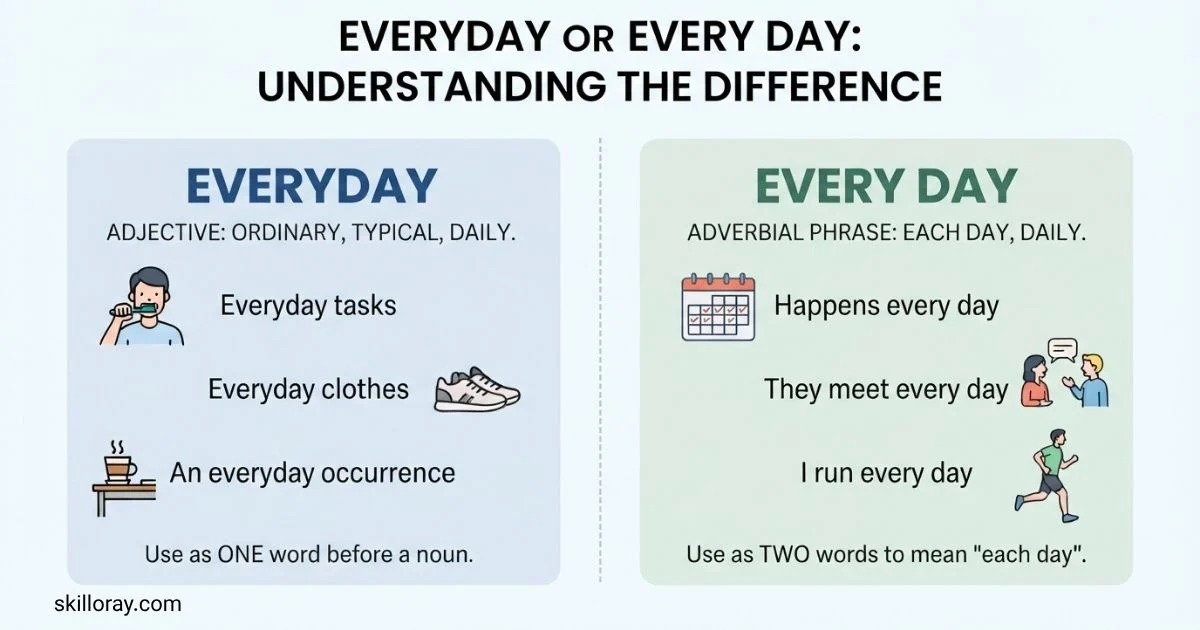
Both forms are correct, but they have different grammatical uses. Use everyday to describe something ordinary, usual, or routine. Use every day to mean each day or daily. The correct choice depends on the role the expression plays in your sentence.
| Form | Part of speech | Meaning | Example |
| Everyday | Adjective | Ordinary or usual | These are my everyday shoes. |
| Every day | Adverbial phrase | Each day | I wear these shoes every day. |
What Does Everyday Mean?
Everyday is a single word that functions as an adjective. It describes a person, object, activity, situation, or experience that is ordinary, familiar, or part of a normal routine.
It often appears directly before a noun. You can usually replace it with words such as ordinary, usual, or regular without changing the main meaning of the sentence.
Examples of Everyday in Sentences
- I prefer everyday clothes that feel comfortable.
- Cooking is an everyday activity in our home.
- Smartphones have become part of everyday life.
- She uses everyday language that everyone understands.
- This is an everyday problem for many students.
- He carries an everyday backpack to school.
- We discussed everyday challenges during the meeting.
- Good communication is an everyday necessity.
- These everyday habits help keep the house organized.
- The book explains everyday expressions in English.
In each example, everyday describes a noun, such as clothes, activity, life, language, problem, or habits.
What Does Every Day Mean?
Every day consists of two words: every, a determiner, and day, a noun. The phrase generally means each day and tells the reader how often an action happens.
Use it when discussing routines, repeated activities, habits, schedules, or events that occur daily.
Examples of Every Day in Sentences
- I go to school every day.
- She reads a book every day.
- We practice English every day.
- He calls his parents every day.
- They walk to the park every day.
- I drink water throughout the day every day.
- Our teacher gives us homework almost every day.
- She checks her emails every day.
- We learn something new every day.
- The store opens at the same time every day.
Here, every day tells us when or how frequently an action takes place.
Everyday or Every Day: What Is the Difference?
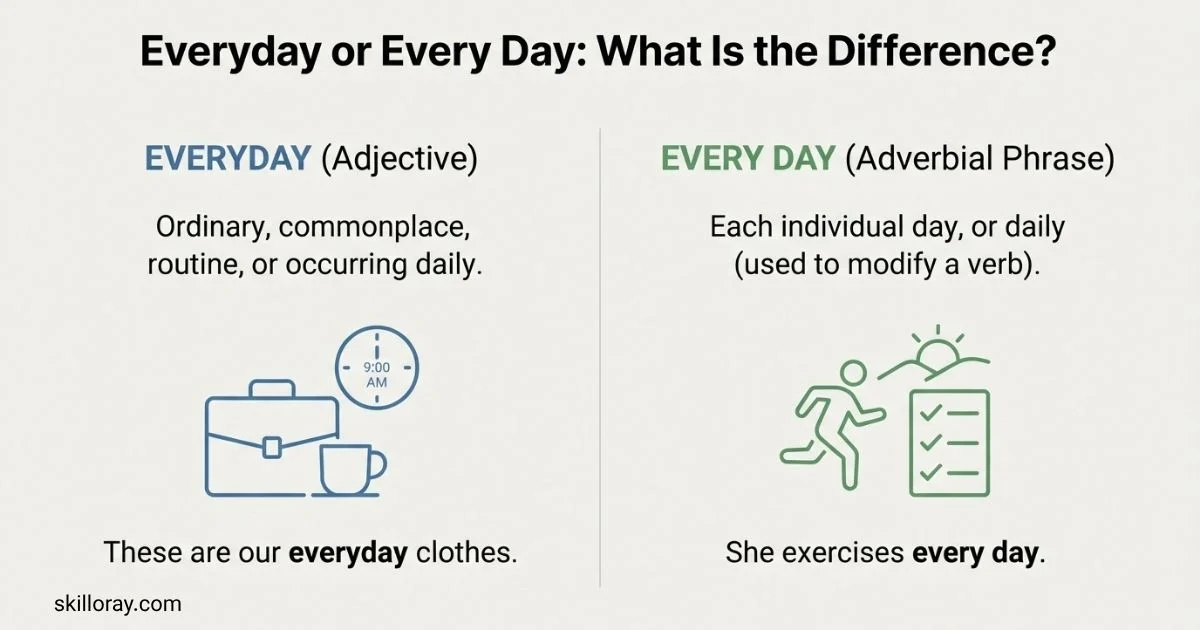
The main difference between everyday or every day is their grammatical function. Although they sound the same when spoken, their spelling determines how they work in a sentence.
Use everyday when describing something ordinary or routine. Use every day when saying that something happens each day.
Consider these examples:
- Everyday: Walking is part of my everyday routine.
- Every day: I go walking every day.
In the first sentence, everyday describes the noun routine. In the second sentence, every day explains how often the person goes walking.
Here is another example that makes the difference clear:
I wear my everyday shoes almost every day.
The first use describes the shoes. The second use tells us how frequently they are worn.
An Easy Trick to Remember the Difference
Try these two simple tests when you’re unsure which form to write.
Test 1: Replace it with “ordinary.”
If the sentence still makes sense, use everyday.
- These are my everyday clothes.
- These are my ordinary clothes.
Both sentences make sense.
Test 2: Replace it with “each day.”
If the sentence still makes sense, use every day.
- I exercise every day.
- I exercise each day.
Both sentences make sense.
These replacement tests are useful for checking your writing quickly.
When Should You Use Everyday?
Use everyday when describing things that are common, typical, ordinary, or regularly encountered. It usually appears before a noun, although other descriptive words can come between it and the noun.
Everyday Life
The expression everyday life refers to normal experiences, routines, responsibilities, and activities.
Examples:
- Technology plays a major role in everyday life.
- Small habits can make everyday life easier.
- Music brings enjoyment to everyday life.
- Many people face stress in everyday life.
Everyday Activities
Everyday activities are routine tasks that people commonly perform.
Examples:
- Cooking is an everyday activity for many families.
- Reading can become an everyday habit.
- Cleaning is part of my everyday responsibilities.
- Walking is an everyday activity in our neighborhood.
Everyday Objects
Everyday objects are ordinary items people commonly use.
Examples:
- A spoon is an everyday household object.
- Phones are everyday tools for communication.
- She turned everyday materials into beautiful artwork.
- The museum displays everyday objects from the past.
Everyday Language
Everyday language refers to ordinary words or expressions used in normal conversation rather than specialized or highly formal language.
Examples:
- The teacher explained the concept in everyday language.
- I prefer books written in everyday English.
- This guide teaches everyday phrases for beginners.
When Should You Use Every Day?
Use every day when you want to express frequency or describe something that happens on each day. It commonly follows a verb or appears elsewhere in a sentence to indicate when an action occurs.
Daily Routines
Examples:
- I wake up early every day.
- She studies mathematics every day.
- We eat breakfast together every day.
- My brother plays football every day.
Learning and Practice
Examples:
- I practice my pronunciation every day.
- You can improve your vocabulary every day.
- She writes in her journal every day.
- They learn new grammar rules every day.
Work and School
Examples:
- I go to school every day.
- He checks his assignments every day.
- Our manager reviews the schedule every day.
- We attend meetings every day during the project.
Habits and Personal Activities
Examples:
- I listen to music every day.
- She drinks tea every day.
- We call our grandparents every day.
- He spends time outdoors every day.
Remember that every day refers to each day. If an activity happens regularly but not daily, you should use a more accurate expression, such as every week or every other day.
Is It Everyday or Every Day in Common Expressions?

Some expressions appear frequently in writing, text messages, schoolwork, or conversation. The correct spelling depends on the intended meaning.
“I Go to School Everyday or Every Day”
The correct sentence is:
I go to school every day.
The phrase every day means that you attend school each day. It describes how often the action occurs.
Incorrect: I go to school everyday.
Correct: I go to school every day.
“I Miss You Everyday or Every Day”
The correct sentence is:
I miss you every day.
Here, every day explains how frequently the speaker misses someone.
Example:
“I miss you every day, even when I’m busy.”
“We Miss You Everyday or Every Day”
The correct sentence is:
We miss you every day.
The phrase indicates that the feeling continues each day.
Example:
“We miss you every day and hope to see you soon.”
“It’s Not Everyday or Every Day”
Both forms can be correct, depending on the intended meaning.
- It’s not every day that you meet someone so kind. This means such an event does not happen each day.
- It’s not an everyday experience. This means the experience is unusual or uncommon.
Notice that everyday in the second example describes the noun experience.
“Today and Everyday or Every Day”
The correct form depends on the sentence.
- Today and every day, I am grateful for my family. This means today plus each day.
- Today is part of my everyday routine. This describes a routine as ordinary or usual.
When everyday describes a noun, write it as one word. When every day means each day, write it as two words.
“Open Everyday or Every Day”
When describing business opening hours, open every day is appropriate if the business opens each day.
Example:
“Our shop is open every day from 9 a.m. to 6 p.m.”
However, open daily is also correct and often more concise.
If you’re describing an ordinary business routine, you could write:
“Opening the shop is part of my everyday responsibilities.”
“All Day Everyday or Every Day”
The usual expression is all day, every day when you mean throughout the day on each day.
Example:
– The workers stay busy all day, every day.
In this sentence, all day describes the duration, while every day describes the frequency.
If you mean something is ordinary or typical, use everyday before a noun instead:
– This is part of my everyday routine.
Everyday or Every Day: Common Mistakes
Even experienced English writers sometimes confuse these forms because the pronunciation is identical. The easiest way to avoid mistakes is to check the meaning of the sentence.
Here are some common errors with their corrections.
| Incorrect sentence | Correct sentence | Explanation |
| I exercise everyday. | I exercise every day. | The phrase means each day. |
| She goes shopping everyday. | She goes shopping every day. | It describes frequency. |
| This is my every day routine. | This is my everyday routine. | The adjective describes routine. |
| He wears his every day shoes. | He wears his everyday shoes. | The adjective describes shoes. |
| We study English everyday. | We study English every day. | The activity occurs each day. |
| These are my every day clothes. | These are my everyday clothes. | The adjective describes clothes. |
Mistake 1: Writing Everyday After a Verb
Incorrect: She practices piano everyday.
Correct: She practices piano every day.
The expression answers the question “How often does she practice?” Because it means each day, it should be written as two words.
Mistake 2: Separating Everyday in an Adjective Phrase
Incorrect: These are my every day shoes.
Correct: These are my everyday shoes.
The word describes the shoes as ordinary or intended for regular use.
Mistake 3: Assuming Everyday Always Means Daily
Although everyday can suggest something associated with daily life, it does not automatically mean an action occurs each day.
For example:
“An everyday problem” means a common or ordinary problem. It does not necessarily mean the problem occurs on every single day.
By contrast, “a problem I face every day” explicitly indicates daily frequency.
Everyday or Every Day in American, British, Canadian, and Australian English
The spelling distinction between everyday or every day is standard in American English, British English, Canadian English, and Australian English.
There is no regional spelling rule that makes one form exclusively American or British. The difference is grammatical rather than geographical.
Examples used across these varieties of English include:
- I walk to work every day.
- Walking is part of my everyday routine.
- We use everyday expressions in conversation.
- She reads the newspaper every day.
If you’re writing for an Australian audience, for example, the same basic distinction applies:
- Every day: The store opens every day.
- Everyday: These are my everyday shoes.
Always follow the intended meaning, regardless of your audience’s location.
Everyday or Every Day: Pronunciation Guide
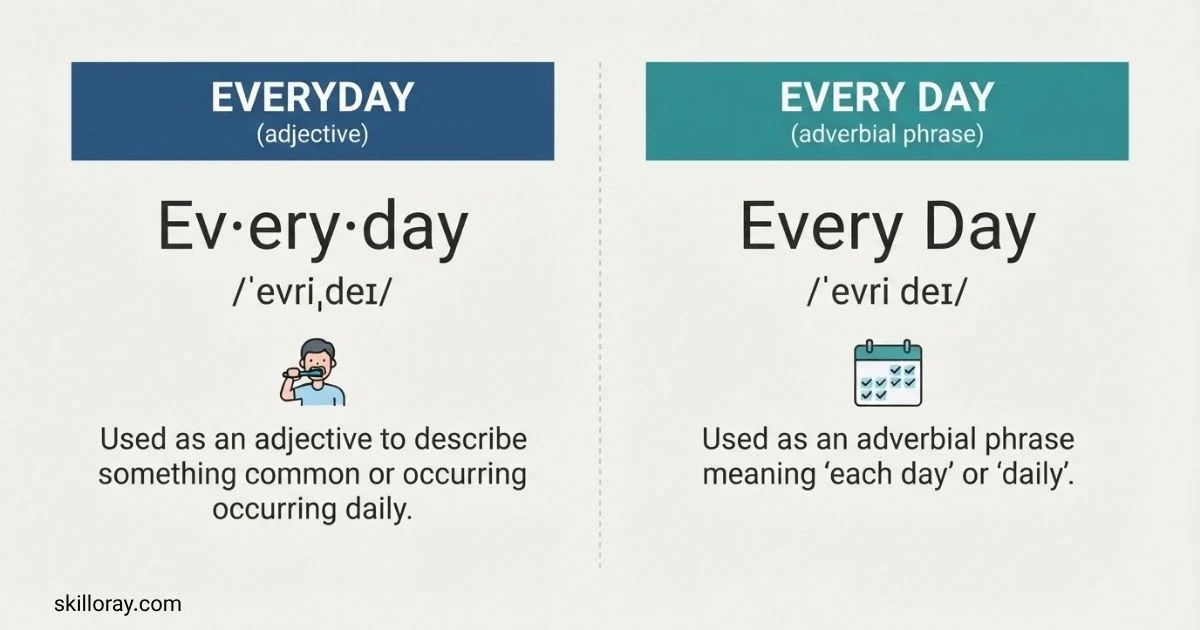
Both forms are generally pronounced the same way in spoken English. The difference is visible in writing, not usually audible in conversation.
The pronunciation of everyday is commonly represented in IPA as /ˈev.ri.deɪ/ in British English and /ˈev.riˌdeɪ/ in American English, with some variation between speakers and dictionaries.
A simple breakdown is:
- Everyday: EV-ree-day
- Every day: EV-ree day
The words may blend together in natural speech, so context helps listeners understand the intended meaning. When writing, however, you must choose the correct form based on grammar.
Everyday or Every Day: Practice Worksheet
Practice choosing the correct form in each sentence. Read the sentence carefully and determine whether it describes something ordinary or explains how frequently an activity occurs.
Fill in the Blanks
Choose everyday or every day for each blank.
- I brush my teeth ______.
- These are my ______ shoes.
- We learn something new ______.
- Cooking is part of our ______ routine.
- She reads for thirty minutes ______.
- Smartphones are part of ______ life.
- He visits his grandparents ______.
- This is an ______ problem in our city.
- I practice speaking English ______.
- Comfortable clothing is ideal for ______ use.
Answers
- Every day
- Everyday
- Every day
- Everyday
- Every day
- Everyday
- Every day
- Everyday
- Every day
- Everyday
Everyday or Every Day Quiz
Test your understanding with these quick questions.
1. I read the news ______.
everyday
every day
2. This is an ______ occurrence.
everyday
every day
3. We go for a walk ______.
everyday
every day
4. She wears ______ clothes to work.
everyday
every day
5. The shop is open ______.
everyday
every day
Check Answers
Frequently Asked Questions
1. Is everyday or every day correct?
Both are correct English forms. Everyday is an adjective meaning ordinary or usual, while every day is a phrase meaning each day. Choose the form that matches your sentence.
2. Is everyday one word or two words?
Everyday is one word when used as an adjective. For example, “These are my everyday clothes.” When you mean each day, write every day as two words.
3. Is “I go to school everyday” grammatically correct?
In standard written English, the preferred form is “I go to school every day.” The phrase refers to an activity that takes place each day.
4. Should I write “I miss you everyday” or “I miss you every day”?
Write “I miss you every day.” The phrase indicates that you miss someone each day. The one-word adjective everyday does not fit this sentence.
5. Is everyday an adjective?
Yes. Everyday is an adjective that describes something ordinary, common, typical, or routine. Examples include everyday life, everyday clothing, and everyday activities.
6. Can everyday mean daily?
Yes, in some contexts, everyday describes something associated with daily life or routine. However, when you specifically mean that an action happens each day, use the two-word phrase every day.
7. Is “everyday life” correct?
Yes. Everyday life is a standard expression referring to normal experiences, activities, responsibilities, and routines.
Example: “Technology has changed everyday life.”
8. Is “open everyday” correct for a shop?
For standard written English, use “open every day” when you mean the shop opens each day. You can also write “open daily.” The word everyday is an adjective, so it does not serve the same function in this sentence.
9. Is everyday or every day used differently in Australia?
The same grammatical distinction applies in Australian English. Use everyday to describe something ordinary and every day to express daily frequency.
10. How can I remember when to use everyday or every day?
Use the replacement test. If ordinary fits, choose everyday. If each day fits, choose every day. This simple trick works in most common sentences.
Conclusion
The difference between everyday or every day becomes much easier once you understand their grammatical roles. Everyday is an adjective describing something ordinary, familiar, or routine. Every day is a two-word phrase meaning each day.
Remember these examples:
- Everyday: Reading is part of my everyday routine.
- Every day: I read for twenty minutes every day.
Whenever you feel unsure, replace the expression with ordinary or each day and check whether the sentence still makes sense. With a little practice, you’ll be able to use both forms confidently in your writing, schoolwork, emails, and everyday conversations.

I am James Walker, an English language specialist with extensive experience in grammar, editing, and academic writing. I enjoy helping students, bloggers, and professionals strengthen their writing by explaining grammar concepts in a clear and engaging way. My focus is on providing accurate, practical, and easy-to-follow guidance that helps learners communicate more effectively in everyday and professional situations.
Books: Perfect English Grammar Handbook and Advanced Writing Techniques
 Daniel Carter
 Olivia Brown