I know how easy it is to pause when writing “your welcome” or “you’re welcome.” I’ve seen this small mistake create unnecessary confusion, especially in everyday messages and professional writing.
You may wonder which phrase is correct and why the other one appears so often. In this guide, I’ll break it down in a simple way so you can understand the difference and use the right expression with confidence.
You’ll quickly see why “you’re welcome” is the standard response to thanks, while “your welcome” has a different grammatical role. Once you understand the difference, choosing the correct form becomes much easier..
Quick Answer: Your Welcome or You’re Welcome?
“You’re welcome” is the correct phrase when replying to someone who says “thank you.” The word “you’re” is a contraction of “you are,” so “you’re welcome” means “you are welcome.”
“Your welcome” is not the standard response to thanks. However, it can be grammatically correct when “welcome” is used as a noun referring to a greeting or reception that someone gives.
| Expression | Meaning | Correct Usage |
| You’re welcome | You are welcome | A polite response to thanks |
| Your welcome | A welcome or greeting associated with you | When referring to someone’s reception or hospitality |
| You are welcome | The complete form of you’re welcome | Polite replies or invitations |
| Youre welcome | An incorrectly written contraction | Avoid this spelling |
For everyday conversations, text messages, emails, and social media replies, use “you’re welcome.”
What Does “You’re Welcome” Mean?

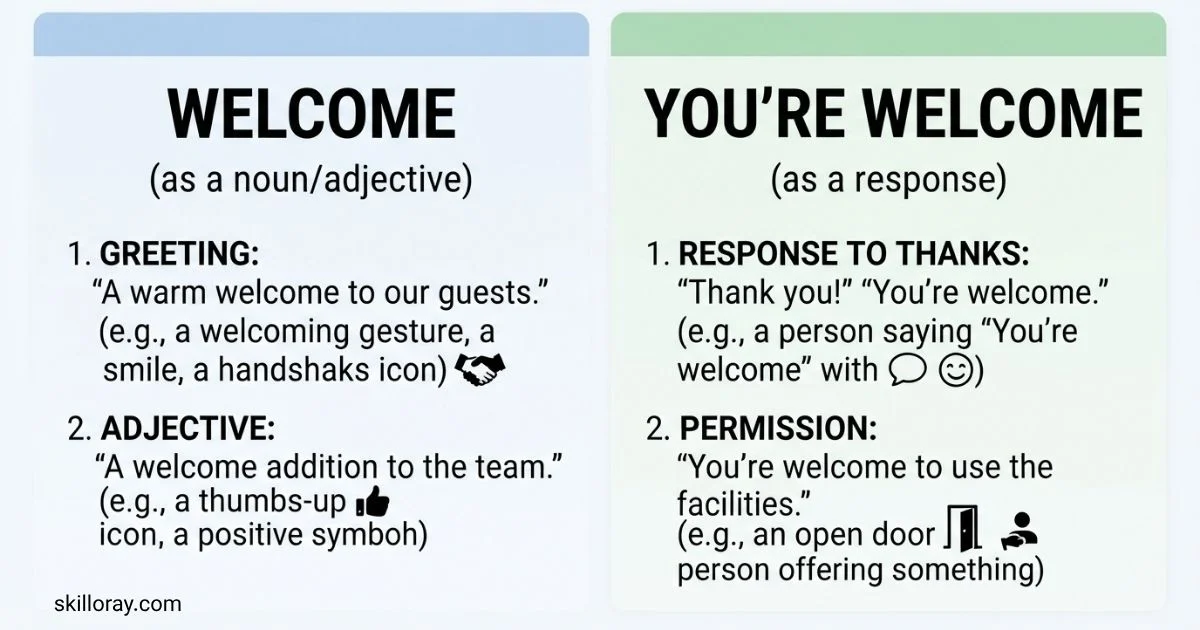
“You’re welcome” is a polite expression used after someone thanks you for helping them, giving them something, or doing a favor. It acknowledges their gratitude and communicates that your help was willingly given.
The phrase is the shortened form of “you are welcome.”
For example:
- Person A: “Thank you for helping me with my homework.”
- Person B: “You’re welcome!”
Here, the reply tells the other person that helping them was perfectly fine.
You can also use “you’re welcome” in other situations. It can express permission or make someone feel invited to participate in something.
Examples:
- You’re welcome to join us for dinner.
- You’re welcome to borrow my book.
- You’re welcome to contact me if you need help.
- You’re welcome to stay as long as you like.
In these sentences, “you’re welcome” does not respond to gratitude. Instead, it indicates that someone is invited or permitted to do something.
What Does “Your Welcome” Mean?
“Your welcome” is not the correct expression when replying to “thank you.” However, the words can appear together in a grammatically correct sentence when “welcome” functions as a noun.
The word “your” indicates possession or association. It tells the reader that something belongs to, relates to, or is connected with the person being addressed.
Examples:
- Your welcome at the hotel was warm and friendly.
- We appreciated your welcome when we arrived.
- Your welcome made our first visit memorable.
- I will always remember your kind welcome.
In these sentences, “welcome” refers to the greeting or hospitality someone receives. The word “your” identifies whose welcome is being discussed.
This distinction is important because “your welcome” is not always grammatically incorrect; it is simply incorrect as the usual response to thanks.
Your or You’re: What Is the Difference?
The easiest way to understand this grammar rule is to learn what each word does in a sentence.
1. You’re: A Contraction of “You Are”
“You’re” combines the pronoun “you” with the verb “are.” The apostrophe indicates that letters have been omitted.
You can use “you’re” whenever “you are” fits naturally in the sentence.
Examples:
- You’re welcome.
- You’re very kind.
- You’re doing a great job.
- You’re invited to the party.
- You’re always helpful.
- You’re welcome to ask questions.
Simple test: Replace “you’re” with “you are.” If the sentence still makes sense, “you’re” is probably the correct choice.
For example:
- You’re welcome. → You are welcome.
- You’re very helpful. → You are very helpful.
- You’re invited. → You are invited.
Each sentence remains grammatically correct after the replacement.
2. Your: A Possessive Word
“Your” is a possessive determiner. It shows that something belongs to or is associated with the person being addressed.
It usually appears before a noun.
Examples:
- Your book is on the table.
- Your answer is correct.
- Your phone is ringing.
- Your kindness means a lot to me.
- Your welcome was very generous.
Notice how “your” identifies the person associated with the book, answer, phone, kindness, or welcome.
Try replacing “your” with “you are” in these sentences. The results will not make sense, which helps you recognize the difference.
Key Differences Between Your or You’re
| Feature | You’re | Your |
| Grammatical role | Contraction | Possessive determiner |
| Full form | You are | No expanded form |
| Apostrophe | Required | Not used |
| Typical position | Before an adjective, phrase, or description | Before a noun |
| Example | You’re welcome. | Your welcome was warm. |
| Used as a reply to thanks | Yes | No |
How to Reply After Someone Says Thank You
If someone thanks you, “you’re welcome” is the standard polite reply in English. You can use it in casual conversations, professional communication, school messages, and online chats.
Here are some natural examples.
Everyday Conversations
Example 1
Person A: “Thank you for lending me your pen.”
Person B: “You’re welcome!”
Example 2
Person A: “Thanks for explaining the lesson.”
Person B: “You’re welcome. I’m glad I could help.”
Example 3
Person A: “Thank you for waiting for me.”
Person B: “You’re welcome!”
Text Messages
You can also use “you’re welcome” in text messages and online conversations.
Examples:
- “Thanks for the information!” — “You’re welcome!”
- “Thank you so much 😊” — “You’re welcome!”
- “Thanks for sharing the notes.” — “You’re welcome. Hope they help!”
- “I appreciate your support.” — “You’re very welcome!”
- “Thank you for your time.” — “You’re welcome. Anytime!”
The spelling remains the same regardless of whether you are writing a short text or a longer message.
Professional Emails
In professional communication, “you’re welcome” is appropriate when someone thanks you for completing a task or providing assistance.
For example:
Hi Sarah,
Thank you for sending the updated document.
You’re welcome! I’m happy to help.
Best regards, Alex
You can also use the complete phrase “you are welcome” when inviting someone to contact you or use a service.
Example:
You are welcome to contact our support team if you need further assistance.
Both forms are grammatically correct in their appropriate contexts.
You’re Welcome: Synonyms and Alternative Replies
Although “you’re welcome” is a common response to gratitude, English offers several other expressions. The best choice depends on the situation, your relationship with the other person, and the tone you want to communicate.
| Alternative | Meaning or Tone | Example |
| No problem | Casual, reassuring | “Thanks for helping!” “No problem!” |
| Not at all | Polite, understated | “Thank you for your time.” “Not at all.” |
| My pleasure | Warm, courteous | “Thank you for assisting me.” “My pleasure.” |
| Anytime | Friendly, informal | “Thanks for the favor!” “Anytime!” |
| Happy to help | Friendly, professional | “Thank you for your support.” “Happy to help.” |
| Don’t mention it | Modest, informal | “Thanks for carrying that.” “Don’t mention it.” |
| Glad to help | Friendly and reassuring | “Thank you for explaining.” “Glad to help.” |
| Of course | Relaxed and reassuring | “Thanks for helping me.” “Of course!” |
These expressions are useful alternatives when you want to vary your replies rather than repeating the same phrase.
However, they do not all fit every situation. For example, “my pleasure” can sound more formal or gracious, while “no problem” tends to feel more casual.
How to Pronounce “Your Welcome” or “You’re Welcome”
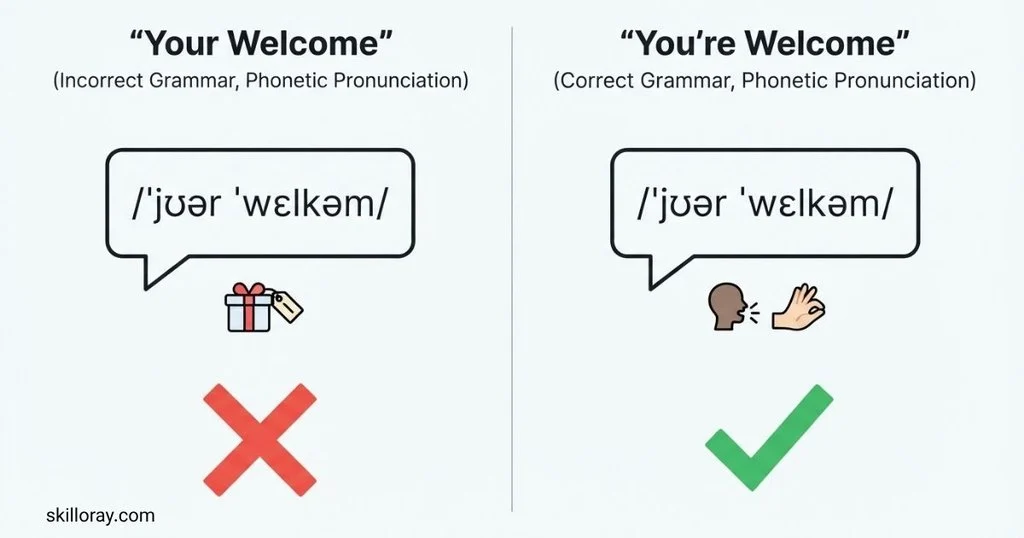
“Your” or “you’re” are generally pronounced alike in English. This similarity explains why people often confuse them when writing.
- You’re: /jʊr/ or /jər/, depending on accent.
- Your: /jʊr/ or /jər/, depending on accent.
- Welcome: /ˈwel.kəm/.
The complete expression “you’re welcome” is commonly pronounced as “yur WEL-kum” or “yer WEL-kum.” The first syllable of “welcome” receives the main stress.
Because the two words sound alike, you usually cannot identify the correct spelling by listening alone. You need to consider the sentence’s meaning and grammar.
For example, if someone thanks you, write “you’re welcome.” If you are describing a greeting someone gave you, “your welcome” may be appropriate.
Is “You’re Welcome” Correct in British or American English?
Yes. “You’re welcome” is standard in both British English and American English. The grammatical rule does not change between these varieties.
Examples:
- British English: “Thank you for your assistance.” “You’re welcome.”
- American English: “Thanks for your help.” “You’re welcome.”
- Canadian English: “Thank you for your support.” “You’re welcome.”
- Australian English: “Thanks for helping me.” “You’re welcome.”
“Your welcome” is not a regional spelling variation of “you’re welcome.” The difference comes from grammar, not geography.
“You’re Welcome” in Hindi
The English expression “you’re welcome” can be translated into Hindi in different ways, depending on the context.
Common Hindi equivalents include:
- आपका स्वागत है (Aapka swagat hai): You are welcome, commonly used to welcome someone.
- कोई बात नहीं (Koi baat nahi): No problem; it is a natural response to thanks in many casual situations.
- खुशी हुई मदद करके (Khushi hui madad karke): Glad to have helped.
- इसमें कोई बात नहीं (Ismein koi baat nahi): It is no trouble.
The exact wording depends on whether you are responding to gratitude or welcoming someone to a place.
For example:
Person A: “Thank you for helping me.”
Person B: “कोई बात नहीं।” (Koi baat nahi.)
This is a natural way to communicate “No problem” in many everyday conversations.
“You’re Welcome” in Spanish
In Spanish, a common response to “thank you” is “de nada,” which means “you’re welcome” or “it’s nothing.”
Other common expressions include:
- No hay de qué: There is no need to thank me.
- Con gusto: With pleasure.
- Por nada: A casual expression used in some Spanish-speaking regions.
- Un placer: A pleasure.
Example:
Person A: “Gracias por tu ayuda.” (Thank you for your help.)
Person B: “De nada.” (You’re welcome.)
Use “de nada” as a practical starting point when learning how to respond to thanks in Spanish. Other expressions may be more natural in particular countries or situations.
“You’re Welcome” in Moana
“You’re Welcome” is also the title of a song from Disney’s animated film Moana. The song is performed by the character Maui, voiced by Dwayne Johnson.
In this context, the title uses the standard English expression “you’re welcome.” It connects with the character’s exaggerated, playful response to being thanked for his actions.
If you searched for “your welcome or you’re welcome Moana,” remember that the song title is spelled “You’re Welcome.” The apostrophe is part of the correct contraction.
The title is a useful cultural example of how the phrase is used to acknowledge gratitude, although the song presents it in a humorous and theatrical way.
Ten Example Sentences Using “You’re Welcome”
Here are ten natural examples to help you remember how to use the expression correctly.
- “Thank you for helping me with my homework.” — “You’re welcome!”
- “Thanks for bringing me a glass of water.” — “You’re welcome.”
- “I really appreciate your advice.” — “You’re welcome. I’m glad it helped.”
- “Thank you for explaining the answer.” — “You’re welcome!”
- “Thanks for sharing your notes with me.” — “You’re welcome. Hope they are useful.”
- “Thank you for inviting me to your birthday party.” — “You’re welcome!”
- “Thanks for helping us organize the event.” — “You’re very welcome.”
- “Thank you for your quick response.” — “You’re welcome. Let me know if you need anything else.”
- “I appreciate you taking the time to help.” — “You’re welcome. Anytime!”
- “Thank you for being so kind.” — “You’re welcome. That’s very nice of you to say.”
Each example uses “you’re” because the intended meaning is “you are welcome.”
Common Mistakes to Avoid
Even people who speak English fluently can confuse these words when typing quickly. The following examples show how to correct the most common errors.
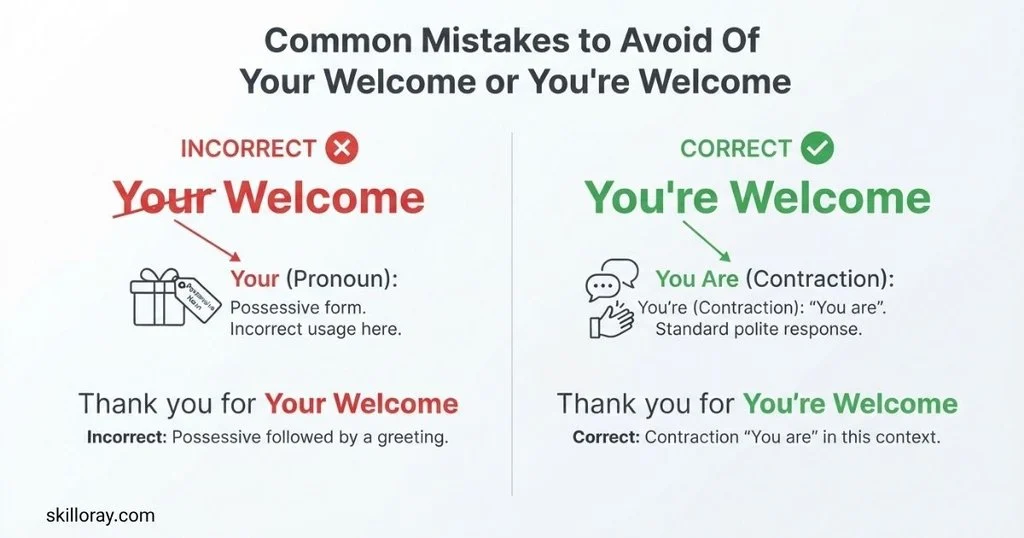
Mistake 1: Writing “Your Welcome” After Thanks
Incorrect:
“Thank you for your help.” — “Your welcome!”
Correct:
“Thank you for your help.” — “You’re welcome!”
Why? The reply means “you are welcome,” so the contraction “you’re” is required.
Mistake 2: Omitting the Apostrophe
Incorrect:
“Youre welcome.”
Correct:
“You’re welcome.”
Why? The apostrophe marks the omitted letters in the contraction “you are.”
Mistake 3: Using “You’re” to Show Possession
Incorrect:
“You’re book is on the desk.”
Correct:
“Your book is on the desk.”
Why? The sentence refers to a book associated with the person being addressed. The possessive word “your” is needed.
Mistake 4: Writing “Your” Before an Adjective
Incorrect:
“Your very helpful.”
Correct:
“You’re very helpful.”
Why? The sentence means “you are very helpful,” so the contraction is appropriate.
Mistake 5: Confusing “Welcome” With “Welcomed”
Incorrect:
“Your welcomed here.”
Correct:
“You’re welcome here.”
Why? The intended meaning is that someone is welcome in a place. The adjective “welcome” expresses that meaning.
Mistake 6: Assuming “Your Welcome” Can Never Be Correct
Incorrect assumption:
“Your welcome” is always grammatically incorrect.
Correct explanation:
“Your welcome was warm and friendly.”
Why? In this example, “welcome” is a noun referring to the greeting or hospitality someone received. The possessive word “your” is grammatically appropriate.
The key is to understand the intended meaning rather than memorizing that one expression is always wrong.
Frequently Asked Questions
1. Is It “Your Welcome” or “You’re Welcome”?
“You’re welcome” is correct when responding to someone who says “thank you.” It is a contraction of “you are welcome.” “Your welcome” is not correct for this purpose, although it can be grammatical when “welcome” is a noun referring to a greeting or reception.
2. Why Do People Write “Your Welcome” Instead of “You’re Welcome”?
People often confuse the expressions because “your” or “you’re” sound alike in spoken English. When typing quickly, writers may forget that “you’re” means “you are,” while “your” indicates possession or association.
3. Is “Your Welcome” Ever Grammatically Correct?
Yes. For example, “Your welcome at the hotel was very warm” is grammatically correct. Here, “welcome” is a noun describing the reception someone received. However, “your welcome” is incorrect as a standard reply to thanks.
4. Should I Say “You’re Welcome” After Someone Says Thank You?
Yes. “You’re welcome” is a conventional, polite response to “thank you.” You can use it in everyday conversations, professional emails, text messages, and other situations where you acknowledge someone’s gratitude.
5. Is “You’re Welcome” Formal or Informal?
“You’re welcome” works in both formal and informal situations. It is appropriate for conversations with friends, teachers, coworkers, customers, or people you have just met. Your tone and the surrounding sentence can make the reply sound more casual or more professional.
6. What Is Another Way to Say “You’re Welcome”?
Common alternatives include “no problem,” “my pleasure,” “not at all,” “anytime,” “happy to help,” and “glad to help.” Choose an expression that suits the situation and the level of formality you want.
7. Are “Your” or “You’re” Pronounced Differently?
In many English accents, “your” and “you’re” sound identical or very similar. Their spelling and grammatical functions differ, even when their pronunciation does not. Context helps you determine which form belongs in a sentence.
8. How Do You Write “You’re Welcome” in a Text Message?
Write “You’re welcome!” when responding to a thank-you message. For example, if someone texts, “Thanks for helping me today,” you can reply, “You’re welcome! Anytime.” You can also use an emoji to make the message feel friendlier.
9. Is “You Are Welcome” Correct?
Yes. “You are welcome” is the complete form of “you’re welcome.” Both are grammatically correct. The contracted version is common in everyday conversation, while the complete version can be useful for emphasis or in a sentence offering permission, such as “You are welcome to join us.”
10. What Is the Difference Between “You’re Welcome” in Hindi or Spanish?
In Hindi, “कोई बात नहीं” (koi baat nahi) is a common casual response to thanks. In Spanish, “de nada” is a widely used equivalent. The most natural translation depends on the context, local usage, and whether you are responding to gratitude or welcoming someone.
Conclusion
The difference between “your welcome” or “you’re welcome” becomes easy to understand once you learn the grammar behind each expression.
Use “you’re welcome” when responding to someone who says “thank you.” It means “you are welcome” and is the standard expression in everyday English, professional communication, text messages, and emails.
Use “your” to indicate possession or association, as in “your book,” “your answer,” or “your welcome was very warm.”
Whenever you’re unsure, try replacing “you’re” with “you are.” If the sentence makes sense, you’ve probably found the correct form. This simple check can help you avoid a common writing mistake and communicate more confidently in English.

I am Daniel Carter, a grammar enthusiast and language educator with over 10 years of experience helping students and professionals improve their English writing and communication skills. I enjoy simplifying complex grammar rules into easy-to-understand lessons that anyone can follow. My goal is to help learners write with confidence, avoid common mistakes, and develop strong communication skills for academic and professional success. I regularly create practical grammar guides, writing tips, and language resources that make learning both enjoyable and effective.
Books: Mastering English Grammar and The Complete Guide to Better Writing
 James Walker
 Olivia Brown