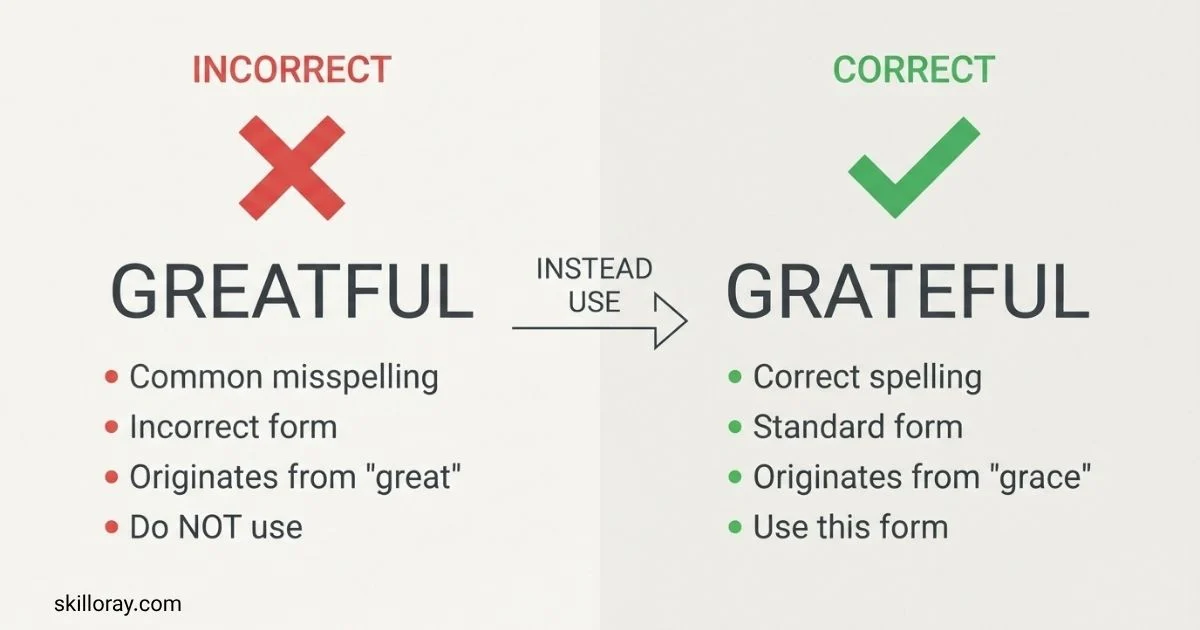
I know how easy it is to hesitate between Greatful or Grateful, especially when both spellings look almost identical. You may have seen “greatful” online and wondered whether it is simply another accepted form.
If you are unsure which spelling to use, you are not alone. I’ll make the difference simple so you can confidently choose the right word whenever you write a message, email, school assignment, or professional document.
By the end, you’ll understand why grateful is the standard spelling, what it means, and how to remember it easily. You’ll also see practical examples that make the correct usage much easier to recognize.
Is It Greatful or Grateful?
The correct spelling is grateful.
Greatful is not the standard spelling of the adjective meaning thankful or appreciative. If you are writing a school assignment, email, article, application, thank-you note, or professional message, use grateful.
| Form | Status | Meaning |
| grateful | Correct | Thankful or appreciative |
| greatful | Common misspelling | Intended to mean grateful |
For example:
- Correct: I am grateful for your help.
- Incorrect: I am greatful for your help.
The confusion is understandable because the two spellings are very close visually, while the pronunciation of grateful makes the spelling difficult to guess from sound alone.
What Does Grateful Mean?
Grateful is an adjective that describes feeling or expressing thanks or appreciation.
You can be grateful because someone helped you, because you received something valuable, because someone showed kindness, or because you appreciate a positive situation.
Cambridge lists grateful as an adjective meaning that someone is showing or expressing thanks, especially toward another person.
Examples of Grateful
- I’m grateful for your kindness.
- She was grateful for the opportunity.
- We are grateful for your support.
- He felt grateful to his teacher.
- I’m grateful that you came.
- They were grateful for the extra help.
- She is grateful to everyone who supported her.
- I’m forever grateful for everything you’ve done.
- We’re deeply grateful for your generosity.
- He was grateful to receive another chance.
The word can describe a temporary feeling or a lasting sense of appreciation.
Why Is Grateful Spelled With “Grat”?
The easiest way to understand the spelling is to connect grateful with gratitude.
Both words begin with grat-:
- gratitude
- grateful
- gratefully
The spelling is not formed by simply taking great and adding -ful. That is why greatful looks plausible but is not the standard spelling.
The historical development of grateful is connected with grate and ultimately the Latin gratus, associated with meanings such as pleasing or thankful.
A useful memory connection is:
gratitude → grateful → gratefully
Once you remember grat-, it becomes much easier to avoid writing greatful.
Why Do People Write Greatful?
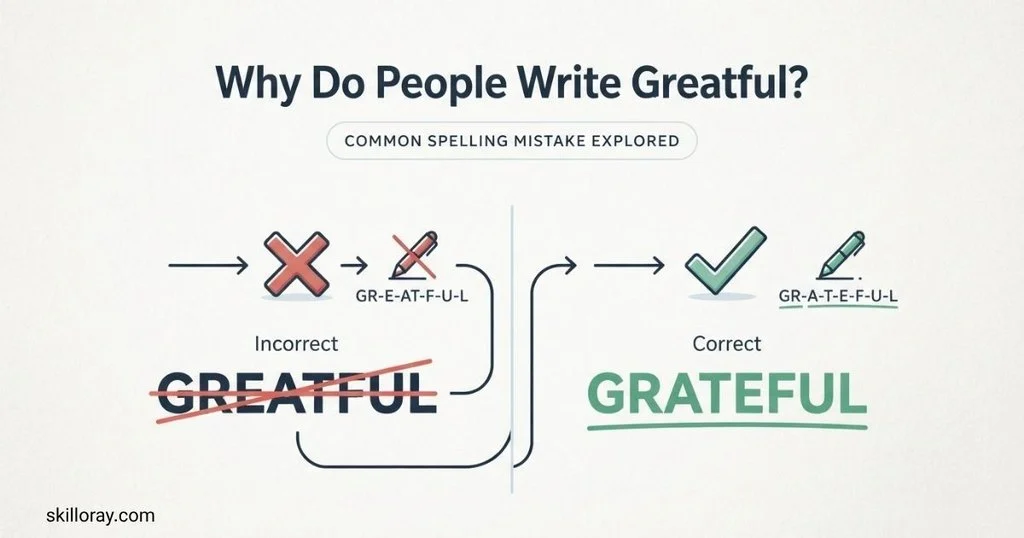
There are several simple reasons for this spelling mistake.
1. “Great” Looks Familiar
The word great is extremely familiar, so writers may naturally see:
great + ful
That makes greatful appear logical at first glance.
But grateful does not get its spelling from the adjective great.
2. The Pronunciation Can Be Misleading
Grateful is pronounced approximately:
GRAYT-fuhl
Cambridge gives the UK and US pronunciation as /ˈɡreɪt.fəl/.
Because the sound resembles great, hearing the word does not necessarily tell you whether the first part should be written grat- or great-.
3. The Suffix “-ful” Creates Confusion
English contains many familiar words that appear to follow patterns such as:
- hope → hopeful
- care → careful
- help → helpful
- joy → joyful
So someone may naturally assume:
great → greatful
But grateful has its own established spelling.
4. Fast Typing Can Cause the Mistake
When people type quickly, they may automatically choose the familiar great spelling.
That can produce:
I’m greatful for your support.
The intended word is clearly grateful, but the spelling still needs correction.
Grateful or Greatful Spelling
If you are asking how to spell the word correctly, remember:
G-R-A-T-E-F-U-L
The correct form is:
grateful
Not:
greatful
There is also another common spelling mistake:
gratefull
The suffix -ful normally contains one l, so the correct word is grateful, not gratefull.
Correct Spelling Examples
- grateful
- gratefully
- gratitude
- gratefulness
Common Misspellings
- greatful
- gratefull
- greatfull
- greateful
For normal modern English writing, grateful is the form you should use.
How Do You Spell Grateful Correctly?
A simple memory trick is to remember gratitude.
If you can spell:
gratitude
you can remember:
grateful
Both begin with grat-.
Another useful reminder is:
Gratitude makes you grateful.
This keeps the spelling connected to a familiar related word.
You can also remember that grateful has only one l at the end.
Is Greatful a Word?
Greatful is not the standard modern English spelling of the adjective meaning thankful.
You may encounter it online, in informal writing, in typing errors, or in searches from people who are unsure about the spelling. Its appearance does not make it an accepted spelling variant.
For careful writing, use grateful.
Correct
I am grateful for the opportunity.
Incorrect
I am greatful for the opportunity.
The same principle applies whether you are writing casually or formally.
Grateful or Greatful in American English
American English uses grateful.
For example:
I’m grateful for your support.
Greatful is not an American spelling variation of grateful.
This is important because English really does have spelling differences between regions. For example, American English commonly uses color, while British English commonly uses colour. Grateful does not follow that kind of regional spelling pattern.
Grateful or Greatful in British English
British English also uses grateful.
So:
- American English: grateful
- British English: grateful
There is no standard British spelling greatful for the meaning “thankful.”
This means you do not need to change the spelling depending on whether your audience is in the United States or the United Kingdom.
Grateful or Greatful in Canada
Canadian English also uses grateful for the standard adjective.
For example:
Canadians can write, “I’m grateful for your help.”
You do not need to use greatful because you are writing for a Canadian audience.
The spelling remains grateful.
Grateful or Greatful Pronunciation
The standard pronunciation of grateful is approximately:
GRAYT-fuhl
IPA:
/ˈɡreɪt.fəl/
Cambridge records this pronunciation for both UK English and US English.
Syllable Breakdown
You can think of it as:
GRAYT + fuhl
The main stress falls on the first syllable.
The pronunciation can contribute to the spelling confusion because the first syllable sounds much like great.
That is why memorizing the written form is more reliable than trying to spell the word from its sound.
Is Grateful an Adjective?
Yes. Grateful is an adjective.
It describes a person’s feeling or attitude of appreciation.
For example:
She is grateful for the opportunity.
Here, grateful describes she.
Another example:
We are grateful to our volunteers.
Here, grateful describes we.
The related word gratefully is an adverb:
We gratefully accepted the invitation.
The noun is gratitude:
Her gratitude was sincere.
These related forms can help you remember the grat- spelling.
How to Use Grateful Correctly
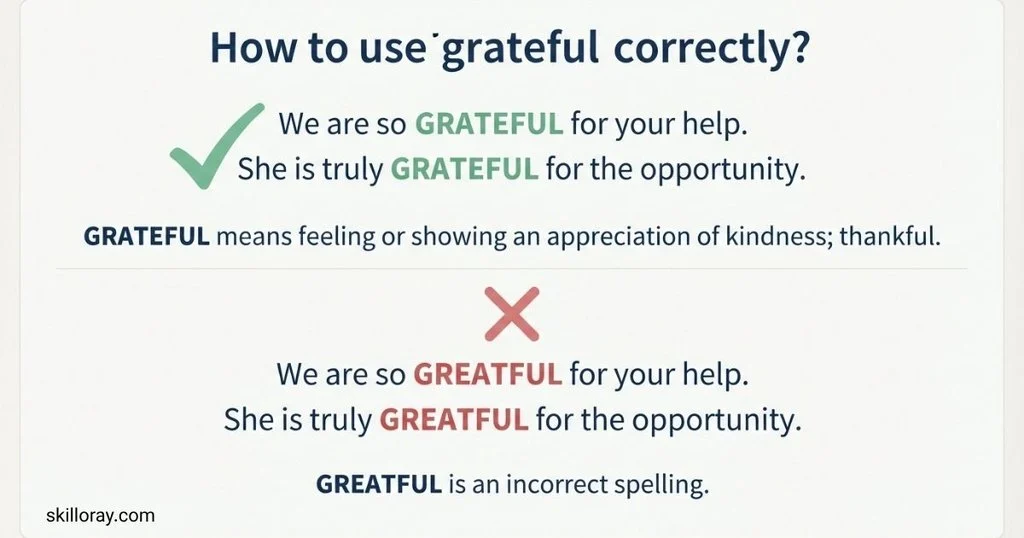
There are several common sentence patterns with grateful.
Grateful for Something
Use grateful for when you identify what you appreciate.
Examples:
- I’m grateful for your help.
- She is grateful for the opportunity.
- We’re grateful for your kindness.
- He was grateful for the advice.
- They are grateful for the support.
Grateful to Someone
Use grateful to when you identify the person receiving your appreciation.
Examples:
- I’m grateful to my parents.
- She is grateful to her teacher.
- We’re grateful to everyone who helped.
- He was grateful to his friends.
- They are grateful to their supporters.
Grateful to Do Something
You can also use grateful to + verb.
Examples:
- I’m grateful to be here.
- She was grateful to receive the award.
- We’re grateful to have another opportunity.
- He was grateful to meet his former teacher.
Grateful That
You can use grateful that when introducing a situation.
Examples:
- I’m grateful that everyone arrived safely.
- She was grateful that her friends stayed nearby.
- We’re grateful that the problem was resolved.
Cambridge also provides examples using patterns such as grateful for, grateful to, and grateful to + infinitive.
Forever Grateful or Greatful
The correct phrase is:
forever grateful
Not:
forever greatful
Forever grateful means that someone expects their appreciation to continue for a very long time.
Examples:
- I’ll be forever grateful for your kindness.
- She is forever grateful to everyone who supported her.
- We will be forever grateful for this opportunity.
- I’m forever grateful that you believed in me.
The word forever does not change the spelling of grateful.
Grateful or Greatful Dead
If you searched for greatful or grateful dead, the correct name is:
The Grateful Dead
The Grateful Dead is the name of the American rock band, and its official website uses the spelling Grateful Dead.
So when referring to the band, write:
The Grateful Dead
not:
The Greatful Dead
This is a proper-name spelling, so preserving the established spelling is especially important.
Grateful Synonyms
Several words can express a similar idea to grateful, although their exact tone or context can differ.
Useful alternatives include:
- thankful
- appreciative
- obliged
- indebted
- appreciative of
- thankful for
- appreciative toward
For example:
I’m grateful for your support.
could be expressed naturally as:
I’m thankful for your support.
However, grateful can carry a strong sense of sincere appreciation, especially when someone has received kindness, help, support, or an opportunity.
Grateful or Thankful
Grateful or thankful are often interchangeable in everyday English, but they can carry slightly different shades of meaning depending on context.
Grateful often emphasizes appreciation toward someone or appreciation for something received.
I’m grateful for your help.
Thankful can emphasize relief or appreciation for a favorable situation.
I’m thankful that everyone arrived safely.
Both are established English words, so the choice depends on the intended meaning and tone.
Grateful or Appreciative
Grateful or appreciative can both express positive recognition of someone’s kindness or help.
For example:
I’m grateful for your support.
or:
I’m appreciative of your support.
The first is usually more natural in ordinary personal communication.
Appreciative is also useful when emphasizing recognition of value, effort, quality, or kindness.
Common Mistakes With Grateful
Mistake 1: Writing Greatful
Incorrect:
I’m greatful for your help.
Correct:
I’m grateful for your help.
The word begins with grat-, not great-.
Mistake 2: Writing Gratefull
Incorrect:
She was gratefull for the opportunity.
Correct:
She was grateful for the opportunity.
The suffix -ful has one l.
Mistake 3: Using Greatful in Formal Writing
Incorrect:
We are greatful for your continued support.
Correct:
We are grateful for your continued support.
Use the standard spelling in formal correspondence, academic writing, business communication, or professional documents.
Mistake 4: Confusing Grateful With Great
The words may sound related, but grateful does not mean “full of greatness.”
For example:
The movie was great.
This describes the movie positively.
I’m grateful for the movie recommendation.
This expresses appreciation for receiving the recommendation.
The two words serve different purposes.
10 Example Sentences With Grateful
Here are natural examples showing how grateful works in everyday English:
- I’m grateful for everything you’ve done.
- She was grateful for the extra time.
- We are grateful to everyone who helped.
- He felt grateful for the opportunity.
- I’m grateful to my parents for their support.
- They were grateful to receive the invitation.
- She is deeply grateful for your kindness.
- I’ll always be grateful for that advice.
- We’re grateful that everyone is safe.
- He was grateful to have another chance.
Notice that the spelling remains grateful in every sentence.
Quick Comparison of Grateful or Greatful
| Feature | Grateful | Greatful |
| Standard English spelling | Yes | No |
| Meaning | Thankful or appreciative | No standard meaning in this use |
| Part of speech | Adjective | Not a standard adjective |
| American English | Correct | Misspelling |
| British English | Correct | Misspelling |
| Canadian English | Correct | Misspelling |
| Pronunciation | /ˈɡreɪt.fəl/ | Usually intended to represent the same sound |
| Formal writing | Use it | Avoid it |
| Common phrase | forever grateful | Not standard |
A Simple Way to Remember the Spelling
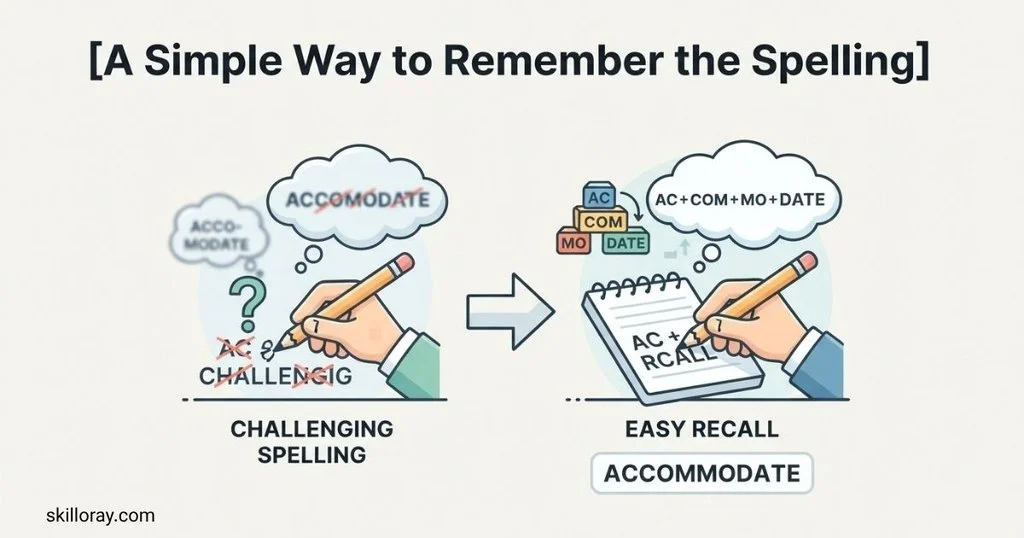
If you regularly forget whether to write greatful or grateful, use this three-step memory trick:
1. Think of gratitude.
gratitude
2. Notice the shared beginning.
grat-
3. Write the adjective.
grateful
So remember:
Gratitude → grateful
Not:
great → greatful
You can also remember the phrase:
Gratitude makes you grateful.
That connection makes the spelling easier to recall.
Frequently Asked Questions
Is greatful or grateful correct?
Grateful is correct when you mean thankful or appreciative. Greatful is a common misspelling.
Is greatful a word?
Greatful is not the standard modern English spelling of the adjective meaning thankful. Use grateful instead.
How do you spell grateful?
The correct spelling is:
G-R-A-T-E-F-U-L
Remember the grat- beginning and the single l in -ful.
Is grateful spelled the same in American English or British English?
Yes. Both American English or British English use grateful. There is no standard regional spelling greatful.
Is grateful spelled the same in Canada?
Yes. Canadian English uses grateful.
What does grateful mean?
Grateful means feeling or expressing thanks or appreciation. Cambridge classifies it as an adjective.
What is the pronunciation of grateful?
It is commonly pronounced approximately GRAYT-fuhl, with the IPA /ˈɡreɪt.fəl/. Cambridge records this pronunciation for both UK English or US English.
Is forever grateful correct?
Yes. Forever grateful is a standard phrase meaning that someone will continue to feel thankful or appreciative.
Is Grateful Dead spelled grateful?
Yes. The band’s established name is The Grateful Dead, with grateful spelled with grat-.
What is the synonym of grateful?
Common synonyms include thankful, appreciative, obliged, or indebted, depending on the sentence and intended meaning.
Why do people spell grateful as greatful?
The mistake is easy to make because greatful looks like great + -ful, while the pronunciation of grateful sounds close to “great-ful.” The correct spelling is historically connected with grat-, as seen in gratitude.
Conclusion
When you’re choosing greatful or grateful, use grateful. It is the standard spelling for the adjective meaning thankful or appreciative. Greatful is a common spelling mistake, not a standard American, British, or Canadian variant.
The easiest way to remember the difference is to connect grateful with gratitude. Both begin with grat-, and grateful ends with the suffix -ful, containing one l.So whenever you write a sentence such as “I’m grateful for your help,” you can confidently choose grateful.

I am Olivia Brown, a professional English editor and grammar writer who believes that great writing begins with a strong foundation in grammar. I have spent years creating educational resources that help students and professionals improve their writing, avoid common errors, and communicate more effectively. I strive to provide clear explanations and practical examples that make grammar easy to understand and apply.
Books: English Grammar Essentials and Modern Writing Success
 James Walker
 Daniel Carter