
Have you ever paused while writing a sentence because you weren’t sure whether to use or or nor? These two small words may look simple, but choosing the wrong one can change how your sentence sounds and affects its meaning. I know English grammar can sometimes feel confusing, especially when two words seem so similar.
The good news is that understanding the difference between or and nor doesn’t have to be difficult. Once you learn when to use each word, you’ll feel more confident writing clear, natural, and grammatically correct sentences.
In this guide, I’ll explain the difference between or vs nor with simple grammar rules, practical examples, and common mistakes to avoid. Whether you’re a student, English learner, or everyday writer, you’ll discover how to use both words correctly.
Or vs Nor: Quick Comparison
| Feature | Or | Nor |
| Meaning | Introduces an alternative or possibility | Adds a negative alternative or statement |
| Part of speech | Coordinating conjunction | Coordinating conjunction |
| Common pairing | Either…or | Neither…nor |
| Used for choices | Yes | Not usually |
| Used in negative sentences | Yes | Yes |
| Example | You can call or email me. | Neither Anna nor James called. |
The main difference is simple: use or to present alternatives and nor to connect negative ideas.
What Does Or Mean?
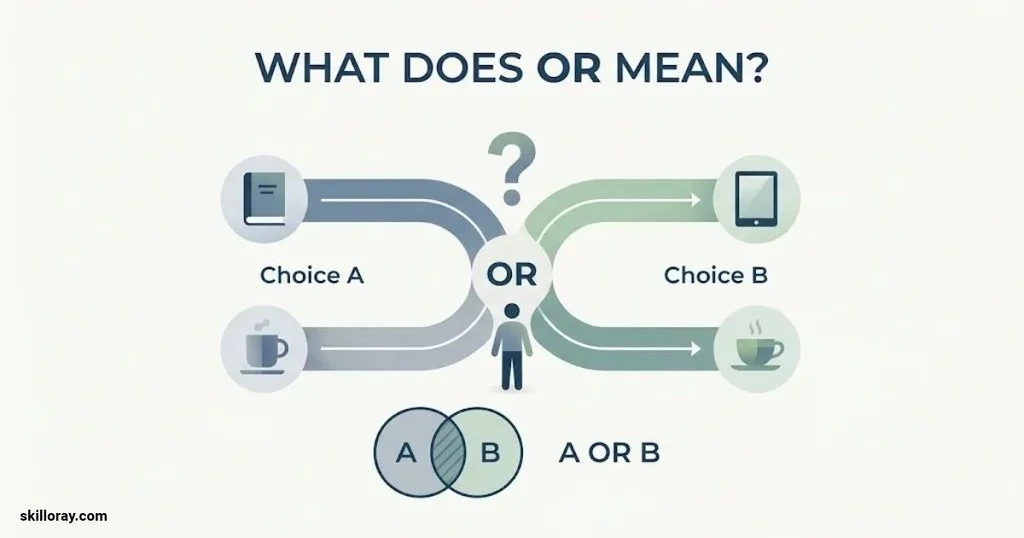
Or is a coordinating conjunction that connects words, phrases, or clauses that present alternatives. It is common in questions, instructions, everyday conversations, and conditional statements.
Here are its main uses.
Or Introduces Choices
Use or when offering two or more options and asking someone to choose between them.
Examples:
- Would you like chicken or fish for dinner?
- Should I book the morning flight or the evening flight?
- Do you want to work from home or go to the office?
- Is your appointment on Monday or Tuesday?
In each example, or connects alternatives. The person can choose one option.
Or Expresses Different Possibilities
Sometimes, or connects possibilities rather than direct choices. It can show that something may happen in one of several ways.
Examples:
- The delivery should arrive today or tomorrow.
- We might visit the museum or spend the afternoon at the park.
- She could be working from home or traveling for business.
- The missing document may be in your email or saved on your computer.
Here, or presents possible situations without asking someone to make a decision.
Or Introduces a Warning or Consequence
You can use or to connect an instruction with a possible result if someone ignores it.
Examples:
- Leave now, or you’ll miss the train.
- Save your document, or you might lose your work.
- Wear comfortable shoes, or your feet may hurt.
- Follow the recipe carefully, or the cake may not turn out as expected.
In these sentences, or has a meaning similar to “otherwise.”
Or Can Explain Something in Different Words
Sometimes, or introduces another name, description, or explanation for the same thing.
Examples:
- A semicolon, or a punctuation mark, separates related clauses.
- The canine, or dog, family includes several different breeds.
- A fortnight, or a period of two weeks, lasts fourteen days.
This use helps readers understand an unfamiliar term or expression.
What Does Nor Mean?
Nor is a coordinating conjunction used to connect negative alternatives or add another negative statement. It often appears with neither, but it can also follow a negative clause.
Unlike or, which commonly presents choices, nor emphasizes that something is not true, wanted, available, or happening.
Nor Is Used with Neither
The most familiar structure is neither…nor. It means that neither of the two people, things, or possibilities applies.
Examples:
- Neither Emma nor Olivia attended the workshop.
- He likes neither football nor basketball.
- Neither the manager nor the assistant knew about the change.
- The hotel offered neither breakfast nor airport transportation.
In this structure, neither introduces the first negative alternative, while nor introduces the second.
Nor Adds Another Negative Statement
You can also use nor after a negative statement to introduce another related negative idea.
Examples:
- She didn’t reply to my email, nor did she return my call.
- He isn’t interested in the position, nor does he have the required experience.
- The company hasn’t announced a date, nor has it explained the delay.
- I have never visited Rome, nor have I traveled to Venice.
Notice the sentence structure after nor. The auxiliary verb usually comes before the subject:
- Correct: Nor did she reply.
- Incorrect: Nor she did reply.
This structure is common in formal writing, although it also appears in everyday English.
Nor Can Start a Sentence
Nor can begin a new sentence when it adds another negative point to the previous statement.
Examples:
- The restaurant wasn’t open. Nor was the café across the street.
- He didn’t explain his decision. Nor did he apologize.
- The team failed to meet its target. Nor did it provide a clear reason.
Starting a sentence with nor is grammatically acceptable. It is often used in formal writing to connect related negative ideas.
Or vs Nor After a Negative Statement
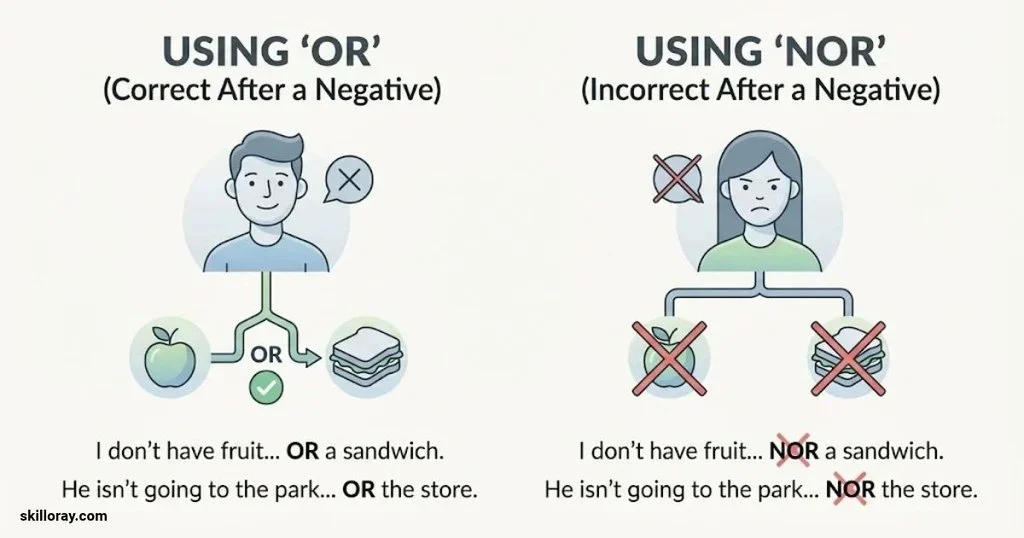
This is one of the most important differences to understand. Both words can appear in negative sentences, but they create different sentence structures.
Use Or to Connect Two Things After a Negative Verb
In ordinary English, or often connects two things that are both included in a negative statement.
Examples:
- I don’t drink coffee or tea.
- She didn’t call or send a text.
- We haven’t visited New York or Chicago.
- He doesn’t own a car or a motorcycle.
These sentences use one negative verb to cover both alternatives.
Use Nor to Add a Second Negative Clause
You can use nor when you want to express the second negative idea as a separate clause.
Examples:
- I don’t drink coffee, nor do I drink tea.
- She didn’t call, nor did she send a text.
- We haven’t visited New York, nor have we visited Chicago.
- He doesn’t own a car, nor does he own a motorcycle.
The important difference is that nor usually requires subject-auxiliary inversion when it introduces a new clause.
Compare:
| With Or | With Nor |
| She didn’t call or text me. | She didn’t call, nor did she text me. |
| He doesn’t play tennis or golf. | He doesn’t play tennis, nor does he play golf. |
| We haven’t booked a hotel or flight. | We haven’t booked a hotel, nor have we booked a flight. |
Both patterns are correct. Choose the one that fits your sentence and writing style.
Neither…Nor vs Either…Or
The pairs neither…nor and either…or are easy to confuse because they connect similar kinds of alternatives. However, they express opposite ideas.
Either…Or Presents a Choice
Use either…or when one of two alternatives is available or possible.
Examples:
- You can either pay online or visit the office.
- Either Sarah or Daniel will lead the meeting.
- We can either order dinner or cook at home.
- You can choose either the red dress or the black one.
Neither…Nor Excludes Both Options
Use neither…nor when both alternatives are excluded or don’t apply.
Examples:
- Neither Sarah nor Daniel attended the meeting.
- I want neither the red dress nor the black one.
- We have neither the time nor the money for another trip.
- Neither option seems suitable for the project.
| Structure | Meaning | Example |
| Either…or | One alternative or the other | Either call me or send an email. |
| Neither…nor | Not one and not the other | Neither my brother nor my sister called. |
Remember: Either…or offers alternatives. Neither…nor rules out both.
Neither…Nor Subject-Verb Agreement
One common grammar question is whether to use a singular or plural verb with neither…nor.
When two subjects are connected by neither…nor, the verb generally agrees with the subject closest to it. This is called the proximity rule.
Examples:
- Neither the teacher nor the students are ready.
- Neither the students nor the teacher is ready.
- Neither my parents nor my brother was at home.
- Neither my brother nor my parents were at home.
Look at the subject immediately before the verb:
- In “Neither the teacher nor the students are ready,” the closest subject is students, so the plural verb are is used.
- In “Neither the students nor the teacher is ready,” the closest subject is teacher, so the singular verb is is used.
When a sentence contains one singular and one plural subject, the result can sound awkward. You can often improve the sentence by changing the order or rewriting it.
For example:
“Neither the teacher nor the students are ready” can become “The teacher and the students are both unprepared.”
This avoids an awkward construction while keeping the meaning clear.
Common Mistakes When Using Or and Nor
Here are some mistakes that can change the meaning or make a sentence grammatically incorrect.
Mistake 1: Using Nor to Offer a Choice
Incorrect: Would you like pizza nor pasta?
Correct: Would you like pizza or pasta?
Why? The question offers two choices. Use or when asking someone to choose.
Mistake 2: Using Or After Neither
Incorrect: Neither Emma or Olivia attended the meeting.
Correct: Neither Emma nor Olivia attended the meeting.
Why? The standard paired construction is neither…nor.
Mistake 3: Forgetting Inversion After Nor
Incorrect: He didn’t respond, nor he explained the problem.
Correct: He didn’t respond, nor did he explain the problem.
Why? When nor introduces a new independent clause, the auxiliary verb normally comes before the subject.
Mistake 4: Creating an Unintended Double Negative
Incorrect: I don’t want neither option.
Correct: I want neither option.
Also correct: I don’t want either option.
Why? In standard English, neither already expresses a negative meaning. Combining it with don’t creates an unintended double negative in this sentence.
Mistake 5: Using the Wrong Verb with Neither…Nor
Incorrect: Neither the students nor the teacher are available.
Correct: Neither the students nor the teacher is available.
Why? The subject closest to the verb is teacher, which is singular. The singular verb is is appropriate.
How to Remember Or vs Nor
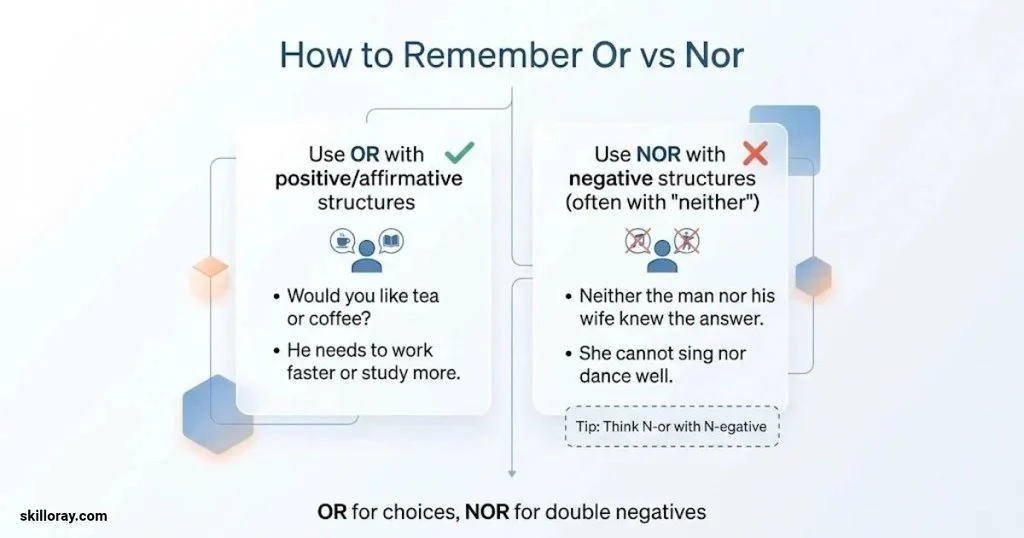
A simple way to remember these conjunctions is to focus on the meaning of your sentence.
- Or = Alternative: Use it when presenting choices or possibilities.
- Nor = Negative addition: Use it to connect negative alternatives or add another negative statement.
Try replacing the conjunction with a phrase that explains its purpose.
- “Would you like tea or juice?” presents two alternatives.
- “I want neither tea nor juice” excludes both.
- “She didn’t call, nor did she send a message” adds a second negative statement.
One more useful tip: If you see neither at the beginning of a paired construction, the second conjunction will normally be nor.
Frequently Asked Questions
What is the difference between or and nor?
Or connects alternatives, choices, and possibilities. Nor connects negative alternatives or introduces another negative statement. For example, “Do you want coffee or tea?” offers a choice, while “I want neither coffee nor tea” excludes both.
Is it neither or nor or neither nor?
The standard paired construction is neither…nor. For example, “Neither the manager nor the employees were available.” The phrase neither…or is generally considered incorrect in standard English.
Can or be used in a negative sentence?
Yes. Or commonly appears after negative verbs to connect two things that are both unwanted or absent.
Example: “I don’t want coffee or tea.”
Can nor start a sentence?
Yes. Nor can begin a sentence when it adds another negative idea to the previous statement.
Example: “The office wasn’t open. Nor was the reception desk available.”
Does nor always need neither?
No. Nor can appear without neither when it introduces another negative clause.
Example: “She didn’t attend the event, nor did she explain her absence.”
What is the difference between either…or and neither…nor?
Either…or presents two alternatives, while neither…nor excludes both.
Example: “You can either stay or leave” presents a choice. “You can neither stay nor leave” means both options are unavailable or excluded.
Should I use or or nor after not?
Both are possible, depending on the sentence structure.
Use or to connect alternatives under one negative verb: “I don’t like tea or coffee.”
Use nor to introduce another negative clause: “I don’t like tea, nor do I like coffee.”
Is nor more formal than or?
They have different grammatical purposes, so they aren’t direct replacements. However, nor often appears in more formal writing, particularly when introducing a second negative clause. Or is common in both formal and informal English.
Conclusion
The difference between or and nor depends on the relationship between the ideas in your sentence. Use or to connect choices and possibilities. Use nor to connect negative alternatives or add another negative statement. Pay particular attention to neither…nor and the word order after nor. Once you understand these patterns, choosing the correct conjunction becomes much easier.

I am James Walker, an English language specialist with extensive experience in grammar, editing, and academic writing. I enjoy helping students, bloggers, and professionals strengthen their writing by explaining grammar concepts in a clear and engaging way. My focus is on providing accurate, practical, and easy-to-follow guidance that helps learners communicate more effectively in everyday and professional situations.
Books: Perfect English Grammar Handbook and Advanced Writing Techniques
 Daniel Carter
 Olivia Brown