
Have you ever stopped while writing because you weren’t sure whether to use seek, sought, or another form? You’re not alone! The past tense of seek can be confusing, especially because it doesn’t follow the usual -ed pattern. I’ll help you understand it without making grammar complicated.
The past tense of seek is sought, not seeked. If you want to use this verb correctly, understanding its three forms and seeing them in everyday sentences will make things much easier.
In this guide, you’ll learn the past tense and past participle of seek, their meanings, pronunciation, and practical examples. I’ll also explain common mistakes so you can use seek and sought confidently in your speaking and writing.
Quick Answer: What Is the Past Tense of Seek?
The past tense of seek is sought. The past participle is also sought.
Here are the main verb forms:
| Verb Form | Word | Example |
| Base form | Seek | I seek new opportunities. |
| Third-person singular | Seeks | She seeks professional advice. |
| Simple past | Sought | He sought a better job. |
| Past participle | Sought | They have sought help. |
| Present participle | Seeking | We are seeking new employees. |
Remember these three main forms:
Seek → Sought → Sought
Why Is Sought Correct Instead of Seeked?
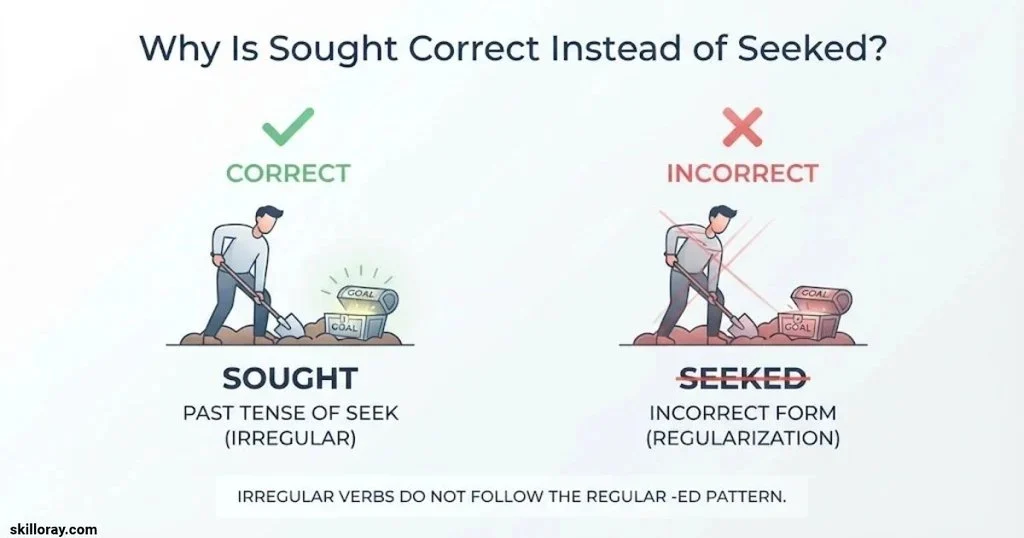
Seek is an irregular verb. Unlike regular verbs, which usually form their past tense by adding -ed, irregular verbs change their spelling or use a different form.
For example:
| Base Form | Past Tense | Past Participle |
| Seek | Sought | Sought |
| Think | Thought | Thought |
| Buy | Bought | Bought |
| Bring | Brought | Brought |
| Teach | Taught | Taught |
| Catch | Caught | Caught |
As you can see, these verbs don’t follow the regular -ed pattern.
That’s why you should write:
- Correct: She sought help from her teacher.
- Incorrect: She seeked help from her teacher.
Although you might occasionally see seeked in nonstandard writing, sought is the accepted form in standard English.
Seek, Sought, and Seeking: Understanding the Verb Forms
The word changes depending on when an action happens and how you use it in a sentence.
Seek (Present and Base Form)
Use seek when talking about something you do regularly, something you want to do, or an action that hasn’t happened yet.
Examples:
- I seek honest advice before making important decisions.
- Many students seek better learning opportunities.
- You should seek professional help when necessary.
Sought (Simple Past)
Use sought when someone looked for, requested, or tried to obtain something in the past.
Examples:
- After the accident, the family sought medical assistance.
- She sought a different solution when the first plan failed.
- The company sought permission to open another branch.
Sought (Past Participle)
The past participle is also sought. It usually appears with helping verbs such as has, have, and had.
Examples:
- I have sought advice from several experts.
- She has sought a new job.
- They had sought approval before starting the project.
Compare these sentences:
- Simple past: He sought help yesterday.
- Present perfect: He has sought help.
- Past perfect: He had sought help before the meeting.
The word stays the same, but the helping verb changes the tense.
How to Use Sought in Sentences
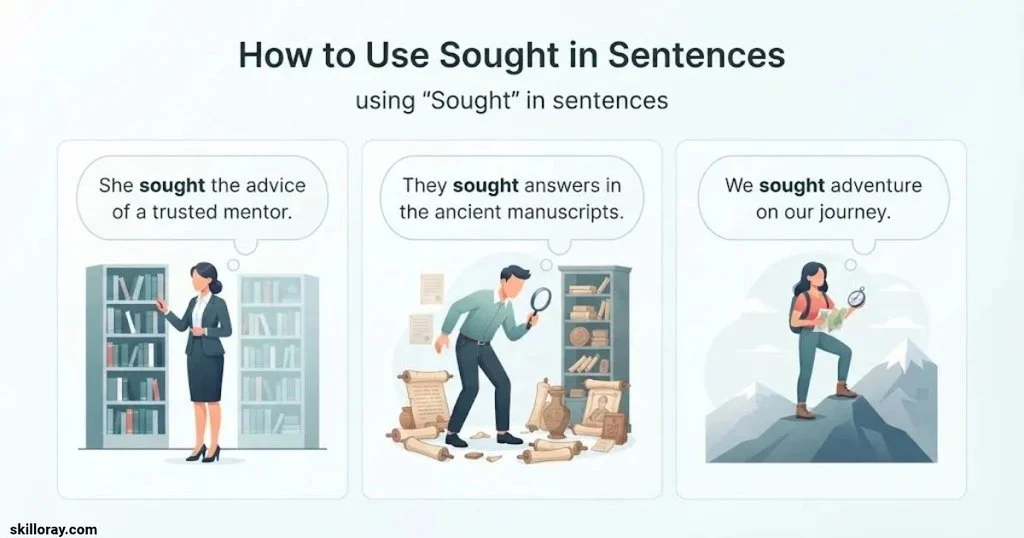
Sought can describe different actions, including looking for something, requesting assistance, and trying to achieve a goal.
Here are some examples from everyday situations:
Looking for something:
- The investigators sought answers about the missing documents.
- We sought a quiet place to study.
- She sought a solution to the problem.
Asking for help or advice:
- He sought legal advice before signing the contract.
- The students sought guidance from their teacher.
- After losing his job, he sought support from his family.
Trying to achieve something:
- She sought a promotion after years of hard work.
- The organization sought to improve its services.
- They sought greater opportunities in the technology industry.
Notice that sought can describe both a physical search and an attempt to achieve something.
Common Expressions With Sought
You will often see sought in phrases related to help, advice, permission, and opportunities.
| Expression | Meaning | Example |
| Sought help | Asked for assistance | He sought help after the accident. |
| Sought advice | Asked for guidance | She sought advice from her manager. |
| Sought permission | Requested approval | They sought permission to use the building. |
| Sought employment | Looked for a job | He sought employment in another city. |
| Highly sought-after | Wanted or valued by many people | Skilled designers are highly sought-after. |
One especially common expression is highly sought-after.
It describes something that many people want because they consider it valuable, useful, or desirable.
For example:
- This university offers highly sought-after courses.
- Experienced software developers are highly sought-after.
- The limited-edition watch became a highly sought-after item.
Common Mistakes When Using Seek
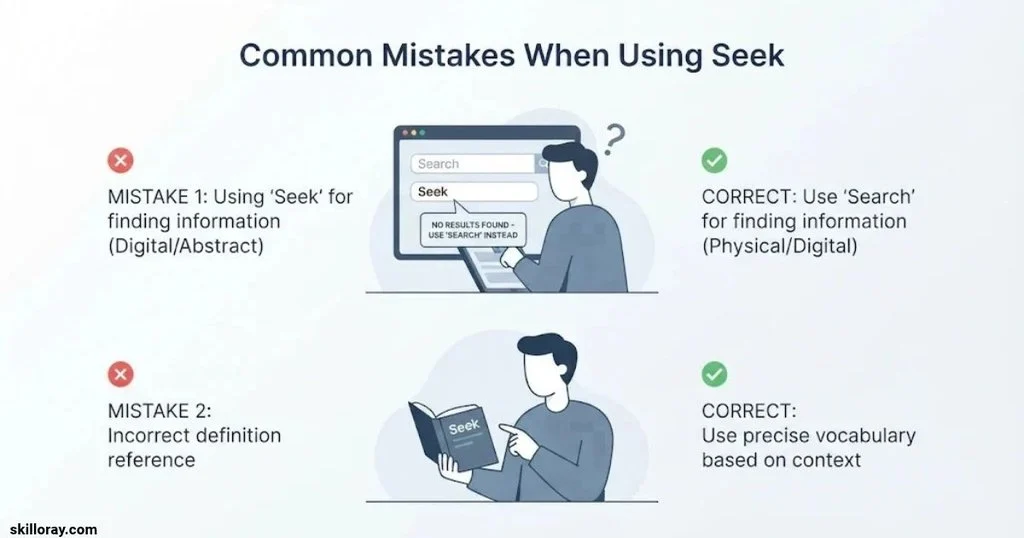
Even though sought is easy to remember once you learn it, some mistakes are common.
1. Using seeked instead of sought
Incorrect: She seeked advice from her manager.
Correct: She sought advice from her manager.
Use sought for the standard past tense.
2. Using seek for a completed past action
Incorrect: He seek a new job last year.
Correct: He sought a new job last year.
The phrase last year shows that the action happened in the past.
3. Writing have seeked instead of have sought
Incorrect: They have seeked professional assistance.
Correct: They have sought professional assistance.
Remember that sought is also the past participle.
4. Confusing sought with seeking
These forms have different uses:
- Sought: She sought a better opportunity last month.
- Seeking: She is seeking a better opportunity now.
Use seeking for an ongoing action and sought for the simple past or as a past participle.
Frequently Asked Questions
What is the past tense of seek?
The past tense of seek is sought. For example, “He sought help from his teacher.”
Is it seeked or sought?
Sought is correct in standard English. Seeked is not the accepted past-tense form of seek.
What is the past participle of seek?
The past participle is also sought. For example, “She has sought advice from an expert.”
Is seek an irregular verb?
Yes. Seek is an irregular verb because its past tense changes to sought instead of following the regular -ed pattern.
What are the three forms of seek?
The three main forms are:
- Base form: Seek
- Past tense: Sought
- Past participle: Sought
What is the present tense of sought?
The base form is seek. Its third-person singular present form is seeks.
Example: She seeks new opportunities.
What does highly sought-after mean?
Highly sought-after describes something that many people want or consider valuable.
Example: Experienced teachers are highly sought-after by good schools.
Final Thoughts
The past tense of seek is sought, and its past participle is the same. Use sought when describing a completed action, as in “She sought advice yesterday.” When using perfect tenses, add a helping verb: “She has sought advice.” Once you remember seek, sought, sought, you’ll know which form to use.

I am James Walker, an English language specialist with extensive experience in grammar, editing, and academic writing. I enjoy helping students, bloggers, and professionals strengthen their writing by explaining grammar concepts in a clear and engaging way. My focus is on providing accurate, practical, and easy-to-follow guidance that helps learners communicate more effectively in everyday and professional situations.
Books: Perfect English Grammar Handbook and Advanced Writing Techniques
 Daniel Carter
 Olivia Brown