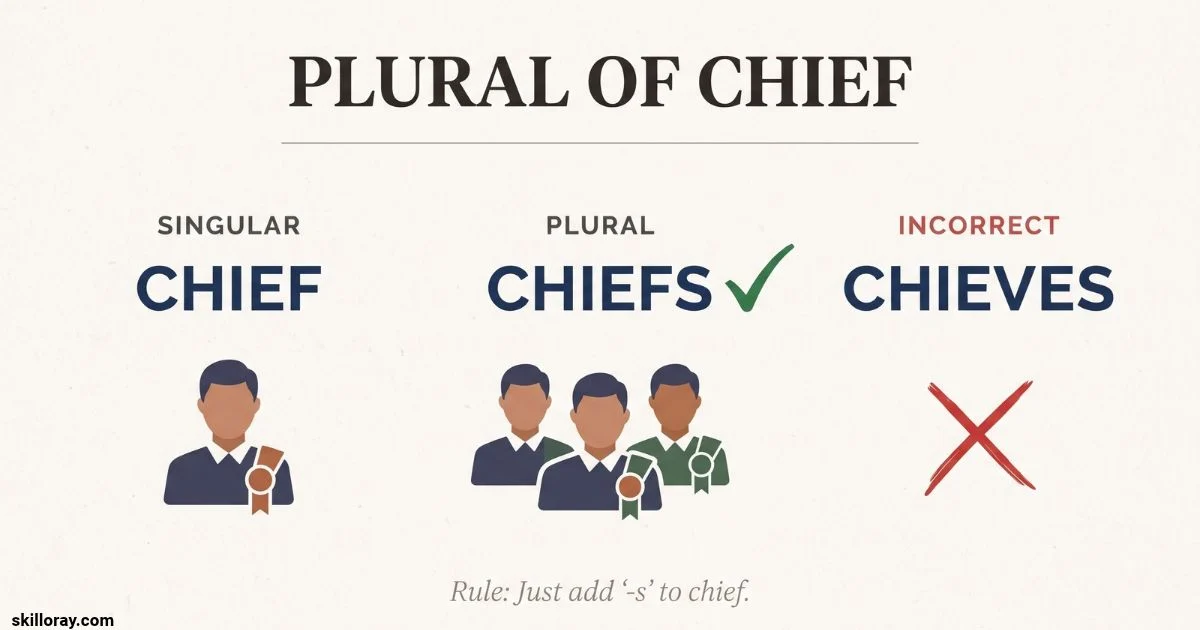
The English language has many plural forms that can be confusing, especially when a word ends in -f. If you’ve ever wondered whether the plural of chief is chiefs or chieves, you’re not alone. It’s an easy spelling question to get wrong if you rely on common pluralization rules.
The correct plural of chief is chiefs, not chieves. You simply add -s to the singular word without changing its spelling. I’ll show you why this form is correct and how you can use it naturally in everyday sentences.
If you’re writing an email, completing a school assignment, or improving your English grammar, you’ll find everything you need here. You’ll also discover clear examples, the spelling rule, and common mistakes to avoid so you can use chiefs with confidence.
Quick Answer: What Is the Plural of Chief?
The correct plural form of chief is chiefs.
- Singular: Chief
- Plural: Chiefs
Examples:
- The chief welcomed the visitors.
- The chiefs attended the annual conference.
- Several police chiefs discussed public safety.
- Two department chiefs approved the new policy.
Remember this simple rule: one chief, two chiefs.
Why Is the Plural of Chief Chiefs Instead of Chieves?
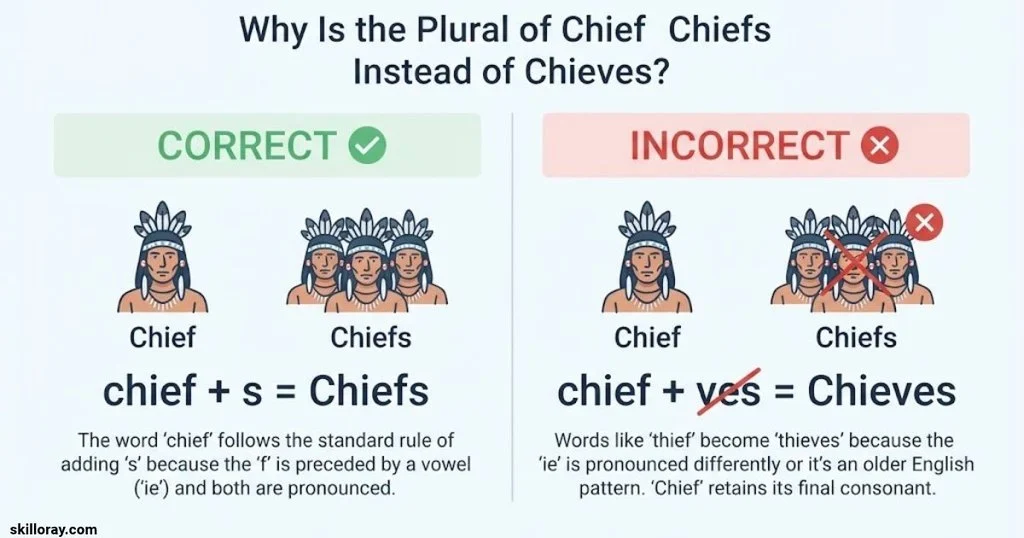
Some English nouns ending in -f form their plurals by changing -f to -ves. For example:
- Leaf → Leaves
- Wolf → Wolves
- Knife → Knives
- Shelf → Shelves
However, not every word ending in -f follows this pattern. Some simply take -s.
| Singular | Plural |
| Chief | Chiefs |
| Chef | Chefs |
| Roof | Roofs |
| Belief | Beliefs |
| Cliff | Cliffs |
| Leaf | Leaves |
| Wolf | Wolves |
Chief belongs to the first group, so its plural is chiefs. The spelling chieves is incorrect in standard English.
There isn’t one reliable rule that predicts every -f plural. Learning common word forms is the easiest way to avoid mistakes.
Chief, Chiefs, Chief’s, and Chiefs’: What’s the Difference?
These four forms look similar, but they have different meanings. Understanding them can help you avoid common spelling and punctuation errors.
| Form | Meaning | Example |
| Chief | One leader | The chief called a meeting. |
| Chiefs | More than one leader | The chiefs attended the meeting. |
| Chief’s | Belonging to one chief | The chief’s office is upstairs. |
| Chiefs’ | Belonging to multiple chiefs | The chiefs’ decision was final. |
The apostrophe changes the meaning:
- Chiefs is simply the plural.
- Chief’s shows possession by one chief.
- Chiefs’ shows possession by multiple chiefs.
For example, “The chiefs’ report” means a report belonging to several chiefs.
Examples of Chief and Chiefs in Sentences
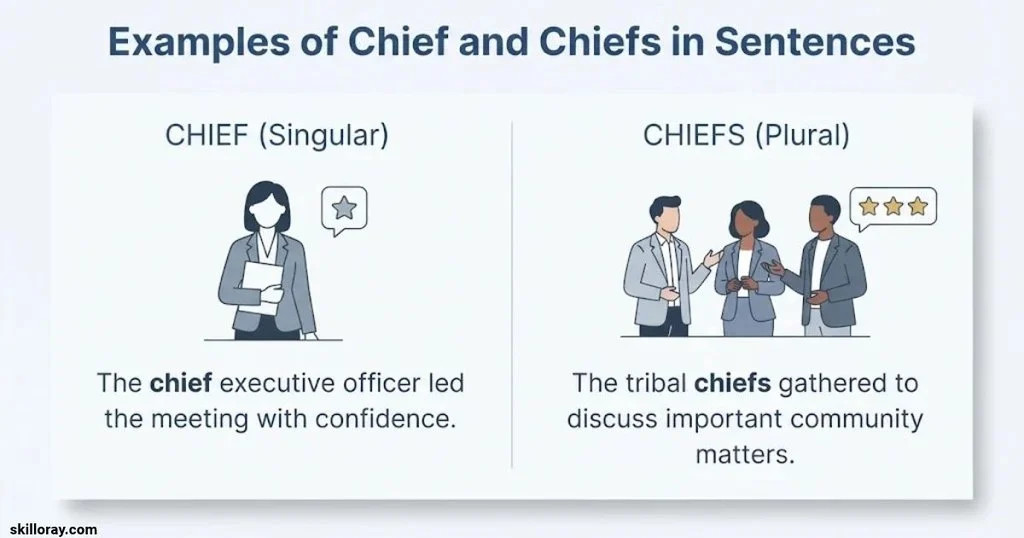
Seeing both forms in different situations makes their use easier to understand.
Using chief as a singular noun:
- The police chief announced new safety measures.
- Our department chief approved the schedule.
- A tribal chief welcomed the guests.
- The chief spoke to the employees after the incident.
Using chiefs as a plural noun:
- Three police chiefs attended the national conference.
- The department chiefs met to discuss their budgets.
- Several tribal chiefs gathered for the ceremony.
- The company appointed two new regional chiefs.
Using chief as an adjective:
The word chief can also describe something most important or main. In this use, it doesn’t need a plural ending.
- Safety is our chief concern.
- Her chief responsibility is managing the team.
- The chief reason for the delay was bad weather.
Common Mistakes When Using Chief
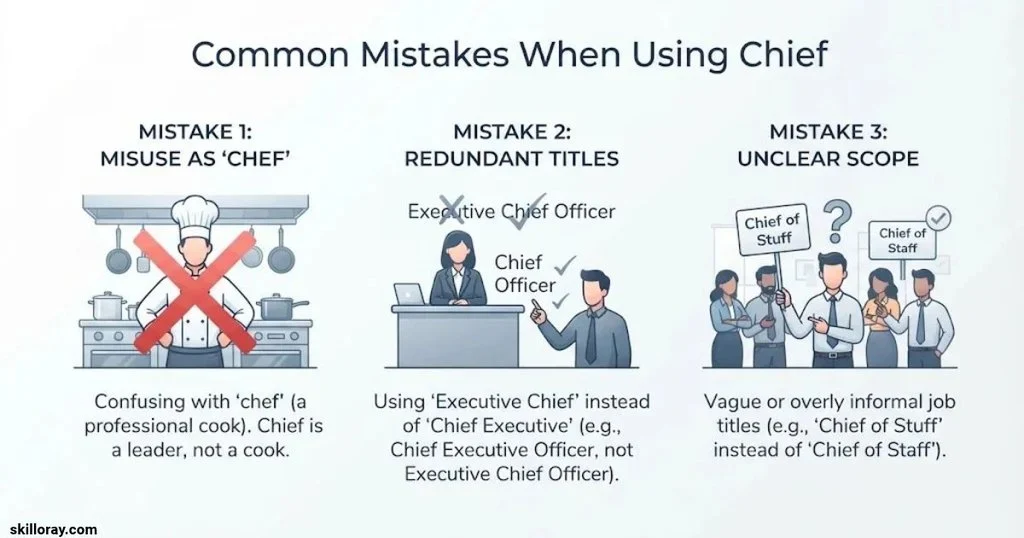
A few spelling mistakes occur because people assume chief follows the same plural pattern as leaf or wolf.
1. Writing chieves instead of chiefs
Incorrect: The company hired two new chieves.
Correct: The company hired two new chiefs.
The word doesn’t change its -f ending to -ves.
2. Adding -es to chief
Incorrect: Several chiefes attended the event.
Correct: Several chiefs attended the event.
Simply add -s to form the plural.
3. Confusing chiefs with chief’s
Incorrect: The chiefs office is near the entrance.
Correct: The chief’s office is near the entrance.
Use an apostrophe before the s when something belongs to one chief.
4. Using the singular for multiple leaders
Incorrect: The chief attended the meeting. (When referring to several leaders.)
Correct: The chiefs attended the meeting.
Use chiefs when you’re talking about two or more people.
Frequently Asked Questions
What is the plural of chief?
The plural of chief is chiefs. Add -s to the singular word. The spelling chieves is incorrect.
Is it chiefs or chieves?
Chiefs is the correct spelling. Unlike leaf, which becomes leaves, chief keeps its original ending and takes -s.
Why doesn’t chief become chieves?
English plural rules aren’t the same for every noun ending in -f. Some words change to -ves, while others simply add -s. Chief belongs to the second group.
Is chiefs a correct word?
Yes. Chiefs is the standard plural of chief. It refers to two or more leaders or people in positions of authority.
What is the singular of chiefs?
The singular form is chief. For example, one chief manages a department, while several chiefs manage different departments.
What is the difference between chiefs and chief’s?
Chiefs means more than one leader. Chief’s shows that something belongs to one leader.
For example:
- The chiefs attended the meeting.
- The chief’s office is closed.
Is chief a regular or irregular plural noun?
Chief has a regular plural form because you add -s to make chiefs. Its spelling doesn’t change to -ves.
Final Thoughts
The plural of chief is chiefs, not chieves or chiefes. Even though words like leaf and wolf change their endings to -ves, chief follows the regular plural pattern. Just add -s when you’re talking about more than one leader. Remember: one chief, two chiefs.

I am Daniel Carter, a grammar enthusiast and language educator with over 10 years of experience helping students and professionals improve their English writing and communication skills. I enjoy simplifying complex grammar rules into easy-to-understand lessons that anyone can follow. My goal is to help learners write with confidence, avoid common mistakes, and develop strong communication skills for academic and professional success. I regularly create practical grammar guides, writing tips, and language resources that make learning both enjoyable and effective.
Books: Mastering English Grammar and The Complete Guide to Better Writing
 James Walker
 Olivia Brown